HCPCS code L3000 describes a custom-fabricated, removable foot insert of the UCB Berkeley Shell design, molded to a model of the patient’s own foot. It is a full-contact orthotic device, not a shelf-stock shoe insert.
L3000 behaves unlike most billing codes because Medicare treats it as a statutory benefit-category exclusion. Standalone inserts are never covered, and the only path to Medicare payment is when the insert is an integral part of a covered leg brace.
That single distinction, statutory exclusion rather than medical-necessity denial, controls every modifier, every ABN decision, and every downstream payer on this code. Many podiatry and DME suppliers route orthotic claims through professional billing services for podiatry to manage it.
What Is the Description of HCPCS Code L3000?
The L3000 HCPCS code descriptor as defined by CMS is: “Foot insert, removable, molded to patient model, UCB type, Berkeley Shell, each.”
This code reports a custom orthotic shell built from a three-dimensional model of the patient’s own foot. HCPCS code L3000 is a University of California Berkeley design, a rigid or semi-rigid device that controls hindfoot position. The word “each” in the descriptor means the code reports a single insert, not a pair.
The device is defined by its custom fabrication and its shell geometry. L3000 is not a comfort insert or an arch cushion, and that construction requirement is what separates a payable claim from an upcoded one.
What Device Does HCPCS Code L3000 Represent, and What Makes a UCB Berkeley Shell Custom-Fabricated?
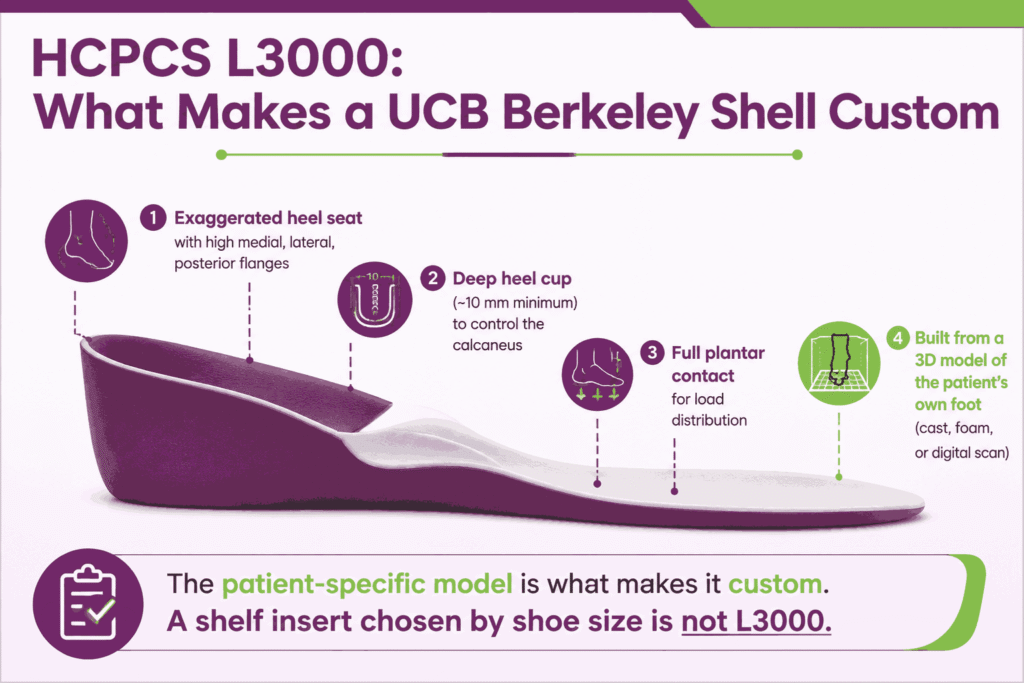
HCPCS code L3000 represents a UCB Berkeley Shell, a deep-heel-seat orthotic that captures and holds the hindfoot. Its custom fabrication from a patient-specific model is the defining feature.
The features that define this custom device are:
- An exaggerated heel seat with high medial, lateral, and posterior flanges
- A deep heel cup, commonly a minimum height near 10 millimeters, to control the calcaneus
- Full contact with the plantar surface to distribute load across the foot
- Fabrication from a 3D model of the patient’s own foot, taken by plaster cast, foam impression, or digital scan
The model is what makes the device custom. A UCB shell built to the individual foot is L3000, while an insert chosen off a shelf by shoe size or arch height is a different item entirely, regardless of how it is marketed.
Why L3000 Is Statutorily Excluded From Medicare Coverage Except as Part of a Covered Leg Brace
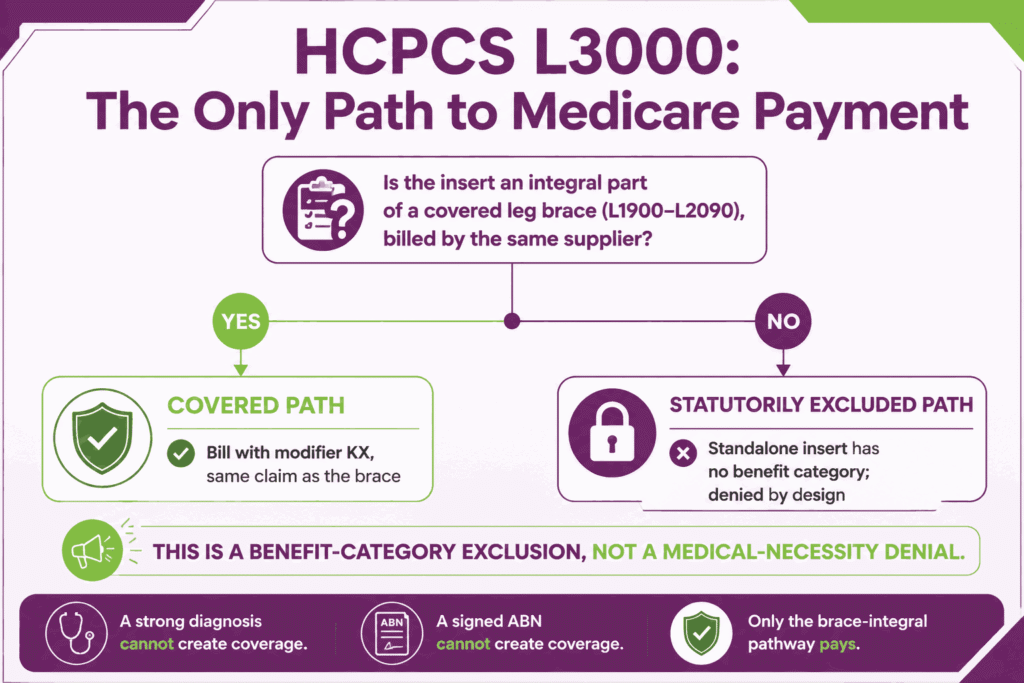
Medicare does not cover HCPCS code L3000 as a standalone item under any circumstances. Orthopedic footwear codes, including L3000, are covered only when the insert is an integral, medically necessary part of a covered leg brace, per Policy Article A52481 and LCD L33641.
The statutory exclusion works as follows:
- The exclusion is a benefit-category determination, not a medical-necessity judgment about the individual patient
- The insert is covered only when it rides on a shoe that is an integral part of a covered leg brace
- The covered leg braces are the L1900 through L2090 codes named in Policy Article A52481
- A standalone insert dispensed by itself is denied as noncovered, because the benefit category does not exist
This distinction drives everything downstream on L3000. A benefit-category exclusion cannot be converted into coverage by a strong diagnosis or a signed waiver, which is why the modifier logic below differs from an ordinary medical-necessity code.
Why Billing a Prefabricated Insert Under L3000 Is Upcoding
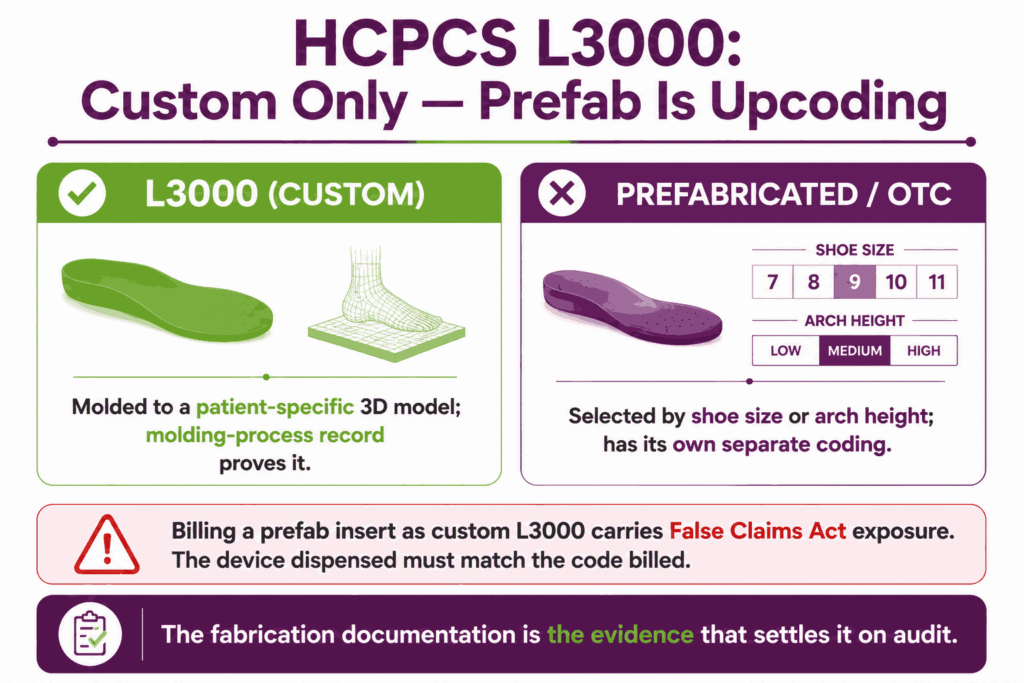
HCPCS code L3000 requires custom fabrication from a patient-specific 3D model. Billing a prefabricated or over-the-counter insert under this code is upcoding, not a coverage question.
The custom-versus-prefabricated line is clear:
- L3000 is a custom device molded to a model of the patient’s foot
- A shelf-stock or over-the-counter insert selected by shoe size or arch height is a prefabricated item with its own coding
- The molding-process record is what proves the device was custom fabricated
- Misbilling a prefabricated insert as custom L3000 carries False Claims Act exposure
The device dispensed must match the code billed. A prefabricated insert never becomes L3000 by being billed that way, and the fabrication documentation is the evidence that settles the question on audit.
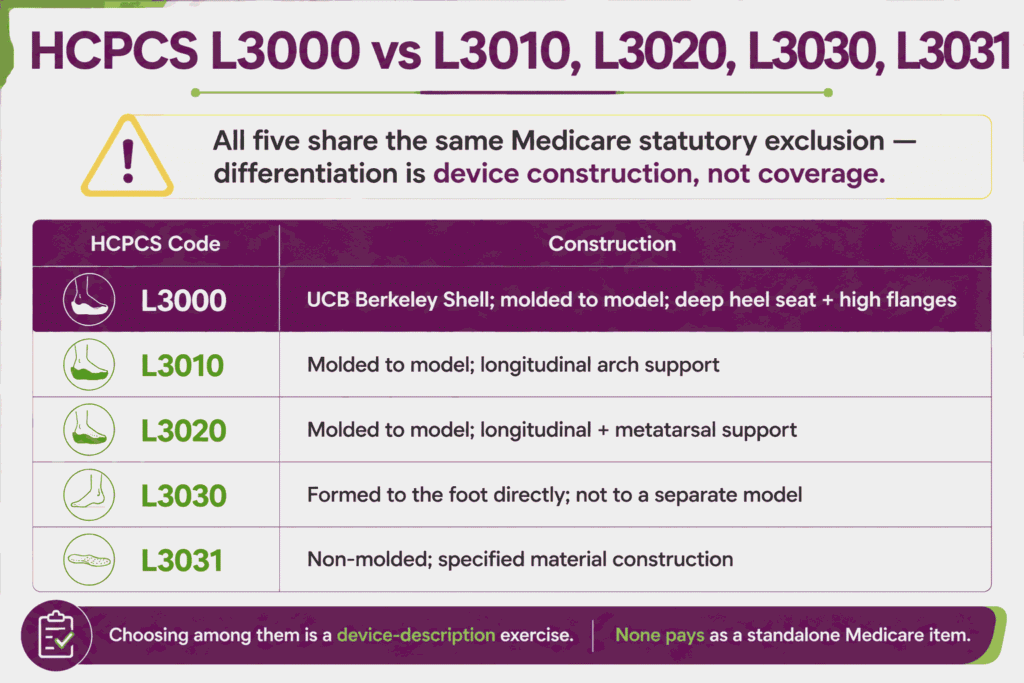
How Does L3000 Differ From L3010, L3020, L3030, and L3031?
The removable-insert family shares one Medicare exclusion, so the differentiation is about device construction, not coverage. All of these codes are statutorily excluded except as part of a covered brace.
The removable-insert family breaks down as follows:
- L3000 UCB Berkeley Shell, molded to a patient model, with the deep heel seat and high flanges
- L3010 removable insert molded to a patient model, with longitudinal arch support
- L3020 removable insert molded to a patient model, with longitudinal and metatarsal support
- L3030 removable insert formed to the patient’s foot directly, rather than molded to a separate model
- L3031 removable insert, non-molded, of a specified material construction
The construction and support features separate these codes. All of them, from L3000 through L3031, carry the same statutory exclusion, so choosing among them is a device-description exercise, and none of them pays as a standalone Medicare item. The removable-insert L-codes sit within the wider run of orthotic and footwear HCPCS codes for podiatry, where construction, not coverage, separates one from the next.
Why Diabetic Patients Require the A5500-Series Codes Instead of L3000
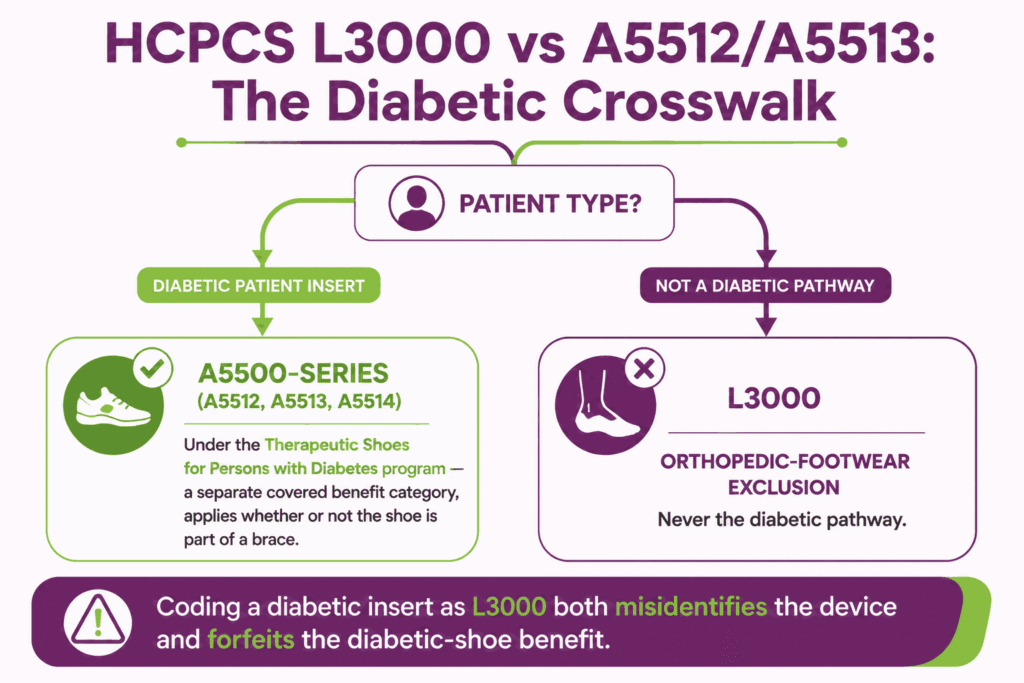
A diabetic patient’s insert is billed under the A5500-series codes, never HCPCS code L3000. Using L3000 for a diabetic insert is a coding error, not a coverage question.
The diabetic crosswalk works as follows:
- Depth-inlay and custom-molded shoes and inserts for diabetic patients bill under A codes, including A5512, A5513, and A5514
- These items fall under the Therapeutic Shoes for Persons with Diabetes program, governed by LCD L33369 and Policy Article A52501
- The diabetic program is a separate Medicare benefit category with its own coverage, unlike the orthopedic-footwear exclusion
- The A-code pathway applies whether or not the shoe is part of a brace
For a qualifying diabetic patient, the insert is a program benefit, not an excluded item. Coding it as L3000 both misidentifies the device and forfeits the coverage the diabetic program provides, so the A5512 and the A5513 carry the correct billing pathway. Cross-coding decisions like this one reach across the procedural codes used in podiatry as well as the HCPCS set, since device and procedure selection often move together.
What ICD-10 Codes and Medical Necessity Criteria Support L3000?
Clinical indications for HCPCS code L3000 include biomechanical foot conditions that a custom orthotic addresses. For Medicare, though, the diagnosis never creates coverage on its own.
Representative supporting diagnoses include:
- M21.4 (Flat foot, pes planus) and M21.6 codes for acquired foot deformities
- M77.4 (Metatarsalgia) for forefoot overload conditions
- Post-surgical biomechanical need documented after a foot or ankle procedure
- Structural foot deformity requiring hindfoot control
The diagnosis matters differently by payer. For Medicare, medical necessity is relevant only within the brace-integral pathway, since a standalone insert is excluded regardless of diagnosis. For commercial and Medicaid plans, the diagnosis and medical necessity can support direct coverage of the L3000 orthotic.
Coding the underlying deformity, from pes planus to acquired forefoot conditions, follows standard podiatric diagnosis coding practice, which matters more for commercial payers than for Medicare here.
What are the Modifiers for HCPCS Code L3000?
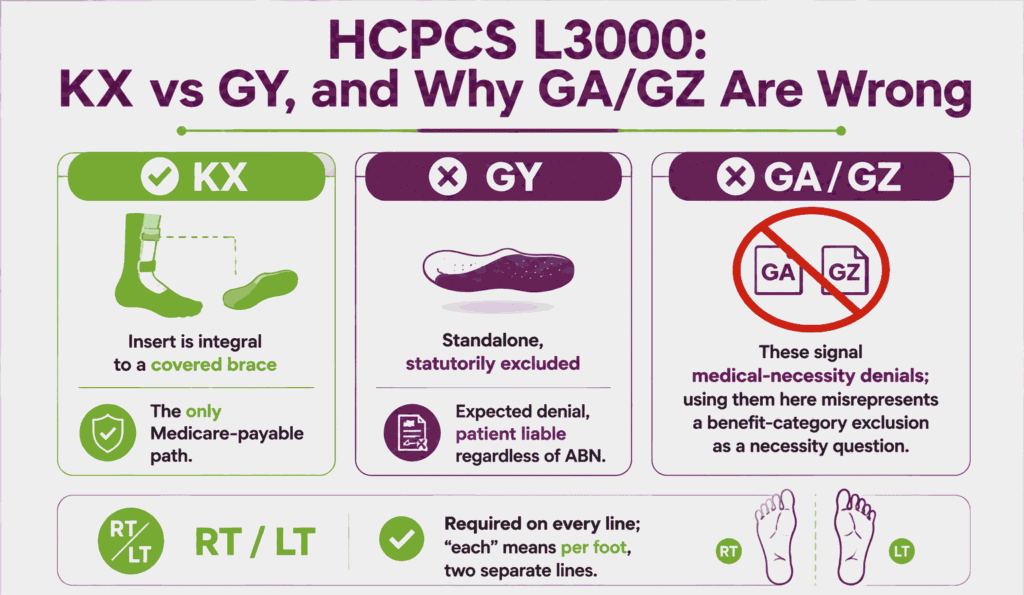
HCPCS code L3000 relies on modifiers that signal the coverage pathway, and the choice between KX and GY defines whether Medicare pays or denies. The laterality modifiers are required on every line.
Modifier KX: Insert Is an Integral Part of a Covered Leg Brace
Modifier KX attests that the insert meets the brace-integral criteria in Policy Article A52481. Append KX to HCPCS code L3000 on the claim line when the insert is an integral, medically necessary part of a covered leg brace billed by the same supplier. This is the only pathway to Medicare payment for the code.
Modifier GY: Statutorily Excluded, Item Has No Medicare Benefit Category
Modifier GY reports that the item is statutorily excluded and has no Medicare benefit category. Append GY to L3000 when billing a standalone insert, which produces an expected denial. The patient is liable regardless of whether an ABN was issued, because this is a benefit-category exclusion, not a medical-necessity denial.
Modifier GA: ABN on File
Modifier GA reports that an Advance Beneficiary Notice of Noncoverage is on file for an expected medical-necessity denial. Moreover, modifier GA is generally wrong on a standalone HCPCS code L3000 claim, because the denial is a statutory exclusion, not a medical-necessity determination. Using GA here misrepresents the denial type, and GY is the correct modifier for the excluded standalone item.
Modifier GZ: No ABN, Denial Expected as Not Medically Necessity
Modifier GZ reports an expected medical-necessity denial with no ABN on file. Like GA, modifier GZ addresses medical-necessity denials rather than statutory exclusions, so it does not fit a standalone L3000 claim. The line would deny with provider liability, and GY remains the accurate modifier for the benefit-category exclusion.
Modifiers RT / LT: Laterality Required on Every Line
Modifiers RT and LT identify the right and left foot. The L3000 descriptor reads “each,” so bill per foot with the laterality modifier, never as a bilateral pair. A pair is reported on two separate claim lines, each with one unit of service and the matching RT or LT modifier.
Which Documents Are Required For HCPCS Code L3000?
Documentation for HCPCS code L3000 must prove the device is custom, identify the coverage pathway, and confirm delivery. The molding record is the central audit defense.
The required documentation includes:
- A written order from the treating provider before delivery of the device
- Documentation of the casting or scanning method and the custom fabrication process
- A detailed device description, including heel cup depth, posts, and flanges
- Fitting documentation completed by a qualified professional
- For a Medicare-payable claim, evidence that the insert is integral to a covered leg brace
- Proof of delivery with the date, item description, and recipient signature
What Is the Cost of HCPCS Code L3000?
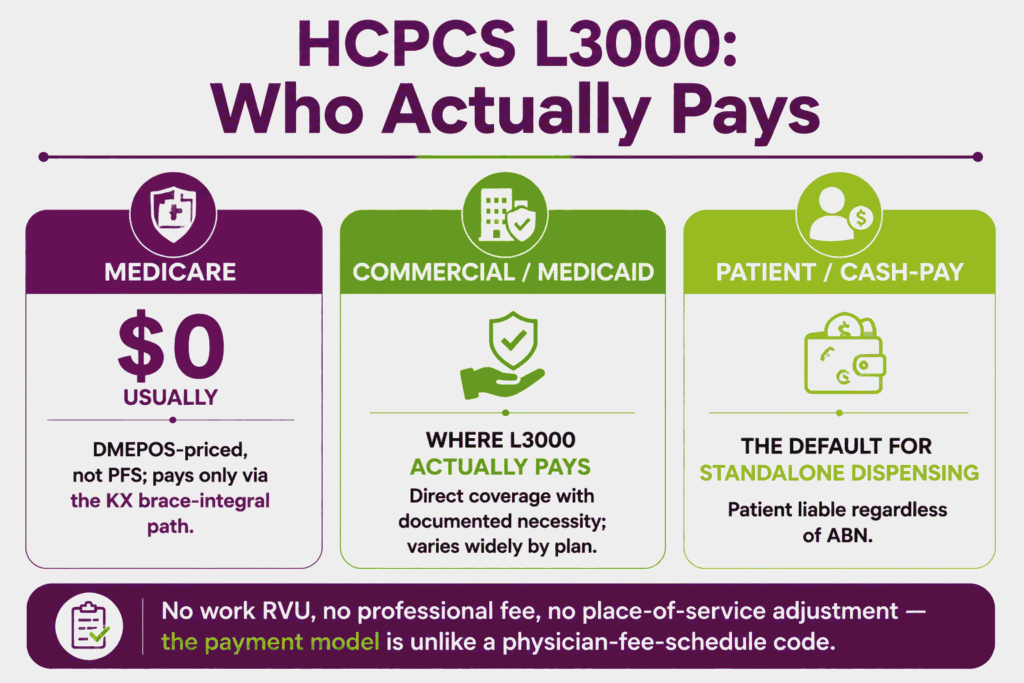
The economics of HCPCS code L3000 look nothing like a physician-fee-schedule code. There is no work RVU and no professional fee, and Medicare payment is usually zero. Pricing runs through the DMEPOS framework rather than the fee schedule, the pathway shared by most HCPCS Level II codes for supplies and devices.
DMEPOS Fee Schedule Status and Why Medicare Payment Is Usually Zero
HCPCS code L3000 is a DMEPOS item, not a physician service, so it has no Physician Fee Schedule value. Medicare payment is usually zero because the standalone item is statutorily excluded.
The payment status points are:
- L3000 is priced through the DMEPOS framework, not the Physician Fee Schedule, so there is no RVU or conversion-factor calculation
- The only Medicare payment scenario is the brace-integral pathway, billed with modifier KX
- A standalone claim with modifier GY produces a zero Medicare payment by design
- Any DMEPOS allowable that exists applies only within the covered brace-integral scenario
Commercial Payers and Medicaid Coverage
Commercial and Medicaid plans are where HCPCS code L3000 actually pays, and coverage varies widely by plan. Unlike Medicare, these payers can cover a custom orthotic directly when medical necessity is documented.
Coverage examples and requirements include:
- Coverage terms differ significantly across commercial and Medicaid plans, so verify the specific policy before dispensing
- The UnitedHealthcare Community Plan reimburses L3000 only with a written prescription from the ordering provider
- When the ordering provider is also the supplier, that plan requires office visit notes instead of a separate prescription
- Plans commonly require proof of custom fabrication and a supporting diagnosis, and deny when documentation is absent
Patient Financial Responsibility and Cash-Pay Workflows
For most standalone HCPCS code L3000 dispensing, the patient is the payer. Since the item is statutorily excluded from Medicare, patient financial responsibility and cash-pay workflows carry the revenue.
The patient-payment points are:
- On a statutory exclusion, the patient is financially responsible for a standalone insert regardless of any ABN
- Cash-pay workflows require a clear up-front financial discussion and a documented patient agreement
- Where a secondary or commercial plan exists, a correctly coded Medicare denial can open that pathway
- Place-of-service and geographic fee adjustments do not apply, because there is no physician-fee-schedule payment to adjust
What Are Example Clinical Scenarios or Use Cases for HCPCS Code L3000?
HCPCS code L3000 appears in both the payable brace-integral pathway and the far more common excluded standalone pathway. The scenarios below show each, plus the diabetic crosswalk.
Scenario 1: Custom UCB Insert Dispensed as an Integral Component of a Covered AFO (KX Pathway, Medicare-Payable)
A patient requires a UCB insert as an integral component of a covered leg brace, dispensed by the same supplier that provides the brace. The insert is medically necessary for the brace to function properly. The supplier bills HCPCS code L3000 with modifier KX and the appropriate laterality modifier, on the same claim as the covered brace. This is the one scenario in which Medicare pays for the insert.
Scenario 2: Standalone Custom Orthotic for Adult-Acquired Flatfoot, GY Modifier, Expected Denial, and Patient Liability
ICD-10: M21.6 (Other acquired deformities of foot)
A patient with adult-acquired flatfoot receives a custom UCB orthotic that is not attached to any leg brace. Because the item is a standalone insert, Medicare excludes it by benefit category. The supplier bills L3000 with modifier GY and the laterality modifier, expecting the denial. The patient is financially responsible for the device, and an ABN does not change that liability, since the denial is a statutory exclusion.
Scenario 3: Billing Medicare for a Denial to Trigger Secondary or Commercial Payment
ICD-10: M21.4 (Flat foot, pes planus)
A patient with secondary insurance receives a standalone custom orthotic, and the secondary plan requires a Medicare denial before it will pay. The supplier bills HCPCS code L3000 with modifier GY specifically to generate the clean denial the secondary payer needs. Here, the Medicare denial is the deliverable, and correct GY coding is what makes the secondary claim process without a rejection for the wrong denial type.
Scenario 4: Diabetic Patient With Neuropathy and No Active Ulceration and Why the Claim Belongs Under A5512/A5513, Not L3000
ICD-10: E11.42 (Type 2 diabetes mellitus with diabetic polyneuropathy)
A patient with diabetic neuropathy and no active ulceration needs a custom insert. This is not an L3000 claim, because the diabetic program governs the item. The supplier bills the correct A5500-series code, such as A5512 or A5513, under the Therapeutic Shoes for Persons with Diabetes program. Coding it as L3000 would misidentify the device and forfeit the diabetic-shoe benefit the patient qualifies for.
What Are the HCPCS Code L3000 Rules To Ensure Successful Reimbursement?
Follow the per-foot billing rules, the custom-fabrication documentation standards, the written-order requirements, and the limits of an ABN. Meeting these rules protects HCPCS code L3000 claims from denial and audit recovery.
Per-Foot Billing, Units, and Frequency Limits
HCPCS code L3000 is billed per foot, because the descriptor reads “each.” A pair is never billed as a single bilateral line.
The unit and frequency rules are:
- Bill one unit of service per foot, on separate lines, with RT on one line and LT on the other
- Never report a pair as a single line or as a bilateral modifier combination
- Commercial plans commonly cap coverage at two inserts per foot per year
- Additional units beyond the plan limit are denied absent a documented plan exception
Custom-Fabrication Documentation Standards That Survive an Audit
The molding-process record is what separates a defensible HCPCS code L3000 claim from an upcoded prefabricated claim. Audit defense rests on proof that the device was custom fabricated from the patient’s model.
The documentation standards are:
- Record the casting or scanning method used to capture the patient’s foot model
- Document the fabrication of the shell to that model, not selection from stock
- Describe the device features, including heel cup depth, posts, and flange heights
- Retain the fitting record and the proof of delivery to complete the audit file
Prior Authorization and Written-Order-Prior-to-Delivery Requirements
HCPCS code L3000 requires a written order before the device is delivered. Some payers add prior authorization on top of the written-order rule.
The order and authorization rules are:
- Obtain a written order from the treating provider before delivering the device
- Confirm each payer’s prior authorization requirement, since commercial and Medicaid rules vary
- Match the ordered device to the code billed, since a custom order supports L3000 and a stock order does not
- Keep the order, the fabrication record, and the proof of delivery aligned on the device described
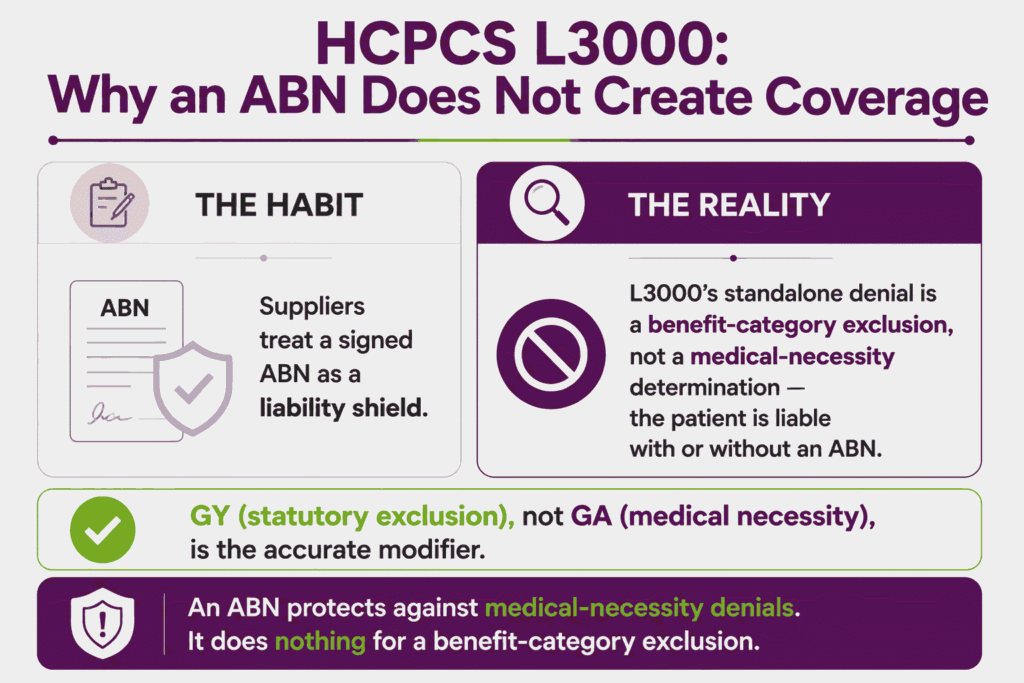
Why the Statutory Exclusion Cannot Be Overcome by an ABN
An ABN does not convert a statutory exclusion into a covered service. Suppliers habitually treat an ABN as a liability shield, but for benefit-category exclusions the patient is responsible regardless.
The ABN limits are:
- The L3000 standalone denial is a benefit-category exclusion, not a medical-necessity determination
- The patient is financially liable for an excluded item whether or not an ABN was signed
- Modifier GY, not GA, is the correct modifier for the statutory exclusion
- Using GA in place of GY misrepresents the denial as a medical-necessity denial, which is inaccurate
Top Reasons For Denials Specific To L3000 & Quick Remedies
- Prefabricated Device Billed as Custom: Prevent by billing HCPCS code L3000 only for a device custom fabricated from the patient’s model, with the molding record on file.
- Missing KX on a Brace-Integral Claim: Prevent by appending modifier KX and billing the insert on the same claim as the covered leg brace when the brace-integral criteria are met.
- Missing GY on a Standalone Claim: Prevent by appending modifier GY to every standalone L3000 claim, so the denial posts as a statutory exclusion.
- Diabetic Insert Billed Under an L Code: Prevent by routing diabetic inserts to the A5500-series codes under the Therapeutic Shoes for Persons with Diabetes program.
- Missing Laterality or Absent Proof of Delivery: Prevent by billing per foot with RT or LT on separate lines and retaining a signed, dated proof of delivery.