Medicare reported a 47.1 percent improper payment rate for diabetic therapeutic shoes in the 2024 reporting period. The projected improper payment amount reached 35.7 million dollars. Insufficient documentation accounted for 85.5 percent of those improper payments.
That figure explains what separates HCPCS billing from procedure billing in podiatry. HCPCS Level II claims are supplier claims, not procedure claims. They answer to DME Medicare Administrative Contractors, written order rules, and delivery proof requirements that never touch a CPT claim. For practices that rely on expert podiatry billing support, understanding these supplier-specific requirements is essential to reducing denials and avoiding documentation-related payment errors.
This guide covers podiatry HCPCS codes in two layers. The first layer covers the supplier mechanics that govern every claim: who bills, what documentation applies, and which modifiers control payment. The second layer covers the code families themselves, grouped by product type.

What Are Podiatry HCPCS Codes?
Podiatry HCPCS codes are Level II alphanumeric codes for the products, supplies, and services a foot and ankle practice provides outside the CPT procedure set. They cover diabetic shoes, orthotics, braces, dressings, and select physician services Medicare defined outside CPT.
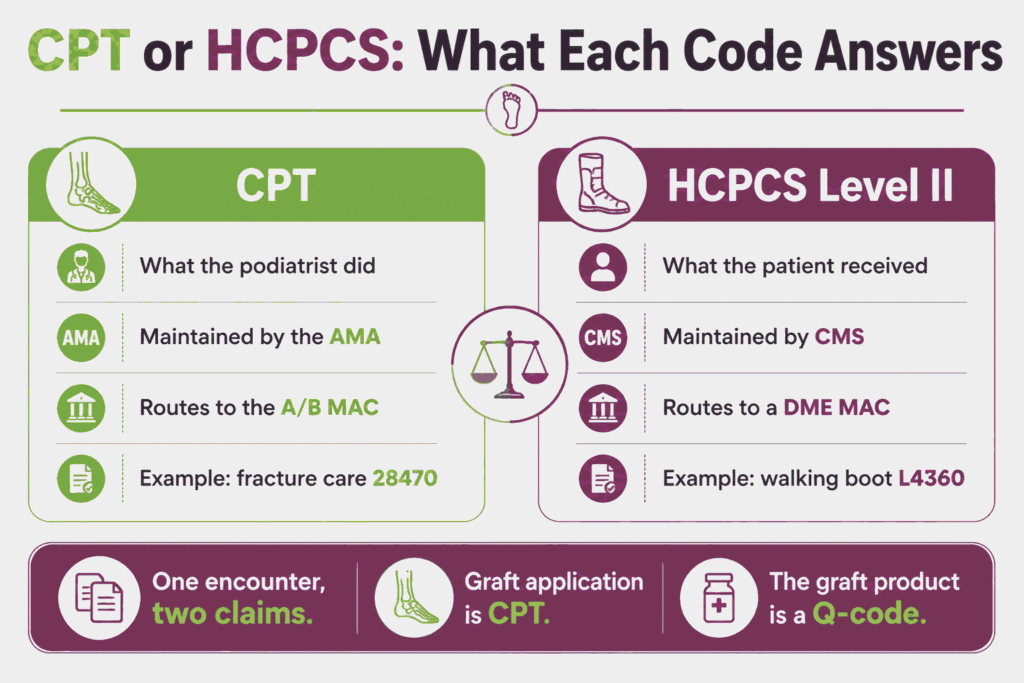
The American Medical Association maintains CPT. The Centers for Medicare and Medicaid Services maintains HCPCS Level II. That split matters because coverage rules, contractors, and appeal pathways differ between the two systems.
Which HCPCS Letter Series Does Podiatry Use?
Podiatry draws from five letter series. Each series carries its own benefit category and coverage logic.
| Series | Covers | Podiatry Examples |
|---|---|---|
| A | Medical supplies, dressings, diabetic shoes | A5500, A5512, A6196 |
| E | Durable medical equipment | E0114, E0143 |
| G | CMS-defined physician services | G0127, G0245 |
| L | Orthotics, braces, prosthetics | L3000, L4360, L4396 |
| Q | Casting supplies, skin substitutes | Q4038, Q4101 |
The A series splits internally. Diabetic shoe codes sit under a separate Part B benefit category. Surgical dressing codes sit under the dressings benefit. The two follow different rules despite sharing a letter.
How Do HCPCS Codes Differ From CPT Codes in Podiatry?
CPT codes describe what the podiatrist did. HCPCS Level II codes describe what the patient received. A single encounter often generates both.
Consider a diabetic patient fitted with a walking boot after a metatarsal fracture. The fracture care is a CPT claim. The boot is an L-code claim submitted to a different contractor under different documentation rules.
The distinction extends to grafts. The procedure of applying a skin substitute is a CPT code. The graft product itself carries a Q-code. Practices that treat these as one line item lose payment on both. The podiatry CPT codes reference covers the procedure side of that pairing.
Who Bills Podiatry HCPCS Codes?
The billing party depends on the benefit category. Physician service G-codes go to the Part B contractor under the practice NPI. DMEPOS items go to a DME Medicare Administrative Contractor under a supplier number.
A podiatry practice that dispenses shoes, orthotics, or braces functions as a supplier for those claims. That role carries enrollment obligations the practice NPI does not satisfy on its own.
What Does DMEPOS Enrollment Require?
Practices dispensing DMEPOS items must hold a supplier number and meet accreditation and surety bond requirements. Without enrollment, the claim has no valid billing pathway regardless of medical necessity.
Accreditation carries a new operating cost in 2026. Effective January 1, 2026, accreditation organizations survey DMEPOS suppliers annually rather than every three years. Compliance now sits on a yearly cycle.
Which Contractor Processes Podiatry HCPCS Claims?
DMEPOS claims route to one of four DME MACs by the beneficiary residence address, not the practice address. Noridian and CGS administer the jurisdictions. Coverage policy comes from DME MAC local coverage determinations, not the A/B MAC policies that govern CPT claims.
Two policy documents govern most podiatry DMEPOS billing:
- LCD L33369 and Policy Article A52501 control therapeutic shoes for persons with diabetes
- LCD L33686 and Policy Article A52457 control ankle-foot and knee-ankle-foot orthoses
- LCD L33831 controls surgical dressings
- Policy Article A52481 controls orthopedic footwear, including foot inserts
- Policy Article A55426 sets standard documentation requirements across all DME MAC claims
Practices billing across state lines answer to multiple jurisdictions at once. A patient who winters in Florida and summers in Michigan may generate claims under two different DME MACs in one year.
What Documentation Do Podiatry DMEPOS Claims Require?
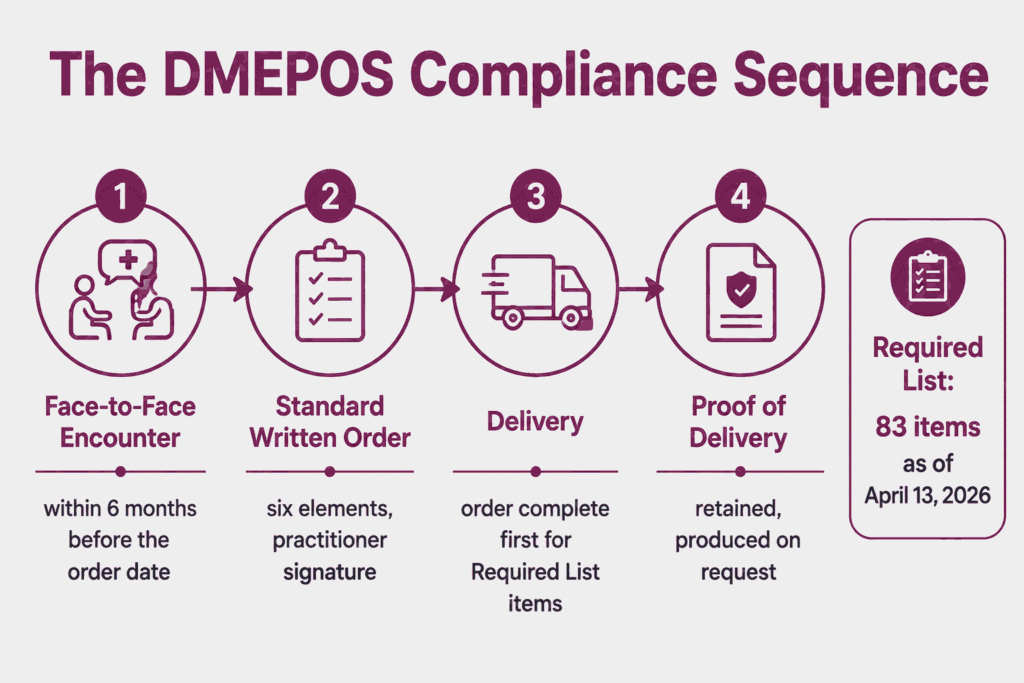
Every DMEPOS claim requires a Standard Written Order. Items on the Required List additionally require a documented face-to-face encounter and a written order delivered before the item reaches the patient.
Documentation failures, not coverage failures, drive most DMEPOS denials. The 85.5 percent documentation share of diabetic shoe improper payments reflects a pattern that repeats across every product family.
What Must a Standard Written Order Include?
CMS standardized order elements effective January 1, 2020. A compliant Standard Written Order contains:
- Beneficiary name or Medicare Beneficiary Identifier
- A description of the item ordered
- Quantity, where applicable
- The order date
- The treating practitioner name or National Provider Identifier
- The treating practitioner signature
Someone other than the treating practitioner may complete the order unless a statute, manual instruction, or local coverage policy states otherwise. The practitioner signature remains non-delegable.
When Is a Face-to-Face Encounter Required?
CMS maintains a Master List of DMEPOS items potentially subject to face-to-face and written order requirements. A subset moves to the Required List, where both become conditions of payment.
The Required List has expanded four times since 2022. As of April 13, 2026, it holds 83 items following a Federal Register notice published January 13, 2026. Practices should verify current Required List status before dispensing any brace or orthosis.
Three rules govern the encounter itself:
- It must occur within six months before the order date
- It must address the clinical condition for which the item is ordered
- A nurse practitioner, clinical nurse specialist, or physician assistant may conduct it within their scope
What Counts as Proof of Delivery?
Proof of delivery documents that the beneficiary received the item. Suppliers must retain it and produce it on contractor request. A claim without retrievable delivery proof fails audit regardless of order quality.
Which Modifiers Govern Podiatry HCPCS Claims?
HCPCS modifiers on DMEPOS claims do different work than CPT modifiers. They attest to coverage criteria, declare equipment status, assign patient liability, and count wounds. Omitting a required modifier produces an automatic denial rather than a review.
KX, GA, GY, and GZ: Coverage and Liability
These four modifiers tell the contractor whether coverage criteria were met and who holds financial liability.
| Modifier | Meaning | Podiatry Use |
|---|---|---|
| KX | All coverage criteria in the policy are met | Required on therapeutic shoes and covered braces |
| GA | Advance Beneficiary Notice on file | Items expected to deny as not medically necessary |
| GY | Statutorily excluded, no benefit category | Standalone foot orthotics, ulcer offloading boots |
| GZ | Expected denial, no ABN on file | No payment expected, avoid where possible |
The KX modifier carries attestation weight. Appending KX to a claim that does not meet the policy criteria is a documentation misstatement, not a coding shortcut.
NU, RR, UE, RA, and RB: Equipment Status
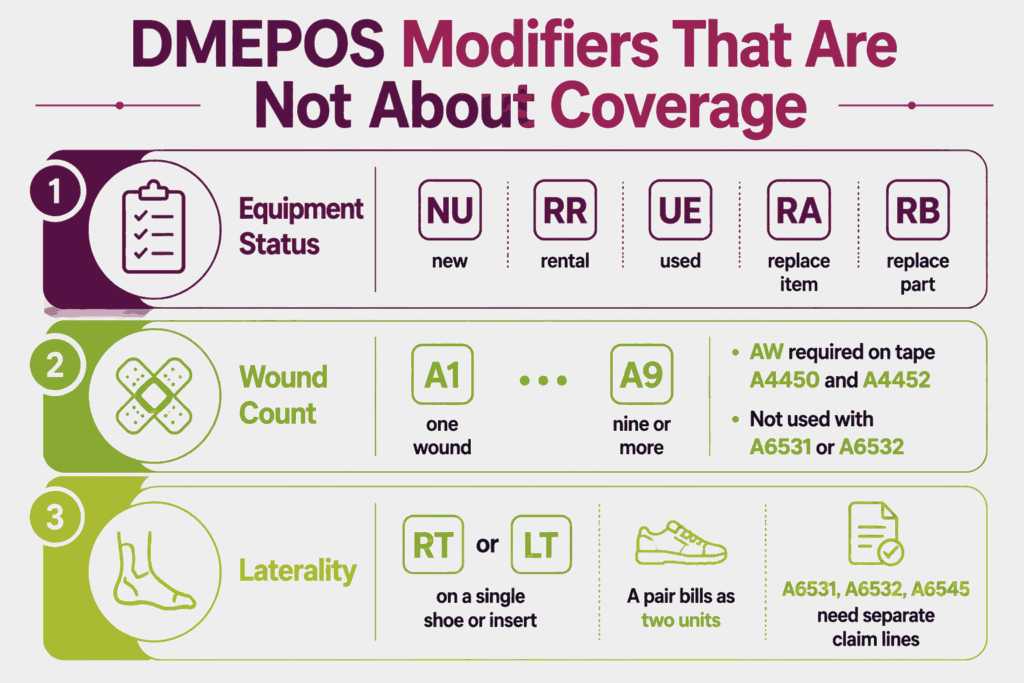
Equipment modifiers declare whether an item is new, rented, used, or a replacement. NU identifies new equipment and appears on most podiatry DMEPOS claims. RA marks replacement of an entire item. RB marks replacement of a part.
A1 Through A9: Number of Wounds
Surgical dressing claims require a modifier identifying how many wounds the dressing treats. A1 marks one wound, and A9 marks nine or more. These modifiers have no CPT equivalent.
Two exceptions apply. Modifiers A1 through A9 are not used with A6531 or A6532. Tape codes A4450 and A4452 require the AW modifier in addition to the applicable A1 through A9 modifier.
RT, LT, and Toe Modifiers on DMEPOS Claims
Laterality rules on DMEPOS claims differ from procedure claims. Therapeutic shoes bill per shoe, so a pair reports as two units. When a single shoe or insert is provided, RT or LT identifies the side.
Gradient compression codes A6531, A6532, and A6545 require separate claim lines for each side. A single line carrying RTLT together is rejected as incorrect coding.
What Are the Therapeutic Shoe HCPCS Codes?
The therapeutic shoe benefit sits in its own Part B coverage category. Diabetic shoes are neither durable medical equipment nor orthotics under Medicare rules. That placement is why the coverage tests differ from every other L-code and A-code family.
Coverage requires diabetes, a qualifying foot condition, and certification from the physician managing the diabetes. Accurate podiatry ICD-10 codes help document the qualifying condition and support the medical-necessity requirements for the shoe benefit. The benefit runs on a calendar year cycle.
A5500: Off-the-Shelf Depth-Inlay Shoe
A5500 covers fitting, custom preparation, and supply of an off-the-shelf depth-inlay shoe. The shoe must be manufactured to accommodate a multi-density insert. The code bills per shoe, so a pair reports as two units.
The product must carry PDAC coding verification before it can be billed under A5500. Shoes without that verification deny as incorrect coding. The A5500 depth-inlay shoe code set covers fitting requirements and annual limits in full.
A5501: Custom Molded Shoe
A5501 covers a shoe molded from a cast of the patient foot, billed per shoe. The code applies when a foot deformity cannot be accommodated by a depth-inlay shoe. Documentation must record the deformity and why the standard shoe fails.
A5500 and A5501 are mutually exclusive for the same shoe. Practices that bill a custom molded shoe under the depth-inlay code invite recoupment.
A5500 vs A5501: Which Shoe Code Applies?
The test is the foot, not the product catalog. A5500 applies when an off-the-shelf depth-inlay shoe accommodates the foot with a multi-density insert. A5501 applies when a documented deformity defeats that option.
The choice also moves the annual insert allowance. A5500 carries three pairs of inserts. A5501 carries two, because the custom shoe includes inserts at supply.
A5512: Prefabricated Heat-Moldable Insert
A5512 covers a prefabricated insert, heat-moldable, formed to the patient foot at fitting. The PDAC Product Classification List controls this code directly. A product billed as A5512 that does not appear on the list denies as incorrect coding.
Written code verification review applies here. Suppliers should confirm PDAC status by product model before fitting rather than after denial. The A5512 insert code set details the verification pathway and fitting documentation.
A5513: Custom Molded Insert
A5513 covers an insert molded directly to a model of the patient foot. Suppliers must produce a list of materials used and a description of the fabrication process on contractor request.
Products in categories that require PCL inclusion deny as incorrect coding when absent from the list. The A5513 custom insert code set covers fabrication records and the annual allowance.
A5514: Direct Milled Custom Insert
A5514 covers a custom insert produced by direct milling from a digital scan or model of the patient foot. Documentation rules mirror A5513. The fabrication method is what separates the two codes.
All three insert codes count against the same annual allowance. Mixing codes across a single beneficiary year does not extend the limit.
A5503 Through A5510: Shoe Modifications
Shoe modifications may substitute for an insert within the annual allowance. The common modifications map to specific codes:
- A5503 rigid rocker bottoms or roller bottoms
- A5504 wedges
- A5505 metatarsal bars
- A5506 offset heels
- A5507 other modifications, including flared heels
These codes apply only to diabetic shoes A5500 and A5501. Modifications to L-coded orthopedic footwear must use L-codes from the L3000 through L3649 range.
What Does the Annual Therapeutic Shoe Benefit Allow?
The benefit permits one of two annual combinations per beneficiary. Quantities beyond the allowance deny as noncovered.
| Shoe Type | Shoes Allowed | Inserts Allowed |
|---|---|---|
| Custom molded (A5501) | One pair | Two additional pairs |
| Depth-inlay (A5500) | One pair | Three pairs |
The benefit supplies a pair even when only one foot carries diabetic foot disease. Each shoe protects either the affected limb or the remaining limb.
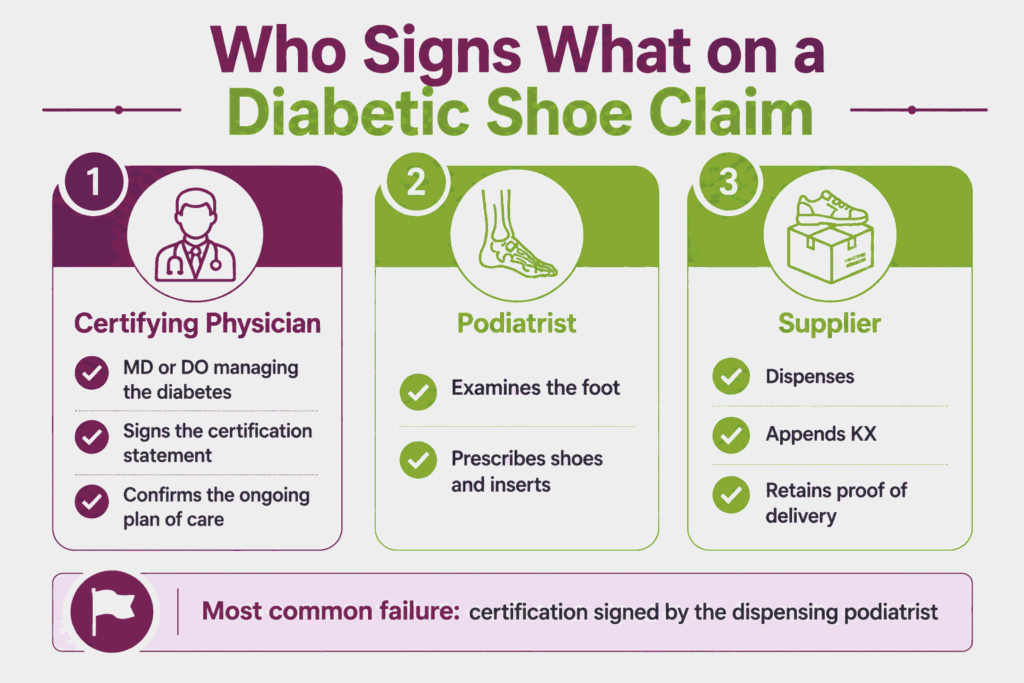
Who Signs the Certifying Physician Statement?
The certifying physician is the doctor of medicine or osteopathy managing the systemic diabetes under an ongoing plan of care. The podiatrist typically prescribes and supplies the shoes but does not certify.
That split is the most common structural failure in this code family. A certification signed by the dispensing podiatrist rather than the diabetes-managing physician does not satisfy the policy.
What Are the Foot Orthotic and AFO HCPCS Codes?
Foot orthotics and ankle-foot orthoses answer to different benefit categories despite adjacent code ranges. Foot orthotics are shoe inserts that do not extend above the ankle. Anything crossing the ankle falls under the brace benefit.
That line determines coverage. The brace benefit requires a rigid or semi-rigid device supporting a weak or deformed body member or restricting motion in a diseased part. Items lacking that rigidity are statutorily noncovered.
L3000: Custom Molded Foot Insert
L3000 covers a removable foot insert molded to a patient model, UCB type, Berkeley shell, billed per insert. The device must be fabricated from a three-dimensional model of the patient foot obtained by cast, foam impression, or digital scan.
HCPCS code L3000 includes built-in additions at fabrication. Postings, padded top covers, soft tissue supplements, balance padding, and lesion accommodations are not separately billable.
Why Does Medicare Deny Most L3000 Claims?
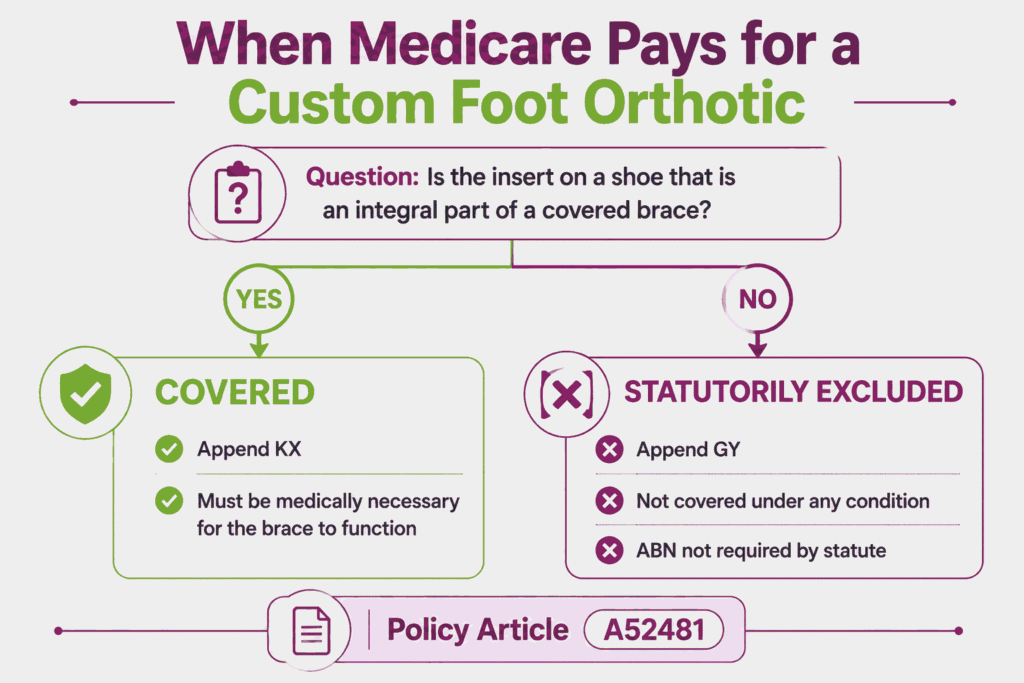
Foot orthotics are statutorily excluded from Medicare coverage as standalone devices. Policy Article A52481 covers L3000 under one condition only. The insert must sit on a shoe forming an integral part of a covered brace. It must also be medically necessary for that brace to function.
The billing consequences follow directly:
- Without an attached leg brace, the claim is statutorily excluded and takes a GY modifier
- With a qualifying brace, the claim requires KX or denies as noncovered
- Appending KX without brace documentation misstates the coverage basis
- Statutory exclusion means beneficiaries are not required to sign an Advance Beneficiary Notice
Patients frequently receive contrary information from payer call centers. Practices dispensing custom orthotics to Medicare beneficiaries should set financial expectations before fabrication rather than after denial.
L3010, L3020, and L3030: Related Insert Codes
The L3000 range extends across molded inserts, longitudinal arch supports, and metatarsal support variants. Every code in the range carries the same brace-attachment coverage test as L3000. Commercial payers often cover these codes where Medicare does not.
L4396 and L4397: Static and Dynamic Positioning AFOs
L4396 and L4397 cover positioning ankle-foot orthoses worn when the beneficiary is not ambulatory. Coverage under LCD L33686 turns on plantar flexion contracture of the ankle and related criteria.
Two adjacent codes fall outside coverage. A foot drop splint or recumbent positioning device codes to L4398. That code and its replacement interface L4394 deny when used solely to prevent or treat a pressure ulcer. Replacement interfaces are limited to one every six months.
What Are the Walking Boot and Immobilization HCPCS Codes?
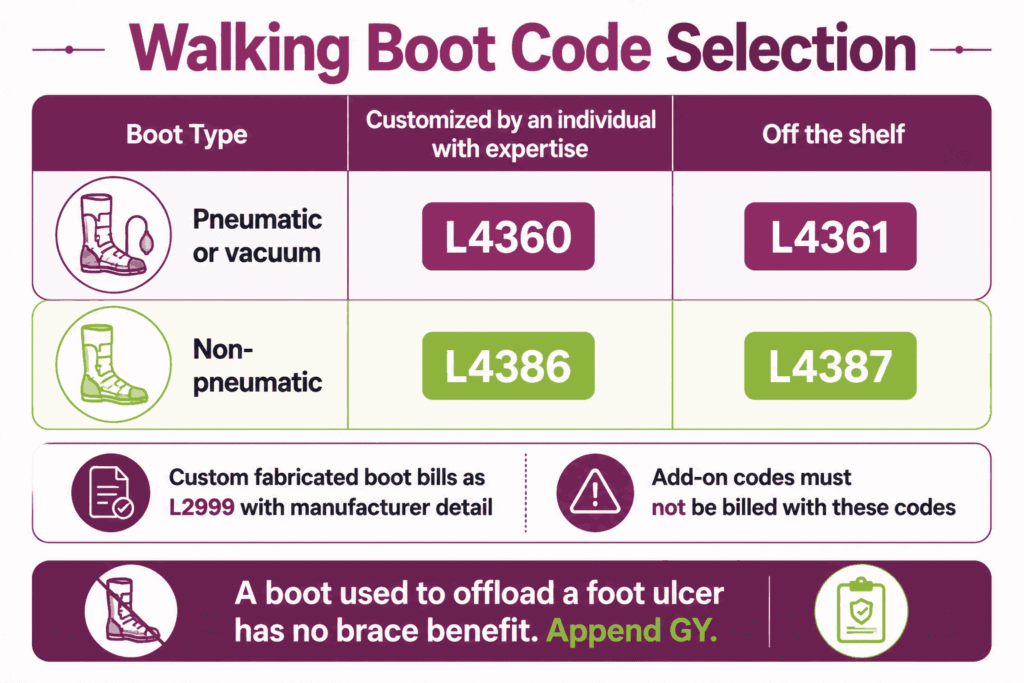
Walking boots code as ankle-foot orthoses under the brace benefit. Four prefabricated codes cover the category. Selection turns on two variables: whether the boot uses a pneumatic or vacuum mechanism, and whether a qualified individual customized it.
Add-on codes must not be billed alongside walking boot codes. Custom fabricated walking boots bill under L2999 with manufacturer details and an explanation of why a prefabricated boot is insufficient.
L4360: Customized Pneumatic Walking Boot
L4360 covers a prefabricated pneumatic or vacuum walking boot customized for a specific patient. Customization means trimmed, bent, molded, or assembled by an individual with expertise. Joints and interface material may or may not be present.
The customization must be real and recorded. A boot dispensed as supplied, with no fitting work by a qualified individual, fails the code definition. The L4360 walking boot code set covers customization records and the brace benefit test.
L4361: Off-the-Shelf Pneumatic Walking Boot
L4361 covers the same pneumatic or vacuum walking boot supplied off the shelf. Off-the-shelf classification assumes the patient needs only minimal self-adjustment. No expertise-level fitting is involved.
L4360 vs L4361: Customized or Off the Shelf?
This pair draws more audit attention than any other walking boot question. A boot the manufacturer labeled as off-the-shelf cannot be recoded to L4360 because a podiatrist adjusted it in office.
Minimal self-adjustment and expertise-level customization are mutually exclusive classifications. Code from the manufacturer designation and the fitting record together, not from the higher fee schedule amount.
L4386 and L4387: Non-Pneumatic Walking Boots
L4386 and L4387 mirror the pneumatic pair without the air bladder or vacuum mechanism. L4386 covers the customized variant, and L4387 covers off-the-shelf. The same manufacturer labeling logic applies.
When Does a Walking Boot Lose Coverage?
Walking boots qualify under the brace benefit only when they immobilize an orthopedic condition or support recovery after orthopedic surgery. Plus, boots used primarily to relieve pressure on the sole, or supplied to patients with foot ulcers, have no benefit category.
Suppliers must append GY when the boot treats or prevents a foot ulcer. Moreover, claims carrying GY are denied as noncovered. Also, the absence of the modifier GY represents an affirmative statement that the boot serves an orthopedic purpose.
This rule catches diabetic practices repeatedly. Offloading a plantar ulcer is exactly the use case Medicare excludes from the brace benefit. The therapeutic shoe benefit, not the brace benefit, addresses diabetic ulcer prevention.
Q4037 and Q4038: Short Leg Cast Supplies
Cast supply codes bill separately from the CPT cast application procedure. Q4037 covers short leg cast supplies for an adult using plaster. Q4038 covers the same cast in fiberglass. Age and material determine code selection.
What Are the Wound Care and Skin Substitute HCPCS Codes?
Wound supplies for diabetic foot ulcers span two separate benefit structures. Surgical dressings fall under the dressings benefit governed by LCD L33831. Skin substitute products carry Q-codes and changed payment methodology in 2026.
Which Surgical Dressing Codes Apply to Foot Ulcers?
Dressing selection follows wound characteristics, and each category carries its own utilization limit.
| Category | Code Range | Coverage Basis |
|---|---|---|
| Alginate and fiber gelling | A6196 to A6199 | Moderately to highly exudative full thickness wounds |
| Collagen | A6021 to A6024 | Full thickness wounds, PDAC verification required |
| Hydrogel | A6242 to A6248 | A6248 capped at three units per wound per 30 days |
| Non-impregnated gauze | A6216 to A6221, A6402 to A6407 | Change frequency varies by adhesive border |
Alginate dressings are not reasonable and necessary on dry wounds or wounds covered with eschar. Using more than one hydrogel form on the same wound at the same time fails the necessity test.
A6196: Alginate Wound Cover, Pad Size 16 Sq In or Less
HCPCS code A6196 reports a sterile alginate or fiber gelling wound cover with a pad size of 16 square inches or less, billed per dressing. It is a surgical dressing billed to the DME MAC, and it is covered only on a qualifying wound, meaning a surgical wound or one that has been debrided.
Podiatry practices see it most often on moderately to heavily exudative full-thickness foot ulcers. The same pad that pays when it is sent home with the patient is not separately billable when applied during an office visit, which is why the rules around HCPCS code A6196 matter before a supply order ships.
What Is the Qualifying Wound Requirement?
The surgical dressing benefit carries a statutory gate. The wound must be surgically created, surgically modified, or debrided. A wound that meets none of those conditions has no dressing benefit regardless of severity.
Documentation must record wound depth, drainage level, and treatment history. Missing wound depth is among the most frequent causes of dressing denials.
Q4101 and the Skin Substitute Product Codes
Skin substitute products carry Q-codes distinct from the CPT application procedure. Q4101 is among the most frequently billed in diabetic foot ulcer care.
Payment for these products changed on January 1, 2026. CMS reclassified most skin substitutes from biologicals to incident-to supplies under both the Physician Fee Schedule in non-facility settings and the Outpatient Prospective Payment System.
Products now group by FDA regulatory pathway across three categories. For 2026, CMS applies a single payment rate of approximately 127.28 dollars per square centimeter across all three. Biologicals licensed under Section 351 of the Public Health Service Act continue under average sales price methodology.
The scale of the change is visible in the spending data CMS cited. Part B spending on skin substitutes rose from 252 million dollars in 2019 to more than 10 billion dollars in 2024. The American Podiatric Medical Association formally objected to the finalized approach.
What Are the Podiatry-Specific G-Codes?
Two G-code families matter in podiatry. One covers dystrophic nail trimming. The other covers diabetic foot care for patients with loss of protective sensation. Both sit outside CPT despite describing physician work.
G0127: Trimming of Dystrophic Nails
G0127 covers trimming of dystrophic toenails, any number. Dystrophic nails are thickened, deformed, or diseased nails that standard clippers cannot manage.
The code follows the same routine foot care necessity framework as its CPT counterparts. A qualifying systemic condition and the applicable Q7, Q8, or Q9 modifier must appear on the claim. Patients with sensory neuropathy and no vascular impairment are the exception and need no class finding modifier. Frequency for the code HCPCS G0127 generally caps at once every 60 days.
G0245, G0246, and G0247: LOPS Diabetic Foot Care
The LOPS series covers diabetic patients with sensory neuropathy causing loss of protective sensation and adequate circulation. Coverage runs every six months.
- G0245 initial evaluation and management, requiring LOPS diagnosis, history, a five-element examination, and patient education
- G0246 follow-up evaluation and management with the same examination elements
- G0247 routine foot care, including local wound care, corn and callus debridement, and nail trimming
G0247 cannot stand alone. It must appear on the same date of service as G0245 or G0246. Coverage also requires that the patient has not seen a foot care specialist for another reason during the interval.
Q Modifiers or LOPS Codes: Which Pathway Applies?
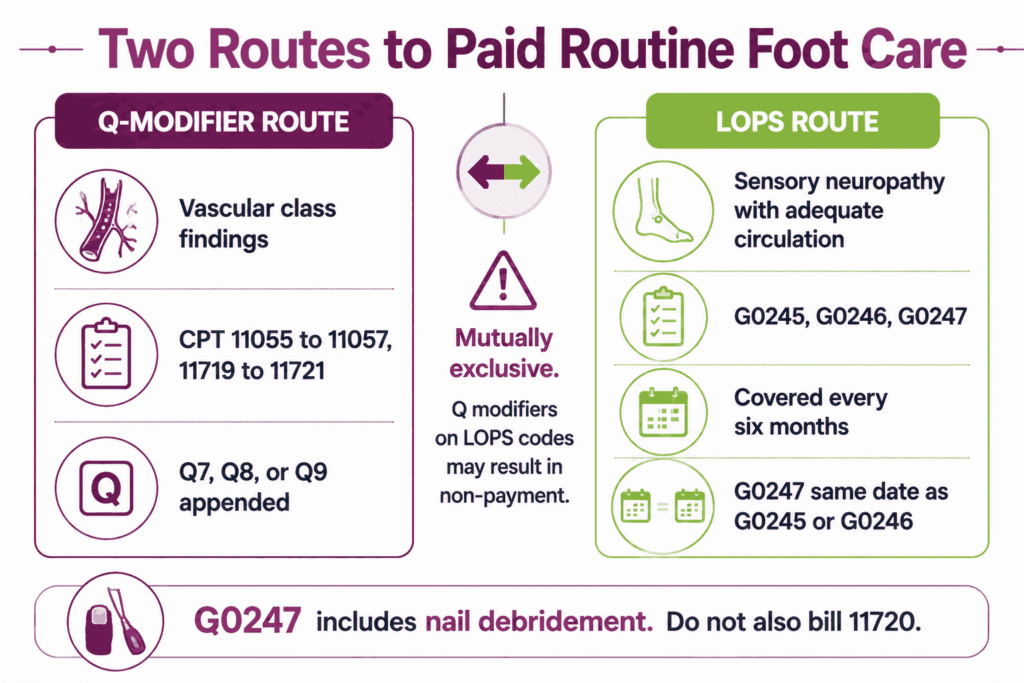
Medicare provides two routes to paid routine foot care, and they are mutually exclusive. Selecting the wrong route produces a denial that no modifier fixes.
The Q-modifier pathway applies when class findings document vascular compromise. It runs through CPT codes 11055 through 11057 and 11719 through 11721 with Q7, Q8, or Q9 appended. The routine foot care class finding framework sits on the procedure side.
The LOPS pathway applies when the patient has documented sensory neuropathy with adequate circulation. Three rules govern the boundary:
- Q modifiers appended to LOPS G-codes may result in non-payment
- LOPS codes deny when routine foot care CPT codes were billed and paid for the same period
- G0247 includes nail debridement, so 11720 must not also appear on the claim
Practices that default to one pathway without screening circulation status leave payable claims unbilled. Many delegate this screening logic to podiatry billing companies that maintain pathway rules inside the claim scrubber.
Why Do Podiatry HCPCS Claims Get Denied?
HCPCS denials in podiatry follow a small set of repeating failures. Each has a defined fix.
Missing or Unsupported KX Modifier
The Error: Billing therapeutic shoes, inserts, or covered braces without KX, or appending KX where policy criteria are not documented.
Fix: Confirm every criterion in the applicable local coverage determination before the modifier goes on the claim. Retain the supporting chart entries.
Certification Signed by the Wrong Physician
The Error: A therapeutic shoe certification signed by the dispensing podiatrist instead of the physician managing the diabetes.
Fix: Route certification to the treating physician for diabetes and confirm the plan of care reference before dispensing.
Standalone Foot Orthotics Billed as Covered
The Error: Submitting L3000 without a leg brace and expecting payment, or appending KX to force adjudication.
Fix: Apply GY for statutorily excluded orthotics. Set patient financial expectations before fabrication begins.
Walking Boots Billed for Ulcer Offloading
The Error: Billing L4360, L4361, L4386, or L4387 for a boot used to offload a plantar ulcer without GY.
Fix: Append GY when the purpose is ulcer treatment or prevention. Route diabetic offloading through the therapeutic shoe benefit instead.
Product Not on the PDAC List
The Error: Billing A5512 or a collagen dressing code for a product that lacks PDAC verification for that code.
Fix: Verify product classification before dispensing. Coding follows the product, not the wound or the clinical intent.
Missing A1 Through A9 Modifier on Dressings
The Error: Submitting surgical dressing claims without the wound count modifier, or omitting AW on associated tape codes.
Fix: Build wound count capture into the dressing order workflow so the modifier populates from documentation.
Exceeding the Annual Shoe Allowance
The Error: Billing more than one pair of shoes or more inserts than the benefit permits within a calendar year.
Fix: Track dispensing dates per beneficiary and check the running annual total before the next fitting.
Order Signed After Delivery
The Error: Delivering a Required List item before the written order is complete, or dating the face-to-face encounter after the order.
Fix: Force a date check between encounter, order, and delivery in the dispensing workflow. Practices building this discipline into daily operations reduce recoupment exposure across every product family, and a structured podiatry billing workflow makes the sequence auditable.
What Changed for Podiatry HCPCS Codes in 2026?
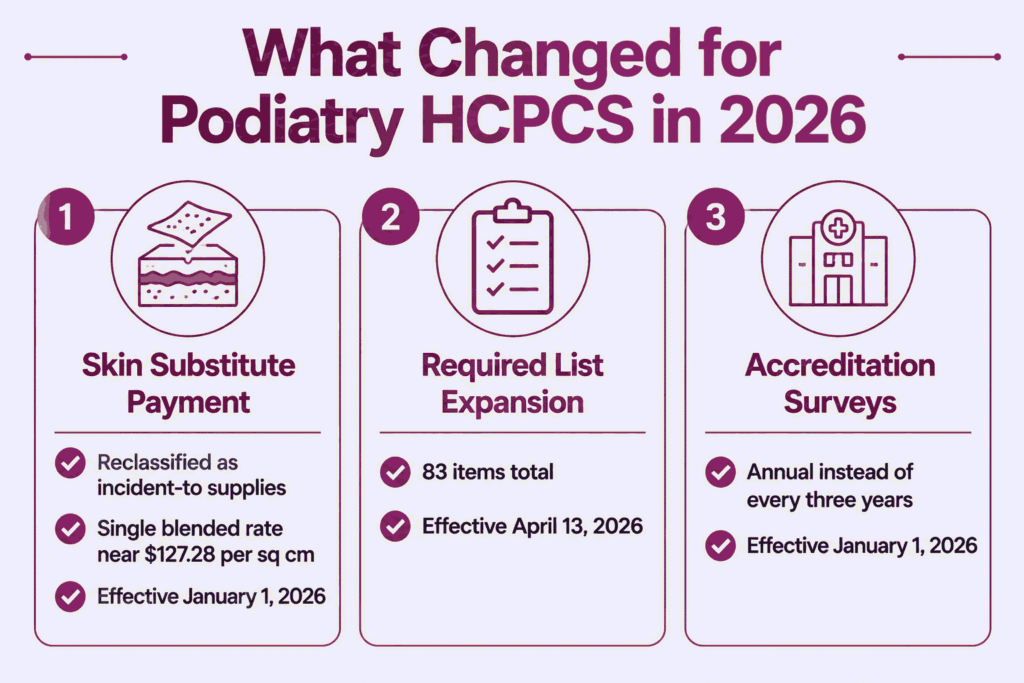
Three changes affect podiatry HCPCS billing this year. None touched the core code descriptors, but all three change what gets paid.
Skin Substitute Payment Reform
Effective January 1, 2026, CMS treats most skin substitutes as incident-to supplies rather than biologicals. Products group by FDA regulatory pathway and pay at a single blended rate near 127.28 dollars per square centimeter for 2026.
CMS has stated an intent to propose differentiated rates across the three categories in future years. Practices running wound care programs should model margin against the blended rate rather than historical product-specific pricing.
Required List Expansion
A Federal Register notice published January 13, 2026 added eight codes to the face-to-face and written order Required List. The list reached 83 items effective April 13, 2026.
The additions were oxygen and oxygen delivery codes rather than podiatry items. The list continues to expand on roughly an annual cycle, so brace and orthosis codes warrant a status check each year.
Annual Accreditation Surveys
Effective January 1, 2026, accreditation organizations survey DMEPOS suppliers annually instead of every three years. Practices dispensing shoes, orthotics, or braces now carry a yearly survey cycle rather than a triennial one.
Podiatry HCPCS Coding FAQs
What Is the Difference Between HCPCS and CPT Codes in Podiatry?
CPT codes describe procedures the podiatrist performs. HCPCS Level II codes describe products and supplies the patient receives, plus a small set of CMS-defined services. HCPCS DMEPOS claims route to DME Medicare Administrative Contractors under separate documentation rules.
Does Medicare Cover Custom Foot Orthotics?
Medicare covers custom foot orthotics only when the insert sits on a shoe that forms an integral part of a covered leg brace. Standalone custom orthotics coded L3000 are statutorily excluded. Those claims take a GY modifier.
How Many Pairs of Diabetic Shoes Does Medicare Cover Per Year?
Medicare covers one pair of shoes per calendar year. Beneficiaries receive one pair of custom molded shoes with two additional pairs of inserts. The alternative is one pair of depth-inlay shoes with three pairs of inserts.
Who Must Sign the Diabetic Shoe Certification?
The physician managing the systemic diabetes signs the certification. That is typically a doctor of medicine or osteopathy treating the patient under an ongoing diabetes plan of care. The dispensing podiatrist prescribes and supplies but does not certify.
Can I Bill a Walking Boot for a Diabetic Foot Ulcer?
Not under the brace benefit. Walking boots used to relieve pressure or treat foot ulcers have no Medicare benefit category and require a GY modifier. Diabetic offloading routes through the therapeutic shoe benefit instead.
What Is the Difference Between L4360 and L4361?
Both cover pneumatic or vacuum walking boots. L4360 applies when an individual with expertise trimmed, bent, molded, or otherwise customized the boot for the patient. L4361 applies to off-the-shelf boots requiring only minimal self-adjustment.
Can G0247 Be Billed Alone?
No, G0247 must appear on the same date of service as G0245 or G0246 to be considered for payment. It also cannot be billed alongside CPT 11720, because nail debridement is already included in the G0247 descriptor.