
Summary: “The ICD-10 code for an ankle sprain is S93.40- (unspecified ligament), with ligament-specific codes S93.41- (calcaneofibular), S93.42- (deltoid), S93.43- (tibiofibular), and S93.49- (other ligament). Every code requires a 6th character for the side and a 7th character for the episode of care: A, D, or S. No bilateral code exists; bilateral sprains report both side codes.”
Ankle sprains are among the most common musculoskeletal injuries in the United States. The Journal of Bone and Joint Surgery estimates 2 million acute ankle sprains each year, at a cost of 2 billion dollars. Nearly half of all sprains, 49.3%, occur during athletic activity.
NIH StatPearls reports that up to 40% of patients develop persistent symptoms after an ankle sprain. Each of these encounters, from the first visit to the last recheck, bills through the S93.4- family. Podiatry billing services track each one across three coding dimensions: ligament, side, and episode.
This guide covers the ankle sprain ICD-10 codes in the S93.4- family, including S93.401A and S93.402A. The guide also explains the 7th character, the CPT pairings, and the denials this family produces. Every code reflects the FY2026 ICD-10-CM set, effective October 1, 2025.
What Is the ICD-10 Code for an Ankle Sprain?
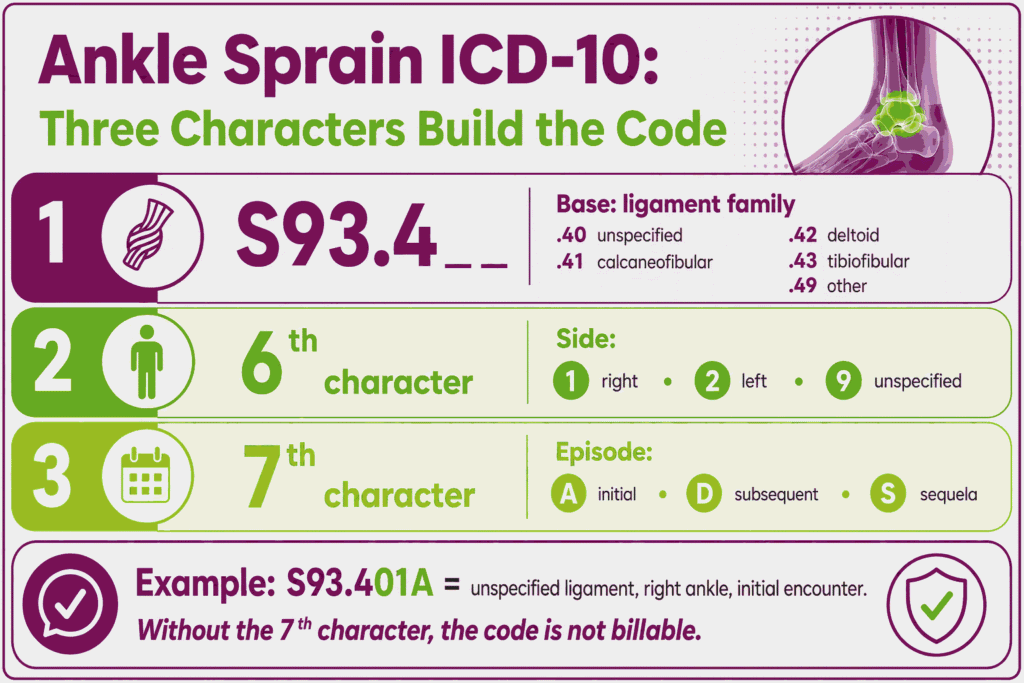
The ICD-10 code for an ankle sprain is S93.40-, sprain of unspecified ligament of ankle, completed with a side and an episode character. A right ankle sprain at the first visit codes to S93.401A. The ankle sprain ICD-10 codes sit in Chapter 19 of ICD-10-CM, the injury chapter.
The family organizes by ligament and side. Every code in the table takes a 7th character: A, D, or S.
| Ligament | Right | Left | Unspecified |
|---|---|---|---|
| Unspecified ligament (S93.40-) | S93.401- | S93.402- | S93.409- |
| Calcaneofibular ligament (S93.41-) | S93.411- | S93.412- | S93.419- |
| Deltoid ligament (S93.42-) | S93.421- | S93.422- | S93.429- |
| Tibiofibular ligament (S93.43-) | S93.431- | S93.432- | S93.439- |
| Other ligament (S93.49-) | S93.491- | S93.492- | S93.499- |
The 6th character carries the side: 1 for right, 2 for left, 9 for unspecified. A code without its 7th character is not billable, which makes this family different from every pain code in podiatry.
What Is the ICD-10 Code for a Right Ankle Sprain? (S93.401-)
The ICD-10 code for a right ankle sprain is S93.401, completed with the episode character. The right ankle sprain ICD-10 code reads S93.401A at the initial encounter and S93.401D at follow-up. The ligament-specific codes replace S93.401- when the note names the injured ligament.
What Is the ICD-10 Code for a Left Ankle Sprain? (S93.402-)
The ICD-10 code for a left ankle sprain is S93.402 plus the episode character. The left ankle sprain ICD-10 code mirrors the right: S93.402A for active treatment and S93.402D for routine follow-up. The side character must match the documented ankle on every visit.
What Is the ICD-10 Code for a Bilateral Ankle Sprain?
A bilateral ankle sprain reports S93.401- and S93.402- together, each with its own 7th character. ICD-10-CM provides no bilateral ankle sprain code. The unspecified-side codes ending in 9 mean undocumented, not bilateral, and never substitute for the two side codes.
Which Ligament-Specific Ankle Sprain Codes Exist?
Four named ligament families sit beside the unspecified codes. S93.41- covers the calcaneofibular ligament. S93.42- covers the deltoid ligament on the medial side. S93.43- covers the tibiofibular ligament. S93.49- covers every other ankle ligament. The note’s ligament detail decides which family applies.
What Is the ICD-10 Code for an ATFL Sprain?
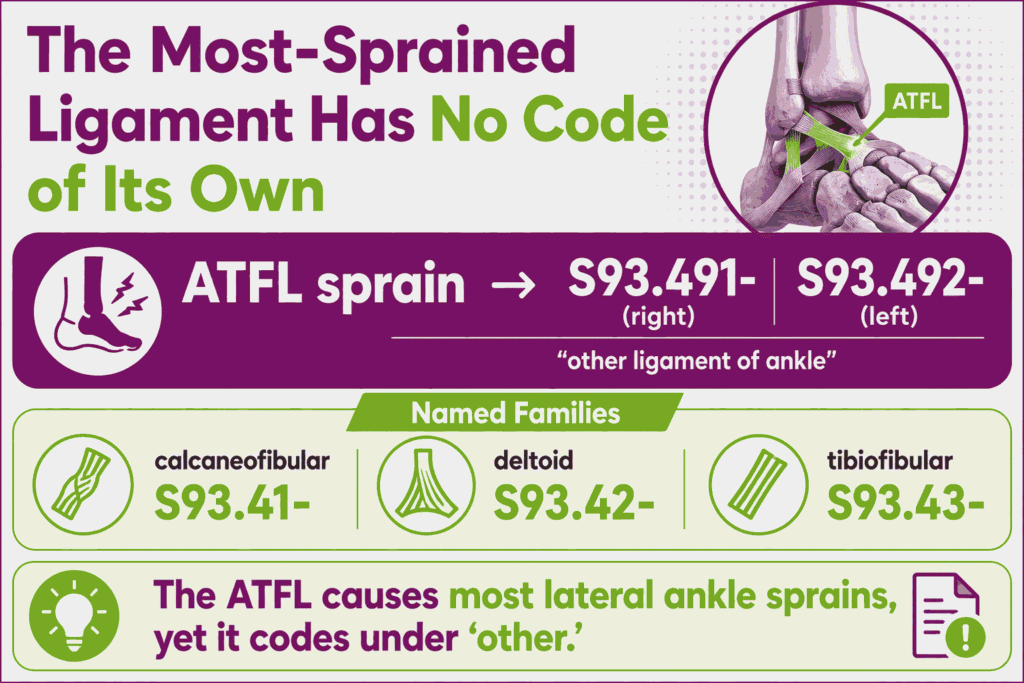
An ATFL sprain codes to S93.49-, sprain of other ligament of ankle: S93.491- right, S93.492- left. The anterior talofibular ligament is the most commonly sprained ankle ligament, yet ICD-10-CM gives it no named code. The tabular lists the talofibular ligament as an inclusion under S93.49-, while the less-injured calcaneofibular ligament holds its own family.
What Is the ICD-10 Code for a High Ankle Sprain?
A high ankle sprain codes to S93.43-, sprain of tibiofibular ligament: S93.431- right, S93.432- left. The tibiofibular ligaments form the syndesmosis above the ankle joint. High ankle sprains heal more slowly than lateral sprains, so the D-character follow-up window runs longer on these claims.
How Does the 7th Character Work on Ankle Sprain Codes?
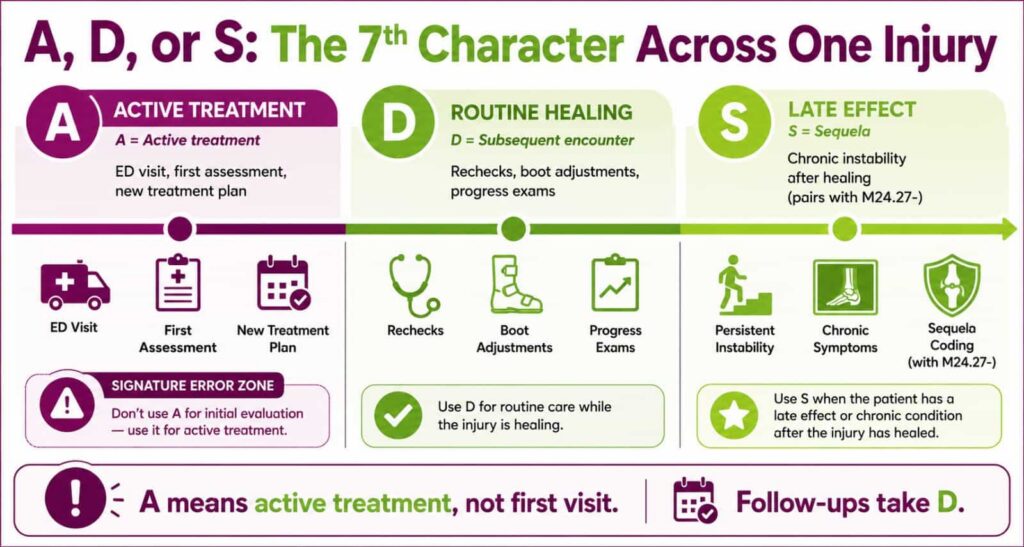
Every S93.4- code requires a 7th character, and the claim is not billable without one. The character reports the episode of care: A for the initial encounter, D for a subsequent encounter, and S for sequela. The episode logic, not the visit count, selects the character.
When Do You Use 7th Character A (Initial Encounter)?
Character A reports active treatment, not the first visit. An emergency department evaluation, the first office assessment, and a new treatment plan all take A. A second opinion that starts new active treatment also takes A, even though it is not the first encounter.
When Do You Use 7th Character D (Subsequent Encounter)?
Character D reports routine care during healing. Recheck visits, boot or brace adjustments, and progress examinations all take D. Billing A on every follow-up visit is the signature error in this family, and payers track episode logic across the claim history.
When Do You Use 7th Character S (Sequela)?
Character S reports a late effect after healing ends. Chronic pain or instability from an old sprain pairs the condition code first with the injury code carrying S. Chronic ankle instability, M24.27-, is the most common sequela diagnosis after repeated lateral sprains.
Why Don’t Aftercare Z Codes Apply to Ankle Sprains?
Aftercare Z codes never apply to injuries. ICD-10-CM convention keeps the S93.4- code on every healing-phase visit and moves the 7th character to D instead. Coders trained on surgical aftercare reach for Z47 or Z48 codes here, and the claim fails the convention.
Which Codes Are Commonly Confused With Ankle Sprain Codes?
Three neighboring code families absorb most ankle sprain miscodes: foot sprains, ankle strains, and ligament ruptures. The full ICD-10 codes set separates each one by anatomy and injury type.
Ankle Sprain (S93.4-) vs Foot Sprain (S93.6-): Which Applies?
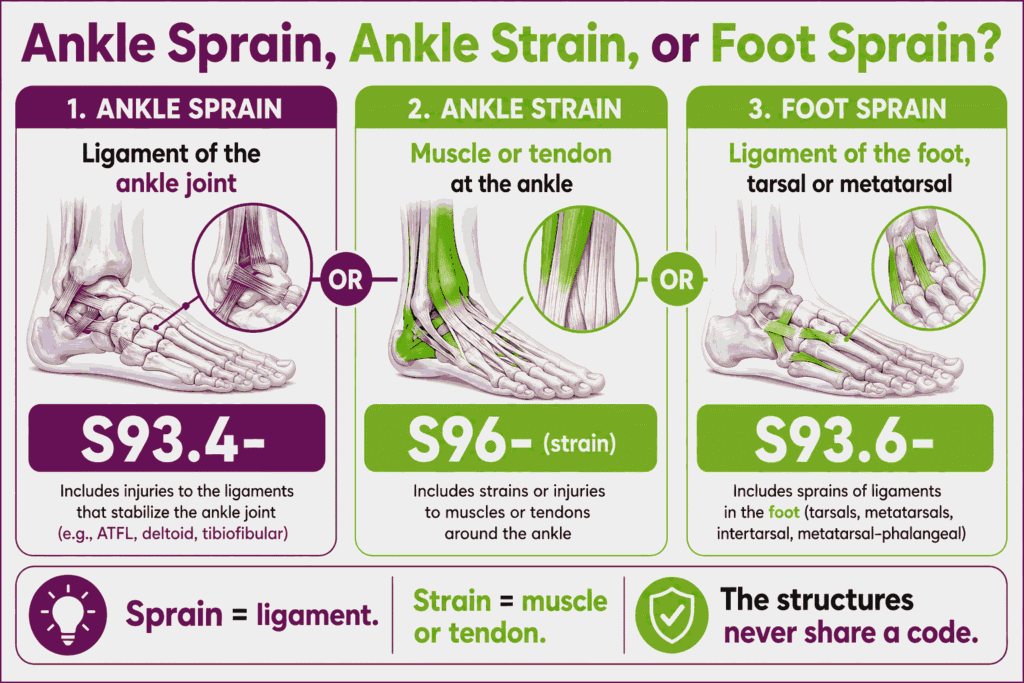
S93.4- covers the ligaments of the ankle joint, and S93.6- covers the ligaments of the foot, including the tarsal and metatarsal joints. The injury site in the note decides the family. An inversion injury can produce both, and each documented sprain codes separately.
Sprain vs Strain: Why Ankle Strains Use S96- Instead?
A sprain is a ligament injury, and a strain is a muscle or tendon injury. Ankle ligament injuries code to S93.4-, while muscle and tendon injuries at the ankle level code to S96-. The tabular carries an Excludes1 note separating the two, so the terms never interchange on a claim.
When Does a Sprain Become a Rupture or Chronic Instability?
A complete ligament tear and chronic instability leave the S93.4- family. A documented rupture codes to the traumatic rupture codes, and instability that persists after healing codes to M24.27- with the sequela character on the old injury. Surgical repair claims build on those diagnoses, not on the acute sprain.
Do Ankle Sprain Claims Need External Cause Codes?
External cause codes are optional context on ankle sprain claims. W codes report falls, and activity codes report sports. No national rule requires them on professional claims, though some payers and state programs request them. The S93.4- code always sequences first.
What Documentation Supports an Ankle Sprain Claim?
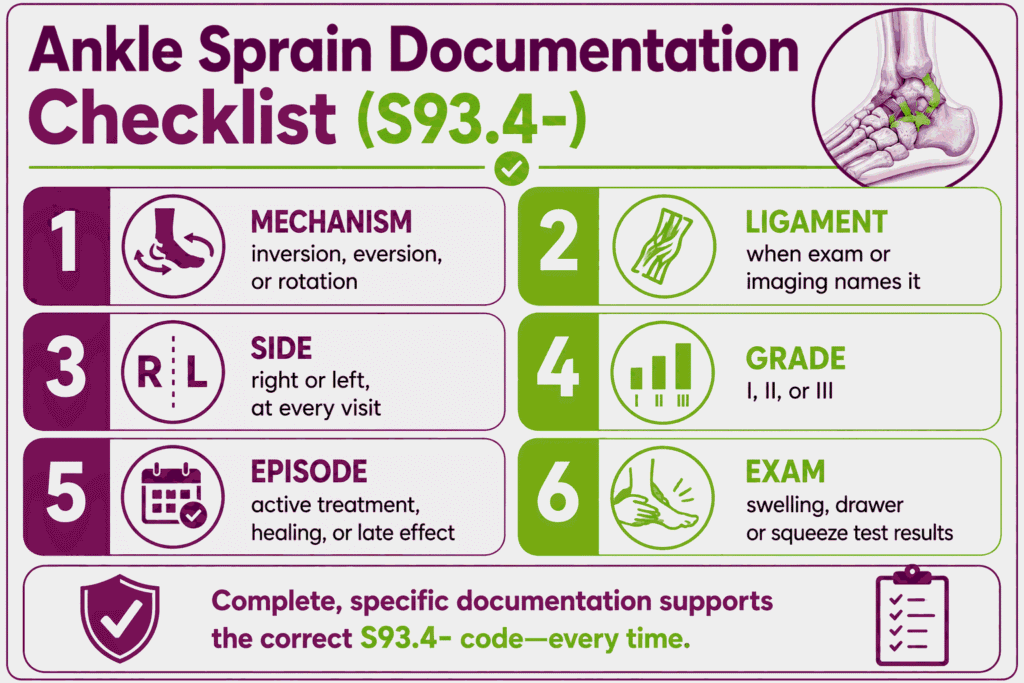
Documentation supports an ankle sprain claim when the note records the mechanism, the ligament, the side, the grade, and the episode status. The side and episode entries drive two of the three coding dimensions, so both appear at every visit.
What Must the Note Contain for an S93.4- Encounter?
The provider note contains six elements for a clean S93.4- claim.
- Mechanism: inversion, eversion, or rotation injury
- Ligament: named when the exam or imaging identifies it
- Side: right or left, at every visit
- Grade: I, II, or III severity
- Episode: active treatment, routine healing, or late effect
- Exam findings: swelling, ecchymosis, anterior drawer, or squeeze test results
How Does Documentation Drive the 7th Character?
The encounter purpose in the note selects the 7th character. A note that opens a treatment plan supports A. A note that tracks healing supports D. A note that ties a current condition to an old sprain supports S. The character follows the documentation, never the visit number.
Which CPT Codes and Modifiers Pair With Ankle Sprain ICD-10 Codes?
Ankle sprain ICD-10 codes pair with evaluation, imaging, strapping, and bracing CPT codes. The acute phase carries almost all claim volume, since most sprains heal without procedures.
Which E/M, Imaging, and Supportive-Care CPT Codes Are Billed With S93.4-?
The table below lists the CPT and HCPCS codes most billed with the ankle sprain codes.
| CPT/HCPCS | Description | Common Pairing |
|---|---|---|
| 99202-99215 | New and established patient E/M visits | All S93.4- codes |
| 73600 / 73610 | X-ray, ankle (2 views / complete) | All S93.4- codes |
| 76881 / 76882 | Ultrasound, extremity (complete / limited) | Ligament-specific codes |
| 29540 | Strapping, ankle and foot | All S93.4- codes |
| 29515 | Application, short leg splint | Grade II-III sprains |
| L1902 / L1906 | Ankle orthosis, off-the-shelf / custom | All S93.4- codes |
| L4360 / L4361 | Walking boot, pneumatic / off-the-shelf | Grade II-III sprains |
Ankle x-rays bill against the Ottawa Ankle Rules: documented malleolar tenderness or an inability to bear weight supports the imaging claim.

Which Modifiers Apply to Ankle Sprain Claims?
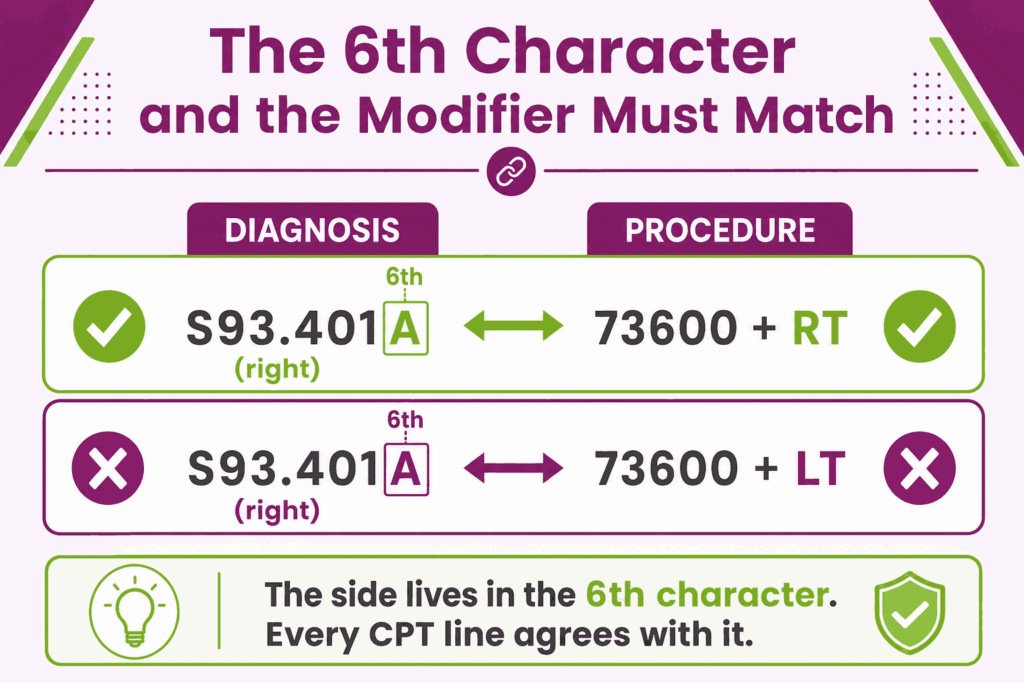
Modifiers RT, LT, and 25 carry most ankle sprain claims. RT and LT mark the side on imaging, strapping, and DME lines. Modifier 25 reports a separate E/M service on the same day as strapping or splint application.
The S93.4- codes carry their side in the 6th character, so the diagnosis side and the modifier side must agree on every line. An S93.401A diagnosis with an LT x-ray line fails the same automated edit that catches foot pain mismatches.
When Is Surgical Repair Billed for Ankle Ligament Injuries?
Surgical repair bills against chronic instability or rupture diagnoses, not the acute sprain code. Lateral ligament reconstruction follows documented conservative-care failure and recurrent instability. The claim builds on M24.27- and the sequela-coded injury, which keeps acute S93.4- claims out of surgical edits.
What Are the Most Common Ankle Sprain Coding Denials, and How Do You Prevent Them?
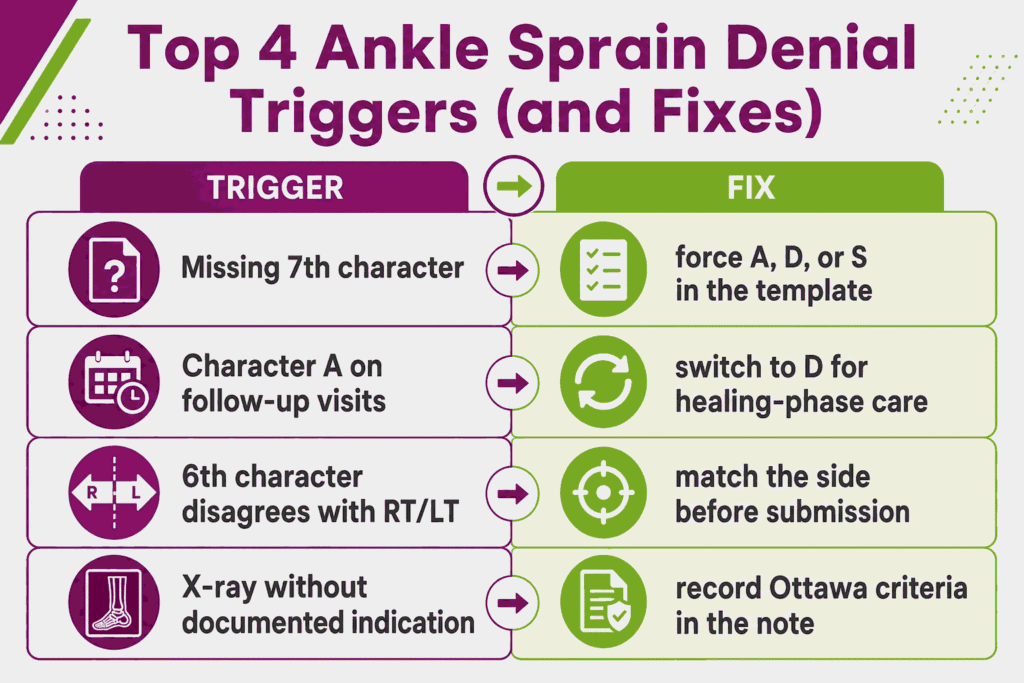
The most common ankle sprain denials come from missing 7th characters, episode misuse, laterality mismatches, and undocumented imaging.
Why Do Missing or Invalid 7th Characters Reject Claims?
A missing 7th character rejects the claim before the payer sees it. S93.401 without A, D, or S is not a valid billable code, and clearinghouse edits stop it at submission. Encounter templates that force the episode field remove the entire denial category.
Why Does Billing 7th Character A on Follow-Up Visits Trigger Edits?
Billing A on follow-up visits signals active treatment that the claim history contradicts. Payers compare the episode character against prior claims for the same injury. A recheck visit on character A reads as a duplicate initial encounter and triggers review.
How Do Laterality Mismatches Between the 6th Character and RT/LT Cause Rejections?
A 6th character that disagrees with the RT or LT modifier stops the claim in automated edits. The same scrubber rule that protects foot and toe pain ICD-10 codes applies here: compare the diagnosis side against the modifier side on every line before submission.
How Do Payer Rules Treat Ankle Sprain Imaging and DME?
Each payer ties ankle sprain imaging and DME to documentation. The table below summarizes common positions.
| Payer | Common Rule |
|---|---|
| Medicare | X-rays payable with documented Ottawa criteria; walking boots require a signed order and medical-necessity note |
| BCBS plans | Imaging payable on acute injury; repeat imaging within the healing window flagged for review |
| UnitedHealthcare | Custom orthoses require prior authorization; off-the-shelf bracing payable with documentation |
| Aetna | DME payable for grade II-III sprains; physical therapy subject to visit limits |
High-volume practices route these DME and episode edits through specialized podiatry billing companies to keep injury claims clean across the full healing cycle.
What Changed in the FY2026 ICD-10-CM Update for Ankle Sprain Codes?
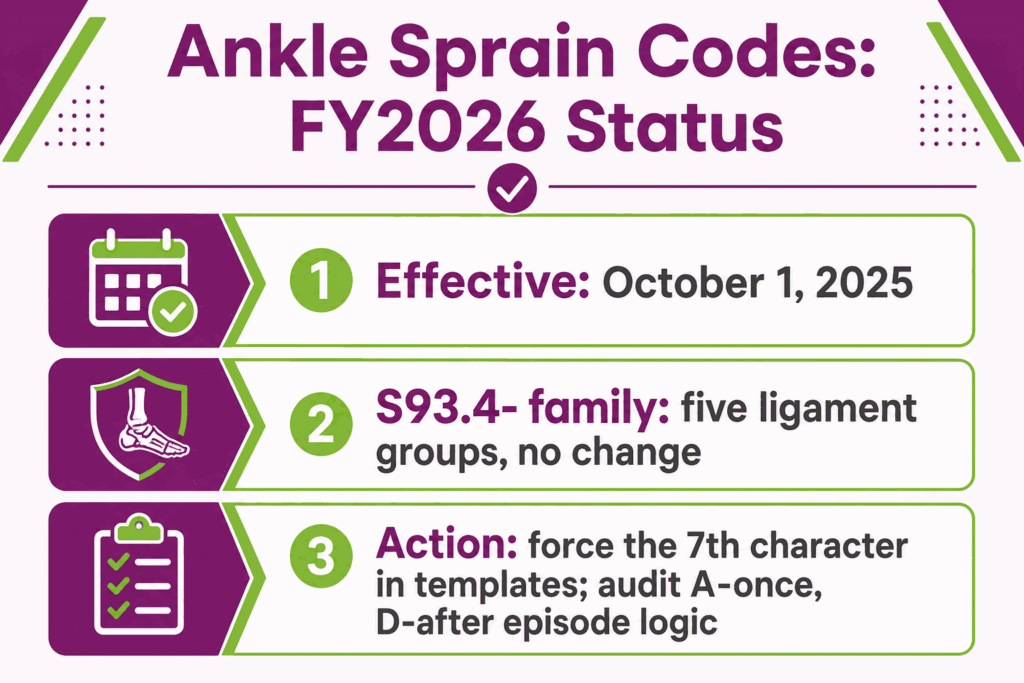
The FY2026 ICD-10-CM update took effect on October 1, 2025, and preserved the S93.4- family. CMS and the National Center for Health Statistics publish the annual set.
Were the S93.4- Codes Revised for FY2026?
The S93.4- codes carried no change in FY2026. The five ligament families, the side characters, and the episode characters all remain stable. Practices confirm descriptors against the CMS-published set before billing.
What 2026 Workflows Do Practices Confirm?
Practices confirm three workflows for 2026. Encounter templates force the 7th character on every injury code. Claim scrubbers compare the 6th character against the RT or LT modifier. Episode audits check that character A appears once per injury, and D carries the follow-up visits.
Frequently Asked Questions About Ankle Sprain ICD-10 Coding
What Is the ICD-10 Code for an Ankle Sprain?
The ICD-10 code for an ankle sprain is S93.40- plus a side and episode character. An unspecified ligament right ankle sprain at the first visit codes to S93.401A.
What Is the ICD-10 Code for a Right Ankle Sprain?
The ICD-10 code for a right ankle sprain is S93.401-, completed with A, D, or S. The ligament-specific codes replace it when the note names the ligament.
What Is the ICD-10 Code for a Left Ankle Sprain?
The ICD-10 code for a left ankle sprain is S93.402-, completed with the episode character. S93.402A reports the initial encounter.
What Is the ICD-10 Code for a Bilateral Ankle Sprain?
A bilateral ankle sprain reports S93.401- and S93.402- together. No single bilateral code exists in the S93.4- family.
What Do the 7th Characters A, D, and S Mean on Ankle Sprain Codes?
A reports active treatment, D reports routine care during healing, and S reports a late effect. Every S93.4- code requires one of the three.
What Is the ICD-10 Code for an ATFL Sprain?
An ATFL sprain codes to S93.491- (right) or S93.492- (left), sprain of other ligament of ankle. The ATFL has no named code of its own.
Is S93.401 a Billable Code Without a 7th Character?
No. S93.401 requires A, D, or S to become billable. Claims submitted without the 7th character reject at the clearinghouse.
What Is the Difference Between an Ankle Sprain and an Ankle Strain Code?
A sprain is a ligament injury coded to S93.4-. A strain is a muscle or tendon injury coded to S96-. The two families never interchange. To understand these codes better, a detailed ICD-10 guide for Podiatry specialists is highly recommended.