The hydrocephalus ICD-10 codes sit under category G91 and describe abnormal cerebrospinal fluid buildup. CMS posted the FY2027 ICD-10-CM files, effective October 1, 2026, and G91 stayed unchanged. Type decides the code, so documenting communicating, obstructive, or normal-pressure hydrocephalus matters for claims.
Reporting G91.9 when the type is documented invites denials and weakens medical necessity support. Shunt patients add complexity, because status, malfunction, and infection each use different ICD-10-CM codes. Z98.2 reports shunt status, while T85 codes capture mechanical complications and infections after surgery.

This guide links each diagnosis to CPT codes such as 62223 for shunt creation. It follows CDC’s National Center for Health Statistics classification and the official ICD-10-CM guidelines. For related diagnosis coding topics, explore our neurosurgery ICD-10 codes guide to learn more about coding neurological conditions accurately.
What Is the ICD-10 Code for Hydrocephalus?
Hydrocephalus is classified in ICD-10-CM under category G91, which covers acquired cerebrospinal fluid disorders. G91 itself is a parent category, so coders must select a more specific subcode.
The category includes acquired hydrocephalus, so congenital forms belong elsewhere in the ICD-10-CM classification. Excludes1 notes send congenital hydrocephalus to Q03, and spina bifida with hydrocephalus to Q05.
| ICD-10-CM Code | Description | Billable? | Use When |
|---|---|---|---|
| G91.0 | Communicating hydrocephalus | Yes | CSF absorption fails without ventricular blockage |
| G91.1 | Obstructive hydrocephalus | Yes | Blockage in the ventricular system |
| G91.2 | (Idiopathic) Normal pressure hydrocephalus | Yes | Documented clinical triad and imaging |
| G91.3 | Post-traumatic hydrocephalus, unspecified | Yes | Develops after traumatic brain injury |
| G91.4 | Hydrocephalus in diseases classified elsewhere | Yes | Underlying disease coded first |
| G91.8 | Other hydrocephalus | Yes | Specified type without its own code |
| G91.9 | Hydrocephalus, unspecified | Yes | Type not documented |
G91.9 is billable, but payers expect the most specific hydrocephalus ICD-10 code documentation supports. G91.3 and G91.4 deserve attention because some short code lists omit both codes entirely.
Which G91 Code Fits Each Type?
The G91 code depends on the documented hydrocephalus type, not on the procedure performed. Neurosurgeons and coders should confirm the type in the chart notes before claim submission.
The sections below explain when each type applies and which documentation supports that selection.
When Do You Use G91.0 for Communicating Hydrocephalus?
Use G91.0 when cerebrospinal fluid circulates freely, but the body fails to absorb it. Communicating hydrocephalus means no blockage exists inside the ventricular system itself, unlike obstructive hydrocephalus.
Documentation should state communicating hydrocephalus clearly, supported by imaging and the provider’s clinical assessment. This code commonly supports shunt placement, so the diagnosis must match the procedure billed.
When Do You Use G91.1 for Obstructive Hydrocephalus?
Use G91.1 when a blockage obstructs cerebrospinal fluid flow within the narrow ventricular pathways. Providers may also call this non-communicating hydrocephalus, and both terms point directly to G91.1.
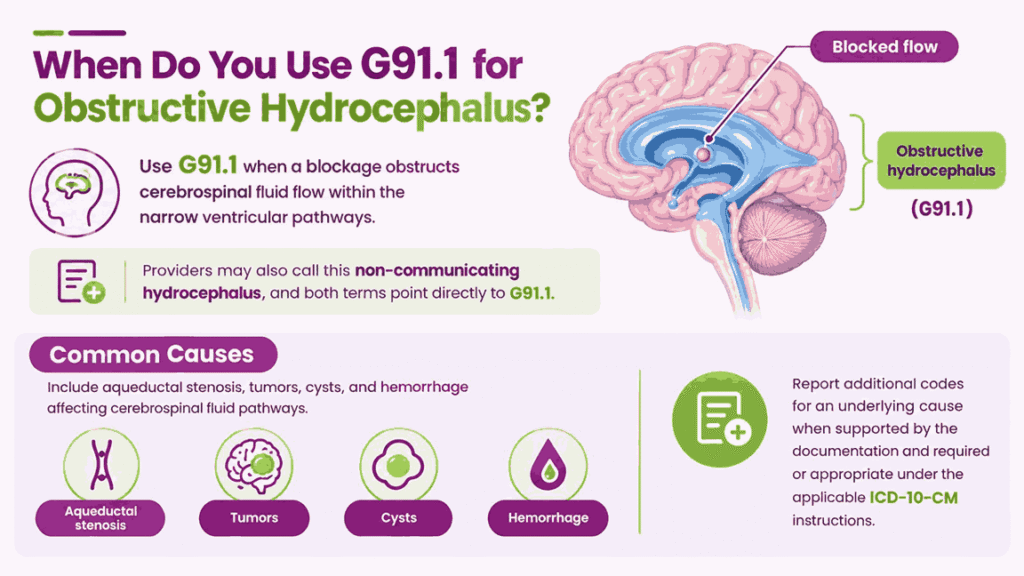
Common causes of obstructive hydrocephalus include aqueductal stenosis, tumors, cysts, and hemorrhage affecting cerebrospinal fluid pathways. Report additional codes for an underlying cause when supported by the documentation and required or appropriate under the applicable ICD-10-CM instructions.
When Do You Use G91.3 for Post-Traumatic Hydrocephalus?
Use G91.3 when hydrocephalus develops after traumatic brain injury, and the type remains unspecified. Providers should clearly document the traumatic event, its timing, and the resulting ventricular enlargement.
Review the applicable injury-code and sequencing instructions when hydrocephalus follows a traumatic brain injury. Do not automatically add an S06 code solely because an earlier injury appears in the medical history. The appropriate codes and sequencing depend on the documented circumstances and applicable ICD-10-CM guidelines.
When Is G91.8 the Right Choice?
Use G91.8 when documentation names a specific hydrocephalus type that lacks its own code. It differs from G91.9, which applies only when the provider never identifies the type.
Choosing G91.8 requires a clear provider statement, not a coder’s assumption about the condition. Query the provider whenever the documented description fits none of the named G91 subcodes.
What Are the Differences Between G91.0 and G91.1?
Choosing between G91.0 and G91.1 depends on where cerebrospinal fluid flow is actually blocked. Communicating hydrocephalus involves impaired absorption, while obstructive hydrocephalus involves a physical ventricular system blockage.
The table below pairs each flow pattern with the imaging finding that supports it.
| Feature | G91.0 Communicating | G91.1 Obstructive |
|---|---|---|
| Where Flow is Blocked | No blockage; absorption fails | Blockage in ventricles, aqueduct, or outlet foramina |
| Imaging Finding (CT or MRI) | All ventricles enlarged, including the fourth | Ventricles enlarged upstream of the blockage |
| Common Causes | Prior hemorrhage or meningitis | Aqueductal stenosis, tumor, cyst |
| Also Called | Non-obstructive | Non-communicating |
| ICD-10-CM Code | G91.0 | G91.1 |
Imaging supports the type, but the treating provider’s diagnostic statement drives final code selection. Coders cannot assign either code from imaging alone without a clearly documented provider diagnosis. Mismatched imaging and diagnosis wording can trigger payer review on CPT 62223 shunt claims.
When Is G91.9 Acceptable?
Use G91.9 when the provider documents hydrocephalus but the available documentation does not support a more specific G91 code. If the provider identifies the type or a disease-related cause, review the applicable code and sequencing instructions before reporting an unspecified code.
Once the type is documented, update the claim to G91.0, G91.1, or another subcode. Repeated G91.9 billing on shunt claims signals weak documentation and invites closer payer scrutiny.
How Is Normal-Pressure Hydrocephalus Coded?
Normal-pressure hydrocephalus is coded G91.2 when supported by the provider’s diagnosis and applicable ICD-10-CM guidance. Its classic clinical features include gait disturbance, urinary or bladder dysfunction, and cognitive impairment, although the presentation can vary.
Document the relevant clinical assessment and CT or MRI findings supporting normal-pressure hydrocephalus. When lumbar puncture or a CSF tap test is performed, record the findings and the provider’s interpretation.
Idiopathic normal-pressure hydrocephalus has no identifiable cause, while the secondary form follows another condition. Coders should check the Alphabetic Index entry for secondary forms before assigning G91.2 automatically.
Symptoms integral to normal-pressure hydrocephalus, like gait disturbance, generally should not receive separate codes. ICD-10-CM guidelines say routine signs and symptoms of a diagnosed condition stay off claims. Report dementia or another distinct diagnosis only when the provider documents it as separate.
| Finding | Separate Code? | Note |
|---|---|---|
| Gait Disturbance (R26.-) | Generally no | Routine triad symptom |
| Urinary Incontinence (R32) | Generally no | Routine triad symptom |
| Dementia or Cognitive Disorder | Only if documented separately | Needs its own provider diagnosis |
| CSF Shunt Status (Z98.2) | Yes, after surgery | Reported as a status code |
How Is Hydrocephalus From Another Disease Coded?
Use G91.4 when hydrocephalus results from a disease classified in another part of ICD-10-CM. A code-first note applies, so the underlying condition must be sequenced before G91.4.
The tabular list’s examples include congenital syphilis A50.4-, neoplasms C00-D49, and plasminogen deficiency E88.02. Never report G91.4 as the first-listed diagnosis, because it behaves as a manifestation code.
Hydrocephalus due to congenital toxoplasmosis falls under Excludes1 and belongs to P37.1, not G91.4.
| Scenario | First-Listed | Second-Listed |
|---|---|---|
| Tumor Documented as Causing Hydrocephalus | Neoplasm code (C00-D49) | G91.4 |
| Hydrocephalus in Congenital Syphilis | A50.4- | G91.4 |
Example one: a brain tumor causing hydrocephalus requires the neoplasm code first, then G91.4. Example two: congenital syphilis coded A50.4- comes first, followed by G91.4 for the hydrocephalus. Always confirm the provider links the hydrocephalus to the underlying disease explicitly in documentation.
What Is Not Acquired Hydrocephalus?
Category G91 covers acquired hydrocephalus only, so several related conditions are excluded from it. Excludes1 notes mean these conditions generally cannot be reported together with a G91 code.
| Condition | ICD-10-CM Code | Why It Is Not G91 |
|---|---|---|
| Congenital Hydrocephalus | Q03.- | Present at birth |
| Spina Bifida with Hydrocephalus | Q05.- | Combination code includes the hydrocephalus |
| Arnold-Chiari Syndrome with Hydrocephalus | Q07.- | Combination code includes the hydrocephalus |
| Hydrocephalus due to Congenital Toxoplasmosis | P37.1 | Excluded at G91.4 |
Combination codes in Q05 and Q07 describe the hydrocephalus, so G91 is not added. Congenital hydrocephalus is present at birth, so documentation of onset matters for code selection. Pediatric neurosurgery practices should review birth history before assigning any G91 code to infants.
For broader diagnosis coding support, refer to our ICD-10 codes guide to understand code selection and documentation requirements across conditions. WHO’s international ICD-10 and the United States ICD-10-CM do not always use the same code structure.
When coding US claims, follow the current ICD-10-CM Alphabetic Index and Tabular List rather than importing G94 codes from an international ICD-10 reference. Use G91.4 only when its instructions apply, and observe its exclusions, including congenital toxoplasmosis (P37.1).
ICD-10-CM does not use those subcodes, and instead reports G91.4 for this specific scenario. Online references built on international data sometimes display G94 codes for United States claims. Coders should always verify each code against the current official CMS ICD-10-CM tabular list.
How Are Shunts Coded?
Shunt coding changes at every stage, from placement through follow-up, malfunction, infection, and revision. Choose the code that matches the encounter’s reason, not simply the presence of hardware.
The lifecycle table at the end of this section summarizes every common claim scenario.
What Is the Code for Shunt Status?
Z98.2 reports the presence of a cerebrospinal fluid drainage device, including a ventriculoperitoneal shunt. It is a status code, so it supports patient history rather than active treatment.
Report Z98.2 on follow-up visits when the shunt functions normally and no complication exists. A malfunction visit needs a complication code, because Z98.2 does not describe the problem.
Which Code Covers Shunt Adjustment?
Z45.41 covers an encounter for adjustment and management of a cerebrospinal fluid drainage device. Programmable valve setting changes during a neurosurgery clinic visit are a typical example here.
Use Z45.41 only when no malfunction is documented, and the device works as intended. Pair it with the evaluation and management service that reflects the visit actually performed.
How Is Shunt Malfunction Coded?
Mechanical shunt problems fall under T85.0-, which covers complications of ventricular intracranial communicating shunts. Subcodes distinguish breakdown, displacement, leakage, and other mechanical complications such as obstruction or occlusion.
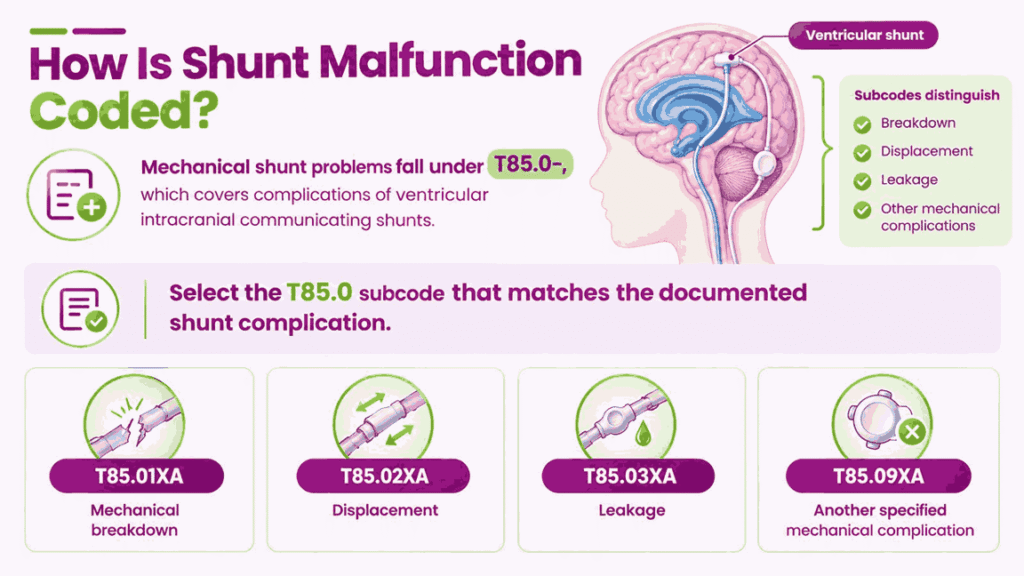
Select the T85.0 subcode that matches the documented shunt complication. For example, T85.01XA identifies mechanical breakdown, T85.02XA identifies displacement, T85.03XA identifies leakage, and T85.09XA identifies another specified mechanical complication of a ventricular intracranial (communicating) shunt during the initial encounter.
How Is Shunt Infection Coded?
T85.730A reports infection and inflammatory reaction due to a ventricular intracranial communicating shunt device. Add a code identifying the infection, such as meningitis or the specific causative organism.
Shunt infection often requires removal and replacement, reported with CPT 62258 or staged procedures. Documentation should state whether the infection involves the device, the cerebrospinal fluid, or both.
What About Overdrainage?
G97.2 reports intracranial hypotension following ventricular shunting, a consequence of excessive cerebrospinal fluid drainage. Providers must document the link between low pressure symptoms and the implanted shunt device.
Orthostatic headache and subdural fluid collections often prompt programmable valve adjustments or valve replacement. Coders should not assume overdrainage; the provider must state it as the final diagnosis.
| Situation | First-Listed Code | Add-On Code |
|---|---|---|
| Shunt Creation, Type Documented | G91.- (documented type) | None at placement |
| Routine Follow-up, Shunt Working | G91.- if hydrocephalus is active | Z98.2 |
| Valve Adjustment Visit | Z45.41 | G91.- if documented |
| Mechanical Malfunction | T85.0-XA (by subtype) | G91.- (documented type) |
| Shunt Infection | T85.730A | Infection or organism code |
| Overdrainage | G97.2 | G91.- if documented |
Which CPT Codes Link to Hydrocephalus?
Hydrocephalus treatment uses CPT codes for shunt creation, revision, removal, and endoscopic third ventriculostomy. Each procedure pairs with a diagnosis that proves why the neurosurgeon performed the service.
| CPT Code | Descriptor (Short) | Common Diagnosis Pairing |
|---|---|---|
| 62220 | Creation of shunt; ventriculo-atrial, -jugular, -auricular | G91.- (documented type) |
| 62223 | Creation of shunt; ventriculo-peritoneal, -pleural, other terminus | G91.- (documented type) |
| 62225 | Replacement or irrigation, ventricular catheter | T85.0-XA or G91.- |
| 62230 | Replacement or revision of shunt, valve, or distal catheter | T85.0-XA or T85.730A |
| 62256 | Removal of complete shunt system, no replacement | T85.730A or T85.0-XA |
| 62258 | Removal of complete shunt system, with replacement | T85.730A or T85.0-XA |
| 62201 | Ventriculocisternostomy, third ventricle (ETV), neuroendoscopic | G91.1 (obstructive) |
For additional procedural coding guidance, read our neurosurgery CPT codes guide for neurosurgical procedures and accurate CPT code selection. Creation codes 62220 and 62223 should pair with the documented G91 type, not G91.9.
Revision, replacement, and removal codes pair with T85 codes when malfunction or infection exists. Endoscopic third ventriculostomy, CPT 62201, commonly treats obstructive hydrocephalus, so G91.1 usually supports it. Inpatient claims also report ICD-10-PCS, which classifies shunt placement as a bypass root operation.
How Do You Code Hydrocephalus?
Coding hydrocephalus follows a repeatable six-step process that protects specificity and payer medical necessity.
How Do You Confirm the Type and Cause?
Start with the provider’s documented diagnosis, then compare it against imaging and clinical findings. Look for words like communicating, obstructive, normal-pressure, post-traumatic, or secondary in the neurosurgery notes.
Identify the cause too, such as tumor, hemorrhage, infection, trauma, or aqueductal stenosis findings. Query the provider when the type or cause remains unclear before assigning any code.
How Do You Rule Out Congenital Causes?
Review birth history, patient age, and onset timing before choosing a code from G91. Congenital hydrocephalus belongs to Q03, while spina bifida and Chiari use Q05 and Q07.
Hydrocephalus from congenital toxoplasmosis uses P37.1, so G91.4 does not apply to those infants. A confirmed congenital cause ends the G91 pathway, while acquired disease moves to assignment.
How Do You Assign the G91 Code?
Match the documented type to its specific subcode: G91.0, G91.1, G91.2, G91.3, or G91.8. Choose G91.9 only when the provider cannot identify the type after a complete evaluation. Specific codes strengthen medical necessity and reduce payer questions during review and prior authorization.
How Do You Add the Underlying Condition?
When another disease causes the hydrocephalus, G91.4 requires that disease to be sequenced first. Neoplasms from C00 through D49 and congenital syphilis A50.4- appear as listed tabular examples.
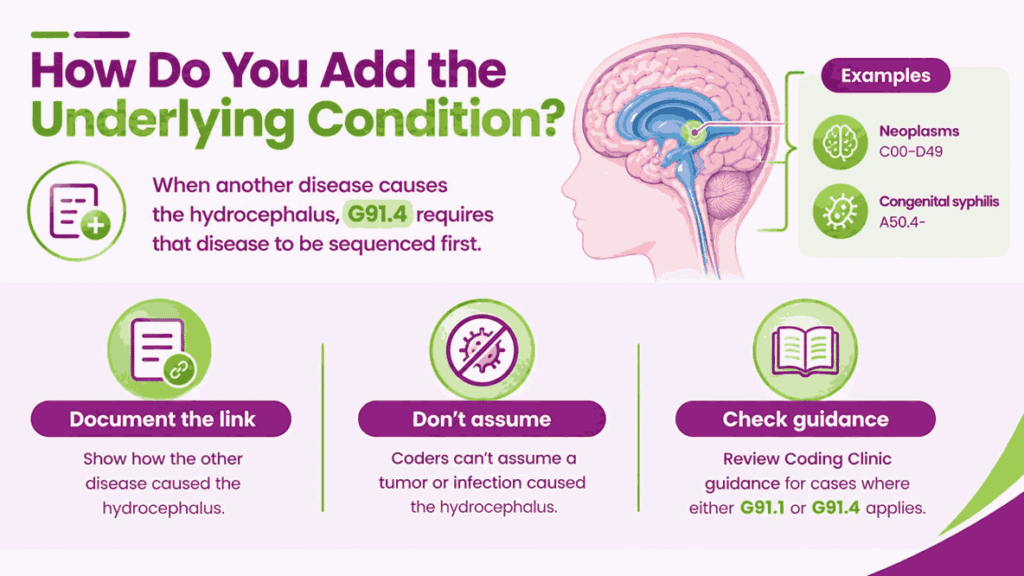
Document the causal link, because coders cannot assume a tumor or infection caused hydrocephalus. Check Coding Clinic guidance when an obstructing tumor could support either G91.1 or G91.4.
How Do You Report the Shunt?
Use Z98.2 for stable shunt status and Z45.41 for routine adjustment and management encounters. Use T85.0- for mechanical complications and T85.730A for infection, adding organism codes when documented.
Report G97.2 only when the provider documents intracranial hypotension caused by ventricular shunt overdrainage.
How Do You Link the CPT Code?
Pair the CPT procedure with the diagnosis that justifies the surgery on the claim. Use G91 types for 62220 and 62223, and T85 codes for 62225 through 62258. Review modifiers and prior authorization requirements before submitting any shunt, revision, or ETV claim.
Why Do Hydrocephalus Claims Get Denied?
Hydrocephalus denials often trace back to avoidable diagnosis coding and documentation gaps in neurosurgery. The table below lists five common causes and the practical fix for each one.
| Denial Cause | What Goes Wrong | Fix |
|---|---|---|
| G91.9 on Shunt Claims | Unspecified type weakens medical necessity | Document and report G91.0, G91.1, or another subcode |
| Missing Seventh Character on T85 Codes | Incomplete code is invalid | Add A, D, or S, plus the X placeholder |
| Z98.2 with a Complication Code | Status code replaces the actual problem | Report the T85 code for the malfunction or infection |
| Wrong Sequencing on G91.4 | Manifestation code listed first | Sequence the underlying condition first |
| No Documented Type for Prior Authorization | Payer cannot confirm necessity | Record type, cause, and imaging before scheduling |
Unspecified G91.9 on shunt claims suggests the provider never determined the actual hydrocephalus type. T85 codes need a seventh character, and missing it makes the whole code invalid.
Z98.2 alone cannot justify a shunt revision when a malfunction or infection code applies. G91.4 listed first violates the code-first instruction and can trigger claim rejection edits.
However, specialized neurosurgery billing services can help practices address coding discrepancies, strengthen claim documentation, and manage denials more effectively. Prior authorization for CPT 62223 often requires documented hydrocephalus type, symptoms, and supporting imaging.
What Should Providers Document?
Complete documentation lets coders select specific hydrocephalus ICD-10 codes and supports payer medical necessity. Providers should record these elements in every visit note tied to a hydrocephalus claim.
| Element | What to Record | Why It Matters |
|---|---|---|
| Type | Communicating, obstructive, normal-pressure, post-traumatic, or other | Selects the G91 subcode |
| Cause | Tumor, hemorrhage, infection, trauma, aqueductal stenosis, or congenital origin | Supports G91.4, Q codes, and sequencing |
| Imaging Findings | Dilated ventricles and blockage location on CT or MRI | Separates G91.0 from G91.1 |
| Shunt Type and Valve | VP shunt, other terminus, programmable valve setting | Supports CPT 62220 or 62223 and Z98.2 |
| Nature of Complication | Breakdown, displacement, leakage, obstruction, infection, overdrainage | Selects the T85 or G97.2 code |
| Encounter Status | Initial active treatment, subsequent care, or sequela | Sets the T85 seventh character |
Type and cause should appear as explicit statements, never as inferences from imaging alone. Imaging findings should name the dilated ventricles and the location of any visible blockage.
Shunt notes should specify the terminus, such as ventriculoperitoneal, and any programmable valve setting. Complication notes must describe the exact problem, like leakage, displacement, obstruction, infection, or overdrainage.
Encounter status sets the T85 seventh character: initial active treatment, subsequent care, or sequela. Clear templates in the electronic health record help neurosurgery teams capture every element consistently.
Frequently Asked Questions
What is the ICD-10 Code for Hydrocephalus?
Acquired hydrocephalus is coded in category G91, with subcodes G91.0 through G91.9 by type. The correct subcode depends on the documented type, such as communicating G91.0 or obstructive G91.1.
What is the Code for Normal-pressure Hydrocephalus?
Normal-pressure hydrocephalus uses G91.2, and providers diagnose it through gait, bladder, and cognitive symptoms. Check the Alphabetic Index for secondary forms before assigning G91.2 to those patient cases.
What is the Code for Congenital Hydrocephalus?
Congenital hydrocephalus is reported with Q03, not G91, because G91 covers acquired disease only. Spina bifida with hydrocephalus uses Q05, and Arnold-Chiari syndrome with hydrocephalus uses Q07 codes.
What is the ICD-10 Code for a VP Shunt?
Z98.2 reports a ventriculoperitoneal shunt in place, while CPT 62223 reports its surgical creation. Complications use T85 codes instead, because Z98.2 only documents that the device remains implanted.
Is G91.9 Billable?
Yes, G91.9 is a valid billable code for unspecified hydrocephalus in ICD-10-CM claims. However, payers expect specificity, so use it only when the provider documents no type.
How do You Code Shunt Malfunction?
Report a T85.0 code matching the problem, such as T85.09XA for another mechanical complication. Add the documented G91 type and link revision procedures like CPT 62230 to the malfunction.