Summary: “Irritable bowel syndrome with diarrhea is classified under ICD-10-CM code K58.0. This code applies when a patient presents with IBS where the predominant symptom is loose or frequent stools. IBS affects approximately 10 to 15 percent of U.S. adults, with the diarrhea-predominant subtype accounting for roughly one-third of all IBS diagnoses. Accurate coding requires documented confirmation of IBS-D, exclusion of organic pathology, and clinical evidence that diarrhea is the predominant symptom.”
Irritable bowel syndrome with diarrhea is classified under ICD-10-CM code K58.0. This code applies when a patient presents with IBS, where the predominant symptom is loose or frequent stools. Gastroenterologists, primary care physicians, and billing staff use K58.0 to submit claims for IBS-diarrhea-predominant cases.
IBS is a functional gastrointestinal disorder affecting approximately 10 to 15 percent of adults in the United States. The diarrhea-predominant subtype, known as IBS-D, accounts for roughly one-third of all IBS diagnoses. Accurate ICD-10 coding for IBS-D directly affects reimbursement accuracy and compliance with payer requirements.
This guide covers the correct ICD-10 code for IBS with diarrhea, the full IBS code family, documentation standards, common billing errors, and the CPT codes used alongside K58.0 in gastroenterology billing.

What Is the ICD-10 Code for IBS with Diarrhea?
The ICD-10-CM code for irritable bowel syndrome with diarrhea is K58.0. The World Health Organization classifies this code under Chapter XI (Diseases of the Digestive System), block K55-K64 (Other diseases of intestines). K58.0 is a billable, specific code accepted by Medicare, Medicaid, and commercial payers.
The descriptor for K58.0 is “Irritable bowel syndrome with diarrhea.” Coders must not assign K58.0 without documented clinical evidence of both an IBS diagnosis and a diarrhea-predominant symptom pattern.
ICD-10 Code K58.0: Key Identifiers
| Field | Detail |
|---|---|
| ICD-10-CM Code | K58.0 |
| Full Descriptor | Irritable bowel syndrome with diarrhea |
| Code Category | K58 (Irritable bowel syndrome) |
| ICD Chapter | XI: Diseases of the Digestive System |
| Code Type | Billable / Specific |
| Valid for Fiscal Year | 2024–2025 |
K58.0 became a distinct code when ICD-10-CM replaced ICD-9-CM in October 2015. The predecessor code under ICD-9 was 564.1 (Irritable bowel syndrome). The transition to ICD-10 gave IBS coding greater specificity by separating diarrhea-predominant, constipation-predominant, mixed, and unspecified subtypes.
Full ICD-10 Code Family for Irritable Bowel Syndrome
The K58 category covers all IBS subtypes. Each subtype requires its own code based on documented symptom predominance.
| ICD-10 Code | Descriptor | Clinical Trigger |
|---|---|---|
| K58.0 | IBS with diarrhea | Loose, frequent, or urgent stools predominate |
| K58.1 | IBS with constipation | Hard, infrequent stools predominate |
| K58.2 | IBS mixed | Alternating diarrhea and constipation |
| K58.8 | Other irritable bowel syndrome | Specified type not classified above |
| K58.9 | IBS without diarrhea (unspecified) | No predominant bowel pattern documented |
K58.9 is the unspecified code. Payers increasingly reject K58.9 when the clinical record contains sufficient documentation to support a more specific code. Coders default to K58.9 only when the provider has not documented a dominant symptom pattern.
When to Use K58.0 vs. K58.9
Two conditions determine whether K58.0 applies:
- The provider documents a confirmed IBS diagnosis using Rome IV or equivalent diagnostic criteria.
- The provider documents that diarrhea is the predominant bowel symptom, not constipation or mixed patterns.
If the record confirms IBS but does not specify the symptom subtype, assign K58.9. If the record shows alternating diarrhea and constipation, assign K58.2, not K58.0.
ICD-10 Diagnostic Criteria That Support K58.0
K58.0 requires clinical documentation that aligns with the Rome IV criteria for IBS-D. The Rome IV framework, published by the Rome Foundation in 2016, defines IBS as recurrent abdominal pain occurring at least one day per week for the past three months, associated with two or more of the following:
- Relation to defecation
- Change in stool frequency
- Change in stool form or appearance
For K58.0 specifically, the patient’s predominant bowel habit must show loose, mushy, or watery stools (Bristol Stool Scale types 6 or 7) in more than 25 percent of bowel movements, with hard or lumpy stools in fewer than 25 percent of bowel movements.
Documentation Elements Required in the Medical Record
Coders cannot assign K58.0 from symptoms alone. The following documentation elements must appear in the clinical record:
- Confirmed IBS diagnosis by a qualified provider
- Documented predominant symptom as diarrhea or loose stools
- Exclusion of organic pathology (colonoscopy, blood work, stool tests as applicable)
- Symptom duration consistent with IBS criteria (at least 6 months of symptoms)
- Clinical rationale supporting the functional disorder classification
Missing any of these elements creates a coding compliance risk. When documentation is incomplete, coders query the provider before assigning K58.0.
ICD-10 Codes Commonly Assigned Alongside K58.0
IBS with diarrhea rarely appears as the sole diagnosis code on a claim. Gastroenterology encounters typically require secondary codes that capture comorbidities, complications, and coexisting symptoms.
Common Secondary ICD-10 Codes with K58.0
| Secondary Code | Descriptor | Clinical Scenario |
|---|---|---|
| F32.9 | Major depressive disorder, unspecified | Depression co-occurring with IBS-D |
| F41.1 | Generalized anxiety disorder | Anxiety comorbidity documented in the chart |
| K21.0 | GERD with esophagitis | Concurrent upper GI symptoms |
| K57.30 | Diverticulosis of the large intestine | Coexisting structural finding |
| Z87.19 | Personal history of other digestive diseases | Relevant history noted |
| R11.0 | Nausea | Symptom documented separately |
| R10.9 | Unspecified abdominal pain | When distinct from IBS symptom pain |
The ICD-10-CM Official Guidelines for Coding and Reporting state that coders assign additional codes for conditions documented as coexisting and requiring treatment or clinical management.
Differentiating K58.0 from Similar GI Disorder Codes
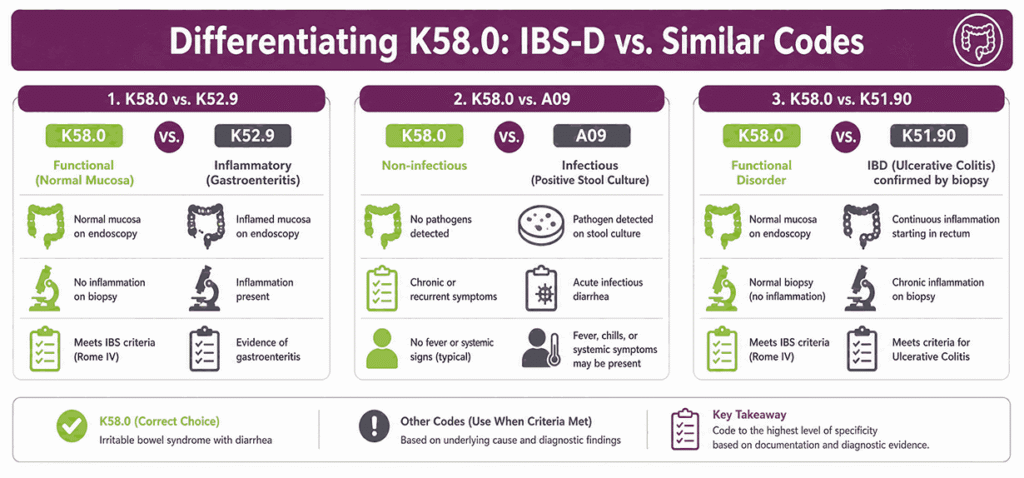
A common source of claim denials is using K58.0 when a more specific or different code applies. Three conditions are frequently confused with IBS-D in coding practice.
K58.0 vs. K52.9 (Noninfective Gastroenteritis)
K52.9 applies to noninfective gastroenteritis and colitis where an inflammatory origin is documented or suspected. K58.0 applies when the disorder is functional, meaning no structural or biochemical abnormality explains the symptoms. A colonoscopy with biopsy showing normal mucosa supports K58.0 over K52.9.
K58.0 vs. A09 (Infectious Gastroenteritis)
A09 covers diarrhea with confirmed or presumed infectious etiology. K58.0 requires the absence of infection. A positive stool culture or documented infectious episode rules out K58.0 for that encounter.
K58.0 vs. K51.90 (Ulcerative Colitis)
Ulcerative colitis produces diarrhea as a primary symptom, but K51.90 applies only when the provider confirms inflammatory bowel disease through endoscopy and biopsy. K58.0 is a functional disorder code. Coders must not assign K58.0 when the record documents confirmed ulcerative colitis or Crohn’s disease.
CPT Codes Used in IBS-D Encounters
Billing for an IBS with diarrhea encounter involves both the ICD-10 diagnosis code K58.0 and the appropriate CPT procedure code. The CPT code reflects the service rendered, not the diagnosis.
Office Visit CPT Codes for IBS-D
| CPT Code | Service Type | Typical Use in IBS-D |
|---|---|---|
| 99213 | Office visit, established patient, low complexity | Follow-up IBS-D visit, stable symptoms |
| 99214 | Office visit, established patient, moderate complexity | IBS-D with new symptom review or medication change |
| 99215 | Office visit, established patient, high complexity | IBS-D with significant comorbidities requiring complex decision-making |
| 99202 | New patient visit, straightforward | Initial IBS-D evaluation, minimal comorbidities |
| 99204 | New patient visit, moderate complexity | New patient with IBS-D requiring a detailed workup |
Medical decision-making (MDM) or total time documentation drives E/M code selection under the 2021 AMA E/M guidelines. Providers must document the number and complexity of problems, data reviewed, and risk of complications to justify the level billed.
Accurate CPT coding for gastroenterology visits requires a working knowledge of code-to-diagnosis pairing rules. For a detailed reference, see Transcure’s Gastroenterology Billing guide.
Diagnostic and Procedural CPT Codes Ordered in IBS-D Workup
Gastroenterologists often order diagnostic procedures before or during IBS-D management. The following CPT codes appear frequently alongside K58.0:
- 45378: Colonoscopy, diagnostic, without biopsy (used to rule out organic pathology)
- 45380: Colonoscopy with biopsy (when mucosal sampling is performed)
- 91112: Gastrointestinal transit and pressure measurement (when motility is evaluated)
- 82270: Fecal occult blood test (ordered to exclude bleeding as a cause of stool changes)
- 87046: Stool culture, aerobic (to rule out infectious etiology)
For the full reference list of codes used in gastrointestinal encounters, Transcure’s Gastroenterology CPT Codes guide provides a procedure-level breakdown.
IBS-D Billing Errors That Trigger Claim Denials
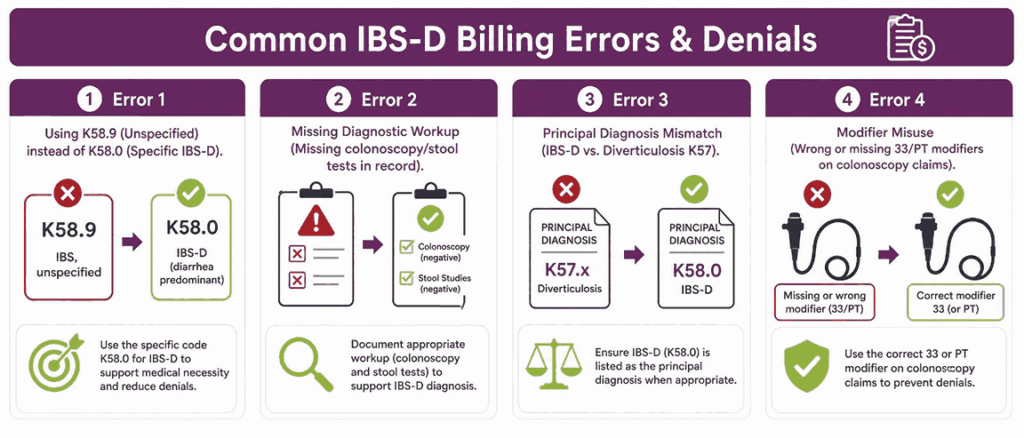
IBS with diarrhea generates a predictable set of claim denials. Understanding each error type reduces rework and improves clean claim rates.
Error 1: Using K58.9 When K58.0 Is Documented
If the provider documents “IBS with diarrhea” or “diarrhea-predominant IBS” in the assessment, coders must assign K58.0. Assigning the unspecified K58.9 when a specific subtype is documented constitutes under-coding. Many payers flag unspecified codes when more specific codes are available and supported by documentation.
Error 2: Assigning K58.0 Without Ruling Out Organic Pathology
Payers, including Medicare, audit IBS-D claims where the record lacks evidence of diagnostic workup. A colonoscopy, blood panel, and stool test do not always appear in the same encounter note, but the overall record must show the provider evaluated and excluded organic causes.
Error 3: Bundling K58.0 with K57-Range Codes Incorrectly
K57-range codes cover diverticular disease. When a patient has both diverticulosis and IBS-D, coders assign both K57.xx and K58.0, but the principal diagnosis must reflect the condition chiefly responsible for the encounter. Misassigning principal diagnosis leads to reimbursement mismatches.
Error 4: Modifier Misuse on Colonoscopy Claims
When a colonoscopy (45378 or 45380) is performed to evaluate IBS-D symptoms and the patient is also due for a preventive screening, Modifier 33 or PT may apply, depending on the payer. Applying the wrong modifier or omitting the required modifier causes denials on the procedural claim even when K58.0 is coded correctly.
Practices managing high-volume gastroenterology billing benefit from dedicated oversight of IBS coding patterns. Transcure’s Gastroenterology Billing Services provide claim-level review to catch these errors before submission.
ICD-10-PCS Codes for IBS-D in Inpatient Settings
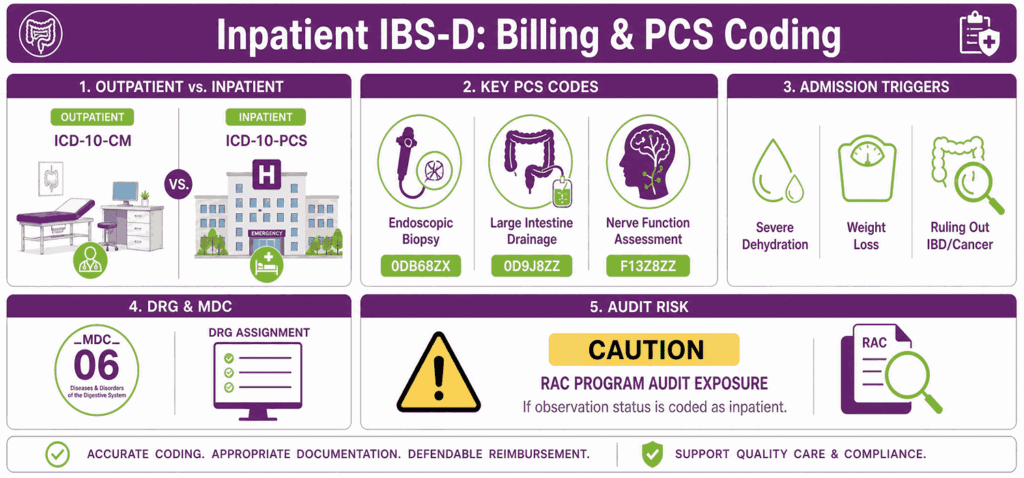
ICD-10-CM codes like K58.0 apply in outpatient and physician billing. Inpatient hospital billing uses ICD-10-PCS codes for procedures. IBS with diarrhea rarely triggers inpatient admission, but in cases of severe dehydration, electrolyte imbalance, or ruling out acute pathology, the following ICD-10-PCS procedure codes may appear:
- 0DB68ZX: Excision of small intestine, endoscopic approach (biopsy)
- 0D9J8ZZ: Drainage of the large intestine, endoscopic approach
- F13Z8ZZ: Motor and nerve function assessment, digestive system
In inpatient settings, the attending physician assigns the principal diagnosis based on the condition established after study to be chiefly responsible for the admission. K58.0 serves as the principal diagnosis when IBS-D is the primary reason for the inpatient stay.
Inpatient IBS-D admissions most commonly occur when a patient cannot maintain oral hydration, when weight loss is clinically significant, or when the provider must rule out inflammatory bowel disease, colorectal cancer, or microscopic colitis through inpatient endoscopy. The DRG assignment for these admissions falls under MDC 06 (Diseases and Disorders of the Digestive System). The specific DRG depends on whether the admission includes a major OR procedure, a minor OR procedure, or non-operative management.
Coding teams handling inpatient IBS-D cases must confirm that the attending physician has documented the clinical basis for inpatient-level care. Observation-level admissions coded as inpatient generate audit exposure under the Recovery Audit Contractor (RAC) program.
How Payers Verify IBS-D Claims
Medicare Administrative Contractors (MACs) and commercial payers use local coverage determinations (LCDs) and clinical payment and coding policies to evaluate IBS-D claims. Three verification factors apply most often.
Factor 1: Medical Necessity Documentation
The provider’s note must establish medical necessity for the encounter and any ordered tests. For IBS-D, medical necessity depends on documented symptom severity, failed prior treatments, and the clinical rationale for any diagnostic procedures performed.
Medicare does not have a national coverage determination (NCD) specific to IBS. Coverage of diagnostic procedures ordered in the IBS-D workup falls under MAC-level LCDs. Novitas Solutions, the MAC for Jurisdiction H and Jurisdiction L, applies LCD L37606 for colonoscopy coverage criteria. The provider must document that the procedure is not solely for routine screening when the patient presents with IBS-D symptoms.
Factor 2: NCCI Edits for Paired Codes
The National Correct Coding Initiative (NCCI) publishes edits that bundle certain CPT codes. Coders must check NCCI edit tables when billing colonoscopy alongside office visit codes to confirm whether a modifier is needed to bypass the edit.
CMS updates NCCI edits quarterly. The most current tables are available through the CMS website. Practices billing colonoscopy (45378) with a separate E/M code (99213-99215) on the same date must attach Modifier 25 to the E/M code when the office visit reflects a separately identifiable service beyond the procedure’s pre-service evaluation.
Factor 3: Place of Service Accuracy
IBS-D encounters billed under K58.0 must carry the correct Place of Service (POS) code. Office visits use POS 11. Outpatient hospital visits use POS 22. Applying the wrong POS code triggers automatic downcoding or denial regardless of diagnosis accuracy.
Ambulatory surgery center claims for colonoscopy use POS 24. Hospital outpatient department claims use POS 22 with the corresponding technical component. Physician professional fees billed separately carry POS 22 when the service takes place in a hospital outpatient setting. Mismatching the POS between the facility claim and the professional claim is a frequent source of coordination errors in gastroenterology billing.
IBS-D in the Context of Mental Health Comorbidities
Research published in the American Journal of Gastroenterology identifies that 54 to 94 percent of IBS patients meet diagnostic criteria for at least one psychiatric comorbidity, most commonly anxiety and depression. This comorbidity rate has direct coding implications.
When the provider documents and manages anxiety or depression alongside IBS-D, coders assign both K58.0 and the relevant mental health code (F41.1 for generalized anxiety, F32.9 for major depressive disorder). The ICD-10-CM guidelines do not limit the number of codes per encounter as long as each code is supported by documentation and reflects a condition that received management during the encounter.
Gastroenterology practices that treat IBS-D with psychological overlays may also see CPT codes for care coordination or behavioral health integration, which require separate documentation and medical necessity support.
Summary: ICD-10 Coding for IBS with Diarrhea
The ICD-10-CM code for IBS with diarrhea is K58.0. Correct assignment of K58.0 requires documented confirmation of IBS-D diagnosis, exclusion of organic pathology, and clinical evidence that diarrhea is the predominant bowel symptom.
The K58 code family includes five distinct codes covering all IBS subtypes. Coders select the most specific code supported by documentation rather than defaulting to K58.9. Referencing an index of gastroenterology ICD-10 codes ensures proper diagnostic specificity across all functional bowel disorders.
Claim accuracy for IBS-D encounters depends on:
- Correct selection between K58.0, K58.1, K58.2, and K58.9 based on documented subtype
- Pairing K58.0 with the appropriate E/M or procedural CPT code
- Documenting secondary diagnoses (anxiety, depression, GERD) when managed in the same encounter
- Applying correct modifiers when colonoscopy and office visit codes appear together
- Using the accurate Place of Service code for each setting
Gastroenterology practices with high IBS-D claim volume benefit from structured coding audits to identify under-coding, modifier errors, and documentation gaps before those patterns generate payer-level scrutiny.