Hospice billing is one of those areas in medical billing that looks straightforward until you are actually in the middle of a claim, staring at modifier codes and wondering which one applies. The GV and GW modifiers come up constantly in hospice-related claims, and getting them wrong costs real money in denials, delays, and compliance headaches.
This guide walks through every layer of how these modifiers work, who uses them, when they apply, and what the Medicare rules actually say. Whether you are a physician, a billing specialist, or a practice manager trying to get a handle on hospice claims, this is the place to start.

What is the Medicare Hospice Benefit and Why Does It Matter for Billing?
Before getting into the modifiers themselves, it helps to understand the broader Medicare hospice framework that makes these codes necessary.
Medicare beneficiaries who are entitled to hospital insurance under Part A and have a terminal illness with a life expectancy of six months or less may elect the hospice benefit. This election replaces standard Medicare coverage for services that are related to the treatment and management of their terminal condition.
The hospice benefit is structured into specific care periods:
- Two initial 90-day periods.
- An unlimited number of 60-day periods for the remainder of the patient’s life.
- The patient retains the right to voluntarily terminate the election at any time.
When a patient elects hospice, their hospice provider receives a per diem rate that is meant to cover all services related to the terminal condition. This bundled payment structure is exactly what makes modifier coding so important for independent physicians who continue treating these patients.
The Role of the Attending Physician in Hospice Care
The attending physician holds a unique position in the hospice care framework and plays a central role in understanding when and how these modifiers are applied.
Who Can Be an Attending Physician?
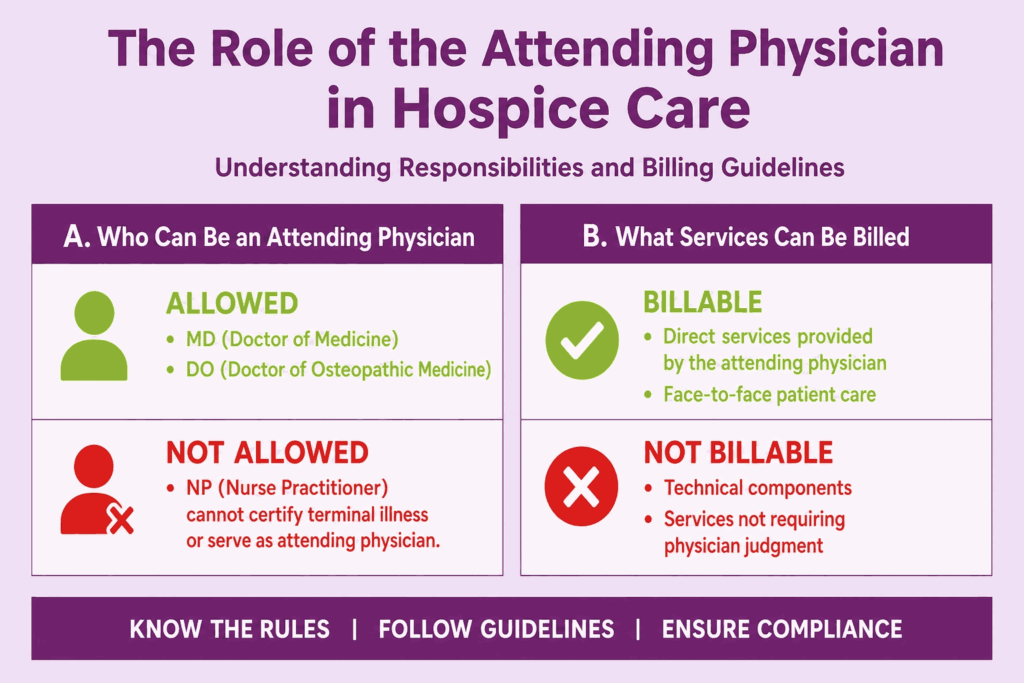
The attending physician is typically the doctor the patient identifies as their primary treating provider at the time of hospice enrollment. Importantly, this role can also be filled by a nurse practitioner in certain circumstances.
However, there is a critical limitation here. Nurse practitioners who serve as attending physicians are not permitted to certify or recertify the terminal illness. That certification responsibility belongs solely to the patient’s attending physician (if there is one) and the hospice medical director or the physician member of the Interdisciplinary Group.
What Services Can the Attending Physician Bill?
Only the direct professional services of the attending physician may be submitted separately for reimbursement. The costs for services such as lab work or X-rays are not included on the claim submitted by the attending physician.
For services that include both a professional and technical component, such as X-rays, the attending physician submits only the professional component to the carrier. The technical component and services with no professional component, like clinical lab tests, are billed to the hospice directly.
Understanding Hospice Modifiers GV and GW
Hospice modifiers are billing indicators appended to physician claims when a patient is enrolled in hospice care. They help Medicare and other payers determine two key things: whether the service is related to the terminal illness, and whether the billing provider has an independent or employed relationship with the hospice organization.
Without these modifiers, Medicare has no efficient way to distinguish between services that fall under the hospice per diem and those that qualify for separate reimbursement under Part B.
GV Modifier for Hospice
The GV modifier indicates that the attending physician is not employed by or paid under arrangement by the patient’s hospice provider. In plain terms, it tells Medicare that the physician treating the hospice-enrolled patient is operating independently and not being compensated through the hospice organization.
HCPCS modifier GV signifies the following three conditions on a claim:
- The service was rendered to a patient currently enrolled in a hospice program
- The service was provided by the physician or nonphysician practitioner identified as the patient’s attending physician at the time of hospice enrollment.
- The attending physician is functioning independently and is not part of the hospice provider’s staff or compensation structure.
When Should the GV Modifier Be Used?
Physicians and nonphysician practitioners should append the GV modifier when the following conditions are met:
- The patient is currently enrolled in a hospice benefit program under Medicare.
- The service provided is related to the patient’s terminal illness or condition.
- The physician is not employed by the hospice provider.
- The physician was specifically identified as the patient’s attending physician at the time of enrollment.
This modifier applies regardless of whether the care is directly or indirectly related to the terminal illness diagnosis. The important eligibility test is the physician’s independent status from the hospice organization.
Who Cannot Use the GV Modifier?
Two categories of physicians are specifically excluded from using this modifier:
- Physicians who are employed by the hospice provider may not use GV because their services are already covered under the hospice payment arrangement.
- Physicians who are not employed by the hospice but were not identified by the beneficiary as their attending physician at the time of enrollment may not use GV either.
GV Modifier Clinical Scenario
Consider a patient with advanced congestive heart failure who has been under the care of a cardiologist for several years. The patient later elects hospice care for their terminal condition. The cardiologist, who has no employment or contractual relationship with the hospice provider, continues to provide cardiac-related services.
In this situation, the cardiologist should append the GV modifier to the claim when submitting to Medicare. This signals that the service is related to the terminal condition but provided by an independent attending physician, making it eligible for separate Part B reimbursement.
GW Modifier for Hospice
The GW modifier indicates that the service rendered to a hospice-enrolled patient is unrelated to their terminal condition. Even when a patient is receiving hospice care, they can develop new medical issues or require ongoing treatment for pre-existing conditions that have nothing to do with the diagnosis that qualifies them for hospice benefits.
This modifier allows any provider, not just the attending physician, to submit claims for those unrelated services under Medicare Part B without those claims conflicting with the hospice provider’s per diem.
When Should the GW Modifier Be Used?
All providers must use the GW modifier when the following conditions apply:
- The service is not related in any way to the terminal illness or conditions associated with it.
- The patient is currently enrolled in a hospice benefit program.
- The service is a covered Medicare benefit outside the hospice bundled payment.
Effective January 5, 2019, Medicare implemented a firm enforcement rule. Any services submitted without the GW modifier, under the conditions outlined above, will be automatically denied. This makes proper modifier placement a non-negotiable step in claim preparation for hospice patients.
GW Modifier Clinical Scenario
A hospice patient receiving end-of-life care for metastatic lung cancer develops a separate fungal skin infection unrelated to the cancer. A dermatologist evaluates and treats the infection. Because the dermatological service has no connection to the terminal illness, the dermatologist must append the GW modifier when submitting the claim to Medicare.
Thus, giving signals that the service falls outside the hospice bundled payment and qualifies for independent reimbursement under Part B.
Difference Between GV and GW Modifiers: Side-by-Side Comparison
The GV and GW modifiers often create confusion because both apply to services provided to hospice-enrolled patients. The distinction lies in what each modifier is communicating about the service and the provider relationship.
| Feature | GV Modifier | GW Modifier |
|---|---|---|
| Full Meaning | The attending physician is not employed by or paid under arrangement by the hospice | Service is unrelated to the patient’s terminal condition |
| Service Relationship to Terminal Illness | Related to terminal illness | Unrelated to terminal illness |
| Provider Requirement | Must be the identified attending physician | Any treating provider |
| Who Can Use It | Independent attending physician or nonphysician practitioner | All providers |
| Who Cannot Use It | Physicians employed by or under contract with the hospice | Not applicable to most providers |
| Reimbursement Pathway | Medicare Part B, attending physician services | Medicare Part B, unrelated services |
| Effective Denial Rule | Claim denied if the physician is hospice-employed | Claims denied without this modifier on unrelated services (effective January 5, 2019) |
The clearest way to understand the difference between the GV and GW modifiers is to look at two separate questions. First, is the service related to terminal illness? Second, is the billing provider independent from the hospice organization? If the answer to the first question is yes and the second question is also yes, GV applies. If the service is simply unrelated to the terminal diagnosis, regardless of provider status, GW applies.
Medicare Billing Guidelines for Hospice Modifiers
Medicare has established specific billing requirements that providers must follow when submitting claims for hospice-enrolled patients. These rules exist to prevent duplicate payments and ensure proper allocation of services under the hospice benefit versus Part B.
Core Billing Requirements
Providers must verify and document the following before submitting a claim for a hospice patient:
- Whether the billing physician has an employment or contractual relationship with the hospice provider.
- Whether the services being billed are directly or indirectly related to the patient’s terminal illness
- Which modifier, GV or GW, is appropriate based on the answers to the above?
- Whether documentation in the medical record supports the medical necessity of the service.
Reviewing an updated oncology CPT coding guide helps teams understand how these requirements match complex chemotherapy administration timelines.
Claims Submission and the Notice of Election
The Notice of Election (NOE) is not required or reviewed for payment under Part B claims and should not be submitted alongside Part B claims to the Medicare Administrative Contractor. Hospice Pre-Election Evaluation and Counseling Services, billed under HCPCS code G0337, are only payable when submitted by the hospice itself to its MAC.
If a new patient evaluation and management service using CPT codes 99202 through 99205 is submitted for the same date of service and same physician as G0337, the evaluation and management service will be denied.
Documentation Standards
Precise documentation is fundamental to compliance and successful reimbursement. Billing teams should ensure that:
- Clinical notes clearly describe the purpose of each service.
- The connection between the service and the hospice diagnosis is explicitly addressed, or explicitly noted as absent.
- Physician affiliation or independence from the hospice is supported by credentialing or contract records.
- All supporting documentation is available in the event of an audit.
Using a detailed oncology billing guide ensures that secondary neoplasms and history of malignancy codes are recorded with maximum audit readiness.
Common Billing Errors with GV and GW Modifiers
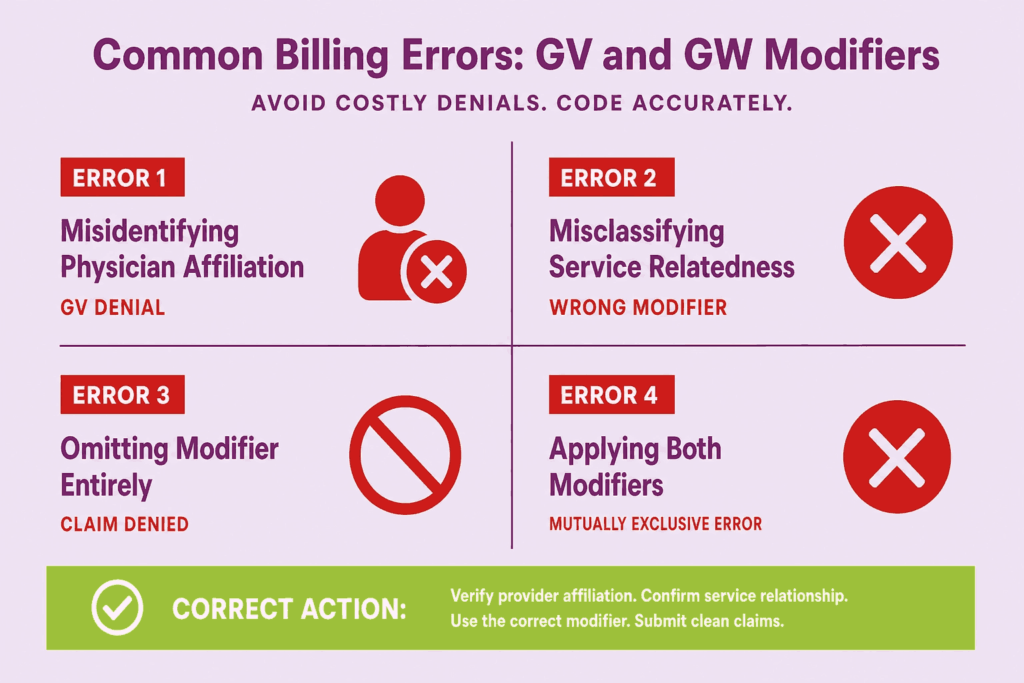
Billing teams across healthcare settings run into a fairly predictable set of mistakes when it comes to hospice modifier coding. Recognizing these errors in advance can prevent costly denials.
Misidentifying Physician Affiliation
One of the most frequent errors occurs when a billing team assumes a physician is independent when that physician actually has a contractual or employment relationship with the hospice. Applying the GV modifier in that situation will result in a claim denial. Verifying physician affiliation should be a standard step in the pre-billing workflow for every hospice patient claim.
Misclassifying Service Relatedness
Determining whether a service is related to the terminal illness is a clinical judgment call, but billing teams often make that determination without sufficient clinical input. A service is incorrectly coded as unrelated when it is actually tied to the terminal condition, or vice versa. This leads to the wrong modifier and potential repayment demands.
Omitting the Modifier Entirely
Some claims are submitted without any hospice modifier at all. When a claim has no modifier and the payer cannot determine whether the service is covered under the hospice per diem or separately under Part B, the claim is typically denied. This is especially problematic for unrelated services since the January 2019 enforcement rule made the GW modifier mandatory in those situations.
Applying Both Modifiers on the Same Claim Line
GV and GW serve mutually exclusive purposes. A service cannot simultaneously be related to the terminal illness and unrelated to it. Applying both modifiers to the same claim line will trigger a processing error or denial.
Hospice Billing for Services Unrelated to the Terminal Condition
When a hospice patient needs treatment for a condition that has no connection to their terminal diagnosis, that service is eligible for standard Medicare Part B billing. This is a point worth emphasizing because some providers mistakenly assume that hospice enrollment restricts all outside billing.
Any covered Medicare service that is unrelated to the terminal illness can be submitted to Medicare Part B. These claims must include the GW modifier to be processed. The absence of the modifier is treated as a missing billing element, and the claim will be denied without further review under current Medicare enforcement rules.
Examples of services that might qualify for GW modifier billing include:
- Treatment of an acute infection unrelated to the terminal diagnosis.
- Orthopedic care for a fracture sustained after hospice enrollment.
- Ophthalmology services for a pre-existing eye condition.
- Dermatological treatment for unrelated skin conditions.
- Dental or oral care outside the hospice scope.
Each of these scenarios requires the treating provider to append GW and submit the claim under Part B with appropriate medical necessity documentation.
Best Practices for Accurate Hospice Modifier Billing
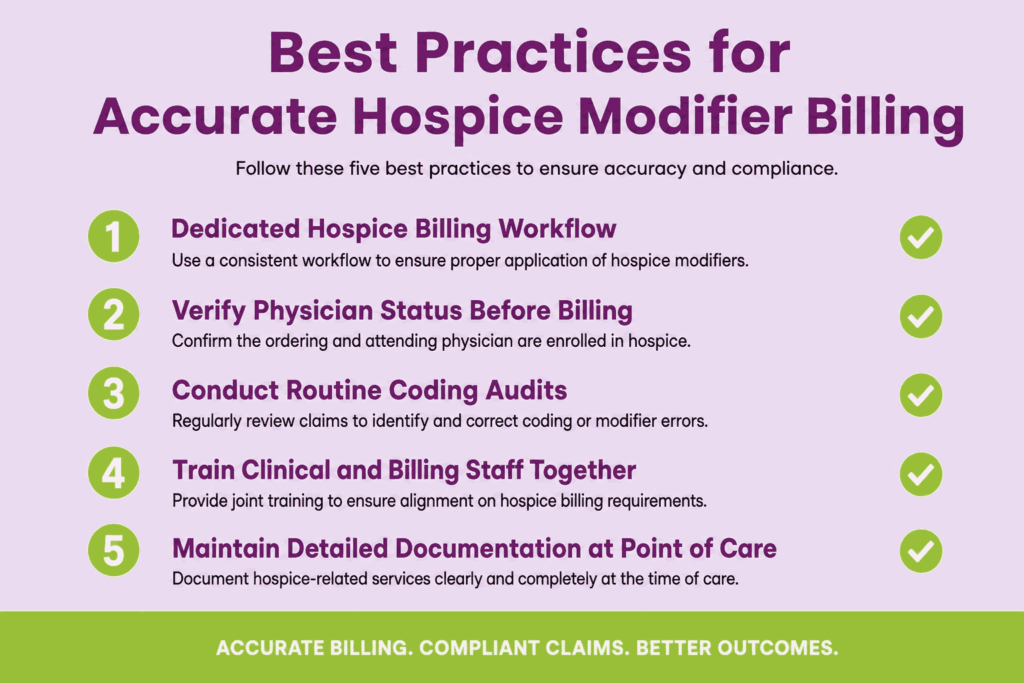
Getting hospice modifier billing right consistently requires more than memorizing the rules. It requires building systems that apply those rules automatically at the point of claim preparation.
1. Establish a Dedicated Hospice Billing Workflow
Hospice patient claims should go through a separate review pathway. Identify these patients at the point of scheduling or intake, flag the chart for modifier review, and assign a billing specialist who understands the GV and GW rules to handle the claim.
2. Verify Physician Status Before Billing
Before any claim is submitted for a hospice-enrolled patient, the billing team should confirm whether the treating physician has an employment or contractual arrangement with the hospice provider. This step should be documented and repeatable across all claims.
3. Conduct Routine Coding Audits
Periodic internal audits of hospice claims can catch patterns of incorrect modifier usage before they become compliance issues. Audits should review claims for both modifiers and cross-check whether the service description aligns with the modifier applied.
4. Train Clinical and Billing Staff Together
The determination of whether a service is related to the terminal condition is partly clinical and partly administrative. Joint training sessions that bring clinicians and billing staff together on hospice billing rules improve accuracy on both sides of the workflow.
5. Maintain Detailed Documentation at the Point of Care
Physicians should note the relationship, or lack thereof, between the service and the hospice diagnosis directly in the clinical note. This makes the billing determination clear and provides audit-ready documentation without requiring a separate administrative review process.
How Specialized Medical Billing Services Support Hospice Claims
Many healthcare organizations find that managing hospice billing rules internally creates a significant administrative burden, particularly as Medicare updates enforcement policies and adds new requirements. Specialized medical billing services that focus on Medicare compliance can provide meaningful support in several areas:
- Verifying modifier accuracy before claim submission.
- Monitoring regulatory updates from CMS and applying them to billing protocols.
- Managing claim denials and resubmissions for hospice-related rejections.
- Providing documentation support to meet Medicare audit requirements.
- Conducting ongoing staff training as policies evolve.
Many multi-specialty practices use specialized oncology billing services to manage these complex, dual-layered revenue streams simultaneously.
Frequently Asked Questions About GV and GW Modifiers
What is the GV modifier in hospice billing?
The GV modifier is a HCPCS billing indicator that tells Medicare the attending physician providing services to a hospice-enrolled patient is not employed by or under a payment arrangement with the hospice provider. It is used when the service is related to the patient’s terminal illness and the physician is operating independently.
What is the GW modifier in hospice billing?
The GW modifier indicates that a service provided to a hospice-enrolled patient is unrelated to the patient’s terminal condition. All providers, not just attending physicians, must use this modifier when submitting Part B claims for services that fall outside the scope of the hospice diagnosis.
What is the difference between GV and GW modifiers?
The GV modifier addresses the physician’s relationship with the hospice organization and applies when the service is related to the terminal illness. The GW modifier addresses the clinical nature of the service and applies when the service has no relation to the terminal condition. The two modifiers are mutually exclusive on any single claim line.
Can a hospice-employed physician use the GV modifier?
No, physicians who are employed by or operating under a payment arrangement with the hospice provider are excluded from using the GV modifier. Their services related to the terminal illness are already compensated through the hospice per diem rate.
What happens if a provider omits the GW modifier on an unrelated service?
Under the rule effective January 5, 2019, any service that qualifies for GW modifier billing but is submitted without it will be automatically denied by Medicare. The omission is treated as a non-compliant claim and requires corrected resubmission with the appropriate modifier.
Can a nurse practitioner use the GV modifier?
Yes, nonphysician practitioners, including nurse practitioners, who are identified as the patient’s attending practitioner and are not employed by the hospice, can use the GV modifier. However, nurse practitioners cannot certify or recertify a patient’s terminal illness; that function remains with the attending physician or the hospice medical director.
Is it possible for a single patient visit to require both modifiers?
No, a single service line cannot be both related and unrelated to the terminal illness at the same time. If a visit addresses multiple issues, the services should be coded separately, with each claim line carrying the appropriate modifier based on its individual clinical purpose.