Orthopedic HCPCS codes are the Level II codes reporting the brace, supply, or drug on an orthopedic claim. The Centers for Medicare and Medicaid Services maintains HCPCS Level II. The American Medical Association maintains CPT, which is HCPCS Level I.
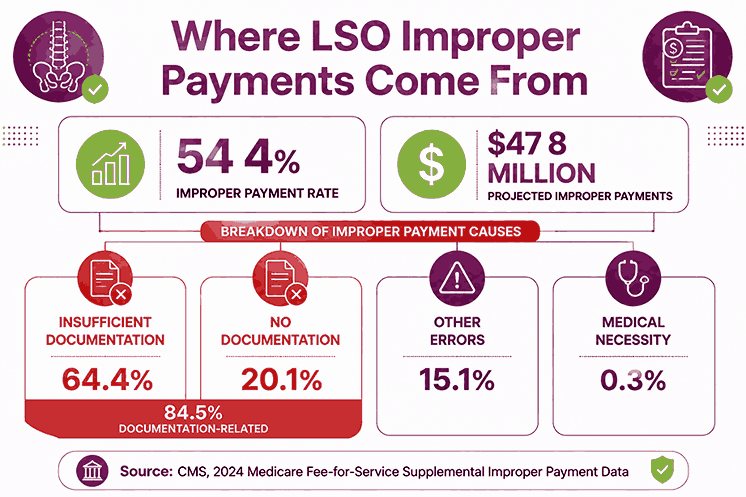
The two systems fail in opposite ways. CPT claims fail on coding judgment. HCPCS claims fail on paperwork. According to CMS, the improper payment rate for the lumbar-sacral orthosis reached 54.4 percent. The projected improper payment amount reached $47.8 million.
The error breakdown proves the point. Insufficient documentation caused 64.4 percent of those improper payments. Missing documentation caused another 20.1 percent. Medical necessity caused 0.3 percent. The clinical decision was almost never the problem.
This guide covers the orthopedic HCPCS layer in two parts. The first part covers the DMEPOS rules governing every claim in this system. The second part covers the code families, organized by device, injectable, and supply.
What Are Orthopedic HCPCS Codes?
Orthopedic HCPCS codes are alphanumeric Level II codes reporting the physical item supplied to an orthopedic patient. Each code starts with a single letter followed by four digits. The letter signals the code family.
A single knee brace encounter carries codes from both systems. CPT reports the office visit and any fitting service. HCPCS Level II reports the brace itself. Payment for the brace runs through an entirely separate rulebook. For the full revenue cycle picture across both systems, payer enrollment, appeals, and denial management, see the orthopedic billing guide.
That separate rulebook is what most orthopedic practices underestimate. A correct code on a correct diagnosis still denies when the supplier standards fail. The rules below decide payment before code selection matters.
Which HCPCS Code Families Do Orthopedic Practices Bill?
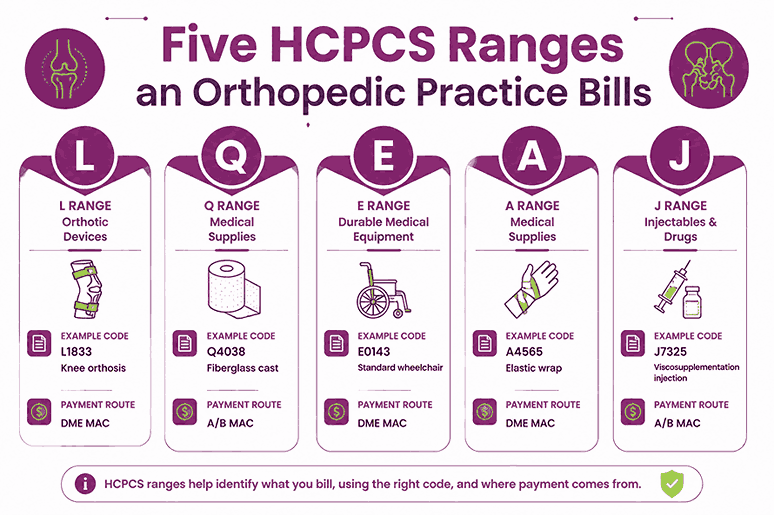
Orthopedic practices bill from five HCPCS Level II ranges: L, Q, E, A, and J. Each range maps to a distinct function in the orthopedic revenue cycle.
The table below maps each range to its orthopedic use and a representative code:
| Range | What It Reports | Orthopedic Example | Payment Route |
|---|---|---|---|
| L-codes | Orthoses, braces, prosthetics | L1833 knee orthosis | DME MAC |
| Q-codes | Cast and splint supplies | Q4038 short leg cast, fiberglass | A/B MAC |
| E-codes | Durable medical equipment | E0143 wheeled walker | DME MAC |
| A-codes | Supplies and non-covered items | A4565 slings | DME MAC |
| J-codes | Injectable drugs and biologicals | J7325 hyaluronan | A/B MAC |
L-codes carry the highest denial exposure of the five ranges. L-codes also carry the deepest documentation requirements, the prior authorization program, and the fitting-level coding trap that follows.
What Does the Medicare Brace Benefit Cover?
The Medicare brace benefit covers rigid or semi-rigid devices that support a weak or deformed body member. The benefit also covers devices restricting or eliminating motion in a diseased or injured body part. Social Security Act section 1861(s)(9) establishes the benefit.
CMS names four specific purposes that support coverage of a spinal orthosis:
- Reducing pain by restricting trunk mobility
- Easing healing after injury to the spine or related soft tissue
- Easing healing after a surgical procedure on the spine or related soft tissue
- Supporting weak spinal muscles or a deformed spine
Benefit category comes first, medical necessity comes second. An item outside the brace benefit never reaches the medical necessity question, and even inside the benefit, the claim still needs a supporting entry from the orthopedic diagnosis code list tied to that LCD. Three codes later in this guide, A9270, A9283, and L3260, turn entirely on that distinction.
What Separates an Off-the-Shelf Code From a Custom-Fitted Code?
Nothing about the device separates them. For the paired orthopedic code sets, CMS states there is no physical difference between the two coded versions. The same brace carries either code depending on what happens at delivery.
CMS treats both off-the-shelf and custom-fitted items as prefabricated for coding purposes. An orthosis assembled from prefabricated components counts as prefabricated. Only a device fabricated over a positive model of the patient qualifies as custom fabricated.
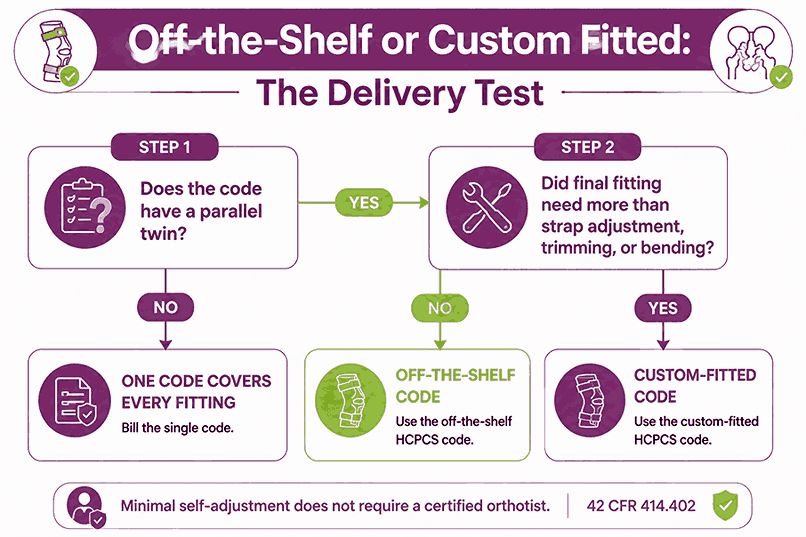
Two questions decide the code. First, does this device even offer a fitting-level choice? Second, if it does, what happened at the final fitting?
What Does “Minimal Self-Adjustment” Mean at Delivery?
Minimal self-adjustment means fitting the beneficiary, caregiver, or supplier performs without specialized training. Items requiring only minimal self-adjustment are coded off-the-shelf. The definition sits at 42 CFR 414.402.
Three examples qualify as minimal self-adjustment:
- Adjusting straps and closures to fit the limb
- Bending or trimming the device for final fit or comfort
- Assembling a kit or installing add-on components
None of these require a certified orthotist. A device needing substantial modification by someone with specialized training is coded custom fitted. Documentation must describe what modifications were performed and why they were necessary.
Which Orthopedic Codes Come in Fitting-Level Pairs?
Eleven orthopedic code pairs describe identical devices at two fitting levels. Each pair splits on the minimal self-adjustment test and nothing else.
The following table lists every fitting-level pair an orthopedic practice bills regularly:
| Device | Custom Fitted | Off-the-Shelf | Governing Article |
|---|---|---|---|
| Elastic knee orthosis with joints | L1810 | L1812 | A52465 |
| Adjustable knee joint orthosis | L1832 | L1833 | A52465 |
| Single upright knee orthosis | L1843 | L1851 | A52465 |
| Double upright knee orthosis | L1845 | L1852 | A52465 |
| Pneumatic walking boot | L4360 | L4361 | A52457 |
| Non-pneumatic walking boot | L4386 | L4387 | A52457 |
| Static or dynamic AFO | L4396 | L4397 | A52457 |
| Wrist hand finger orthosis | L3807 | L3809 | Brace benefit |
| LSO, sagittal control, rigid panels | L0631 | L0648 | A52500 |
| LSO, sagittal-coronal, rigid frame | L0637 | L0650 | A52500 |
| LSO, sagittal-coronal, rigid shell | L0639 | L0651 | A52500 |
Three separate CMS policy articles govern these pairs. Knee orthoses sit under A52465, ankle-foot orthoses under A52457, and spinal orthoses under A52500. Each article carries its own version of the no-physical-difference language.
Which Codes Have No Fitting-Level Choice at All?
Fourteen prefabricated ankle-foot and knee-ankle-foot codes offer no fitting-level choice. CMS states there is no HCPCS coding distinction between custom-fit and off-the-shelf for these codes. One code describes the item regardless of how it was fitted at delivery.
Policy Article A52457 names the no-choice group:
- Ankle orthoses: L1902, L1906, L1910
- Ankle-foot orthoses: L1930, L1932, L1933, L1951, L1952, L1971, L4350, L4398
- Knee-ankle-foot orthoses: L2035, L2112 through L2116, L2132 through L2136
Coders who append a fitting-level judgment to these codes are answering a question CMS did not ask. Only L4360, L4361, L4386, L4387, L4396, and L4397 form parallel sets inside the ankle-foot family.
Why Does the Wrong Fitting Level Cost More Than the Payment Difference?
The wrong fitting level exposes the claim to a Recovery Audit Contractor review, not just a payment adjustment. RAC approved issue 0144 targets prefabricated knee orthoses specifically.
That issue covers seventeen codes across two groups:
- Prefabricated knee orthoses: L1810, L1812, L1820, L1830, L1831, L1832, L1833, L1836, L1843, L1845, L1850, L1851, L1852
- Lower extremity orthosis additions: L2385, L2395, L2397, L2810
Reviewers examine whether the medical record supports the coverage and medical necessity requirements for the code billed. A fitting-level error creates two problems at once. The payment differs, and the record no longer matches the code.
Which Orthopedic HCPCS Codes Require Prior Authorization in 2026?
Fifteen orthopedic orthosis codes require prior authorization as of 2026. The requirement is code-specific and date-specific. Prior authorization is defined at 42 CFR 414.234(c)(1). CMS last updated the Required Prior Authorization List on January 13, 2026.
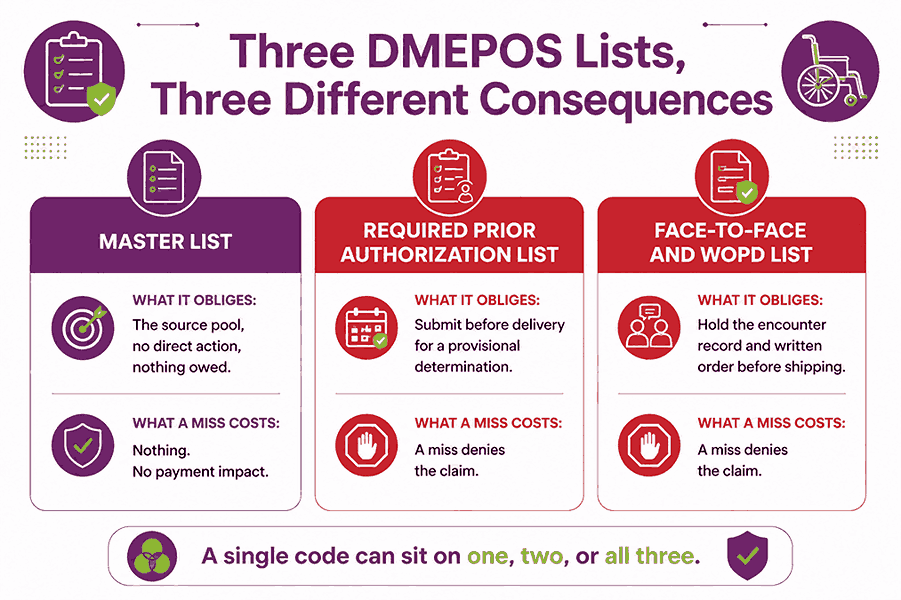
Three separate lists govern these codes, and practices routinely conflate them. The Master List is the source pool. The Required Prior Authorization List triggers a submission before delivery. The Required Face-to-Face Encounter and Written Order Prior to Delivery List triggers a document-gathering obligation.
A code sits on one list, two lists, or all three. The consequence differs for each.
Which Codes Sit on the Required Prior Authorization List?
The Required Prior Authorization List covers fifteen orthosis codes, phased in across three nationwide effective dates. Submission goes to the DME MAC for a provisional coverage determination before delivery.
The table below shows every orthopedic orthosis code on the list with its nationwide effective date:
| Effective Date | Codes | Device Type |
|---|---|---|
| 10/10/2022 | L0648, L0650, L1832, L1851 | LSO and knee orthoses |
| 08/12/2024 | L0631, L0637, L0639, L1843, L1845, L1951 | LSO, knee orthoses, AFO |
| 04/13/2026 | L0651, L1844, L1846, L1852, L1932 | LSO, knee orthoses, AFO |
The 2022 codes phased in geographically before going nationwide. Phase one covered New York, Illinois, Florida, and California from April 13, 2022. Phase two added twelve states from July 12, 2022.
Five of these codes also fall inside the Competitive Bidding Program: L0648, L0650, L0651, L1851, and L1852. Suppliers furnishing these items under a competitive bidding exception bill modifier KV, J5, or J4. The exception sits at 42 CFR 414.404(b).
What Changed on April 13, 2026?
Five codes joined the Required Prior Authorization List nationwide on April 13, 2026: L0651, L1844, L1846, L1852, and L1932. DME MACs began accepting requests for these codes ahead of the effective date.
L1852 is the code that catches practices. The double upright off-the-shelf knee orthosis carried no prior authorization requirement through the whole of 2025. Its custom-fitted twin, L1845, has required prior authorization since August 2024.
Any brace workflow built before April 2026 treats L1852 as a same-day dispense. That workflow now produces a denial. Practices dispensing L1852 from stock need the provisional determination first.
How Is the Face-to-Face and WOPD List Different?
The Face-to-Face and WOPD List requires the supplier to hold documents before delivery, not to submit them for review. Inclusion means holding two documents before the item ships: the face-to-face encounter record and the standard written order.
Two orthopedic groups sit on this list:
- Lumbar-sacral orthoses: L0631, L0635, L0636, L0637, L0638, L0639, L0640, L0648, L0650, L0651
- Knee orthoses: L1832, L1843, L1845, L1851, L1852
L1833 is the instructive case. The code required a face-to-face encounter and written order prior to delivery before August 12, 2024. CMS removed L1833 from the Required Prior Authorization List on that date. The code no longer met Master List criteria.
L1833 is now the highest-volume orthopedic knee orthosis code with the lightest pre-delivery burden. Its twin, L1832, still requires prior authorization nationwide.
When Does the ST Modifier Apply?
The ST modifier applies when medical need for a listed item arises urgently, and prior authorization is not obtainable first. Post-surgical need and acute or emergent situations both qualify. Suppliers furnish the brace and append ST to the claim line.
The modifier carries a review cost. Claims billed with ST for the listed orthosis codes face 50 percent prepayment review. That rate stood at 100 percent before January 1, 2024.
ST is a legitimate pathway, not a workaround. A practice appending ST to routine outpatient dispenses builds a prepayment review pattern that slows every claim in the queue.
What Documentation Must Support an Orthopedic DMEPOS Claim?
Three documents support every orthopedic DMEPOS claim: the standard written order, the treating practitioner medical record, and proof of delivery. All three must be produced on request. Missing any one of the three loses the claim.
The order of failure is counterintuitive. Practices invest documentation effort in medical necessity, which causes 0.3 percent of lumbar-sacral orthosis improper payments. Documentation gaps cause 84.5 percent of them.
What Must a Standard Written Order Contain?
The standard written order establishes what the treating practitioner ordered and when. The order must carry correct HCPCS coding that matches the item delivered.
An SWO with the wrong fitting level creates a mismatch even when every other document is clean. An order written for a custom-fitted knee orthosis does not support an off-the-shelf claim. The reverse holds equally.
Practices that let the supplier assign the code after delivery invert the sequence. The order comes first. The claim follows the order.
Why Does Proof of Delivery Cause More Denials Than Medical Necessity?
Proof of delivery causes more denials because proof of delivery is a supplier standard living outside the clinical record. DMEPOS suppliers maintain proof of delivery in supplier files and produce it on request.
CMS published a worked example showing exactly how the claim dies. A supplier billed L0631 and, on request from the review contractor, submitted two documents:
- A standard written order with correct HCPCS coding
- The treating practitioner medical record documenting the spinal orthosis
The supplier did not send proof of delivery. The review contractor scored the claim as a no-documentation error, and the MAC recouped payment. The clinical case was never examined.
Services lacking appropriate proof of delivery are denied as not reasonable and necessary. The denial reason names medical necessity even though the failure was administrative.
Which Modifiers Belong on an Orthopedic HCPCS Claim?
Eight modifier groups carry orthopedic DMEPOS claims. Each modifier answers a different question about coverage status, laterality, or equipment condition.
The table below defines each modifier and the claim question it answers:
| Modifier | Meaning | Orthopedic Use |
|---|---|---|
| KX | Coverage criteria met | Attests documentation supports the listed requirements |
| GA | ABN on file, expected denial | Item in a benefit category, denied as not reasonable and necessary |
| GY | Statutorily excluded | Item outside any Medicare benefit category |
| GZ | Expected denial, no ABN | Item expected to deny with no advance notice signed |
| RT / LT | Right or left | Laterality on every unilateral orthosis |
| NU / RR / UE | New, rental, used | Equipment purchase status on E-codes |
| ST | Urgently furnished | Prior authorization not obtained before delivery |
| KV / J4 / J5 | Competitive bidding exception | Furnished under an exception at 42 CFR 414.404(b) |
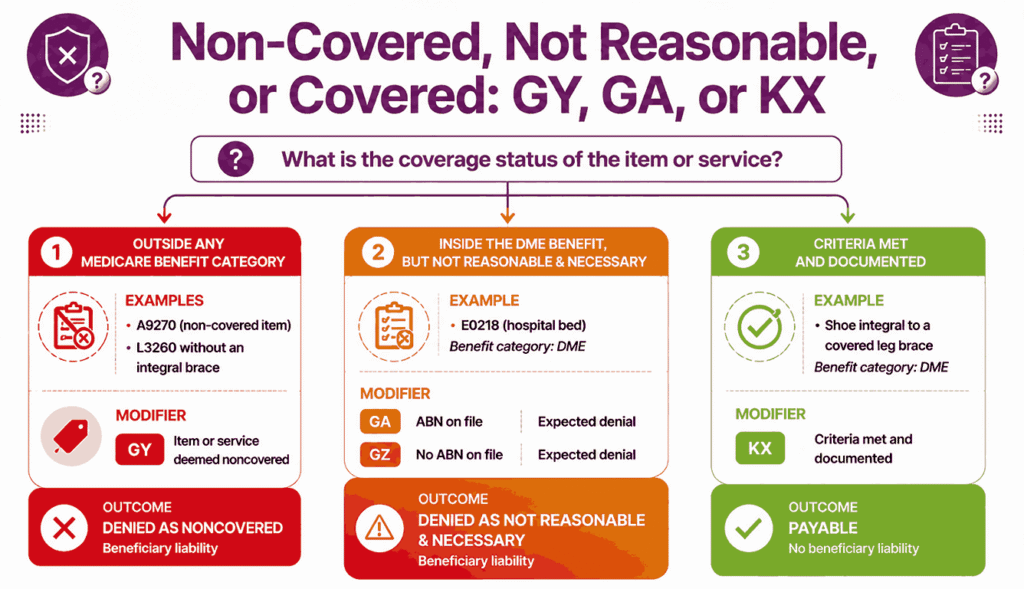
GA and GY are the pair that decides appeal rights, and orthopedic practices confuse them constantly. GA belongs on an item inside a Medicare benefit category that fails the reasonable and necessary test. GY belongs on an item that never had a benefit category at all.
Three codes in this guide demonstrate the split directly. E0218 takes GA. A9270 and L3260 take GY.
When Can a Brace Be Delivered During an Inpatient or SNF Stay?
A brace delivered during an inpatient or Part A skilled nursing facility stay reaches the DME MAC under three conditions. All three must hold simultaneously.
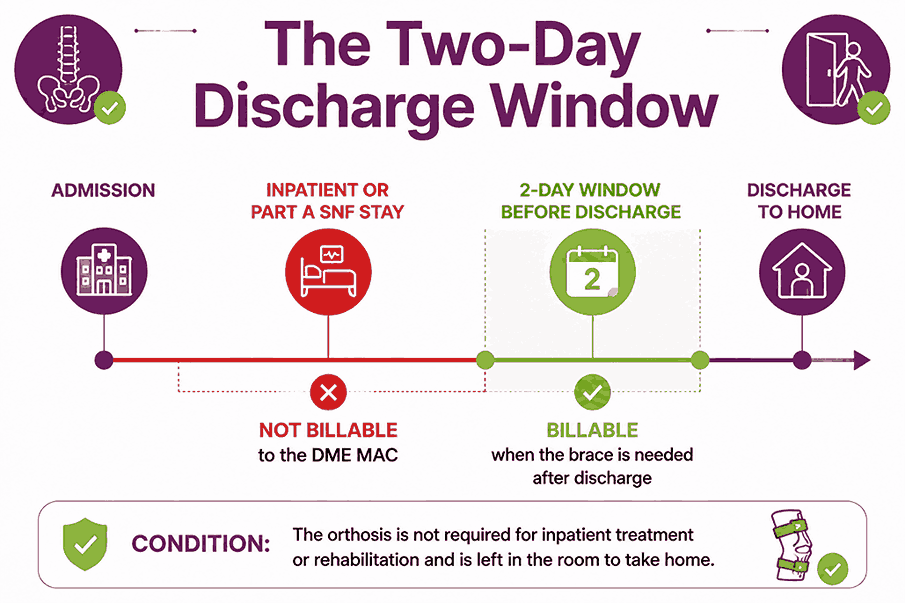
CMS states the DME MAC covers payment when:
- The orthosis is medically necessary for the patient after discharge
- The patient receives the orthosis within the two days before discharge to home
- Inpatient treatment or rehabilitation does not require the orthosis, which is left in the room to take home
This timing rule exists separately from, and is often confused with, global surgery package bundling, where post-op supplies furnished during the 10- or 90-day global period are already included in the surgeon’s payment. Three situations move the payment into the facility stay instead. Delivery before admission bars a DME MAC claim. So does delivery during the stay before discharge day. So does medical necessity beginning during the stay.

Which HCPCS Codes Cover Orthopedic Braces and Orthoses?
Orthopedic braces and orthoses fall into six families:
- Knee orthoses: elastic and immobilizer designs, plus adjustable joint and upright designs
- Ankle and foot: walking boots and ankle-foot orthoses
- Upper limb: wrist, hand, elbow, and shoulder orthoses
- Spine: lumbar-sacral orthoses
Each family carries its own coverage article and its own fitting rules.
Every code below reports a device. The procedure that fits, applies, or surgically supports that device sits in the CPT range for orthopedic claims, which covers that half of the claim.
Which HCPCS Codes Cover Elastic and Immobilizer Knee Orthoses?
Elastic and immobilizer knee orthoses report the soft and rigid braces dispensed without adjustable range-of-motion joints. CMS Policy Article A52465 governs the family alongside the adjustable joint codes.
One documentation rule splits this group. The supplier includes the diagnosis code on the claim line for L1830, L1831, L1836, and L1850. That requirement does not extend to L1810, L1812, or L1820.
L1820: Elastic Knee Orthosis With Condylar Pads
Condylar pads are what separate L1820 from the plainer elastic knee braces. Elastic construction with condylar pads and joints, with or without patellar control, defines the prefabricated brace. A52465 places L1820 in the prefabricated group, where no physical difference separates custom-fitted from off-the-shelf coding.
L1812: Elastic Knee Orthosis With Joints, Off-the-Shelf
L1812 is the off-the-shelf half of the elastic knee brace pair. Delivery requiring only strap adjustment or trimming keeps the claim here rather than at L1810. Neither code carries the claim-line diagnosis requirement that applies further down this family.
L1830: Knee Immobilizer Without Joints
A patient leaving clinic in a stock immobilizer after knee surgery carries L1830. The canvas longitudinal design has no joints and blocks both flexion and extension. Coverage runs to a beneficiary with a recent knee injury or recent knee surgery. The diagnosis code appears on the claim line.
L1810: Elastic Knee Orthosis With Joints, Custom Fitted
L1810 describes the same elastic knee orthosis with joints as L1812, fitted differently. Substantial modification by an individual with expertise at final delivery moves the claim to this code. Neither L1810 nor L1812 contains rigid uprights or adjustable range-of-motion joints.
L1831, L1836, and L1850: Locking, Rigid, and Swedish Designs
Three older designs round out the family. L1831 covers a knee orthosis with locking knee joints in a positional orthosis, prefabricated. L1836 covers a rigid knee orthosis without joints, and L1834 is its custom-fabricated counterpart. L1850 covers the Swedish type, and all three require the claim-line diagnosis.
L1810 vs L1812: Where Does the Elastic Knee Brace Split?
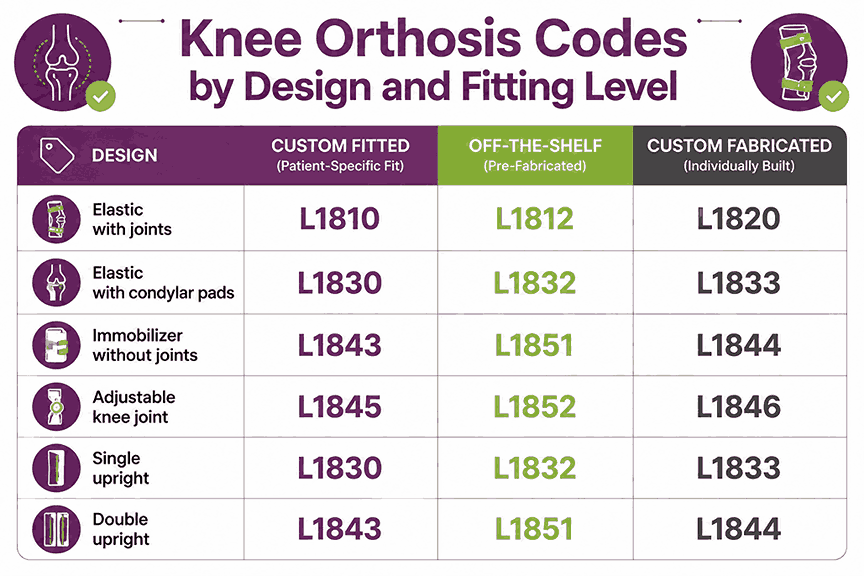
The split falls entirely at delivery. L1810 and L1812 describe the same elastic knee orthosis with joints, and no physical difference separates them.
Strap adjustment, trimming for comfort, or assembling a kit counts as minimal self-adjustment. That delivery produces L1812. Reshaping the brace in a way requiring specialized training produces L1810.
Neither code carries the claim-line diagnosis requirement that applies to L1830 and the adjustable joint codes. Neither code sits on the Required Prior Authorization List.
Which HCPCS Codes Cover Adjustable Joint and Upright Knee Orthoses?
Six adjustable joint and upright knee orthosis codes carry the majority of orthopedic volume. Every code in this group requires the diagnosis code on the claim line.
Prior authorization applies to five of the six. The exception is the highest-volume code in the family.
L1833: Adjustable Knee Joint Orthosis, Off-the-Shelf
Prior authorization came off this code in 2024, which makes L1833 the lightest pre-delivery burden in the family. Adjustable knee joints, positional design, and rigid support define the brace, supplied off-the-shelf for the HCPCS L1833 code. Searchers often look for an L1833 CPT code description, though L1833 is HCPCS Level II.
L1832: Adjustable Knee Joint Orthosis, Custom Fitted
Objective joint laxity is what the record must show for L1832, the custom-fitted twin of L1833. Medical records document a physical examination of the affected knee with findings supporting that laxity. Nationwide prior authorization has applied since October 10, 2022, alongside face-to-face and WOPD.
L1852: Double Upright Knee Orthosis, Off-the-Shelf
L1852 changed status in 2026. Adjustable flexion and extension, medial-lateral control, and rotation control run through a double upright frame, supplied off-the-shelf. It joined the Required Prior Authorization List nationwide on April 13, 2026. Competitive bidding adds the KV, J5, or J4 exception modifiers.
L1851: Single Upright Knee Orthosis, Off-the-Shelf
Rigid thigh and calf cuffs, a single upright, and condylar pads define the device behind L1851. Straps crossing the knee exert rotational control and varus or valgus force. Nationwide prior authorization has applied since October 10, 2022, and L1851 also sits inside competitive bidding.
L1845: Double Upright Knee Orthosis, Custom Fitted
Osteoarthritis pain in a fully ambulatory patient is the classic indication behind L1845. A double upright custom-fitted frame opens the medial or lateral compartment to unload the affected side. Nationwide prior authorization has applied since August 12, 2024.
L1843: Single Upright Knee Orthosis, Custom Fitted
Two attributes place a claim at L1843 rather than anywhere else in the family. Upright count separates it from L1845, and fitting level separates it from L1851. Nationwide prior authorization has applied since August 12, 2024, matching its double upright counterpart.
L1844 and L1846: Custom Fabricated Upright Knee Orthoses
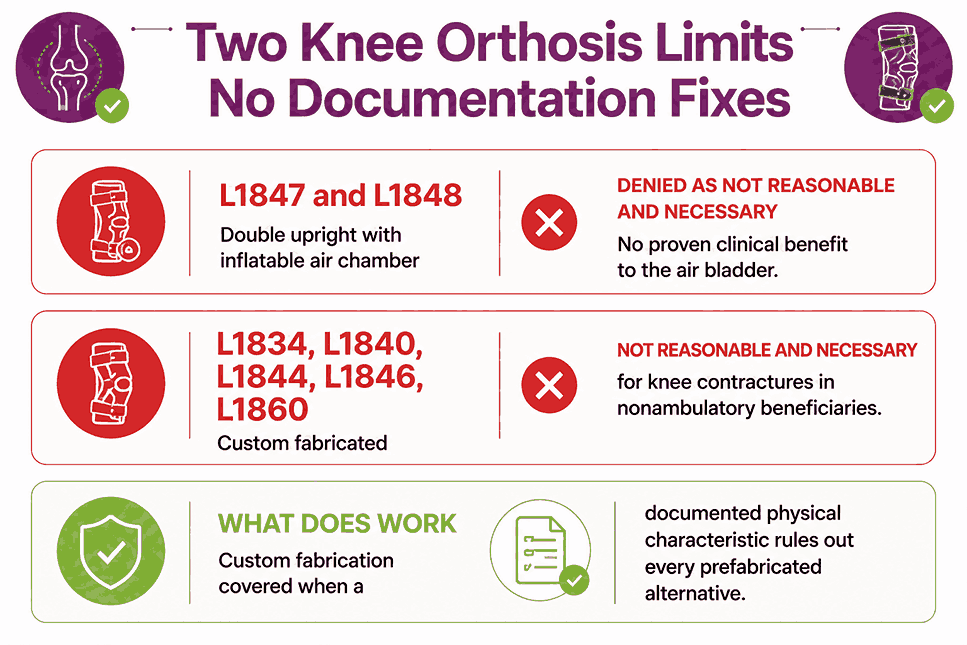
Custom fabrication is a separate answer, not a stronger version of custom fitting. L1844 covers the single upright version and L1846 the double upright, both formed over a positive model. Coverage requires a documented physical characteristic ruling out any prefabricated device. Both codes joined the prior authorization list on April 13, 2026.
Single Upright or Double Upright: Which Knee Orthosis Code Applies?
Upright count and fitting level are two separate questions, and each one changes the code. Count the uprights first. A single upright brace uses L1843, L1851, or L1844. A double upright brace uses L1845, L1852, or L1846.
Fitting level answers the second question. Minimal self-adjustment at delivery produces the off-the-shelf code, L1851 or L1852. Substantial modification by someone with specialized training produces L1843 or L1845.
Custom fabrication is a third answer, not a harder version of the second. L1844 and L1846 require a documented physical characteristic that rules out any prefabricated alternative.
Why Are L1847 and L1848 Denied?
L1847 and L1848 are denied as not reasonable and necessary. Both codes describe a double upright knee orthosis with an adjustable joint and an inflatable air supply chamber.
CMS states there is no proven clinical benefit to the inflatable air bladder incorporated into either design. The denial is categorical rather than documentation-driven, so no additional record closes the gap.
One further limitation applies to the custom fabricated group. Codes L1834, L1840, L1844, L1846, and L1860 are not reasonable and necessary for knee contractures in nonambulatory beneficiaries.
Which HCPCS Codes Cover Walking Boots?
Four prefabricated walking boot codes form two fitting-level pairs, plus one custom fabricated option. CMS Local Coverage Determination L33686 and Policy Article A52457 govern the family.
Coverage runs to ambulatory beneficiaries with weakness or deformity of the foot and ankle. Those beneficiaries must require stabilization for medical reasons and have the potential to benefit functionally.
L4361: Pneumatic Walking Boot, Off-the-Shelf
L4361 is the highest-volume orthopedic HCPCS code in general practice. Pneumatic or vacuum construction, with or without joints, prefabricated off-the-shelf, defines the device. Many searches look for an L4361 CPT code description, though L4361 is HCPCS Level II. Add-on codes billed alongside are denied as unbundling.
L4360: Pneumatic Walking Boot, Custom Fitted
Nothing physical distinguishes the boot billed as L4360 from the boot billed as L4361. The custom-fitted code applies when final fitting demands substantial modification by an individual with expertise. Suppliers defaulting to this code on every dispense build an audit pattern rather than a payment advantage.
L4387: Non-Pneumatic Walking Boot, Off-the-Shelf
The absence of an air bladder or vacuum mechanism is what puts a boot at L4387. A rigid non-pneumatic shell, prefabricated and fitted with minimal self-adjustment, belongs here. The unbundling rule governing L4361 applies identically, so interface material is never billed alongside.
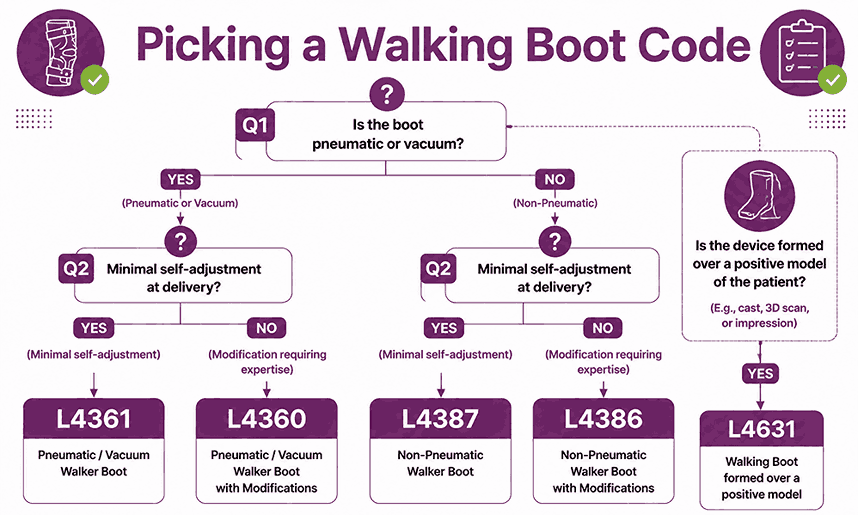
L4386: Non-Pneumatic Walking Boot, Custom Fitted
L4386 completes the second walking boot pair. Non-pneumatic construction plus fitting that requires specialized training produces this code rather than L4387. Both non-pneumatic codes describe complete products, which rules out separate billing for joints or padding.
L4631: Custom Fabricated Walking Boot
When no prefabricated boot fits the limb, the claim moves to L4631. Custom fabrication means the device was formed over a positive model of the patient, not modified from stock. Documentation must explain specifically why every prefabricated alternative was inadequate.
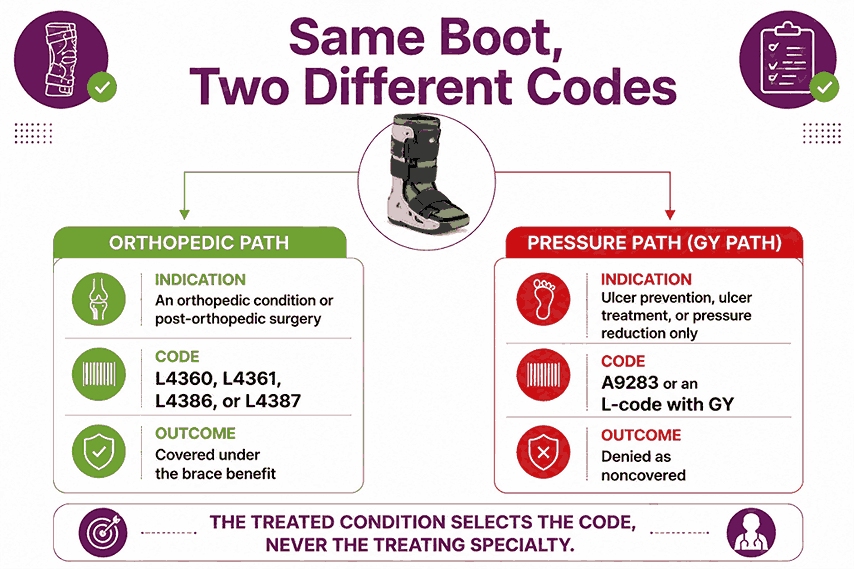
When Is a Walking Boot A9283 Instead of an L-Code?
The treated condition selects the code, not the treating specialty. A walking boot immobilizing an orthopedic condition, or following orthopedic surgery, uses L4360, L4361, L4386, or L4387.
A walking boot used solely for ulcer prevention, ulcer treatment, or pressure reduction uses A9283 instead. A9283 reports a foot pressure offloading or supportive device, any type, each.
An L-code billed when the boot serves only ulcer care requires the GY modifier. The claim is then denied as noncovered. The same patient moves between the two codes as the indication changes.
Which HCPCS Codes Cover Ankle-Foot Orthoses?
Ankle-foot orthoses divide by ambulatory status and by whether the code offers a fitting-level choice. Most AFO codes offer no choice at all.
Codes L1900 through L1990, L2106 through L2116, L4350, and L4631 describe orthoses worn by ambulatory beneficiaries. Codes L4396, L4397, and L4398 describe orthoses worn when the beneficiary is nonambulatory.
L1902: Ankle Orthosis, Prefabricated
An ankle gauntlet stops at the ankle, which is what separates L1902 from the calf-height AFO codes. Gauntlet or similar construction, with or without joints, defines the prefabricated device. A52457 assigns no fitting-level choice here, so one code covers every delivery scenario.
L4397: Static or Dynamic AFO, Off-the-Shelf
Plantar fasciitis night splints and contracture positioning devices both land at L4397. The static or dynamic AFO is adjustable for fit and supplied prefabricated off-the-shelf. CMS assigns L4397 to nonambulatory use rather than to ambulatory bracing.
L2397: Suspension Sleeve Addition
L2397 is an addition code and never stands alone on a claim. The suspension sleeve attaches to a compatible lower extremity base orthosis, which must appear on the same claim. RAC approved issue 0144 lists L2397 alongside the prefabricated knee orthoses.
L1906: Multiligamentous Ankle Support
L1906 covers an ankle-foot orthosis providing multiligamentous ankle support, prefabricated. Documentation records which ligamentous structures the orthosis stabilizes and why a simpler ankle orthosis falls short. A52457 assigns no fitting-level choice, so the delivery event does not change the code.
L4396: Static or Dynamic AFO, Custom Fitted
Fitting level is the only question separating L4396 from L4397. The two form a parallel set inside the ankle-foot family, unlike most AFO codes in this section. Contracture management and plantar fasciitis remain the dominant indications for both.
L1951: Spiral Ankle-Foot Orthosis, Prefabricated
Nationwide prior authorization has covered L1951 since August 12, 2024. A spiral shell in plastic or comparable material defines the orthosis, supplied prefabricated. No fitting-level choice exists for L1951, so the authorization submission is the only pre-delivery step.
L4350: Ankle Control Orthosis, Stirrup Style
L4350 covers an ankle control orthosis in a stirrup style, prefabricated. Coverage follows the same ambulatory weakness or deformity criteria that govern the walking boots. A52457 places L4350 in the no-fitting-choice group, so custom-fit language on the order changes nothing.
L1930, L1932, and L1971: Plastic and Rigid AFO Designs
Three plastic and rigid designs complete the ambulatory AFO set. L1930 covers a prefabricated ankle-foot orthosis in plastic or other material. L1932 joined the Required Prior Authorization List nationwide on April 13, 2026. L1971 adds an ankle joint, and all three sit in the no-fitting-choice group.
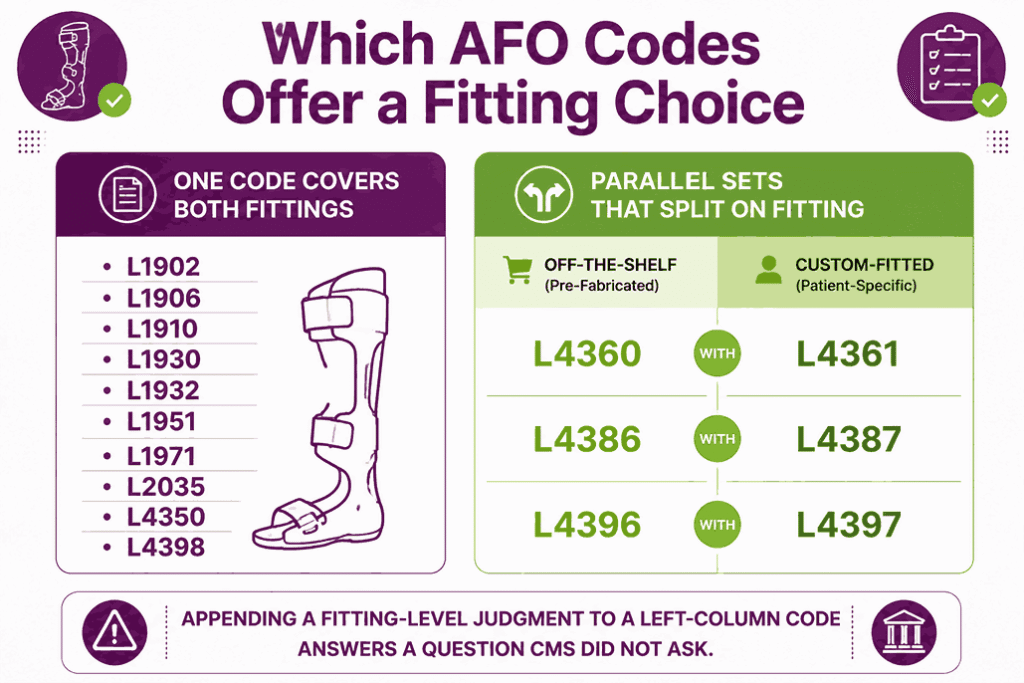
Which AFO Codes Serve Nonambulatory Beneficiaries?
Three codes serve nonambulatory beneficiaries: L4396, L4397, and L4398. Every other ankle-foot orthosis code in this section assumes the beneficiary walks.
Ambulatory status is a coverage question, not a comfort question. The ambulatory AFO codes are covered for beneficiaries with weakness or deformity of the foot and ankle. Those beneficiaries must require stabilization and be able to benefit functionally. A nonambulatory beneficiary fails that basic criterion.
Billing an ambulatory AFO code for a bedbound patient inverts the policy. The correct code for positioning without ambulation is L4396, L4397, or L4398, selected by fitting level and design.
Which HCPCS Codes Cover Wrist, Hand, Elbow, and Shoulder Orthoses?
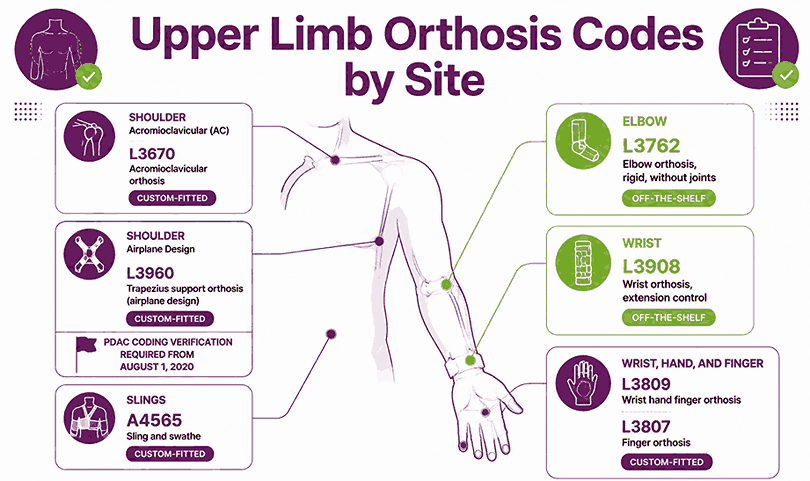
Seven upper limb codes carry meaningful orthopedic volume across the wrist, hand, elbow, and shoulder. The minimal self-adjustment test governs fitting level here exactly as it does in the lower limb.
Upper limb orthoses lack a national coverage determination equivalent to L33686. Coverage runs through the brace benefit and local policy. Diagnosis linkage on the claim line carries more weight here than usual.
L3908: Wrist Extension Control Orthosis, Off-the-Shelf
L3908 is the highest-volume upper limb orthosis in orthopedic practice. A non-molded cock-up design holds the wrist in extension, supplied prefabricated off-the-shelf. Searchers commonly look for an L3908 CPT code description, though L3908 belongs to HCPCS Level II.
L3670: Acromioclavicular Shoulder Orthosis, Off-the-Shelf
A figure-of-eight strap dispensed after clavicle fracture or acromioclavicular separation bills as L3670. The canvas and webbing shoulder orthosis is supplied prefabricated off-the-shelf. Laterality applies to the claim, so append RT or LT.
L3809: Wrist Hand Finger Orthosis, Off-the-Shelf
Coverage across the fingers is what separates L3809 from the wrist-only L3908. The jointless wrist hand finger orthosis is supplied prefabricated off-the-shelf. Delivery requiring only strap adjustment or trimming keeps the claim at this code rather than L3807.
L3960: Airplane Design Shoulder Orthosis
PDAC verification is a hard requirement on L3960, not a recommendation. The airplane-design shoulder elbow wrist hand orthosis provides abduction positioning and is supplied prefabricated. A written PDAC coding verification review applies to dates of service from August 1, 2020. Products without one are miscoded by default.
L3807: Wrist Hand Finger Orthosis, Custom Fitted
L3807 and L3809 describe the same jointless wrist hand finger orthosis. Only the fitting event separates them, and this code requires modification by someone with specialized training. The supplier record must describe what was modified and why.
L3762: Rigid Elbow Orthosis Without Joints
Immobilization rather than motion control is the point of L3762. The rigid elbow orthosis has no joints and includes soft interface material, supplied prefabricated off-the-shelf. Devices offering an adjustable range of motion fall to L3760 and L3761 instead.
A4565: Slings
A4565 is a supply code rather than an orthosis code, which shifts the documentation expectation. Slings bill as each. A sling dispensed within a covered surgical or fracture care episode is frequently bundled. Verify payer rules before billing A4565 separately.
Where Is the Fitting-Level Line on a Wrist-Hand-Finger Orthosis?
The line falls at whether fitting requires specialized training. L3809 and L3807 describe the same jointless wrist hand finger orthosis, and only the delivery event separates them.
Adjusting straps, bending the palmar bar, or trimming the edge for comfort counts as minimal self-adjustment, which produces L3809. Reshaping the device to accommodate a deformity, in a way requiring orthotic expertise, produces L3807.
Coders who assume a longer fitting appointment justifies L3807 apply the wrong test. Appointment length is not the standard. The nature of the modification is the standard, and the supplier record must describe it.
Which HCPCS Codes Cover Spinal Orthoses?
Spinal orthoses carry the worst improper payment profile of any orthopedic HCPCS family. CMS Local Coverage Determination L33790 and Policy Article A52500 govern thoracic-lumbar-sacral and lumbar-sacral orthoses.
Six lumbar-sacral codes form three fitting-level pairs. Every one of the six sits on the Face-to-Face and WOPD List, and five of the six require prior authorization.
L0650: LSO, Sagittal-Coronal Control, Rigid Frame, Off-the-Shelf
Prior authorization has applied to L0650 nationwide since October 10, 2022, alongside face-to-face and WOPD. The lumbar-sacral orthosis provides sagittal-coronal control through a rigid anterior and posterior frame, supplied off-the-shelf. Competitive Bidding Program membership adds the KV, J5, or J4 exception modifiers.
L0637: LSO, Sagittal-Coronal Control, Rigid Frame, Custom Fitted
L0637 is the custom-fitted counterpart to L0650. Lateral strength comes from rigid lateral frame or panels, and the posterior section extends from the sacrococcygeal junction to T-9. Nationwide prior authorization has applied since August 12, 2024.
L0648: LSO, Sagittal Control, Rigid Panels, Off-the-Shelf
Intracavitary pressure to unload the intervertebral discs is the mechanism behind L0648. Sagittal control comes from rigid anterior and posterior panels, supplied off-the-shelf. Nationwide prior authorization has applied since October 10, 2022, and L0648 sits inside competitive bidding.
L0651: LSO, Sagittal-Coronal Control, Rigid Shell, Off-the-Shelf
L0651 joined the Required Prior Authorization List nationwide on April 13, 2026. Sagittal-coronal control comes from rigid shells or panels, supplied off-the-shelf. A52500 classifies L0651 as a body jacket type alongside L0639 and L0640, requiring a rigid shell that encircles the trunk.
L0631: LSO, Sagittal Control, Rigid Panels, Custom Fitted
CMS uses L0631 as its published example of a claim recouped for missing proof of delivery. The sagittal control rigid panel orthosis is supplied custom fitted. Nationwide prior authorization has applied since August 12, 2024.
L0639: LSO, Sagittal-Coronal Control, Rigid Shell, Custom Fitted
Shell uniformity is the technical requirement behind L0639. The entire circumference of the plastic shell must be the same rigid material, with overlapping edges and stabilizing closures. This body jacket type orthosis is supplied custom fitted, and nationwide prior authorization has applied since August 12, 2024.
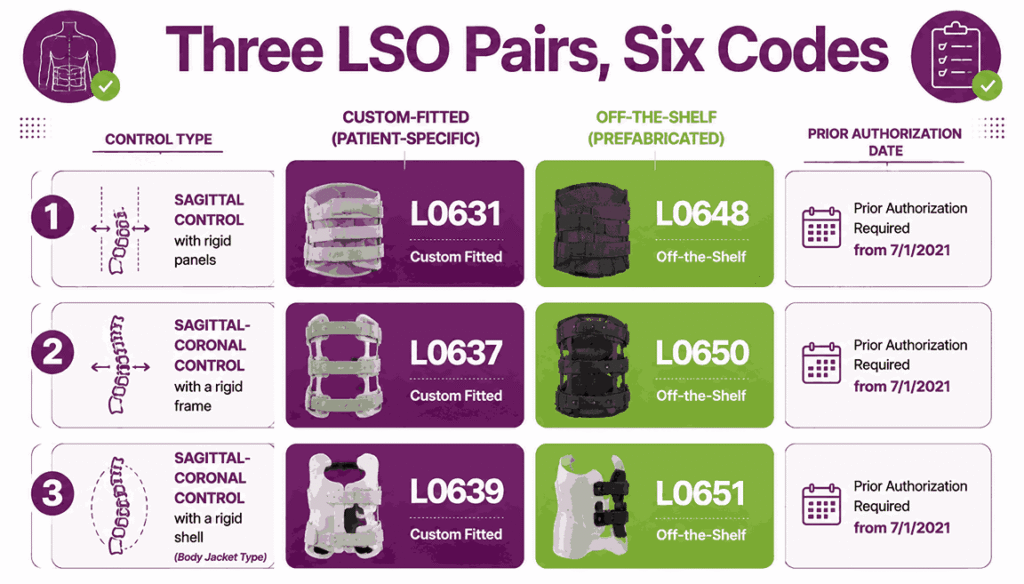
How Do the Three LSO Pairs Line Up?
Control type picks the pair, and fitting level picks the code inside it. Two questions, answered in that order, resolve all six lumbar-sacral codes.
Control type comes first. Sagittal control with rigid panels gives L0631 or L0648. Sagittal-coronal control with a rigid frame gives L0637 or L0650. Sagittal-coronal control with a rigid shell gives L0639 or L0651.
Fitting level comes second. Minimal self-adjustment produces L0648, L0650, or L0651. Modification requiring specialized training produces L0631, L0637, or L0639. Pairing across control types, such as billing L0631 against an L0650 device, misstates the orthosis.
Which HCPCS Codes Cover Orthopedic Injectables?
Orthopedic injectables split into two groups: viscosupplementation agents and corticosteroid or anesthetic agents. Both groups bill as HCPCS Level II drug codes alongside a CPT administration code.
Unit calculation is where these claims fail. The billing unit comes from the code descriptor, never from the vial or syringe size.
Which HCPCS Codes Cover Viscosupplementation Injections?
Six hyaluronan codes carry orthopedic volume, and the products are not interchangeable. CMS billing and coding guidance under LCD L30149 governs unit reporting. Novitas LCD L35427 governs coverage in several jurisdictions.
Coverage sits at carrier judgment, so the governing LCD varies by Medicare Administrative Contractor. One rule holds across contractors: only one injection service is allowed per knee.
J7325: Synvisc and Synvisc-One
J7325 is the one hyaluronan code that ignores dose entirely. Synvisc and Synvisc-One bill in 1 mg increments, so the claim lists total milligrams administered. Reporting a single unit after a three-injection series underbills the entire course.
J7323: Euflexxa
J7323 covers Euflexxa for intra-articular injection, per dose. A single injection bills as one unit regardless of milligrams delivered. Reporting a milligram count here overcodes the claim and triggers a unit review.
J7321: Hyalgan, Supartz, and Visco-3
Three separate branded products share J7321: Hyalgan, Supartz, and Visco-3. Visco-3 was added to the code effective April 1, 2021. Moving a patient to a product outside this group mid-series requires a code change for the remaining injections.
J7324: Orthovisc
Product identity, not dose size, drives J7324. Orthovisc bills per dose under this code and under no other. Substituting a different hyaluronan without changing the code is a leading viscosupplementation denial cause.
J7327: Monovisc
J7327 covers Monovisc for intra-articular injection, per dose. A single-injection course makes the unit calculation straightforward. Confirm the administered product against the code before submission, because every hyaluronan code is product-specific.
J7326: Gel-One
Gel-One completes the per-dose group, billing as J7326. The code joins J7321, J7323, J7324, and J7327 in describing a full dose rather than a milligram increment. The National Drug Code appears on the claim line here as on every Medicare Part B drug.
J7322, J7328, J7329, and J7331: Additional Hyaluronan Products
Four additional branded hyaluronan products carry their own codes: J7322, J7328, J7329, and J7331. Each is product-specific, and the billing unit differs from code to code. Read the current descriptor before reporting units, because some describe a dose and others a milligram increment.
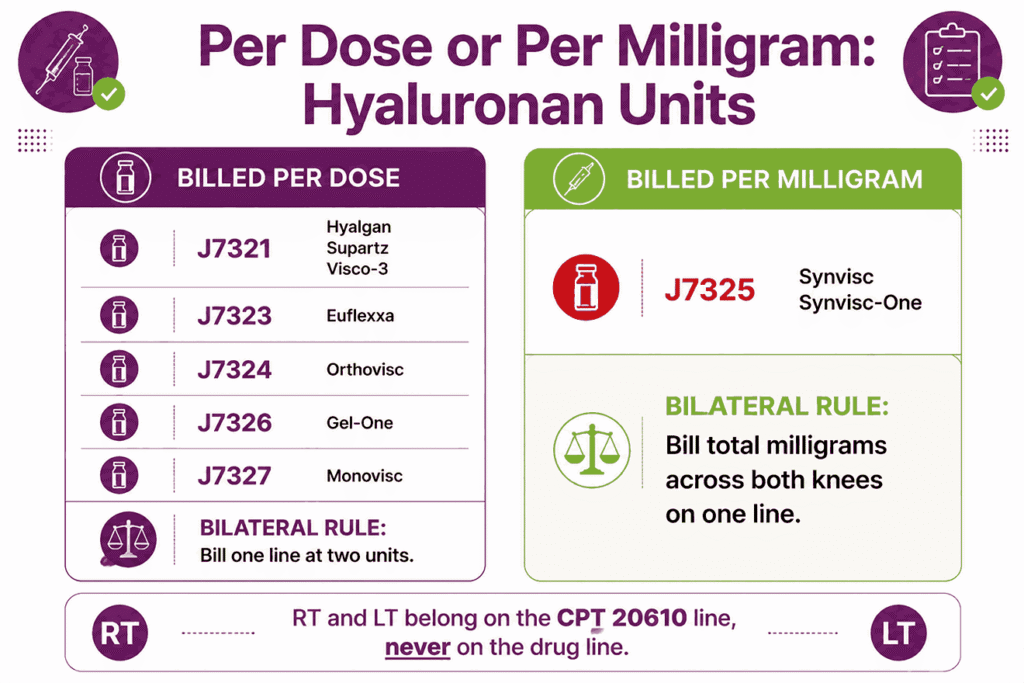
Why Is J7325 the Only Code Billed by Milligram?
J7325 describes Synvisc and Synvisc-One in 1 mg increments, while the other five main hyaluronan codes describe a complete dose. That descriptor difference changes both the unit math and the bilateral reporting method.
Bilateral administration follows two different rules as a result:
- Per-dose codes J7321, J7323, J7324, and J7326 are reported on a single line with a unit of 2
- J7325 is reported by listing the total milligrams administered across both knees
Submitting two separate line items with one unit each on a per-dose code triggers duplicate claim edits. Laterality does not go on the drug line at all. RT and LT belong on the CPT 20610 administration line accompanying the drug.
Which HCPCS Codes Cover Corticosteroid and Anesthetic Injections?
Four corticosteroid codes carry the bulk of orthopedic joint injection volume. These codes appear across pain management, rheumatology, and dermatology as well. Confirm the descriptor and unit against the administered product each time.
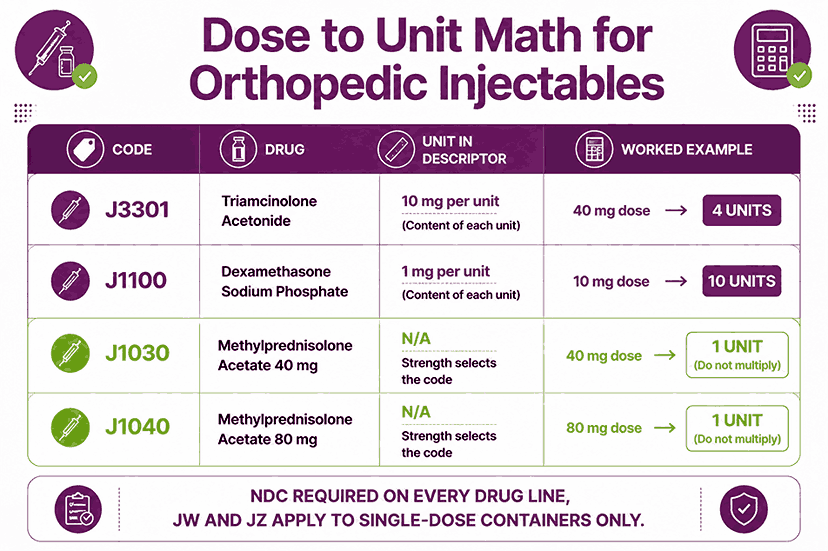
Unit calculation follows the same rule as every other Part B drug. Divide the administered dose by the unit stated in the code descriptor.
J3301: Triamcinolone Acetonide
An NDC on the claim line is non-negotiable for J3301. Triamcinolone acetonide, not otherwise specified, bills in 10 mg units, so a 40 mg dose reports as four. Payers reject drug lines carrying HCPCS units without a matching NDC and unit qualifier.
J1100: Dexamethasone Sodium Phosphate
Multi-dose vials put J1100 outside the discarded-drug rules entirely. Dexamethasone sodium phosphate bills in 1 mg units. JW and JZ apply only to single-dose containers and single-use packages, so a multi-dose vial needs neither modifier.
J1030: Methylprednisolone Acetate, 40 mg
Strength administered, not volume drawn, picks between J1030 and J1040. Methylprednisolone acetate at 40 mg bills under this code. An 80 mg dose is never two units of J1030.
J1040: Methylprednisolone Acetate, 80 mg
J1040 covers methylprednisolone acetate at 80 mg. Vial strength selects the code, and the two strengths are not interchangeable on a claim. Confirm the strength against the code before submission rather than after the denial.
Unit math, NDC reporting, and the JW and JZ discarded-drug rules apply identically across every Part B drug family. The full framework, including the July 1, 2023 modifier requirement, is covered in the neurology HCPCS codes reference.
Which HCPCS Codes Cover Orthopedic Equipment and Supplies?
Orthopedic equipment and supply codes divide into four groups. Those groups are mobility equipment, cold therapy, cast supplies, and non-covered items. Coverage status differs sharply across the four.
Mobility equipment is covered durable medical equipment. Cold therapy sits inside the DME benefit but fails the reasonable and necessary test. Cast supplies route to a different contractor. The fourth group is not covered at all.
Which HCPCS Codes Cover Post-Operative Mobility Equipment?
Five codes cover the ambulatory aids and stimulation devices dispensed after orthopedic surgery. Each is durable medical equipment billed to the DME MAC with an equipment status modifier.
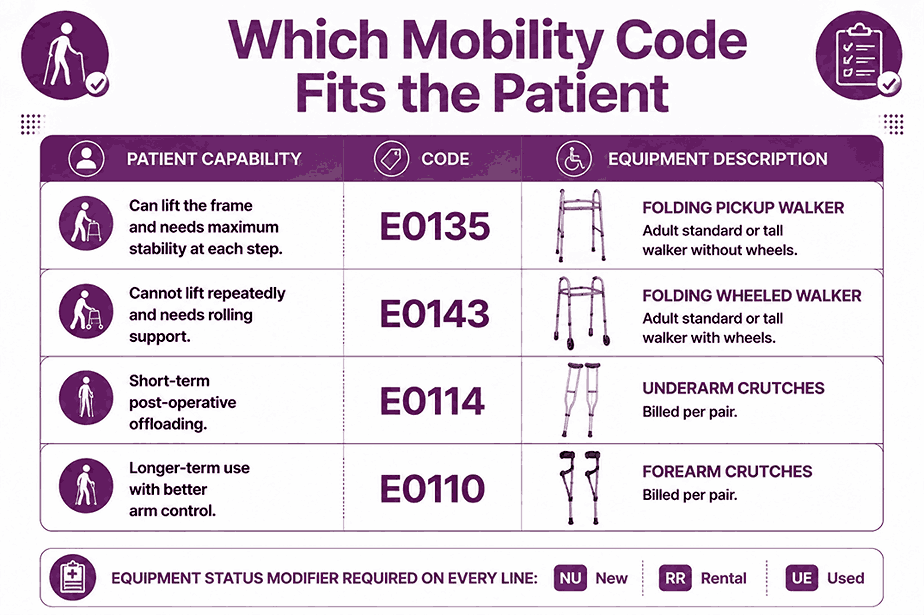
Purchase status changes the modifier. NU reports new equipment, RR reports a rental, and UE reports used equipment.
E0143: Folding Wheeled Walker
E0143 is the highest-volume post-operative mobility code in orthopedic practice. A folding wheeled frame, adjustable or fixed height, defines the equipment. Searchers frequently look for an E0143 CPT code description, though E0143 is HCPCS Level II. Wheels separate it from the pickup walker at E0135.
E0114: Underarm Crutches
Pairs, not units, are how E0114 bills. Underarm crutches other than wood, adjustable or fixed, with pads, tips, and handgrips, report as one line for two crutches. The phrase E0114 CPT code description appears often in search, though E0114 belongs to HCPCS Level II.
E0730: TENS Unit, Four or More Leads
Lead count alone separates E0730 from E0720. Four or more leads for multiple nerve stimulation belong here. Coverage rules for TENS devices sit outside the orthosis policies and follow the applicable TENS local coverage determination.
E0135: Folding Pickup Walker
A patient who can lift the frame but needs maximum stability at each step gets E0135. The folding pickup walker has no wheels. Documentation must support why a walker rather than a cane, and why the pickup style suits the gait pattern.
E0110: Forearm Crutches
Forearm crutches bill as E0110, also per pair. Various materials qualify, adjustable or fixed, with tips and handgrips included. Forearm crutches suit longer-term use, while underarm crutches suit short post-operative recovery.
E0135 vs E0143: Does the Walker Have Wheels?
Wheels decide the code. E0143 reports a folding wheeled walker, and E0135 reports a folding pickup walker with no wheels.
The clinical distinction drives the documentation. A patient who lacks the upper body strength to lift a walker repeatedly requires wheels, which supports E0143. A patient who needs maximum stability at each step, and who can lift the frame, supports E0135.
Records describing only “a walker” support neither code cleanly. The order and the medical record must name the style, because the supplier cannot assign wheels after the fact.
Which HCPCS Codes Cover Cold Therapy Equipment?
Two cold and heat therapy codes appear on orthopedic claims after surgery. Both sit inside the durable medical equipment benefit under Social Security Act section 1861(s)(6), and neither is payable by Medicare.
Benefit category and payment are separate questions. That split makes this family a modifier problem rather than a coverage problem.
E0218: Fluid Circulating Cold Pad With Pump
E0218 is the cleanest GA case in orthopedic billing. A fluid circulating cold pad with an electric pump sits inside the DME benefit. Medicare still denies it as not reasonable and necessary under Local Coverage Determination L33735. An ABN on file makes GA correct, not GY.
E0217: Water Circulating Heat Pad With Pump
E0217 covers the water circulating heat pad with pump. Cold therapy policy article A52460 governs it alongside E0218, with the same payment outcome. Non-electric reusable hot or cold wraps fall to A9273 instead.
Which HCPCS Codes Cover Cast and Splint Supplies?
Cast and splint supply codes report the material, never the work of applying it. These codes route to the A/B MAC alongside the CPT application code, not to the DME MAC.
Supply codes split by cast site, patient age, and material. Adult codes cover ages 11 and over, and pediatric codes cover ages 0 through 10.
Q4038: Short Leg Cast, Adult, Fiberglass
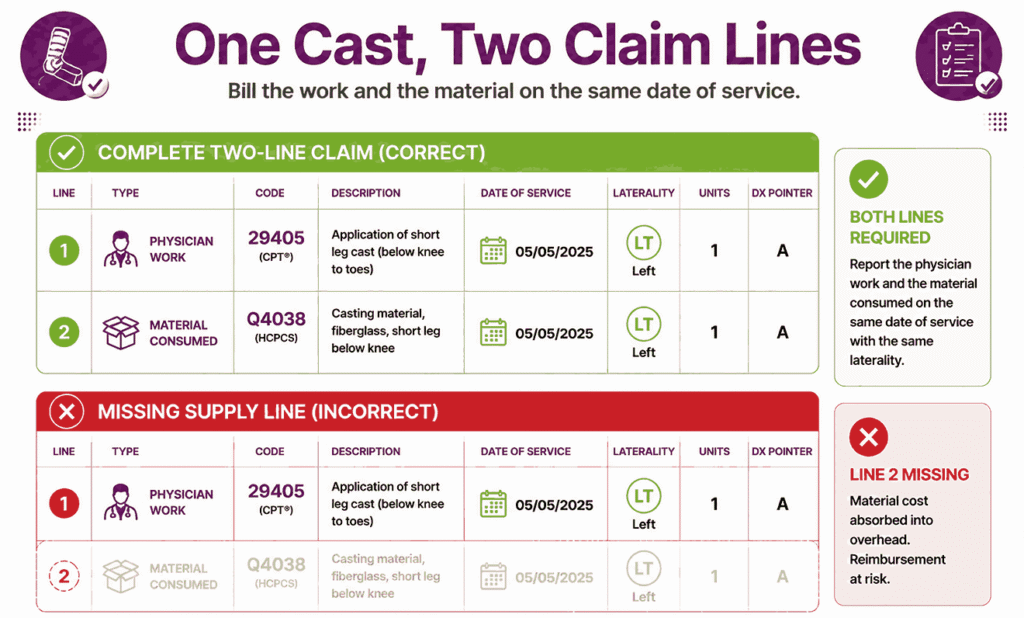
A short leg fiberglass cast on an adult consumes material billed as Q4038. Material is all this code pays for, never the application work. Practices billing the application without the supply leave the material cost unreimbursed on every cast.
Q4010: Short Arm Cast, Adult, Fiberglass
Q4010 is the short arm equivalent, covering adult fiberglass cast supplies. Patient age at the date of service selects the code, and the pediatric version bills under Q4012. Adult codes cover ages 11 and over.
A4570 and A4580: Splint and Plaster Cast Supplies
Two A-codes catch what the Q-code series misses. A4570 covers a splint, and A4580 covers cast supplies such as plaster. Prefabricated splint material dispensed outside the Q-code cast series belongs at A4570. Neither carries independent search demand, though both close reimbursement gaps on immobilization encounters.
How Does a Cast Supply Q-Code Pair With Its CPT Application Code?
Every cast produces two claim lines. The CPT application code reports the physician work of placing the cast, and the HCPCS Q-code reports the material consumed.
Both lines carry the same date of service and the same laterality. Neither line replaces the other, and neither is bundled into the other by rule.
The failure mode is one-sided. Practices bill the application code because it sits in the procedure workflow. The supply code gets omitted because it sits in the inventory workflow. The material cost absorbs into overhead silently, one cast at a time.
Which HCPCS Codes Report Non-Covered and Miscellaneous Items?
Six codes report items Medicare does not pay for, or items with no specific code of their own. These codes exist to generate a clean denial, not a payment.
A clean denial has real value. It establishes beneficiary liability, closes the claim, and opens secondary billing. A missing or wrong non-covered code leaves the balance stranded.
A9270: Non-Covered Item or Service
Routing, not coverage, is what practices get wrong with A9270. A non-covered item or service with no specific code and no not-otherwise-classified match belongs here. A9270 goes to the DME MAC only. A/B MACs have not accepted the code since January 1, 2002.
L3260: Surgical Boot or Shoe
L3260 covers a surgical boot or shoe, billed as each, and Medicare denies it as noncovered. Policy Article A52481 places orthopedic footwear outside the benefit by statute. One exception restores coverage: a shoe integral to a covered leg brace, billed with KX. Without KX, append GY.
A9273: Non-Electric Hot or Cold Wraps
Anything without an electric pump lands at A9273. Hot or cold water bottles, ice caps and collars, and heat or cold wraps of any type all qualify. Gravity-fed ice water devices belong here rather than under the cold therapy equipment codes.
L2999: Lower Extremity Orthosis, Not Otherwise Specified
L2999 exists for replacement components with no unique code of their own. Lower extremity orthosis parts that HCPCS does not name individually belong here. Items with a unique code must never be billed under L2999. Misuse of the code invites a coding verification request.
L3999: Upper Limb Orthosis, Not Otherwise Specified
The upper limb follows the same rule under L3999. A not-otherwise-specified code is a last resort. Exhaust the specific code set and the PDAC product classification list first.
A9283: Foot Pressure Offloading Device
Indication moves a device to A9283, which reports a foot pressure offloading or supportive device, any type, each. The code replaces the walking boot L-codes when the device serves only ulcer prevention, ulcer treatment, or pressure reduction. Treating specialty never enters the decision.
Why Does A9270 Go to the DME MAC and Not the A/B MAC?
A9270 has been unacceptable to A/B MACs since January 1, 2002. CMS instructed carriers to stop accepting the code on that date, and the restriction still stands.
Two different routes apply as a result:
- DME MAC claims: suppliers use A9270 for statutorily non-covered items and items outside any Medicare benefit, where no not-otherwise-classified code fits
- A/B MAC claims: the appropriate not-otherwise-classified code is used instead, carrying either GY or GZ
An orthopedic practice billing A9270 to the Part B carrier receives an unprocessable claim, not a denial. An unprocessable claim carries no appeal rights and establishes no beneficiary liability. The distinction between those two outcomes is the entire reason the routing matters.
Why Do Orthopedic HCPCS Claims Get Denied?
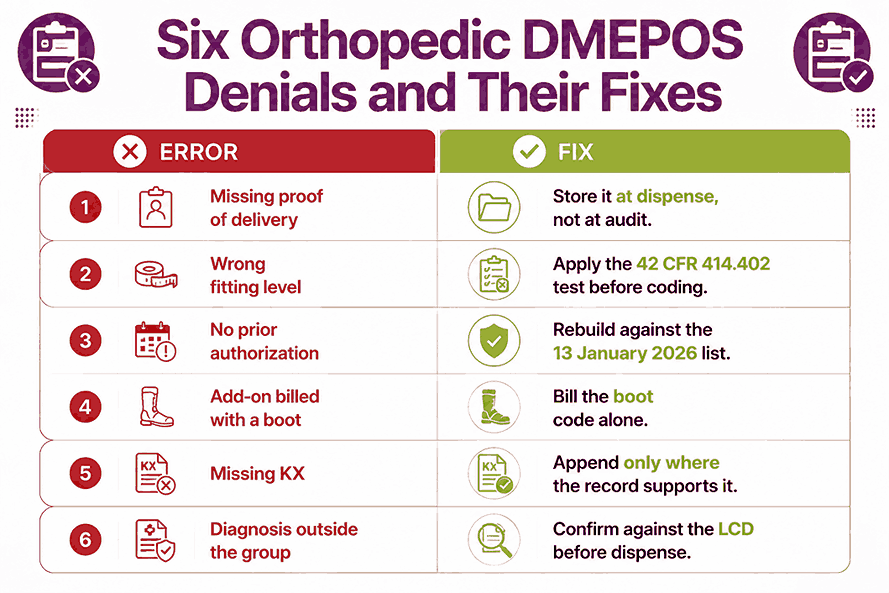
Orthopedic HCPCS claims get denied for six recurring reasons, and five of the six are administrative rather than clinical. Each has a defined fix operating before submission.
Documentation failure dominates the category. Insufficient and missing documentation together caused 84.5 percent of improper payments for lumbar-sacral orthosis in the CMS reporting period. Medical necessity caused 0.3 percent.
Why Do Claims Deny Without Proof of Delivery?
The Error: Submitting a standard written order and a complete practitioner record without proof of delivery. The review contractor scores the claim as a no-documentation error, and the MAC recoups payment.
Fix: Store proof of delivery in the supplier file at the moment of dispense, not at the moment of audit. Proof of delivery is a supplier standard, and services lacking it are denied as not reasonable and necessary.
Why Does the Wrong Fitting Level Fail a Review?
The Error: Billing the custom-fitted code when delivery required only strap adjustment or trimming. The device is identical, so the record cannot support the code selected.
Fix: Document what happened at fitting, in the supplier record, on the day of delivery. Apply the minimal self-adjustment test at 42 CFR 414.402 before the code is assigned. Check first whether the code even offers a fitting-level choice.
What Happens When Prior Authorization Is Missed?
The Error: Dispensing L1852, L0651, L1844, L1846, or L1932 from stock without a provisional determination. All five joined the Required Prior Authorization List nationwide on April 13, 2026.
Fix: Rebuild the dispense workflow against the January 13, 2026 version of the Required Prior Authorization List. Reserve the ST modifier for genuine post-surgical and emergent need, because ST claims face 50 percent prepayment review.
Why Are Add-On Codes Denied With a Walking Boot?
The Error: Reporting interface material, joints, or other additions alongside L4360, L4361, L4386, or L4387. Claims for add-on codes billed with walking boots are denied as unbundling.
Fix: Bill the boot code alone. The four walking boot codes describe complete products, and a custom fabricated boot uses L4631 with separate justification.
What Does a Missing KX Attestation Cost?
The Error: Billing orthopedic footwear or a coverage-criteria item without KX. Shoes, inserts, heel and sole replacements, and shoe transfers billed without KX are denied as noncovered. Coverage is statutorily excluded.
Fix: Append KX only where the record supports it, such as a shoe integral to a covered leg brace. Use GY for statutorily excluded items, and GA where an ABN covers an item denied as not reasonable and necessary.
Why Does a Supported Diagnosis Still Deny?
The Error: Linking a brace to a diagnosis outside the payer coverage group under the applicable LCD. The device is appropriate, the documentation is complete, and the claim still denies on medical necessity.
Fix: Confirm the diagnosis against the LCD before dispense. Carry the diagnosis code on the claim line for the knee orthosis codes A52465 names, beginning at L1830. Match each brace to a supporting orthopedic diagnosis code. The device, the fitting level, and the condition then describe one clinical picture.
Front-end validation returns this money faster than any appeal. One pre-submission pass catches all six.
Check the fitting level, the prior authorization status, the proof of delivery, the modifier, and the diagnosis group. Practices running that pass through orthopedic brace and DME billing move the check to charge entry. A correction there costs minutes instead of a recoupment cycle.
What Changed for Orthopedic HCPCS Codes in 2026?
Three changes affect orthopedic HCPCS billing in 2026, and all three concern prior authorization rather than code descriptors. The orthopedic device code set itself remained largely stable.
Which Codes Joined the Prior Authorization List on April 13, 2026?
L0651, L1844, L1846, L1852, and L1932 became subject to nationwide prior authorization on April 13, 2026. The addition covers one lumbar-sacral orthosis, three knee orthoses, and one ankle-foot orthosis.
L1852 carries the largest operational impact. The double upright off-the-shelf knee orthosis moved from same-day dispense to pre-delivery review in a single step.
What Did CMS Change on January 13, 2026?
CMS updated the Required Prior Authorization List, defined at 42 CFR 414.234(c)(1), with a revision date of January 13, 2026. The list is the authoritative record of which codes require a provisional determination and from which date.
Any internal brace policy referencing an earlier version of the list is out of date. The list changes without a code descriptor change, which is why annual code-set review alone misses it.
How Often Do HCPCS Level II Codes Update?
HCPCS Level II codes update annually on January 1, with quarterly updates for drug and biological codes. Orthosis L-codes follow the annual cycle. Drug J-codes shift more often because Average Sales Price pricing recalculates every quarter.
Viscosupplementation products in particular move between codes as manufacturers change. Visco-3 joined J7321 effective April 1, 2021, and product-to-code assignments continue to shift.
Orthopedic HCPCS Codes: Frequently Asked Questions
Are Orthopedic HCPCS Codes the Same as CPT Codes?
No, orthopedic HCPCS Level II codes report the brace, supply, or drug, while CPT codes report the physician work. CPT is technically HCPCS Level I, maintained by the American Medical Association. CMS maintains Level II. Both appear on the same claim for a single encounter.
What Is the Difference Between an Off-the-Shelf and a Custom-Fitted Brace Code?
Nothing about the device differs. CMS states there is no physical difference between paired orthoses coded off-the-shelf and custom-fitted. The differentiator is whether fitting at delivery requires more than minimal self-adjustment. Many prefabricated codes offer no fitting-level choice at all.
Which Orthopedic Braces Require Prior Authorization?
Fifteen orthopedic orthosis codes require nationwide prior authorization. The list covers L0631, L0637, L0639, L0648, L0650, L0651, L1832, L1843, L1844, L1845, L1846, L1851, L1852, L1932, and L1951. Effective dates run from October 10, 2022 through April 13, 2026.
What Is the HCPCS Code for a Walking Boot?
Four codes report a prefabricated walking boot. L4361 covers a pneumatic boot off-the-shelf, and L4360 covers the same boot custom fitted. L4387 covers a non-pneumatic boot off-the-shelf, and L4386 covers it custom fitted. A custom fabricated walking boot uses L4631.
Can an Orthopedic Practice Bill for Braces Without a DMEPOS Supplier Number?
No, billing DMEPOS items to the DME MAC requires an active DMEPOS supplier number. Compliance with the supplier standards, including proof of delivery, also applies. Physicians and non-physician practitioners furnishing items to their own patients face specific enrollment conditions under 42 CFR 424.57. Many practices offload that ongoing compliance burden to dedicated orthopedic billing providers rather than staffing it internally.”
Are Cast Supplies Billed Separately From Cast Application?
Yes, cast application bills under a CPT code covering the physician work. Cast material bills under a HCPCS Q-code such as Q4038 or Q4010. Both lines carry the same date of service and laterality. Omitting the supply line leaves the material cost unreimbursed.
What Documentation Does Medicare Require for a Knee Brace Claim?
Medicare requires a standard written order with correct HCPCS coding, the treating practitioner medical record, and proof of delivery. Records for L1832 and L1833 must document a physical examination of the affected knee. Exam findings must support objective joint laxity.