HCPCS code L1833 describes a prefabricated, off-the-shelf knee orthosis with adjustable unicentric or polycentric joints and rigid support. It is a rigid, adjustable-joint brace fitted with only minimal self-adjustment, not custom fabrication.
L1833 carries a coding fork found on few other codes. It describes a physically identical brace to custom-fitted L1832, and the two are separated only by who performs the fitting. For two years they carried opposite prior-authorization burdens, and that window closes on October 28, 2026, when L1833 returns to required prior authorization nationwide.
That distinction, plus the competitive-bidding gap period that governs current pricing, drives most billing risk on the code, and it is the kind of detail dedicated orthopedic billing support tracks claim by claim.
What Is the Description of HCPCS Code L1833?
The L1833 HCPCS code descriptor as defined by CMS is: “Knee orthosis, adjustable knee joints (unicentric or polycentric), positional orthosis, rigid support, prefabricated, off-the-shelf.”
This code reports a rigid, adjustable knee brace taken from stock and fitted with minimal adjustment. HCPCS code L1833 controls knee position through adjustable unicentric or polycentric joints on a rigid frame. The term “off-the-shelf” is a fitting classification, not a quality statement.
The code was added to the HCPCS set on January 1, 2014, alongside the elastic off-the-shelf code L1812. L1833 is the off-the-shelf member of a code pair, and its custom-fitted twin, L1832, describes the same physical device fitted differently.
Which Codes Are Billed Alongside L1833, and Which Are Not Separately Payable?
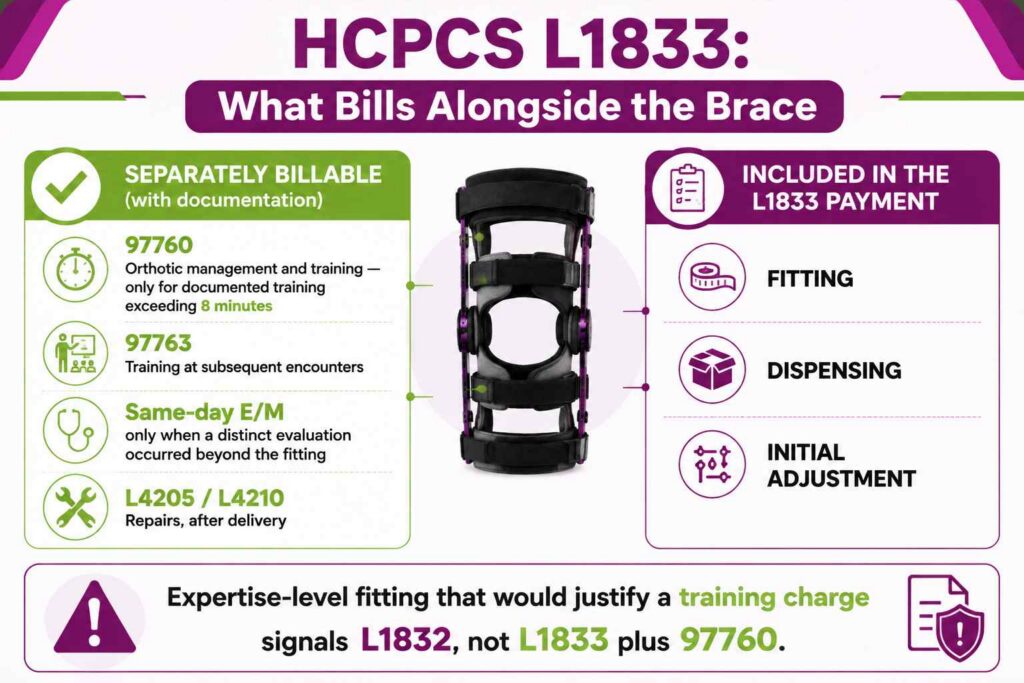
Some services can accompany HCPCS code L1833, while others are part of the dispensing and never billed separately. The distinction turns on whether a separately identifiable service occurred.
- 97760 orthotic management and training is billable only for documented training exceeding 8 minutes, never for fitting or dispensing the brace
- Expertise-level fitting that would justify a training charge signals L1832 rather than L1833 plus 97760, and 97763 covers training at subsequent encounters
- A same-day office evaluation and management service is separately billable only when a distinct, documented evaluation occurred beyond the brace fitting
- Repair codes L4205 and L4210 apply after delivery for later repairs, not at the initial dispensing
Fitting and dispensing are included in the L1833 payment. A training or evaluation line requires its own documented service, and the presence of substantial training work is itself a signal that the device may have been custom-fitted. Orthotic training and management services like 97760 and 97763 sit among the procedure codes used across orthopedics, separate from the device code itself.
What Device Does HCPCS Code L1833 Represent?
HCPCS code L1833 represents a rigid knee orthosis with adjustable joints that holds the knee in a controlled position. The descriptor names its features directly, and each one excludes a neighboring code.
- Adjustable knee joints, either unicentric or polycentric, that set and change the permitted range of motion
- A positional orthosis design that holds the knee at a set position or within a set range
- Rigid support, which separates it from elastic knee orthoses with joints
- A prefabricated build supplied off the shelf and fitted with minimal self-adjustment
The descriptor does not specify an upright configuration, so single- and double-upright thigh-and-calf designs report under their own codes. The typical use is early rehabilitation following knee surgery, where the joint needs both support and a controlled, adjustable range.
What Separates Off-the-Shelf L1833 From Custom-Fitted L1832 When the Brace Is Physically Identical?
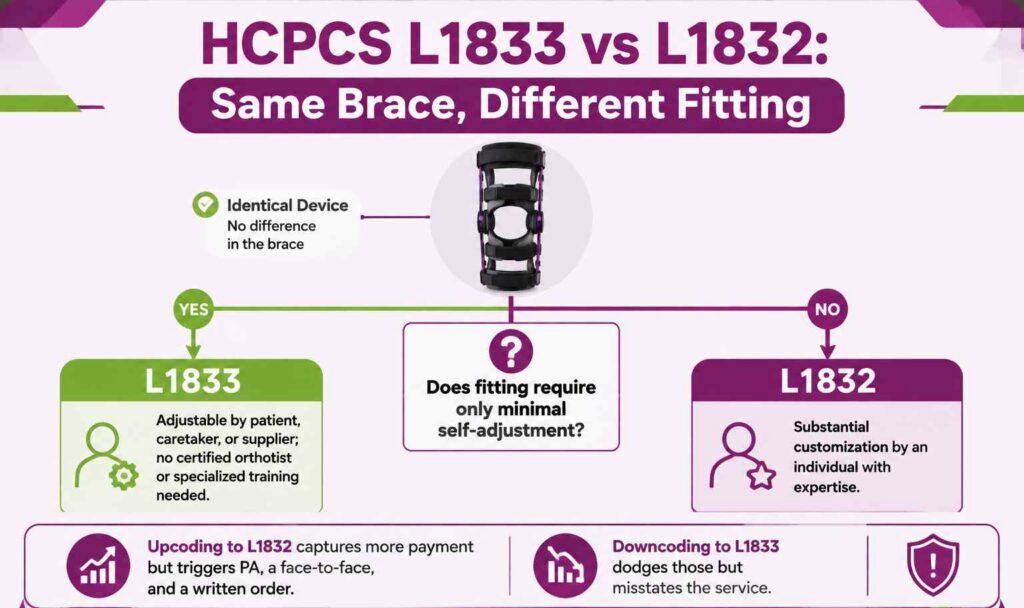
There is no physical difference between the prefabricated orthoses coded off-the-shelf versus custom-fitted. Per Policy Article A52465, the differentiating factor is whether fitting requires only minimal self-adjustment.
- Minimal self-adjustment can be performed by the patient, the caretaker, or the supplier
- Minimal self-adjustment does not require a certified orthotist or an individual with specialized training
- Items requiring only minimal self-adjustment are coded off-the-shelf as L1833
- Items requiring substantial customization by an individual with expertise are coded L1832
The same brace can be either code, decided entirely by the fitting performed. This is why supplier records, not the device itself, are the evidence that separates HCPCS code L1833 from L1832.
Why L1833 Returns to Prior Authorization on October 28, 2026
EffCMS removed HCPCS code L1833 from the Master List effective August 12, 2024, which took it off the Required Prior Authorization List. A Federal Register notice published July 30, 2026 reinstates it, and prior authorization for L1833 resumes nationwide for dates of service on or after October 28, 2026.
- From August 12, 2024 through October 27, 2026, L1833 required no prior authorization, face-to-face encounter, or written order prior to delivery
- From October 28, 2026, an affirmed prior authorization decision is a condition of payment, and the request package must include the written order prior to delivery and the face-to-face examination
- L1832 and L1851 have required prior authorization since the 2022 rollout, L1843 and L1845 since August 12, 2024, and L1844, L1846, and L1852 since April 13, 2026
- A standard written order and medical-necessity documentation remain mandatory in either period
Two codes describing the same physical device carried opposite pre-claim burdens for about two years. From October 28, 2026 both require authorization, so the lasting differences are the fitting performed, the delivery method, and the payment amount.
How Does L1833 Differ From Other Prefabricated Knee Orthosis Codes (L1831, L1843, L1845, L1851, L1852)?
Base-code selection within the prefabricated knee orthosis family turns on joint type, rigidity, and control mechanism. Each code describes a different device configuration.
- L1831 knee orthosis with locking knee joint(s), positional orthosis, prefabricated, includes fitting and adjustment
- L1833 adjustable knee joints, rigid support, prefabricated, off-the-shelf
- L1843 and L1845 single upright and double upright thigh-and-calf orthoses with adjustable flexion and extension joints and medial-lateral and rotation control, both custom fitted
- L1851 and L1852 the off-the-shelf versions of those single upright and double upright designs
The joint mechanism and the upright structure decide the base code. HCPCS code L1833 is the adjustable-joint, rigid, positional option supplied off the shelf, distinct from the locking-joint brace and the thigh-and-calf upright configurations in the family. Joint type, rigidity, and upright structure sort the whole run of orthopedic bracing and orthosis codes, where each configuration gets its own L-code.
When Does a Knee Orthosis Require Custom-Fabricated Code L1834 Instead?
A knee orthosis requires the custom-fabricated code when the device is molded to a model of the patient, not selected from stock. This is the prefabricated-to-custom-fabricated boundary.
- L1833 and the rest of the prefabricated family are stock devices fitted to the patient
- L1834 is a custom-fabricated knee orthosis without joints, molded to a patient model
- L1836 is a rigid knee orthosis without joints that includes soft interface material and is supplied prefabricated, off-the-shelf, so it is not a custom-fabricated code
- Custom fabrication means the device is built from the individual patient’s model, a different process from fitting a stock brace
Custom fabrication describes a construction method, while L1833 describes a fitting classification of a stock item. A brace built to a patient cast or scan is L1834, not any prefabricated code, and L1836 belongs with the prefabricated jointless braces.
What ICD-10 Codes and Medical Necessity Criteria Support HCPCS Code L1833?
Medical necessity for HCPCS code L1833 rests on objective knee instability or a qualifying contracture, documented per LCD L33318. Generic instability language without the specific findings does not meet the standard.
- Objective knee instability supported by a physical examination that documents the specific joint laxity tests performed
- Knee flexion or extension contracture meeting the LCD definitions
- Diagnoses such as M23.5 (Chronic instability of knee) and M24.56 (Contracture of knee)
- Documentation that the patient expresses willingness to use the orthosis
The physical examination is the gate. Claims that fail these criteria are denied as not reasonable and necessary, so the record must name the laxity tests performed rather than assert instability in general terms. Coding chronic instability and contracture correctly, across the M23 and M24 families, follows the same orthopedic diagnosis coding discipline the LCD expects.
What Are the Modifiers for HCPCS Code L1833?
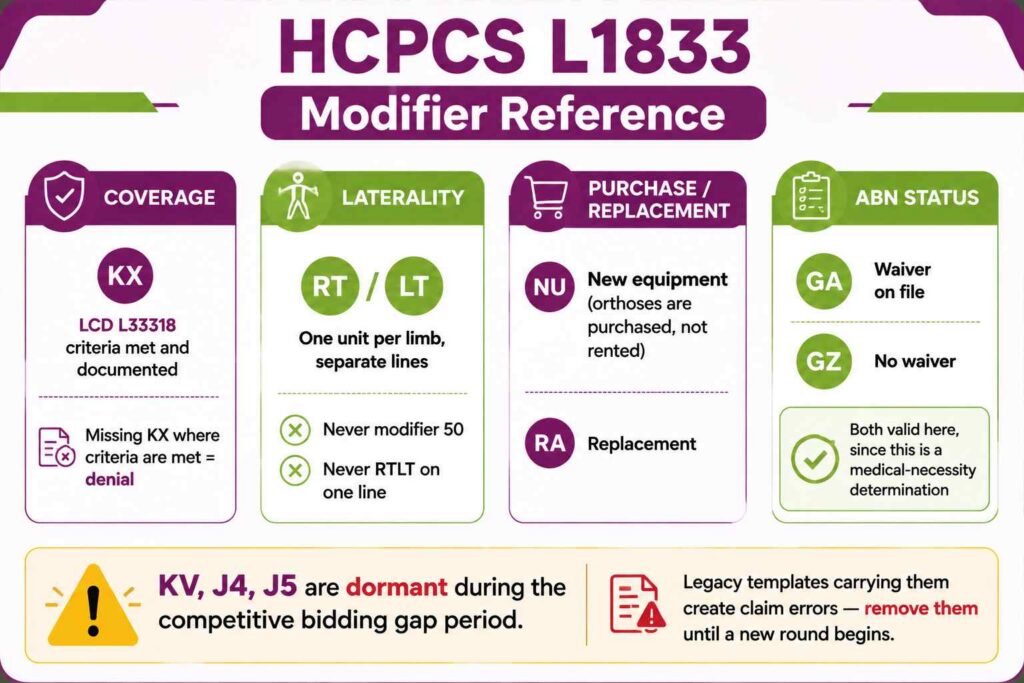
HCPCS code L1833 uses modifiers that signal coverage, laterality, purchase type, and replacement. Laterality is required on every claim line.
Modifier KX: Coverage Criteria in LCD L33318 Are Met
Modifier KX attests that the coverage criteria in LCD L33318 are met and documented. Append KX to HCPCS code L1833 when the record supports objective instability or a qualifying contracture. A claim missing KX where the criteria are met is denied.
Modifiers RT and LT: One Unit Per Limb on Separate Claim Lines
Modifiers RT and LT identify the right and left limb. Bill L1833 as one unit per limb on separate claim lines, never as modifier 50 and never as RTLT on a single line. A bilateral fitting is two lines, each with one unit of service and its matching laterality modifier.
Modifier NU: New Equipment Purchase
Modifier NU identifies the purchase of new equipment. Append NU to HCPCS code L1833 when dispensing a new brace, since orthoses are purchased rather than rented. The modifier confirms the item is new at the time of the claim.
Modifier GA: ABN on File for an Expected Medical-Necessity Denial
Modifier GA reports that an Advance Beneficiary Notice of Noncoverage is on file for an expected medical-necessity denial. Append GA to L1833 when the coverage criteria may not be met, and the patient accepted liability in writing. Unlike a statutory exclusion, this is a medical-necessity determination, so the ABN is meaningful here.
Modifier GZ: No ABN, Denial Expected as Not Medically Necessary
Modifier GZ reports an expected medical-necessity denial with no ABN on file. Append GZ to HCPCS code L1833 when necessity is doubtful and no waiver was obtained. The line is denied with supplier liability.
Modifier RA: Replacement of the Orthosis
Modifier RA reports the replacement of an orthosis. Append RA to L1833 when replacing a previously dispensed brace, such as after the reasonable useful lifetime or a qualifying loss. The record must document the reason for the replacement.
Modifiers KV, J4, and J5: Competitive Bidding Exceptions During Active Program Periods
Modifiers KV, J4, and J5 identify competitive bidding exceptions that apply only during active program periods. These modifiers are dormant during the current gap period, since no competitive bidding contracts are in force. Legacy claim templates that still carry KV, J4, or J5 on HCPCS code L1833 create claim errors, so those modifiers should be removed until a new round begins.
Which Documents Are Required For HCPCS Code L1833?
Documentation for HCPCS code L1833 must support medical necessity, justify the off-the-shelf code selection, and confirm delivery. The physical examination record is the coverage gate.
- A standard written order from the treating practitioner
- A physical examination documenting objective instability and the specific laxity tests performed
- Documentation of a qualifying contracture where that is the basis for coverage
- Supplier records justifying the off-the-shelf code over the custom-fitted code
- Proof of delivery with the date, item description, and recipient signature
- The patient’s expressed willingness to use the orthosis
What Is the Cost of HCPCS Code L1833?
The cost of HCPCS code L1833 flows through the DMEPOS fee schedule, not a physician fee schedule. The competitive-bidding gap period currently governs how the fee is calculated.
DMEPOS Fee Schedule Payment for L1833
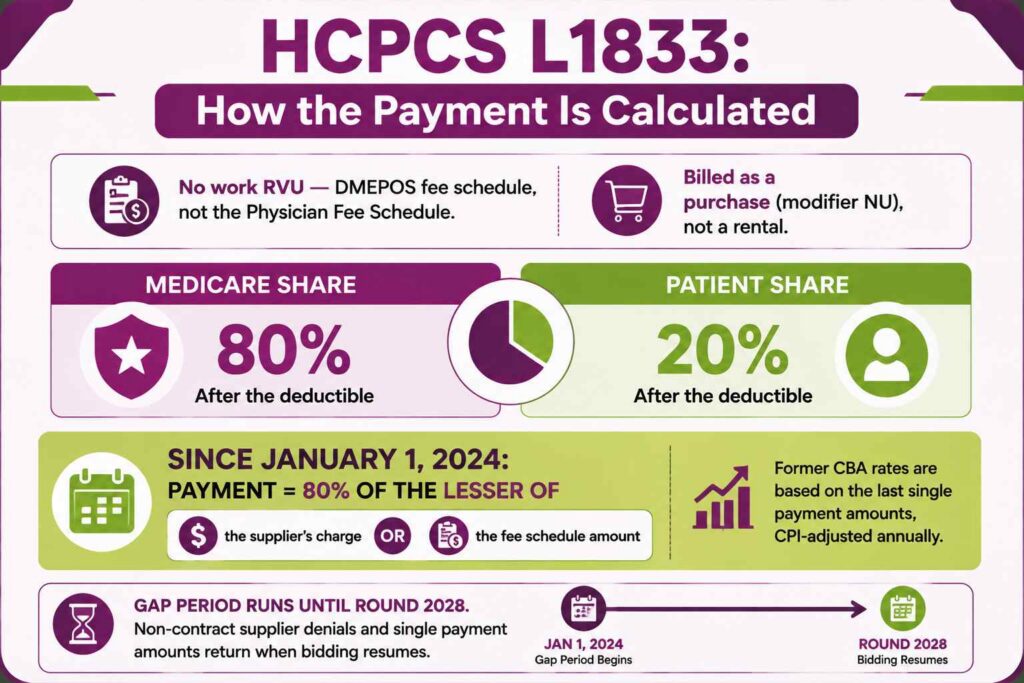
HCPCS code L1833 is paid as a purchased orthotic device through the DMEPOS fee schedule. There is no work RVU, since the code describes a device rather than a physician service. Device pricing runs through the DMEPOS fee schedule rather than physician RVUs, the model behind Level II HCPCS codes for supplies and equipment.
- Payment is set by the DMEPOS fee schedule for the state where the item is furnished
- The device is billed as a purchase with modifier NU, not as a rental
- Medicare pays 80 percent of the allowed amount, and the patient is responsible for the remaining 20 percent after the deductible
- Under the October 2026 fee schedule, the allowed amount runs from $455.16 to $556.31 in non-rural areas and $627.47 to $743.90 in rural ZIP codes, so the patient’s 20 percent coinsurance falls between about $91 and $149
Why the Competitive Bidding Gap Period Currently Governs L1833 Pricing
Off-the-shelf knee braces were one of only two categories under DMEPOS Competitive Bidding Round 2021. All of those contracts expired December 31, 2023, and a temporary gap period has been in effect since January 1, 2024, pending rulemaking and the next round.
- During the gap period, payment equals 80 percent of the lesser of the supplier’s charge or the fee schedule amount
- Fee schedule amounts in former competitive bidding areas are based on the last single payment amounts, increased annually by the Consumer Price Index
- The gap period runs until the implementation of the next round, identified by CMS as Round 2028
- Non-contract supplier denials and single payment amounts return when the next round begins
This gap period is why current L1833 pricing follows the adjusted fee schedule rather than a competitive-bid single payment amount. Suppliers should track the transition, since the rules change when bidding resumes.
Commercial Payers and Medicaid Coverage
Commercial and Medicaid plans set their own coverage terms for HCPCS code L1833, which vary by plan. Many mirror the Medicare instability documentation standard, while others apply their own medical policy.
- Verify each plan’s coverage criteria and documentation requirements before dispensing
- Some plans required prior authorization for the off-the-shelf brace even while Medicare did not, and their rules run independently of the Medicare change on October 28, 2026
- Plans commonly require the same objective instability findings that LCD L33318 specifies
- The written order and proof of delivery support the claim across payer types
Patient Financial Responsibility and Replacement Cost Timing
The patient’s financial responsibility on HCPCS code L1833 includes the standard coinsurance and any non-covered charges. Replacement timing turns on the five-year reasonable useful lifetime.
- After the deductible, the patient owes the 20 percent coinsurance on a covered brace
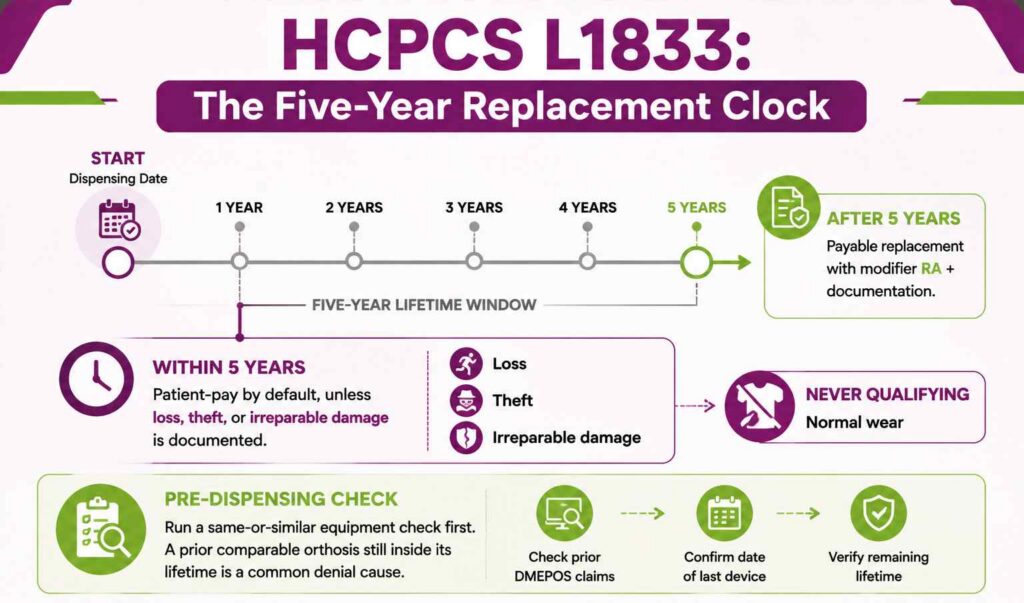
- A brace has a five-year reasonable useful lifetime, and a replacement within that window is generally patient-pay absent a qualifying reason
- Loss, theft, or irreparable damage can support a covered replacement inside the five years with documentation
- A denied claim, where coverage criteria were not met, shifts the cost to the patient per the ABN rules
What Are Example Clinical Scenarios or Use Cases for HCPCS Code L1833?
HCPCS code L1833 appears in post-operative rehabilitation, instability documentation, the coding fork with L1832, and replacement. The scenarios below show each.
Scenario 1: Post-Operative ACL Reconstruction Requiring a Rigid Adjustable Knee Orthosis Fitted Without Specialized Expertise
ICD-10: Z47.89 (Encounter for other orthopedic aftercare)
A patient recovering from ACL reconstruction needs a rigid adjustable knee brace to control range of motion during early rehabilitation. The supplier fits the stock brace with minimal self-adjustment, requiring no certified orthotist. The supplier bills HCPCS code L1833 with the laterality and NU modifiers. For dates of service on or after October 28, 2026, the supplier needs an affirmed prior authorization before delivery, but no in-person custom fitting, so the brace can still be shipped once the decision is affirmed.
Scenario 2: Documented Knee Instability With Joint Laxity Testing Supporting Medical Necessity
ICD-10: M23.51 (Chronic instability of knee, right knee)
A patient presents with knee instability, and the physical examination documents the specific laxity tests performed, with objective findings. The record establishes medical necessity under LCD L33318 and notes the patient’s willingness to use the brace. The supplier bills L1833 with modifiers KX, RT, and NU. The named laxity tests, not a generic instability statement, are what carry the claim past the coverage gate.
Scenario 3: Same Brace, Different Code, When Fitting by an Individual With Expertise Moves the Claim to L1832
ICD-10: M23.52 (Chronic instability of knee, left knee)
A patient receives the same physical brace, but an individual with expertise performs substantial customization to fit it. Because the fitting required specialized expertise rather than minimal self-adjustment, the correct code is L1832, not HCPCS code L1833. The supplier bills L1832, which carries prior authorization, a face-to-face encounter, and a written order prior to delivery. The fitting performed, documented in the record, determines the fork.
Scenario 4: Replacement After the Five-Year Reasonable Useful Lifetime
ICD-10: M23.51 (Chronic instability of knee, right knee)
A patient who received a knee orthosis more than five years earlier needs a replacement, and the original has reached the end of its reasonable useful lifetime. The supplier dispenses a new brace and bills HCPCS code L1833 with modifier RA for the replacement, plus laterality. The documentation records that the five-year lifetime has passed, which is distinct from a replacement for loss, theft, or irreparable damage.
What Are the HCPCS Code L1833 Rules To Ensure Successful Reimbursement?
Follow the off-the-shelf coding standard, the addition-code bundling rules, the per-limb billing rules, and the replacement rules. Meeting these rules protects HCPCS code L1833 claims from denial and audit recovery.
Why OTS Versus Custom-Fitted Miscoding Runs in Both Directions
Miscoding between off-the-shelf L1833 and custom-fitted L1832 runs both ways, and each direction carries its own risk. Supplier records are the only evidence separating two identical devices.
- Upcoding to L1832 captures higher payment but triggers prior authorization, a face-to-face encounter, and a written order prior to delivery
- Down-coding to L1833 misstates the service when an individual with expertise performed substantial customization, and the authorization advantage it once offered ends on October 28, 2026
- The correct code depends entirely on the fitting performed, not the device dispensed
- Supplier records must justify the code selected, since the record is the only proof of which fitting occurred
Which Addition Codes Are Bundled Into the L1833 Base and Which Are Separately Billable
The LCD groups addition codes into categories relative to the base code, and components frequently incorporated into the prefabricated base are not separately payable. The base code selection determines which additions can be billed.
- Components already built into the prefabricated L1833 base are not separately billable
- Additions integral to a prefabricated brace are considered part of the base payment
- Only additions that represent a distinct, separately payable component under the LCD may be billed alongside the base
- Verify the LCD addition-code grouping before billing any addition with HCPCS code L1833
Units, Bilateral Billing, and Same or Similar Equipment Denials
HCPCS code L1833 is billed as one unit per limb, and a same-or-similar item already on file leads to denial. Both rules require a pre-dispensing check.
- Bill one unit per limb, with RT on one line and LT on the other for a bilateral fitting
- Never combine both limbs on a single line or use a bilateral modifier
- Check the patient’s same-or-similar equipment history before dispensing, since an existing comparable brace triggers denial
- A prior orthosis still within its reasonable useful lifetime is a common same-or-similar denial cause
Replacement Rules and the Five-Year Reasonable Useful Lifetime
HCPCS code L1833 has a five-year reasonable useful lifetime, which governs when a replacement is payable. A replacement inside that window requires a qualifying reason.
- A replacement after the five-year reasonable useful lifetime is payable with modifier RA and documentation
- A replacement within five years requires a qualifying reason such as loss, theft, or irreparable damage
- Normal wear does not justify a replacement before the lifetime expires
- The documentation must distinguish a lifetime-based replacement from a loss-or-damage replacement
Top Reasons For Denials Specific To L1833 & Quick Remedies
- Missing or Generic Instability Documentation: Prevent by documenting the specific joint laxity tests performed and objective findings, not a general statement of instability.
- Wrong Side of the OTS Versus Custom-Fitted Fork: Prevent by coding L1833 for minimal self-adjustment and L1832 for expertise-level fitting, with supplier records that justify the choice.
- Missing RT or LT, or Both Limbs on One Line: Prevent by billing one unit per limb on separate RT and LT lines, never as a bilateral pair.
- Replacement Inside the Reasonable Useful Lifetime: Prevent by replacing within five years only for a documented loss, theft, or irreparable damage, and using modifier RA after the lifetime passes.
- Legacy Competitive Bidding Modifiers During the Gap Period: Prevent by removing KV, J4, and J5 from HCPCS code L1833 claims while the gap period is in effect, and appending KX where coverage criteria are met.
- No Affirmed Prior Authorization for Dates of Service on or After October 28, 2026: Prevent by submitting the request with the written order and face-to-face documentation before delivery, and reporting the unique tracking number on the claim.