An urgent care center earns revenue one walk-in at a time, and each visit can lose money in a different place. A patient arrives with a sprained ankle, receives an X-ray and a splint, and leaves within an hour. That single visit carries an E/M level, an imaging code, a procedure code, and supply charges. The place of service must also match the payer contract. One wrong modifier returns the claim unpaid.
Moreover, urgent care billing runs on high volume and narrow margins, so small errors multiply fast across hundreds of weekly visits. Unlike a primary care office, an urgent care center must route each claim to the correct billing model. That model may be an E/M code or a global fee. Therefore, accuracy at the front desk and the coding desk decides how much revenue arrives.
Urgent care billing services from a specialty partner bring certified coders who already know these payer rules, procedure bundles, and point-of-care lab requirements. Correct codes, clean notes, and disciplined follow-up keep urgent care claims clean and cash flow steady.

What Is Urgent Care Billing?
Urgent care billing is the process of coding, submitting, and managing insurance claims for walk-in medical care. These services include illness visits, minor injury treatment, X-rays, point-of-care lab tests, and occupational medicine. The process ends only after the center collects the full payer and patient balance.
Unlike a hospital emergency room, an urgent care center bills office-style E/M codes with place of service 20. Moreover, many centers run their own X-ray and lab equipment, which adds imaging and waived-test rules. Therefore, urgent care medical billing connects registration, coding, claims, and collections into one workflow. The Urgent Care Association counted 14,075 centers nationwide by the end of 2022, up from 11,481 at the end of 2019.
What Makes Urgent Care Billing Different?
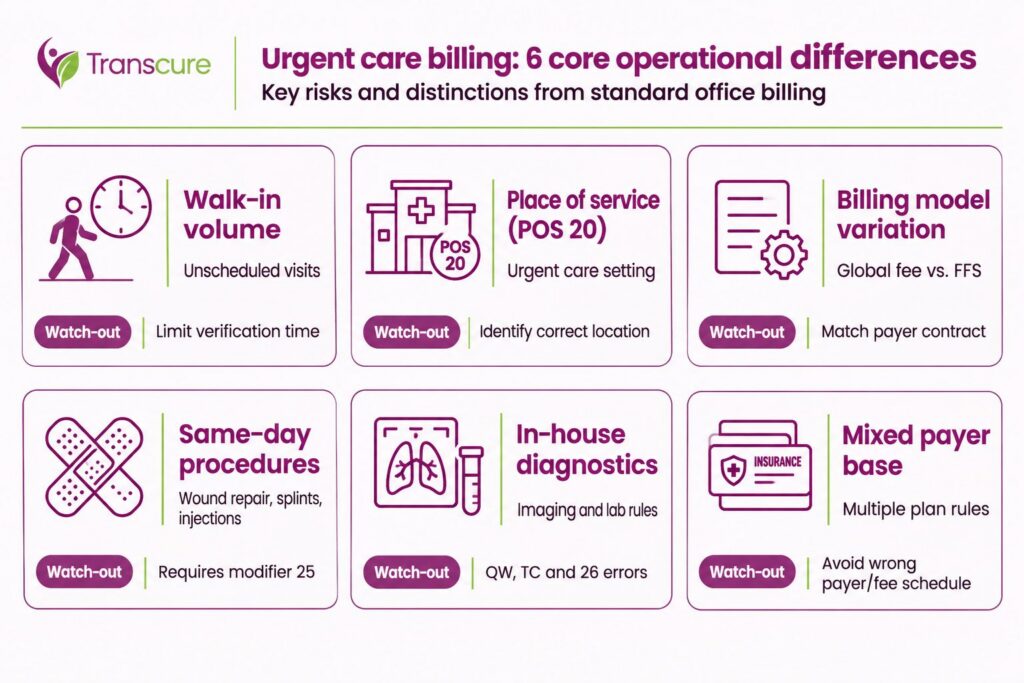
Urgent care billing differs from standard office billing in 6 ways. Walk-in volume limits verification time, and the billing model changes by payer. Place of service, same-day procedures, in-house diagnostics, and payer mix add four more risk points. Therefore, each visit requires several payer decisions before the claim leaves the building.
| Distinction | What It Means | Primary Denial Risk |
|---|---|---|
| Walk-in volume | Unscheduled visits leave little time to verify coverage | Inactive or wrong coverage |
| Place of service 20 | The claim identifies the urgent care setting and its payment rate | Wrong place of service |
| Billing model | Some payers pay the S9083 global fee, and others pay itemized codes | Wrong code for the contract |
| Same-day procedures | Wound repair, splints, and injections bill beside the visit | Missing modifier 25 |
| In-house imaging and labs | Technical, professional, and waived-test rules apply | Missing QW or TC and 26 errors |
| Mixed payer base | Commercial, Medicare, Medicaid, self-pay, and workers’ compensation claims share one queue | Wrong payer or fee schedule |
How Does the Urgent Care Billing Process Work?
Urgent care RCM carries each visit through 10 stages, from check-in to reporting. Every stage protects one part of the claim. A missed eligibility check at the front desk therefore becomes a denial weeks later. Clean front-end work drives back-end cash.
1. Patient Registration and Eligibility Verification
Registration captures demographics, insurance cards, photo identification, and the reason for the visit. Staff then verify active coverage before the provider sees the patient. Automated patient eligibility verification services confirm coverage and benefits before the claim is built, which matters when walk-ins arrive without notice. Verified coverage prevents the most avoidable denials.
2. Payer Routing and Billing Model Selection
The billing team identifies the payer and the contracted billing model. Some commercial contracts pay the S9083 global fee, while others pay itemized E/M and procedure codes. Medicare does not recognize S9083, so Medicare claims bill itemized codes. Therefore, routing each claim correctly at charge entry prevents flat denials and silent underpayments.
3. Clinical Documentation Review
After the visit, the billing team reviews the note against the services performed. Documentation records the chief complaint, history, exam, diagnosis, medical decision making, and treatment. Procedure notes add the site, size, method, and supplies. Imaging requires a signed interpretation and report. Gaps go back to the provider before coding starts.
4. Medical Coding
Coders translate the note into ICD-10-CM diagnoses, CPT and HCPCS codes, and modifiers. For example, a sprained ankle visit with an X-ray and a splint reports an E/M code, 73610, and 29515 with a linked diagnosis. Modifier 25 attaches to the E/M code when the visit is separately identifiable.
5. Charge Entry and Claim Creation
Charge entry links each service line to its diagnosis, modifier, units, and rendering provider. Urgent care centers also add place of service 20 and the correct billing provider. Supply and drug lines carry the right HCPCS code and units. Verification at this stage confirms that every procedure points to a supporting diagnosis.
6. Claim Scrubbing and Quality Assurance
Scrubbing software and billing specialists test each claim against NCCI edits, payer rules, and urgent care logic before it leaves. Scrubbers flag missing modifiers, bundled code pairs, mismatched places of service, and absent QW modifiers. Claims that pass scrubbing are more likely to pay the first time.
7. Electronic Claim Submission
The finalized claim travels to the payer through a clearinghouse that checks the format and routes the claim for adjudication. Freestanding urgent care centers typically bill on the professional claim, known electronically as the 837P. Electronic filing speeds adjudication and removes manual re-keying. Filing inside the payer window protects every dollar.
8. Payment Posting and Reconciliation
Payment posting records payments, adjustments, and explanations of benefits in the billing system. The team compares each payment with the contracted rate. Underpayments on procedures, injections, and X-rays surface at this stage and trigger follow-up. Reconciliation recovers money that payers owed but never paid.
9. Denial Management and Appeals
Denial management groups rejected claims by cause, so staff know whether to fix, resend, or appeal. Common urgent care triggers include missing modifier 25, place of service errors, and missing QW modifiers. Root-cause tracking then feeds fixes back to the front desk. Appeals cite medical necessity and clinical documentation.
10. Patient Billing, A/R Follow-Up, and Reporting
After insurance pays, the remaining balance moves to the patient as a copay, deductible, or coinsurance. A/R follow-up works unpaid claims by dollar value, payer, and age. Reporting tracks clean claim rate and days in A/R. Medicare allows 12 months from the date of service for timely filing, while commercial contracts often set shorter windows.
What Are the Fundamentals of Urgent Care Billing and Coding?
Seven habits keep urgent care billing accurate. Each habit closes a specific gap between check-in and payment. Centers that follow all seven submit cleaner claims and meet fewer payer edits. The habits cover place of service, visit coding, diagnoses, modifiers, waived tests, bundling, and documentation.
What Does Place of Service 20 Report?
Place of service 20 identifies an urgent care facility on the claim. CMS defines it as a location, distinct from an emergency room, office, or clinic, that treats unscheduled patients seeking immediate attention. Medicare pays POS 20 at the non-facility rate. Therefore, the code must match the payer contract.
How Do You Choose the Right Visit Code?
Urgent care centers report office or outpatient E/M codes 99202 through 99205 for new patients and 99211 through 99215 for established patients. Emergency department codes 99281 through 99285 describe hospital-based emergency care and do not fit urgent care claims. Levels follow medical decision making or total time on the date of the encounter.
How Do Diagnosis Codes Support Medical Necessity?
Every test and procedure needs a diagnosis that supports it. Chest X-rays link to cough, fever, or chest pain, and ankle X-rays link to the injury. ICD-10-CM codes also report laterality and the encounter type, such as initial encounter for injuries. Payers deny services whose diagnosis does not support the order.
When Does Modifier 25 Apply?
Modifier 25 reports a significant, separately identifiable E/M service on the same day as a procedure. Wound repair, abscess drainage, and splinting often trigger it. The note must show evaluation work beyond the usual pre-procedure assessment. Without that documentation, payers bundle the visit into the procedure and pay only once.
How Do CLIA-Waived Tests and Modifier QW Work?
Urgent care centers perform rapid flu, strep, and urinalysis tests under a CLIA certificate of waiver. Medicare requires modifier QW on many waived tests, including 87804 and 87880. Some waived codes, such as 81002, do not need it. Therefore, billers must check each code against the current CMS waived test list.
How Do Bundling and Global Periods Affect Claims?
Wound repair codes and splint codes carry 0-day global periods, and abscess drainage code 10060 carries 10 days. Related follow-up care inside a global window is included in the original payment. NCCI edits also bundle common code pairs. Modifier 59 or an X modifier separates distinct services when documentation supports it.
What Documentation Supports Urgent Care Claims?
Documentation is the proof behind every code. Visit notes show the history, exam, and decision making or total time. Procedure notes record the site, size, and technique. Imaging claims need a signed report, and waived tests need the result recorded. Late or unsigned notes delay claims and invite audits.
What Are the Most Common Urgent Care Billing Codes?
Urgent care coding relies on 3 core code families: E/M visit codes, procedure and test codes, and modifiers. These codes appear most often on urgent care claims, and each one needs a supporting diagnosis and the right modifier. Therefore, coders verify each code against payer policy before the claim leaves the building.
Which Service and Procedure Codes Appear Most Often?
The table lists 16 service, imaging, and test codes that urgent care centers report frequently. Each code needs a linked diagnosis, and payers may apply bundling edits to same-day combinations.
| Service | Typical Urgent Care Use | CPT Code |
|---|---|---|
| Simple wound repair, 2.5 cm or less (trunk, extremities) | Minor laceration | 12001 |
| Simple wound repair, face, 2.5 cm or less | Facial laceration | 12011 |
| Incision and drainage of abscess, simple | Skin abscess | 10060 |
| Short arm splint, static | Wrist or forearm injury | 29125 |
| Short leg splint | Ankle or foot injury | 29515 |
| Chest X-ray, 2 views | Cough, fever, or chest pain | 71046 |
| Ankle X-ray, minimum 3 views | Ankle injury | 73610 |
| Foot X-ray, minimum 3 views | Foot injury | 73630 |
| Rapid influenza antigen test | Flu symptoms | 87804 |
| Rapid strep A antigen test | Sore throat | 87880 |
| Rapid SARS-CoV-2 antigen test | COVID-19 symptoms or exposure | 87811 |
| Urinalysis, nonautomated, without microscopy | Urinary symptoms | 81002 |
| Therapeutic injection, IM or subcutaneous | Antibiotic or steroid injection | 96372 |
| Venipuncture | Blood draw for outside lab | 36415 |
| ECG with interpretation and report | Chest pain evaluation | 93000 |
| Impacted cerumen removal, unilateral | Ear blockage | 69210 |
How Are Point-of-Care Labs and Injectable Drugs Billed?
Point-of-care labs add a separate revenue stream and a separate compliance layer. Rapid tests report 87804, 87880, 81002, and 87811, with QW where required. Centers that run moderate-complexity tests need a different CLIA certificate.
Injectable drugs report a HCPCS J-code with units that match the descriptor. For example, J0696 reports ceftriaxone per 250 mg, and J1885 reports ketorolac per 15 mg. The administration code, such as 96372, bills on a separate line. Therefore, units follow the descriptor, not the vial size.
Which Modifiers Carry the Most Weight?
Six modifiers drive most urgent care modifier decisions. The table pairs each modifier with its meaning and its most common urgent care use.
| Modifier | Description | Common Urgent Care Use |
|---|---|---|
| 25 | Significant, separately identifiable E/M service on the same day as a procedure | Visit billed with wound repair, splinting, or abscess drainage |
| 59 / XE, XS, XP, XU | Distinct procedural service | Two services that NCCI bundles but that were truly separate |
| RT / LT | Right side / left side | Extremity X-rays such as 73610-RT |
| 26 / TC | Professional component / technical component | Radiologist overread (26) or equipment-only billing (TC) |
| QW | CLIA-waived test | Rapid tests such as 87804-QW and 87880-QW |
| 95 | Synchronous telemedicine service | Virtual visits when the payer accepts the modifier |
When Do Urgent Care Centers Bill S9083 and After-Hours Codes?
S9083 is the HCPCS code for the urgent care global fee. Some commercial payers contract on it in place of itemized visit codes. Medicare does not recognize it, so Medicare claims bill E/M and procedure codes. Always confirm the model in the payer contract before billing.
After-hours codes 99050, 99051, and 99053 rarely pay at urgent care centers. CMS bundles these codes into the payment for other services, and many commercial payers follow that approach. Some payers also deny them outright on POS 20 claims. Therefore, centers bill them only when the contract allows.
How Do Payers and Plans Affect Urgent Care Claims?
Each payer category applies different rules to urgent care claims. Medicare adds waived-test edits and the 12-month filing limit. Commercial plans add contract-specific billing models. Medicaid, self-pay, and workers’ compensation add state-specific rules. Practices therefore need a separate checklist for each category.
How Does Original Medicare Treat Urgent Care Claims?
Original Medicare applies national rules and contractor edits to urgent care claims.
- Billing model: Itemized E/M and procedure codes apply, and S9083 is not valid.
- Waived tests: Modifier QW applies to many CLIA-waived tests.
- Place of service: POS 20 pays at the non-facility rate.
- Timely filing: Claims file within 12 months of the date of service.
- Bundling: NCCI edits update quarterly and govern same-day code pairs.
How Do Medicare Advantage and Commercial Plans Differ?
Medicare Advantage and commercial plans apply contract-specific rules on top of standard coding requirements.
- Billing model: Contracts set S9083 or itemized E/M billing.
- Carve-out codes: Some global fee contracts pay X-rays, labs, or procedures separately.
- Claim edits: Medicare Advantage plans set their own edits, which may differ from Original Medicare.
- Filing windows: Commercial contracts often set windows shorter than Medicare’s 12 months.
- After-hours codes: Many payers bundle or deny 99050 and 99051 on POS 20 claims.
How Do Medicaid, Self-Pay, and Workers’ Compensation Claims Work?
Medicaid programs set state-specific fee schedules and filing limits. Self-pay patients need a clear fee estimate and payment at the time of service. Workers’ compensation claims follow state fee schedules and carrier authorization rules. Transcure supports workers’ compensation, personal injury, and no-fault billing alongside standard insurance claims.
Why Does Payer Credentialing Affect Urgent Care Revenue?
A new urgent care location or provider cannot bill most payers in the network until enrollment completes. Claims from unenrolled providers deny or pay at out-of-network rates. Therefore, enrollment protects the first dollar a new location earns. Transcure’s credentialing services complete CAQH, PECOS, and payer enrollment in 60 days, which shortens the gap between opening day and payment.
What Are the Most Common Urgent Care Claim Denial Causes?
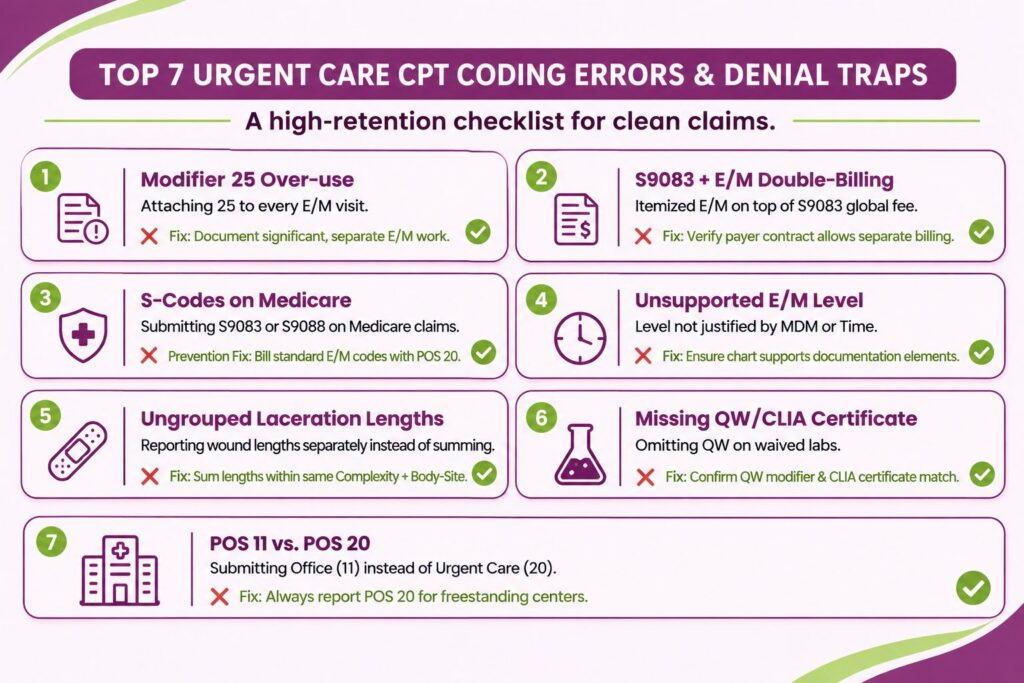
Many urgent care billing mistakes trace back to front-end and coding errors. Five causes recur in denials, and each has a defined prevention step. Practices that track denial codes by payer spot repeating patterns first. Therefore, the fix usually starts at registration or charge entry.
Missing or Misused Modifier 25
Modifier 25 sits at the center of many urgent care denials. Payers bundle the visit into the procedure when the modifier is missing. Certified coders from medical billing and coding services apply the modifier only when the note supports a separate evaluation. Therefore, notes should separate visit work from procedure work.
Place of Service and Billing Model Mismatch
A claim denies or underpays when the place of service or billing model conflicts with the contract. Billing POS 11 under a POS 20 contract, or an S9083 global fee to a payer that pays itemized codes, produces rework. Therefore, the payer routing table must be built from the actual contracts.
Missing QW Modifier on Waived Tests
Medicare edits waived tests at the CLIA certificate level. A claim for 87804 or 87880 without QW can return unpaid. Claims also fail when the center’s certificate does not cover the test performed. Therefore, billers match each waived code to the center’s current CLIA certificate.
Eligibility and Coverage Errors
Walk-in patients arrive with expired cards, new plans, or no coverage at all. Claims submitted to the wrong payer deny, and late corrections risk timely filing limits. Verification at check-in catches both problems before the provider sees the patient. Moreover, correct payer order matters for patients with two plans.
Medical Necessity and Diagnosis Mismatch
Payers review whether the diagnosis supports each X-ray, test, and procedure. An ankle X-ray linked only to a cough fails the edit. Specific ICD-10-CM codes with laterality and encounter type support payment. Therefore, coders link every service line to the diagnosis that justifies it.
How Do AI Agents Support Urgent Care Billing?
High walk-in volume creates more claims than manual review can check closely. Transcure’s seven AI agents for medical billing scrub and prepare claims and support denial follow-up. Billers review claim submission, so automation speeds the work without removing human oversight. Therefore, centers get faster claim preparation and fewer repeat errors.
What Are Urgent Care Billing Best Practices?
Urgent care billing best practices pair front-end checks with back-end follow-up. Each practice targets a known cause of lost revenue. Checks at registration and charge entry stop errors early, while denial work recovers what slips through. Centers that apply all of them improve clean claim rate and shorten days in A/R.
- Verify eligibility at every check-in, including returning patients.
- Confirm the billing model, S9083 or itemized E/M, at charge entry.
- Report POS 20 only where the setting and payer contract support it.
- Attach modifier 25 only when the note shows a separate evaluation.
- Append QW to waived tests that require it.
- Link every X-ray and test to a supporting diagnosis.
- Capture every charge for supplies, injections, and imaging on the day of service.
- Submit claims quickly, well inside the payer filing window.
- Work denials by root cause instead of resubmitting claims unchanged.
Regular internal reviews catch drift before payers do. A medical billing audit that reviews 90 days of claims shows where coding, charge capture, and payer routing leak revenue. Urgent care volume makes small leaks expensive. Therefore, centers fix the process instead of repeating the same denials.
In-House vs Outsourced Urgent Care Billing: Which Is Better?
Urgent care centers run billing in-house or through an outsourced partner. Four factors separate the 2 models: pros, cons, cost, and fit. Therefore, centers can weigh control against expertise and cost before choosing. Urgent care adds weight to this decision because high volume multiplies the cost of every error.
| Factor | In-House Urgent Care Billing | Outsourced Urgent Care Billing |
|---|---|---|
| Pros | Direct control of daily billing work, Fast access to clinicians and records, Close contact with providers | Certified coders who know urgent care codes and modifiers, Fewer denials through claim scrubbing, Lighter administrative load on the center, Code updates handled by the partner, Capacity that scales with visit volume |
| Cons | Hiring, training, and payroll costs, Continuous coding education, Turnover that interrupts claim flow | Less direct oversight of daily work, Results depend on the partner chosen, Onboarding takes time |
| Cost | Salaries, benefits, software, and training, with total cost varying by team size | Typically a percentage of collections or a flat monthly fee, with scope varying by partner |
| Best for | Large urgent care groups with dedicated billing teams | Single-site and multi-site operators that want specialty expertise and fewer denials |
Outsourcing moves staffing, software, and update tracking to the partner, while in-house billing keeps direct control of each claim. Transcure’s flat 5% of collections pricing covers end-to-end RCM, complimentary credentialing, and old A/R recovery for practices of any size. Therefore, centers know their billing cost before the first claim goes out.
How to Select the Best Urgent Care Billing Company?
The right urgent care billing company lifts collections, lowers denials, and frees your staff. Six criteria separate partners that protect revenue from partners that only submit claims. Therefore, ask each candidate for documented results by payer and by code family.
1. Urgent Care Coding Expertise
A strong partner applies E/M leveling, modifier 25, waived-test, and POS 20 rules correctly. Certified coders also track annual CPT, ICD-10-CM, and HCPCS updates. Transcure employs 1,100+ AAPC-certified billers. Ask how many coders work urgent care claims every day.
2. Proven First-Pass Clean Claim Performance
First-pass clean claim rate measures coding and claim review quality. A rate of 98% reduces rework and payment delays. Transcure’s first-pass clean claim rate is 98%. Partners should report the rate by payer so errors surface early. Moreover, urgent care volume makes a single recurring error expensive within days.
3. Strong Denial Management and Recovery
A strong partner studies denial trends, fixes root causes, and runs appeals instead of simply resubmitting claims. Claim scrubbing and dedicated A/R follow-up recover revenue that denials hold back. Transcure reports an 80% denied claim recovery rate. Appeals on medical necessity cite payer policy and clinical documentation.
4. Technology That Fits Your EHR
A billing partner works inside the EHR and practice management system the center already uses. Transcure supports 43+ EHR integrations, so a billing change does not force a software change. EMR billing services built for any platform keep notes, orders, and charges aligned. Integration also reduces manual entry errors.
5. Transparent Reporting and Fast Communication
Live dashboards show denial rates, first-pass acceptance, A/R days, and collections by payer. Transcure’s Master Command Dashboard tracks these metrics, and an account manager responds within 2 hours. Clear reporting informs decisions on payer mix, staffing, and operating hours. Moreover, a named contact keeps questions from stalling claims.
6. Compliance, Security, and Certified Professionals
Protecting patient data comes first when choosing a partner. A qualified company signs a BAA, follows HIPAA standards, and holds a recognized security certification. Transcure is ISO 27001 certified and follows the OIG compliance guidance for third-party medical billing companies. Payer payments also deposit into the center’s own accounts, never the partner’s.
Frequently Asked Questions
What Are the Most Common CPT Codes for Urgent Care Billing?
Urgent care claims often include E/M codes 99202 through 99215, 12001 for wound repair, 29125 for splints, and 71046 for chest X-rays. Rapid tests such as 87804 and 87880 also appear often. Code selection depends on documentation, the payer contract, and the service performed.
Can Urgent Care Centers Bill Emergency Department Codes?
Urgent care centers do not bill emergency department codes 99281 through 99285. Those codes describe care in hospital-based emergency departments. Urgent care centers report office or outpatient E/M codes 99202 through 99215 with place of service 20 instead. Billing ED codes invites denials and audits.
Does Medicare Pay the S9083 Urgent Care Global Fee?
Medicare does not recognize S9083, which carries a CMS status of not valid for Medicare purposes. Some commercial payers contract on the global fee instead of itemized codes. Therefore, Medicare claims bill E/M and procedure codes, and each commercial claim follows its own contract.
What Place of Service Code Do Urgent Care Centers Use?
Urgent care centers report place of service 20, the code for an urgent care facility. Medicare pays it at the non-facility rate. Payers may require a different code when the center is hospital-based or contracted as primary care. Therefore, billers confirm the code against each payer contract.
How Much Do Urgent Care Billing Services Cost at Transcure?
Outsourced urgent care billing typically prices as a percentage of collections or a flat monthly fee. Transcure charges a flat 3-5% of collections regardless of practice size, covering end-to-end RCM, complimentary credentialing, and old A/R recovery. In-house cost combines salaries, benefits, software, and training, and varies with team size and visit volume.