Dental billing is facing increased scrutiny, which leads to more denials. After a brief slowdown during COVID, government agencies and private insurers stepped up audits. More dental practices are being reviewed, and even small billing inconsistencies can trigger questions. Under such scrutiny, compliance matters because the consequences are real.
However, there is a clear difference between fraud and an honest mistake, which can affect the overall penalty. Fraud involves intent based on which dental billers knowingly submitting false information to get paid. Even without intent, those errors can still lead to claim denials and even licensing problems.
That’s why understanding illegal dental billing practices and having strong compliance processes in place is critical. Read till the end of this article to explore common unethical dental billing practices and how to tackle them.
What Are Illegal Dental Billing Practices?
Illegal billing practices are those that violate state/federal regulations or insurance contract rules. This can be caused by deliberate fraud or from ignorance. Fraud involves intentionally misrepresenting services (knowingly charging for a procedure not performed), whereas unintentional errors or misunderstandings (lack of training) are mistakes.
However, even if honest, consistent errors (like repeated miscoding) can still draw scrutiny. Some major concepts regarding illegal dental practices include:
- Fraud vs. Billing Errors: Fraudulent claims are submitted with intent to deceive. In contrast, an honest coding error (selecting the wrong code by accident) is a billing error. Billing mistakes can often be corrected without penalties if caught early, but intentional mis-billing violates laws like the False Claims Act.
- Intent vs. Negligence: Liability hinges on intent. If a claim is wrong due to negligence (misunderstanding of complex rules), it’s an error. However, if the dentist “intended the insurer to rely on” false information, it’s fraud. Courts generally require proof of willful intent to pursue fraud charges.
- Why Practices Unknowingly Violate Rules: Regulations change annually (over 300 CDT code changes since 2020), and each insurer has unique rules. Busy practices without expert billing support may inadvertently misapply codes or bundling rules. In short, even honest attempts at compliance can go wrong without internal controls and updated knowledge.
What Are the Most Common Illegal Dental Billing Practices?
Practices need to watch for high-risk billing behaviors that audits typically flag. Below are the most frequent unethical dental billing practices.
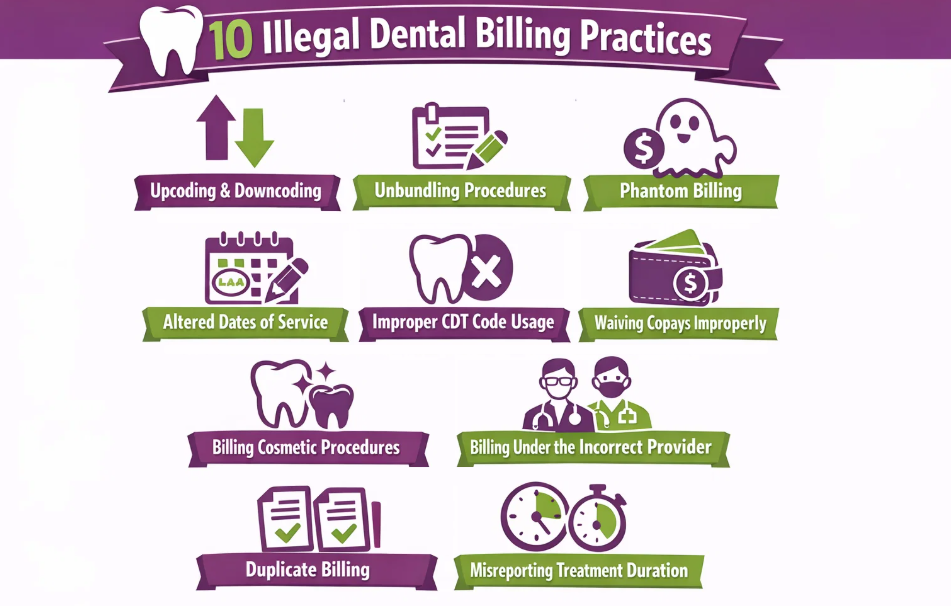
1. Upcoding and Downcoding
Upcoding and downcoding involve deliberately misrepresenting the procedure’s complexity. Upcoding is billing for a more expensive service than was actually performed. It violates the False Claims Act and can lead to fines or license loss. Conversely, downcoding is billing a less expensive code than appropriate, often to ensure insurance approval. For instance,
- Billing a simple extraction (code D7140) as a surgical extraction (D7210) without surgical procedure.
- Coding a routine prophylaxis cleaning (D1110) as a complex scaling planing (D4341) when no active gum disease was treated.
- Downcoding a needed composite restoration as an amalgam filling to fit insurance coverage (intentionally using a cheaper code).
2. Unbundling Procedures
Unbundling means splitting one comprehensive procedure code into multiple component codes to increase total reimbursement. Many CDT codes already cover multiple steps. For example, a root canal code includes X-rays and anesthesia. Separating these into extra line items is a dental insurance fraud. It artificially inflates the claim. Examples include:
- Separating components like reinforcing pins from a tooth buildup. (The core buildup code already includes posts, but billing pins separately yields extra payment.)
- Charging for adhesive or liner used during a filling as a separate code when it’s included in the restoration code.
- Billing for suture removal separately after an extraction, even though the extraction code covers suturing.
3. Phantom Billing (Services Not Rendered)
Phantom billing means charging for procedures that never happened. It is outright fraud (billing for “non-performed procedures”) and violates the False Claims Act. Insurers detect this via audits since the clinical records won’t back up the claims. For example,
- Claiming a fluoride treatment was applied when it was not given.
- Billing for X-rays or sealants that were never performed.
- Charging for periodontal therapy (scaling and root planing) when only a simple cleaning was done.
4. Altered Dates of Service
Another illegal dental billing practice include changing service dates to fit coverage rules to falsify medical records. Dentists might re-date treatments to fall within a patient’s benefit year or avoid preauthorization windows. This bypasses frequency limits and eligibility checks. Some of the major examples of this dental insurance fraud include:
- Backdating a tooth restoration to make it appear completed within the annual limit.
- Forward-dating a procedure to fall after a waiting period, ensuring insurance covers it.
- Resubmitting an already-paid claim with a new date to skirt audit software.
5. Improper CDT Code Usage
Using incorrect or outdated CDT codes breaks ADA coding standards. Even honest mix-ups (wrong code selection) are compliance violations. Using an obsolete code instead of the current code violates dental regulatory compliance. For instance,
- Charging D4210 (gingivectomy) when the procedure was actually a palliative emergency (D9110).
- Using a catch-all preventive code when a specific service was rendered (billing D0140 instead of D0150 without justification).
- Failing to update to the latest CDT version (using deleted codes).
6. Waiving Copays Improperly
Routine waiving of patient copayments or deductibles without insurer approval is fraud. The ADA warns that if you submit the full fee to the insurer but don’t collect the patient’s share, you are engaged in overbilling. Only documented charity cases or hardship exceptions should waive fees, and even then insurers must be notified. For example:
- Automatically waiving co-pays for family members or convenient patients without adjusting claims.
- Offering a discount at checkout but billing the insurer full, effectively hiding the waiver.
- Not reporting legitimate financial-assistance discounts to the insurer, making a charitable waiver appear as fraudulent reduced patient responsibility.
7. Billing Cosmetic Procedures as Medical Necessity
Insurance plans exclude purely elective procedures. Billing a cosmetic service as if it were medically necessary is unethical dental billing practice. Each of the following misclassifications violates coverage rules and would be flagged as misrepresentation:
- Submitting a claim for a teeth-whitening treatment as if it were preventive or periodontal therapy.
- Coding a cosmetic veneer or bonding as a structural crown or restorative filling.
- Labeling orthodontic treatment as medically necessary when done for minor cosmetic alignment.
8. Billing Under the Incorrect Provider
Each claim must list the actual treating provider’s NPI. A common illegal dental billing practice is billing under an in-network dentist’s identifier when an uncredentialed or out-of-network dentist performed the work. Insurers may verify provider credentials, so this deception easily triggers network exclusion or charges. For example,
- Claiming an out-of-network specialist’s work under the general dentist’s in-network NPI.
- Using the practice owner’s ID for procedures done by a non-credentialed associate or vice versa.
- Listing a licensed dentist’s name when a dental therapist or trainee (not authorized for that service) performed the work.
9. Duplicate Billing or Double Claim Submission
Submitting the same service multiple times (even with slight modifications) is a dental insurance fraud. This can happen accidentally (clerical mistakes) or intentionally (to inflate revenue). It always violates the False Claims Act regardless of intent. Some common examples include:
- Submitting an identical claim twice on the same date.
- Refilling a previously denied or unpaid claim without changes or waiting for the appeal.
- Two staff members inadvertently billing the same procedure.
10. Misreporting Treatment Duration
Certain dental services are billed by time (anesthesia, sedation, or extended hygiene). Falsely inflating treatment time for higher reimbursement is dental billing fraudulent. Such misreporting breaches time-based coding standards and can be identified by audit of clinical notes and anesthesia records. Examples include:
- Charging for two units of nitrous oxide sedation when only 30 minutes were administered.
- Reporting 60 minutes of periodontal scaling (to justify an add-on code) when only 45 minutes of therapy occurred.
- Using a longer appointment time code to bill for prophylaxis as if it were deeper cleaning without justification.
How Hidden Compliance Risks Most Practices Overlook Cause Illegal Billing?
Even diligent offices can slip up on subtler compliance rules. Below are often-overlooked dental billing issues:
- Documentation Mismatch: If the clinical chart doesn’t support the billed code, insurers may flag fraud. For instance, billing periodontal therapy without charted pocket measurements is a unethical dental billing practice. Practices should ensure notes (diagnosis, treatment details) align with each claim.
- Incorrect NPI Usage: Filing claims under the wrong provider identification is deceptive. For example, using the wrong dentist’s NPI on a claim (even by mistake) can be considered fraudulent dental billing practice.
- Insurance Coordination Errors: When patients have dual coverage, benefits must be coordinated. Submitting both policies as if each were primary is outright dental billing fraud. Failing to list the primary carrier or misapplying coordination rules can trigger audits.
- Fee Schedule Violations: Insurance contracts often mandate that a covered service be billed at or below the agreed schedule. Charging a non-covered or above-schedule fee (when not permitted) breaches contract terms.
- Automated Software Misconfiguration: Modern billing software and scrubbing tools are invaluable, but if misconfigured, they can introduce dental billing errors. Examples include outdated CDT code sets in the system or incorrect automatic modifier assignments.
What Are the Legal and Financial Consequences of Illegal Dental Billing?
Illegal dental billing carries severe repercussions both financially and legally:
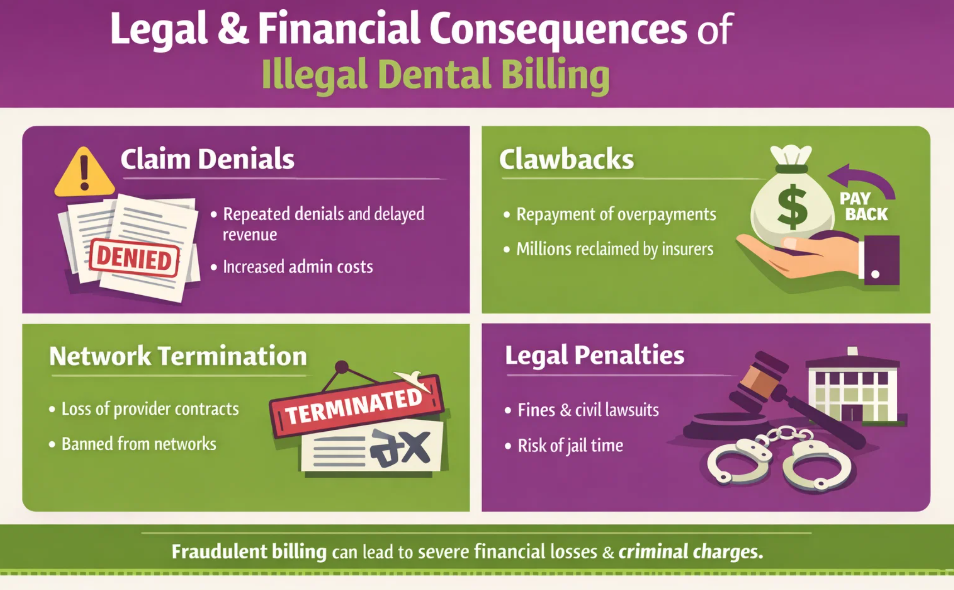
- Claim Denial Cycles: Improper claims generate repeated denials, delaying revenue. Excessive denials increase administrative costs and signal risk to payors.
- Clawbacks: Insurers will demand return of overpayments. In major cases, practices have repaid millions. For example, Kool Smiles paid $23.9 million to settle Medicaid fraud charges including phantom billing.
- Network Termination: Persistent dental billing violations can lead insurers to terminate provider contracts. A terminated practice loses its in-network status, harming patient trust and access. State boards and plans have also revoked licenses or kicked dentists out of PPO networks for fraud.
- Legal Penalties: Dental billing violations can invite fines, lawsuits, and even criminal charges. Under fraud laws, each false claim can incur damages and penalties. In extreme cases, individuals have faced hefty fines and jail time.
How Professional Dental Billing Services Reduce Illegal Practices and Compliance Risk?
Professional billing services combine expertise and technology to keep practices compliant. They employ certified coders and advanced AI tools to ensure every claim meets payer rules. Transcure and other expert dental billing companies offers:
1. Certified Coders
Experienced and certified coders apply the latest CDT and ICD knowledge. As Transcure notes, certified coders assign precise CPT, ICD, and HCPCS codes for clean claims. In dentistry, this means fewer upcoding/downcoding errors and more accurate claims.
2. CDT Updates Tracking
Billing services invest in ongoing education and system updates. For example, one analysis highlights that over 300 CDT code changes have occurred since 2020. Outsourced teams systematically apply each annual update, ensuring codes on claims are always current.
3. Insurance Rule Monitoring
Specialized billers maintain up-to-date libraries of payer rules. They use tools (like Transcure’s AI agents) that incorporate each insurer’s specific requirements. For instance, Transcure’s CLAIR agent analyzes claim line items using AI and payer rules to catch coverage or modifier issues before submission.
4. Audit-ready Documentation
Dental billing services enforce thorough charting standards. AI agents like CODIN scan for missing information. Transcure explains that CODIN audits every claim, detecting every missing documentation. The result is clinical notes that fully support billed procedures, so claims pass payer review smoothly.
5. Claim Scrubbing Systems
Automated scrubbing removes errors pre-submission. CLAIR, for example, auto-fixes minor issues like modifier errors or code mismatches using trained models. Such systems flag or auto-correct anomalies (duplicate procedures), substantially reducing risky submissions.
Why Outsourcing Dental Billing Improves Revenue and Compliance?
Partnering with a professional billing service streamlines both income and compliance. These six advantages illustrate why outsourcing pays dividends:
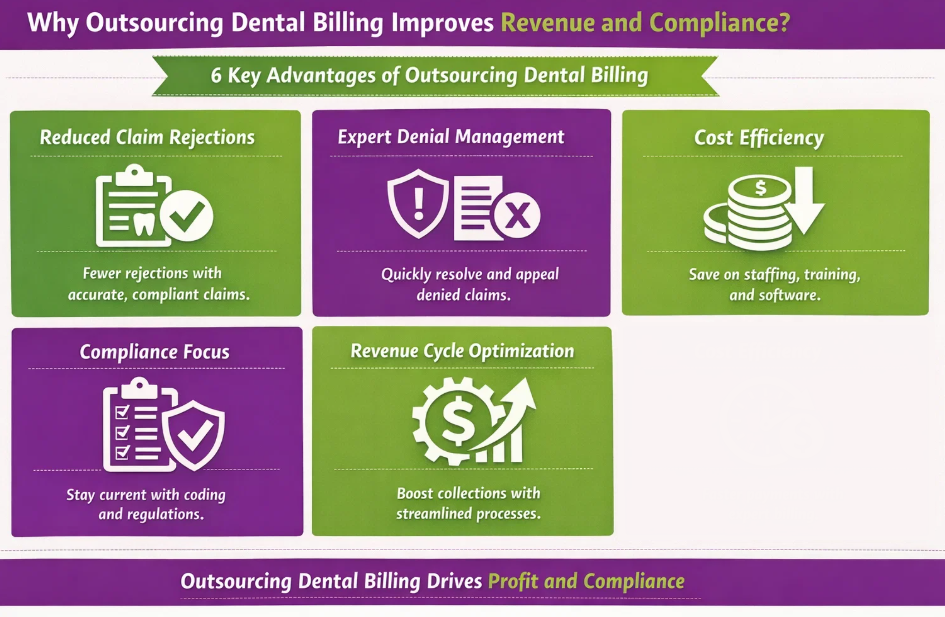
- Reduced Claim Rejections: Expert billers catch errors before submission, so claim rejections drop dramatically. With precise coding and scrubbing, compliant claims are accepted the first time.
- Expert Denial Management: When denials occur, specialists employ targeted denial management strategies. They analyze reasons, correct claims rapidly, and appeal where possible, recovering revenue that might be lost.
- Cost Efficiency: Outsourcing eliminates in-house billing overhead. Practices save on salaries, training and software while gaining access to scalable expertise.
- Compliance Focus: A dedicated service stays on top of coding updates and insurance rules. This compliance-focused billing prevents many mistakes.
- Revenue Cycle Optimization: By optimizing workflows, outsourced billing boosts net collections. Automated systems and specialists ensure clean claims and prompt payment.
Conclusion
Illegal dental billing practices, intentional fraud, or accidental error, poses severe financial and legal threats. Practices must uphold strict billing compliance by following CDT rules, or face audits, denials, and penalties.
In doing so, professional billing services protect practices from risky mistakes and improve revenue capture. With these outsourced billing services, dentists can focus on patient care knowing their revenue cycle is accurate.