
Summary: “The ICD-10-CM code for dysphagia is R13.1, a non-billable category header that requires a fifth digit for claim submission. Six billable codes sit beneath R13.1: R13.10, R13.11, R13.12, R13.13, R13.14, and R13.19. Each code identifies a specific swallowing phase or dysphagia type. Dysphagia affects roughly 1 in 25 adults each year, with higher rates among stroke survivors and elderly patients. Correct coding requires phase-specific documentation, proper sequencing with I69.x91 for stroke sequelae, and pairing with appropriate CPT codes.”
The ICD-10-CM code for dysphagia is R13.1, a non-billable category header that requires a fifth digit for claim submission. Six billable codes sit beneath R13.1: R13.10, R13.11, R13.12, R13.13, R13.14, and R13.19. Each code identifies a specific swallowing phase or dysphagia type.
Dysphagia is the difficulty moving solids, liquids, or both from the mouth to the stomach. Population estimates place adult dysphagia at roughly 1 in 25 each year, with higher rates among stroke survivors and elderly patients. Correct dysphagia coding requires documentation of the swallowing phase, the underlying cause, and medical necessity.
This guide covers all six R13.1x codes, the symptom-versus-diagnosis sequencing rule, stroke and pediatric overlaps, Excludes1 conflicts, paired CPT codes and modifiers, worked coding scenarios, and the denial triggers tied to unspecified coding.

R13.1x Dysphagia Codes Quick Reference
The following table maps each FY2026 dysphagia code to its swallowing phase and billable status. All six subcodes became effective on October 1, 2025, with no change for the current code year. Only the five-character codes carry payment. R13.1 fails claim edits and forces a resubmission.
| Code | Descriptor | Swallowing Phase | Billable |
|---|---|---|---|
| R13.1 | Dysphagia (header) | Category header | No |
| R13.10 | Dysphagia, unspecified | Phase not documented | Yes |
| R13.11 | Dysphagia, oral phase | Mouth, bolus preparation | Yes |
| R13.12 | Dysphagia, oropharyngeal phase | Mouth-to-pharynx transfer | Yes |
| R13.13 | Dysphagia, pharyngeal phase | Within the pharynx | Yes |
| R13.14 | Dysphagia, pharyngoesophageal phase | Cricopharyngeal junction | Yes |
| R13.19 | Other dysphagia | Cervical, neurogenic, NEC | Yes |
What Is the ICD-10 Code for Dysphagia?
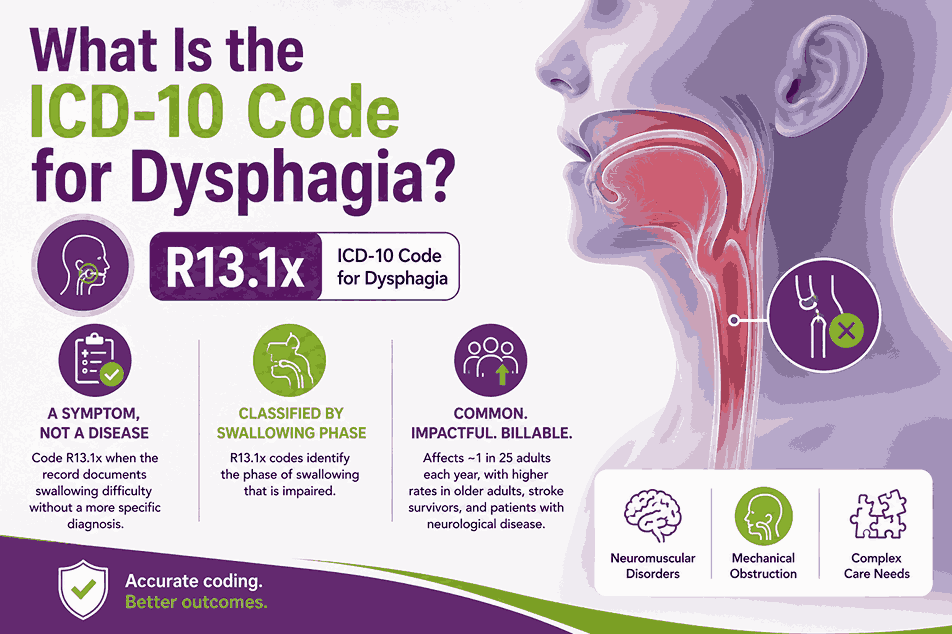
The ICD-10 code for dysphagia is R13.1x, found in Chapter 18 under “Symptoms and signs involving the digestive system and abdomen” (R10-R19). Dysphagia is the medical term for difficulty swallowing food, liquid, or saliva. The R13.1x family classifies dysphagia by the impaired swallowing phase.
Dysphagia is a symptom, not a disease. Coders report R13.1x when the record documents a swallowing difficulty without a more specific, definitive diagnosis that already captures the symptom. A neuromuscular disorder or a mechanical obstruction produces most dysphagia presentations.
Dysphagia affects roughly 1 in 25 adults each year, and prevalence climbs with age. Older adults, stroke survivors, and patients with progressive neurological disease account for the highest claim volumes. That concentration makes phase-specific coding a frequent revenue driver for gastroenterology, ENT, and rehabilitation teams.
What Does R13.1 Mean in ICD-10?
R13.1 means “Dysphagia” at the category-header level and carries no billing value. R13.1 requires a fifth character to reach valid specificity for HIPAA-covered transactions. A claim submitted with R13.1 returns as invalid.
R13.1 also carries a “Code first” instruction. The note directs coders to first list dysphagia following cerebrovascular disease when the condition is a stroke sequela. Utilizing an updated index of gastroenterology ICD 10 codes helps verify these primary sequencing dependencies. Phase specificity then comes from the R13.1x subcode.
What Are the R13.1x Dysphagia Subcodes?
The R13.1x family contains six billable subcodes, each tied to a documented swallowing phase or qualifier. Coders select the subcode that matches the clinician’s documentation of where the swallow breaks down.
When Do You Use R13.10 (Dysphagia, Unspecified)?
Assign R13.10 when the record documents dysphagia but does not state the swallowing phase. R13.10 is billable, yet it signals low documentation specificity. Repeated use of R13.10 raises payer scrutiny of medical-necessity reviews for swallow studies and therapy.
Query the provider for the phase when the chart supports a more specific code. A documented phase moves the claim to R13.11 through R13.14 and strengthens the medical-necessity argument. R13.10 fits a first encounter before instrumental testing identifies the phase.
When Do You Use R13.11 (Oral Phase)?
Assign R13.11 when the swallowing difficulty occurs in the oral phase. The oral phase covers bolus preparation inside the mouth, including tongue control and movement of food toward the pharynx. Oral-phase dysphagia appears in patients with tongue weakness, poor lip seal, or impaired mastication. Drooling and pocketing of food are documentation cues for R13.11.
When Do You Use R13.12 (Oropharyngeal Phase)?
Assign R13.12 when the swallow fails during transfer from the mouth into the pharynx. Oropharyngeal dysphagia is the most documented neurogenic subtype. Parkinson’s disease, multiple sclerosis, and stroke sequelae drive most oropharyngeal-phase cases. Delayed swallow initiation and nasal regurgitation support R13.12.
When Do You Use R13.13 (Pharyngeal Phase)?
Assign R13.13 when impairment occurs within the pharynx after the swallow triggers. Pharyngeal-phase dysphagia involves weak pharyngeal transit and reduced airway protection. Patients describe food caught in the throat and report coughing during meals. Documented aspiration or penetration on a swallow study supports R13.13.
When Do You Use R13.14 (Pharyngoesophageal Phase)?
Assign R13.14 when dysfunction sits at the pharyngoesophageal junction, where the cricopharyngeal muscle and upper esophageal sphincter control passage. R13.14 supports claims for upper esophageal sphincter dilation and cricopharyngeal botulinum toxin injection. Food sticking at the base of the throat points to this code. A Zenker diverticulum often presents with R13.14 documentation.
When Do You Use R13.19 (Other Dysphagia)?
Assign R13.19 for dysphagia specified as a type outside the four-phase codes. R13.19 captures cervical dysphagia, neurogenic dysphagia, and dysphagia specified NEC. R13.19 also covers multi-stage swallowing problems documented across more than one phase. Limit R13.19 to records that name a specific type, the phase codes do not describe.
What Conditions Cause Dysphagia and How Are They Coded?
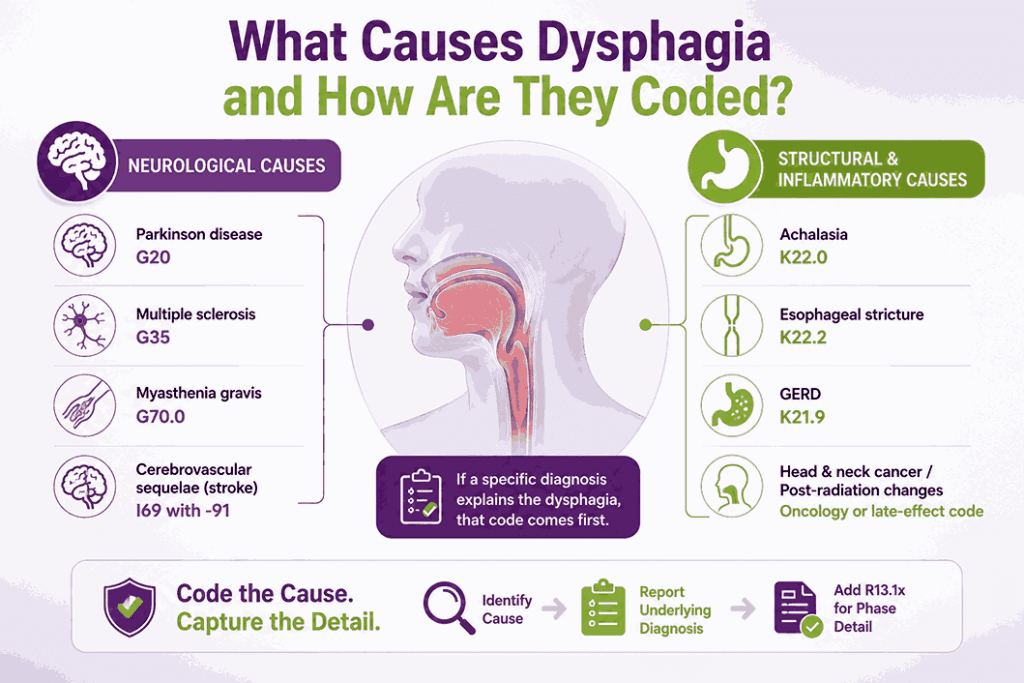
Dysphagia stems from neurological, structural, and inflammatory conditions, and the cause determines whether R13.1x is the first-listed code. When a definitive diagnosis explains the swallowing difficulty, that diagnosis leads, and R13.1x adds phase detail when documented.
Neurological causes carry their own etiology codes:
- Parkinson’s disease (G20) produces progressive oropharyngeal dysphagia.
- Multiple sclerosis (G35) disrupts neuromuscular control of the swallow.
- Myasthenia gravis (G70.0) causes fatigable swallowing weakness.
- Cerebrovascular sequelae (I69 with -91) follow stroke, sequenced ahead of R13.1x.
Structural and inflammatory causes shift coding toward the esophageal disease itself. Food that lodges in the chest after the swallow points to an esophageal disorder rather than a phase code.
Report the underlying diagnosis, such as achalasia (K22.0), esophageal stricture (K22.2), or GERD (K21.9). Head and neck cancer and post-radiation changes also produce dysphagia and lead with the oncology or late-effect code. For the full diagnosis set, review the gastroenterology guide.
How Does Dysphagia Differ From Aphagia and Odynophagia?
Dysphagia, aphagia, and odynophagia describe distinct swallowing problems and carry separate ICD-10 codes. Coders confirm the documented condition before assigning R13.1x, because a near-synonym changes the code entirely.
- Aphagia (R13.0) describes the complete inability to swallow, a more severe condition than dysphagia.
- Odynophagia describes painful swallowing rather than obstructed swallowing, and the record drives separate symptom coding.
- Globus and psychogenic dysphagia (F45.8) describe a lump sensation without true swallowing impairment, and R13 excludes this presentation.
A documented swallowing complaint does not always equal dysphagia. Coders match the chart language to the precise code because aphagia, odynophagia, and globus each route to a different family. Substituting R13.1x for one of these conditions creates a clinical-validation denial.
How Do You Code Pediatric Dysphagia and Feeding Difficulties?
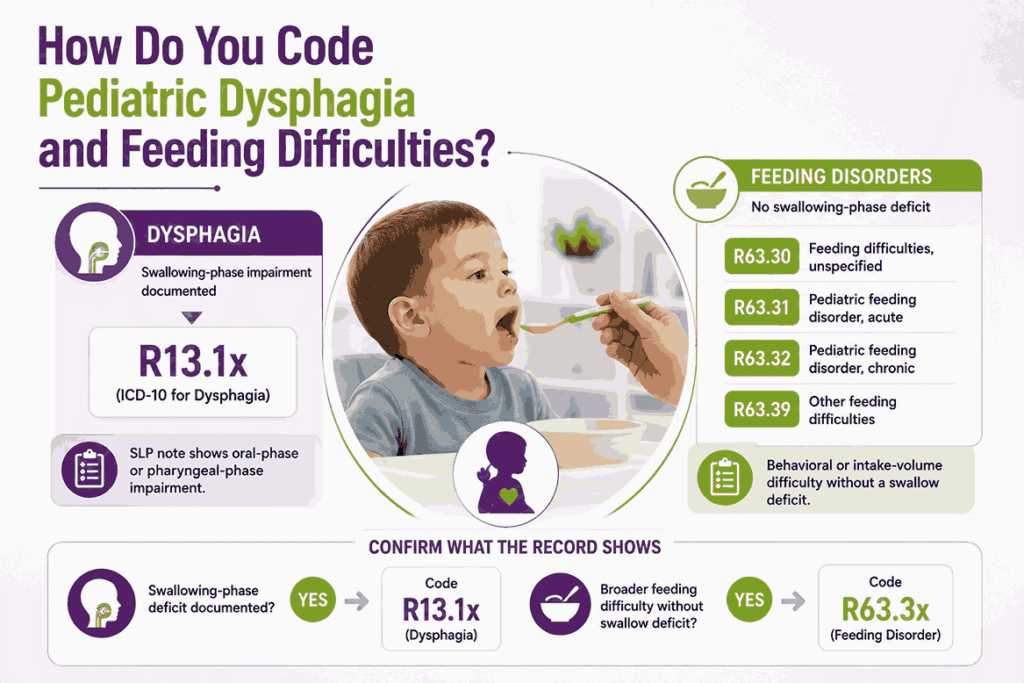
Pediatric dysphagia and pediatric feeding disorder use different ICD-10 families, and the distinction drives clean pediatric claims. R13.1x applies to children with a documented swallowing-phase impairment, the same as adults. A feeding disorder without a phase-specific swallowing deficit routes to the R63.3 family.
The pediatric feeding codes are separated by acuity:
- R63.30 — Feeding difficulties, unspecified
- R63.31 — Pediatric feeding disorder, acute
- R63.32 — Pediatric feeding disorder, chronic
- R63.39 — Other feeding difficulties
Confirm whether the record documents a swallowing-phase deficit or a broader feeding difficulty. A speech-language pathologist notes that names oral-phase or pharyngeal-phase impairment supports R13.1x. Behavioral or intake-volume difficulty without a swallow deficit supports the R63.3 family.
Which CPT Codes Pair With Dysphagia Diagnoses?
Dysphagia diagnoses pair with swallow evaluation and therapy CPT codes, and the diagnosis supports medical necessity for each. The R13.1x code justifies the service, while the CPT code reports the work performed. The following table maps the core swallow procedure codes to their use.
| CPT | Service | Notes |
|---|---|---|
| 92610 | Clinical (bedside) swallow evaluation | Untimed, any setting |
| 92611 | Motion fluoroscopic swallow evaluation (MBSS) | SLP’s role in the study |
| 74230 | Swallowing function with fluoroscopy | Radiologist’s role, not the SLP’s |
| 92612 | Flexible endoscopic evaluation of swallowing (FEES) | Requires scope and training |
| 92616 | FEES with laryngeal sensory testing | One code, not 92612 plus 92614 |
| 92526 | Treatment of swallowing dysfunction | Therapy, not evaluation |
Three billing rules govern these pairings. CPT 92610 and 92611 do not bill in duplicate on the same day. The treatment code 92526 bills on the same day as an evaluation only when the record documents a separate, distinct service under an established plan of care.
Modifier 26 reports the professional component of the radiology service, and modifier 59 marks distinct procedural services. Pair each procedure with the matching diagnosis from our gastroenterology CPT code guide.
How Do You Code Dysphagia Following a Stroke?
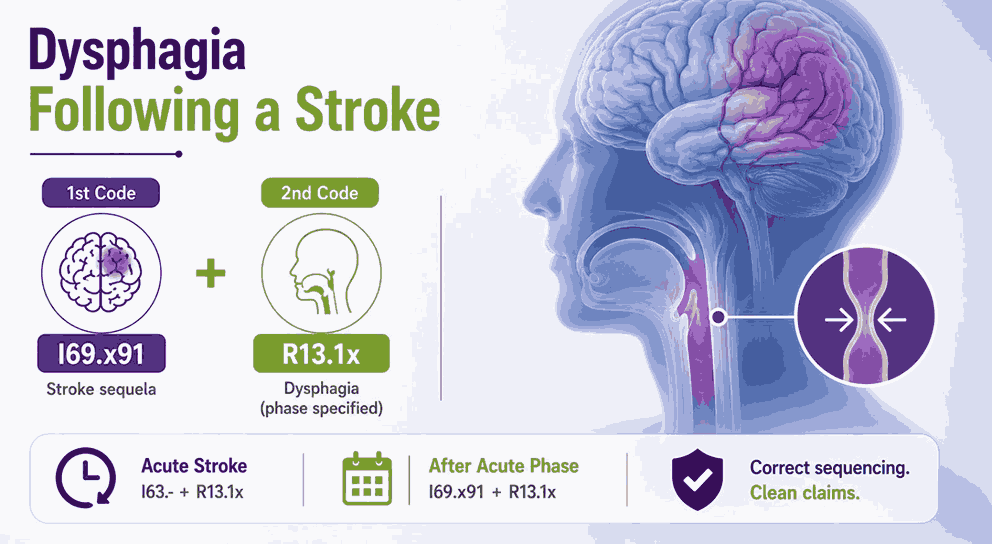
Code dysphagia following a stroke with I69.x91 first, then add R13.1x to identify the phase when documented. The R13.1 “Code first” note and the reciprocal I69 “Use additional code” note establish this etiology-manifestation pair. Reversing the order produces a sequencing-error denial.
I69.391, dysphagia following cerebral infarction, is the most reported sequela code. Match the I69 subcode to the documented cerebrovascular event:
- I69.091 — Dysphagia following nontraumatic subarachnoid hemorrhage
- I69.191 — Dysphagia following nontraumatic intracerebral hemorrhage
- I69.291 — Dysphagia following other nontraumatic intracranial hemorrhage
- I69.391 — Dysphagia following cerebral infarction
- I69.891 — Dysphagia following other cerebrovascular disease
- I69.991 — Dysphagia following unspecified cerebrovascular disease
Timing changes the etiology code. During the acute stroke admission, report the acute cerebrovascular code (I63.-) with R13.1x. After the acute phase resolves, report the I69.x91 sequela code with R13.1x.
What Are Common Dysphagia Coding Scenarios?
Worked scenarios show how cause and timing change the code order. Each example assumes documentation supports the phase named.
A 68-year-old presents during an acute admission for cerebral infarction with oropharyngeal dysphagia confirmed on bedside evaluation. Report I63.- for the acute infarction, add R13.12 for the phase, and bill 92610 for the clinical swallow evaluation.
A patient returns six months after a cerebral infarction with persistent oropharyngeal dysphagia confirmed on FEES. Report I69.391 first as the sequela, add R13.12 for the phase, and bill 92612 for the endoscopic evaluation.
A Parkinson’s disease patient develops progressive oropharyngeal dysphagia and undergoes a clinical swallow evaluation. Report G20 for Parkinson’s disease, add R13.12 for the phase, and bill 92610. The neurological diagnosis and the phase code together support the medical necessity of the evaluation.
What Documentation Supports Dysphagia Claims?
Strong dysphagia documentation records the swallowing phase, the severity, the suspected etiology, and the functional impact on intake. Payers review dysphagia claims at a high rate because diagnostic and therapy costs run high. Phase-specific coding reduces medical-necessity denials.
Instrumental and clinical swallow assessments depend on a supported dysphagia diagnosis. A modified barium swallow study (MBSS) and a fiberoptic endoscopic evaluation of swallowing (FEES) each require documented difficulty swallowing. The note connects the R13.1x code to aspiration risk, diet level, and the recommended intervention.
A documentation checklist keeps dysphagia claims audit-ready:
- Phase of the swallow impaired, mapped to the R13.1x subcode.
- Etiology of the dysphagia, including any stroke, neurological, or structural cause.
- Severity and aspiration risk were observed during the assessment.
- Diet modification and compensatory technique recommended.
- Functional impact on nutrition, hydration, and intake.
A speech-language pathologist documents the swallow evaluation, the diet modifications, and the compensatory techniques. That record links the R13.1x code to the service and protects the claim during audit.
How Do Payers Review Dysphagia Claims?
Payers review dysphagia claims against medical-necessity policy and diagnosis specificity. Medicare contractors publish local coverage determinations (LCDs) that list covered diagnoses for swallowing studies and therapy. A phase-specific R13.1x code matched to the LCD supports first-pass payment.
Frequency patterns also draw review. Repeated R13.10 across encounters signals missing specificity and invites a medical-necessity audit. Working with professional medical billing services for gastroenterology practices ensures clinical records match required payer standards. A documented phase code and correct sequencing move the claim through review.
Inpatient dysphagia coding maps to MS-DRG 391 and 392 for esophagitis, gastroenteritis, and miscellaneous digestive disorders, with the presence of a major complication directing the assignment.
What Are Common Dysphagia Coding Errors?
Five coding errors generate most dysphagia denials. Each error traces to documentation specificity or sequencing.
- Assigning R13.10 when the chart documents a phase, which weakens medical necessity and invites review.
- Reversing the I69 and R13 sequence for a stroke sequela, the leading cause of sequencing-error denials.
- Reporting R13.1 on a claim, the non-billable header that fails fifth-character edits.
- Confusing pharyngeal (R13.13) with pharyngoesophageal (R13.14), two phases with different procedure links.
- Substituting R13.1x for an esophageal disease diagnosis when achalasia, stricture, or GERD captures the cause.
Each correction restores specificity and aligns the claim with payer policy. Coders who catch these patterns at charge entry prevent the rework that delays cash.
How Does Accurate Dysphagia Coding Affect Reimbursement?
Accurate dysphagia coding reduces denials on swallow studies, therapy, and follow-up procedures. A phase-specific R13.1x code, correct I69 sequencing, and supporting documentation move dysphagia claims to first-pass payment. Vague or reversed coding adds rework, delays cash, and raises audit exposure.
Specialty teams that bill high volumes of dysphagia services benefit from coders trained on the R13.1x family and the I69 sequencing rules. Transcure handles diagnosis selection, sequencing, and documentation review across gastroenterology workflows.
Dysphagia ICD-10 Coding FAQs
Is R13.1 a billable code?
R13.1 is not billable; coders assign a five-character subcode from R13.10 through R13.19 to reach valid specificity.
What is the ICD-10 code for difficulty swallowing?
The ICD-10 code for difficulty swallowing is R13.1x, with the specific subcode determined by the documented swallowing phase.
How do you code dysphagia after a stroke?
Code dysphagia after a stroke with I69.x91 first, such as I69.391, then add R13.1x to identify the phase when the record documents it.
What is the difference between R13.12 and R13.14?
R13.12 covers the oropharyngeal phase during mouth-to-pharynx transfer, while R13.14 covers the pharyngoesophageal junction at the upper esophageal sphincter.
Is dysphagia a symptom or a diagnosis code?
Dysphagia is a symptom, and R13.1x is the symptom diagnosis code coders report when no more specific definitive diagnosis already captures it.
Which CPT code reports a bedside swallow evaluation?
CPT 92610 reports a clinical bedside evaluation of oral and pharyngeal swallowing function, paired with the matching R13.1x diagnosis.
Does pediatric dysphagia use the R13.1x codes?
Pediatric dysphagia uses R13.1x when the record documents a swallowing-phase deficit, while a feeding difficulty without a swallow deficit uses the R63.3 family.
Note: By matching each claim to the correct R13.1x subcode, sequencing I69.x91 first for stroke sequelae, pairing the right CPT code, and documenting the swallowing phase, billing teams move dysphagia services to clean, first-pass payment.