ICD-10-CM diagnosis codes tell payers why a procedure was medically necessary in an Ambulatory Surgery Center. Every ASC claim pairs a diagnosis code with a CPT procedure code to prove the service was warranted. Without that link, clean claims turn into denials.
Three coding systems govern ASC billing. ICD-10-CM captures the diagnosis, CPT describes the surgical procedure, and HCPCS Level II covers supplies, drugs, and implants. Each system does a different job, and payers check all three for consistency.
This guide breaks down the ICD-10 codes ASCs use most, organized by specialty instead of one long list. It covers FY2026 code updates, ASC-specific coding rules versus hospital and office settings, denial patterns tied to diagnosis coding, and the workflow for linking a diagnosis to a covered procedure.
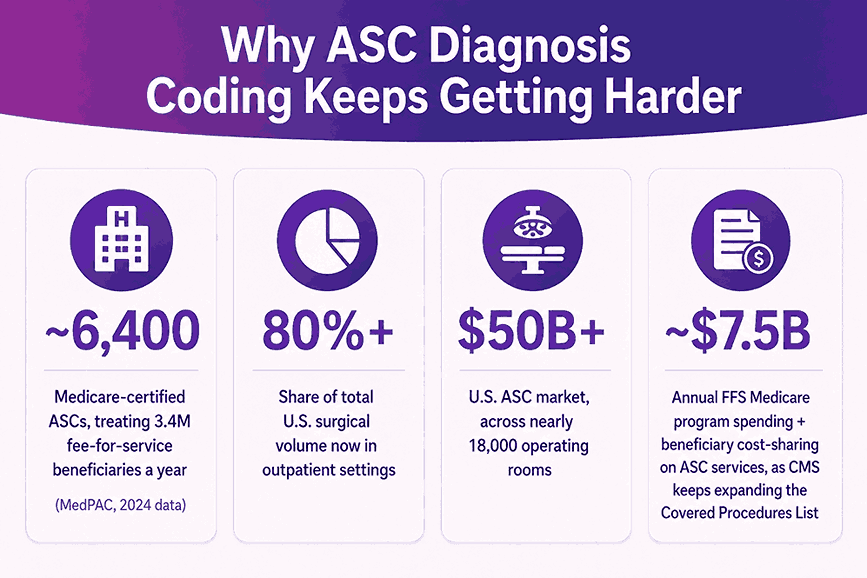
Why ASC Diagnosis Coding Complexity Is Increasing
More than 6,400 Medicare-certified ASCs now treat roughly 3.4 million fee-for-service beneficiaries a year, and outpatient settings account for over 80% of total surgical volume nationally. The U.S. ASC market has passed $50 billion, spread across nearly 18,000 operating rooms.
Medicare payments to ASCs have surpassed $7.5 billion in recent years as CMS keeps expanding the Covered Procedures List (CPL). Higher-acuity cases, including total joint replacement and complex GI endoscopy, keep shifting from hospitals into ASC settings.
What this means for diagnosis coding:
- More procedure types now require ASC-specific ICD-10 pairing knowledge that didn’t exist five years ago.
- Higher-acuity cases carry stricter medical necessity documentation requirements than routine outpatient procedures.
- Payers apply more pre-payment review to newly CPL-eligible procedures, since utilization patterns are still being established.
What ICD-10-CM Codes Do in ASC Billing
An ICD-10-CM code is a five-to-seven character alphanumeric string that identifies a specific diagnosis, condition, or reason for a visit. In an ASC setting, this code answers the question for the payer: why did this patient need this surgery today?
Medicare and commercial payers cross-check the diagnosis against the CPT code before paying a claim. A cataract removal without a documented visual impairment code gets flagged. A joint replacement without a matching osteoarthritis code gets denied on pre-payment review.
ICD-10-CM is distinct from ICD-10-PCS, which hospitals use for inpatient procedure coding. ASCs never report ICD-10-PCS. Confusing the two systems is a common error among coders transitioning from inpatient facility work.
ICD-10-CM vs. CPT vs. HCPCS Level II
| System | Maintained By | What It Reports | Update Cycle |
|---|---|---|---|
| ICD-10-CM | CMS / NCHS | Diagnosis, condition, reason for encounter | Annual, October 1 |
| CPT | American Medical Association | Surgical procedure, service performed | Annual, January 1 |
| HCPCS Level II | CMS | Supplies, drugs, implants, DME | Quarterly |
ASCs report all three on the same claim. ICD-10-CM never appears alone. It exists to justify the CPT code sitting next to it on the claim form, and the HCPCS code fills in any supply or implant detail the CPT code doesn’t already cover.
How ASC Diagnosis Coding Differs From Physician Office and Hospital Coding
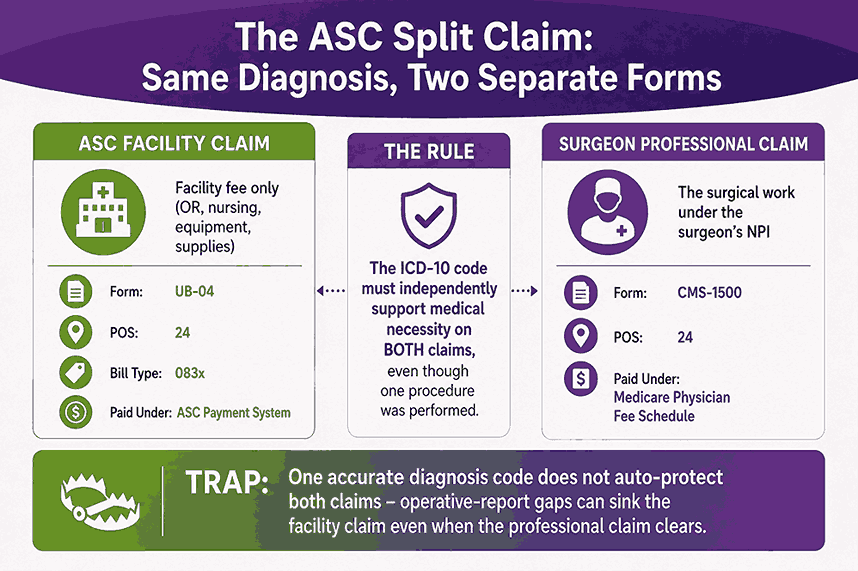
An ASC bills the facility fee only. This covers the operating room, nursing staff, equipment, and supplies used during the procedure. The surgeon bills a separate professional claim under their own NPI.
That split changes how diagnosis codes get used. Both claims often carry the same ICD-10 code, but they travel on different forms, to different fee schedules, under different scrutiny levels.
Diagnosis coding is only one layer of that split-claim structure. The full facility-fee workflow, from POS 24 setup through UB-04 submission and payment posting, is covered in our ASC billing guide. This article stays focused on the diagnosis side of the claim.
- The ASC facility claim uses Place of Service 24 and reports on a UB-04 (institutional claim form) under bill type 083x.
- The surgeon’s professional claim also uses Place of Service 24, but reports on a CMS-1500 and pays from the Medicare Physician Fee Schedule.
- The ICD-10 diagnosis code must independently support medical necessity on both claims, even though only one procedure was performed.
A common mistake here is assuming one accurate diagnosis code protects both claims automatically. Documentation gaps on the operative report can sink the facility claim even when the professional claim clears.
ASC vs. HOPD vs. Physician Office: A Coding Comparison
Hospital Outpatient Departments (HOPDs) and physician offices use the same ICD-10-CM code set, but payment structure and payer scrutiny differ enough to change coding priorities.
| Setting | Claim Form | Place of Service | Payment Basis | Typical Scrutiny |
|---|---|---|---|---|
| ASC | UB-04 | 24 | ASC Payment System (facility fee) | High, tied to CPL eligibility |
| HOPD | UB-04 | 19/22 | OPPS (higher facility rates) | Moderate, broader procedure allowance |
| Physician office | CMS-1500 | 11 | Physician Fee Schedule | Lower, no facility fee component |
An ASC-eligible procedure billed at HOPD facility rates instead of ASC rates is one of the more common site-of-service payment errors auditors flag, and it starts with a coding and setting mismatch rather than a diagnosis error.
Top ICD-10 Codes for ASC by Specialty
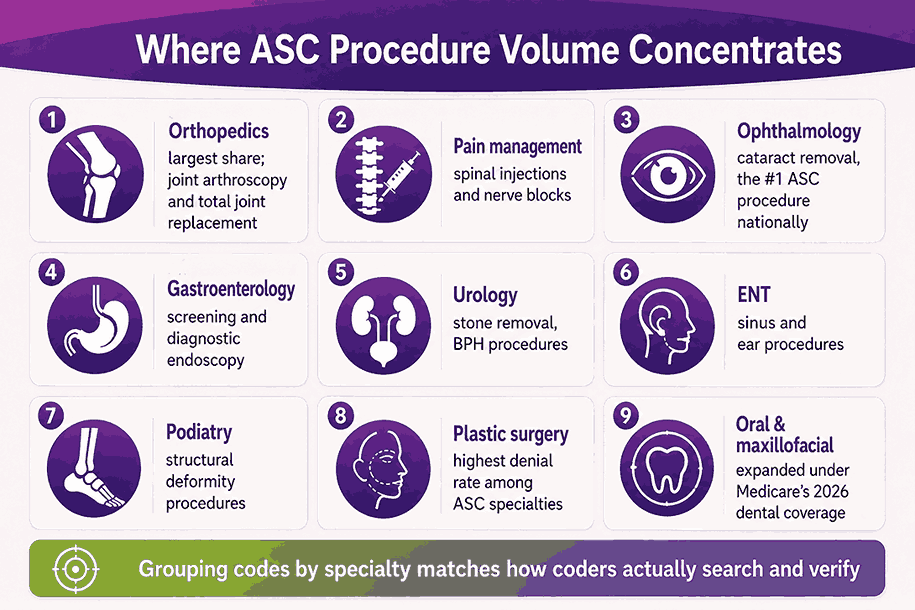
ASCA data shows orthopedics, pain management, ophthalmology, gastroenterology, and urology account for most ASC procedure volume, with otolaryngology, podiatry, plastic surgery, and oral and maxillofacial surgery close behind. Grouping codes by specialty, instead of one flat list, matches how coders actually search and verify.
Orthopedics
Orthopedic procedures make up the largest share of ASC surgical volume, driven by joint arthroscopy and total joint replacement growth under the expanding Covered Procedures List.
| ICD-10 Code | Description | Common Paired CPT |
|---|---|---|
| M17.11 | Primary osteoarthritis, right knee | 27447 (Total knee arthroplasty) |
| M75.100 | Rotator cuff tear, right shoulder, unspecified | 29827 (Arthroscopic rotator cuff repair) |
| S83.006A | Unspecified dislocation of an unspecified patella, initial encounter | 29881 (Knee arthroscopy, meniscectomy) |
| M16.11 | Primary osteoarthritis, right hip | 27130 (Total hip arthroplasty) |
| M65.311 | Trigger finger, right index finger | 26055 (Tendon sheath incision) |
| M23.201 | Derangement of lateral meniscus, old tear, right knee | 29881 (Knee arthroscopy, meniscectomy) |
Pain Management
Pain management ASC volume centers on spinal injections and nerve blocks, most performed under fluoroscopic guidance.
- M54.50 (Low back pain, unspecified) pairs with epidural steroid injections.
- M51.36 (Lumbar intervertebral disc degeneration) supports transforaminal epidural procedures.
- G89.29 (Other chronic pain) supports ongoing pain management billing series.
- G54.2 (Cervical root disorders) supports cervical epidural and nerve block claims.
- M47.816 (Lumbar spondylosis without myelopathy) supports facet joint injection claims
Gastroenterology
GI procedures split into screening and diagnostic categories, and the ICD-10 code determines which bucket a colonoscopy falls into for cost-sharing purposes.
| ICD-10 Code | Description | Common Paired CPT |
|---|---|---|
| Z12.11 | Screening for malignant neoplasm of colon | 45378 (Diagnostic colonoscopy) |
| K57.30 | Diverticulosis without bleeding | 45380 (Colonoscopy with biopsy) |
| K21.0 | GERD with esophagitis | 43235 (Diagnostic EGD) |
| K80.20 | Gallbladder calculus, no cholecystitis | 47562 (Laparoscopic cholecystectomy) |
| K92.1 | Melena | 45380 (Colonoscopy with biopsy) |
A screening colonoscopy that turns therapeutic mid-procedure is one of the most frequently miscoded GI encounters in ASC billing. The section on frequently asked questions below breaks down how the diagnosis and CPT code both shift in that scenario.
Ophthalmology
Cataract removal remains the single highest-volume ASC procedure nationally, and its diagnosis coding is one of the most audited pairings in the specialty.
- H25.11 (Age-related nuclear cataract, right eye) is the primary code for standard cataract claims.
- H26.9 (Unspecified cataract) works but invites payer scrutiny for lacking specificity.
- H40.1110 (Primary open-angle glaucoma, right eye, unspecified stage) supports combined glaucoma procedures.
- H35.30 (Unspecified macular degeneration) supports intravitreal injection claims.
- H04.123 (Dry eye syndrome, bilateral lacrimal glands) supports punctal plug and related procedures.
Urology and Gynecology
- N20.0 (Calculus of kidney) pairs with ureteroscopy and stone removal procedures.
- N40.1 (Benign prostatic hyperplasia with LUTS) supports minimally invasive BPH procedures.
- N32.81 (Overactive bladder) supports urodynamic and sling procedures.
- N13.30 (Unspecified hydronephrosis) supports stent placement and drainage procedures.
Otolaryngology (ENT)
ENT volume in ASCs skews toward sinus and ear procedures, where diagnosis specificity around chronicity directly affects reimbursement.
| ICD-10 Code | Description | Common Paired CPT |
|---|---|---|
| J32.9 | Chronic sinusitis, unspecified | 31255 (Nasal/sinus endoscopy, ethmoidectomy) |
| H66.90 | Otitis media, unspecified | 69436 (Tympanostomy with tube insertion) |
| J34.2 | Deviated nasal septum | 30520 (Septoplasty) |
Podiatry
Podiatric ASC procedures rely heavily on structural deformity codes, where laterality and joint specificity determine claim acceptance.
- M20.11 (Hallux valgus, right foot) supports bunionectomy claims.
- M77.31 (Calcaneal spur, right foot) supports plantar fascia release procedures.
- M72.2 (Plantar fascial fibromatosis) supports minimally invasive fasciotomy claims.
Plastic and Reconstructive Surgery
Plastic surgery carries the highest denial rate among ASC specialties, largely because cosmetic and reconstructive intent must be documented clearly to separate covered from non-covered services.
- N60.11 (Diffuse cystic mastopathy, right breast) supports covered reduction mammaplasty claims.
- L72.3 (Sebaceous cyst) supports covered excision procedures.
- Cosmetic-intent diagnoses generally have no covered ICD-10 pairing at all, since payers exclude the service regardless of documentation quality.
Oral and Maxillofacial Surgery
Dental-adjacent ASC procedures use a mix of ICD-10-CM and CDT codes, and Medicare’s 2026 expansion added roughly 46 new dental surgical procedures plus nearly 80 ancillary services to ASC-eligible coverage.
- K04.7 (Periapical abscess without sinus) supports covered extraction and surgical claims.
- M26.60 (Temporomandibular joint disorder, unspecified) supports TMJ-related surgical procedures.
Vascular Surgery
- I83.90 (Varicose veins, unspecified, no complications) supports endovenous ablation procedures.
- I70.209 (Atherosclerosis of native arteries, unspecified extremity) supports angioplasty and stent claims.
A Real-World Coding Example: From Encounter to Clean Claim
A 68-year-old patient presents for cataract surgery. The surgeon’s note documents decreased visual acuity, lens opacity confirmed on slit-lamp exam, and functional impairment affecting daily activities.
The coder assigns H25.11 (age-related nuclear cataract, right eye) rather than the unspecified H26.9, since the documentation supports laterality and cataract type. This specificity avoids an automatic scrutiny flag some MACs apply to unspecified ophthalmology codes.
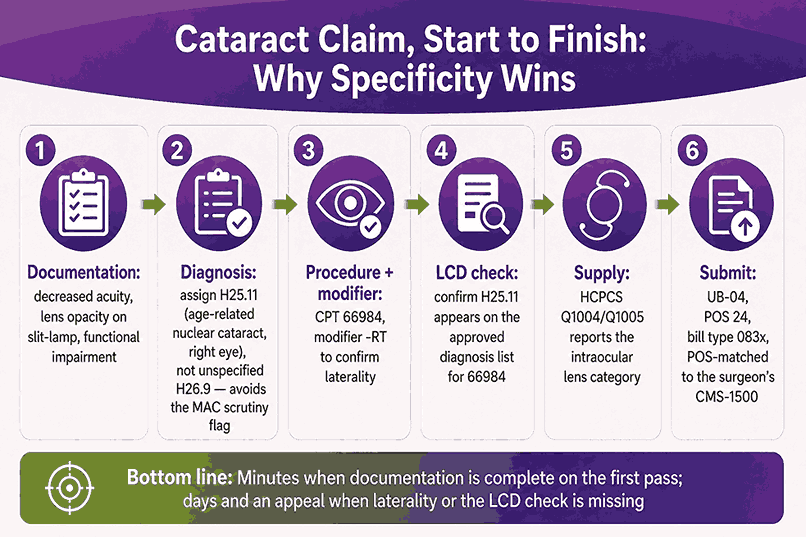
The claim then moves through this sequence:
- CPT 66984 is assigned for extracapsular cataract removal with intraocular lens insertion.
- Modifier -RT confirms the right-eye laterality already established in the diagnosis code.
- The coder checks the MAC’s LCD for 66984 and confirms H25.11 appears on the approved diagnosis list.
- HCPCS code Q1004 or Q1005 reports the intraocular lens category, since standard lenses carry no separate charge but premium lenses require accurate reporting.
- The claim submits on a UB-04, Place of Service 24, bill type 083x, with POS-matching data on the surgeon’s separate CMS-1500.
This sequence takes minutes when the documentation is complete on the first pass. It takes days, and often an appeal, when the operative note lacks laterality or the LCD wasn’t checked before scheduling.
Common ASC ICD-10 Coding Errors Beyond Denial Triggers
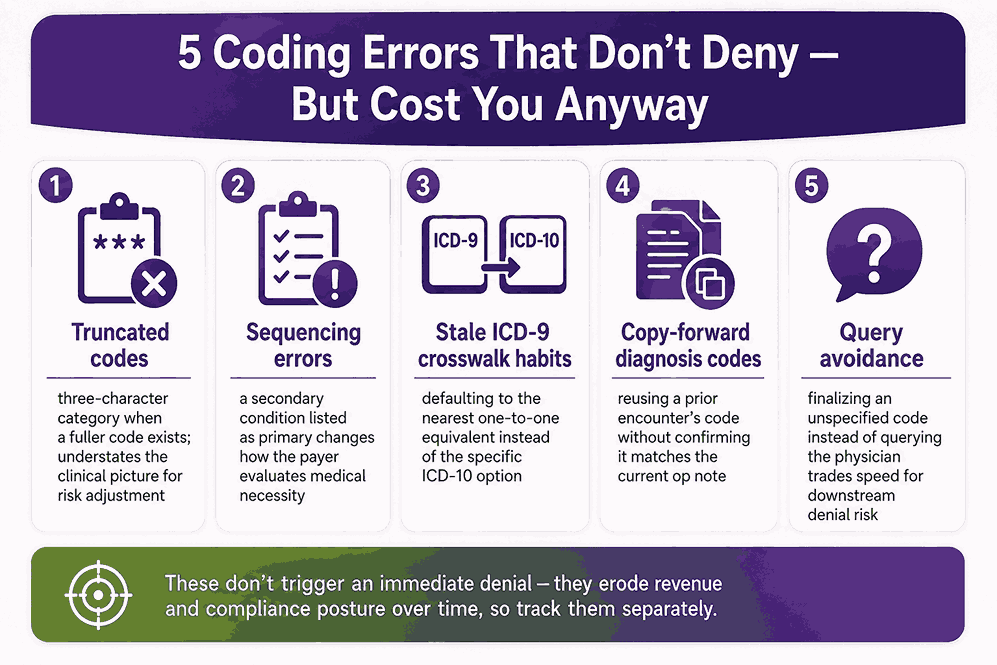
Some coding errors don’t trigger an immediate denial but erode revenue and compliance posture over time. These are worth tracking separately from the denial-reason table above.
- Truncated codes: Reporting a three-character category code when a fuller code exists loses specificity and can understate the clinical picture for risk-adjustment purposes.
- Sequencing errors: Listing a secondary condition as the primary diagnosis changes how the payer evaluates medical necessity for the primary procedure.
- Stale ICD-9 crosswalk habits: Coders who trained pre-2015 sometimes default to the nearest one-to-one ICD-9 equivalent instead of the more specific ICD-10 option available.
- Copy-forward diagnosis codes: Reusing a prior encounter’s diagnosis code without confirming it still matches the current operative note is a frequent source of mismatched claims in high-volume centers.
- Query avoidance: Coders finalizing an unspecified code rather than querying the physician for missing detail trade short-term speed for downstream denial risk.
Payer-Specific Considerations: Medicare, Medicare Advantage, and Commercial Plans
Traditional Medicare follows published LCDs and NCDs consistently across a MAC’s jurisdiction, which makes verification predictable once a coder knows the applicable MAC.
Medicare Advantage (MA) plans are required to cover what Traditional Medicare covers, but many apply their own prior authorization rules and internal medical necessity criteria on top of the CMS baseline. An ICD-10 code that clears Traditional Medicare’s LCD can still need a separate MA prior authorization for the same procedure.
Commercial payers diverge the most. Each carrier publishes its own medical policy for high-cost ASC procedures, and these policies change more frequently than CMS’s annual cycle. ASCs that serve a broad payer mix generally maintain a payer-specific policy library rather than relying on Medicare’s LCD as a universal proxy.
Maintaining that policy library, tracking MA prior authorization rules, and re-verifying LCD pairings every payer year is a full-time function in itself. Centers without dedicated coding staff often route this through specialized ASC billing services rather than absorbing the overhead in-house. The economics usually favor outsourcing once payer mix crosses three or four major commercial carriers.
Documentation Templates That Support Cleaner ICD-10 Coding
Structured templates in the EHR reduce the query volume between coders and physicians, since the required specificity elements are captured at the point of care instead of after the fact.
| Specialty | Key Documentation Elements | Why It Matters for Coding |
|---|---|---|
| Orthopedics | Laterality, joint, chronicity, injury mechanism | Drives code selection between acute injury and chronic degenerative categories |
| Ophthalmology | Visual acuity, cataract type, eye laterality | Supports specific codes over unspecified defaults |
| Pain management | Spinal level, chronicity, prior conservative treatment | Required by most LCDs before injection procedures are approved |
| Gastroenterology | Screening vs. diagnostic intent, findings during procedure | Determines whether Z12.11 or a diagnostic code applies |
Templates only help when physicians complete them consistently. A template with an optional laterality field still produces unspecified codes if the field goes unanswered on half of all operative notes.
Templates only help when physicians complete them consistently, and that depends heavily on how the fields are built into the system. Modern ASC EMRs let administrators make laterality and chronicity fields required rather than optional, which closes the unspecified-code gap at the source. A template with an optional laterality field still produces unspecified codes if the field goes unanswered.
Single-Specialty vs. Multi-Specialty ASC Coding Considerations
A single-specialty ASC, such as an ophthalmology-only or GI-only center, can standardize its top ICD-10 and CPT pairings into a tight reference list and audit against it consistently. Coding accuracy tends to run higher because the code universe is narrow.
Multi-specialty ASCs face a harder coding environment. Coders rotate across orthopedics, pain management, and GI in the same shift, and each specialty carries its own LCD nuances and modifier conventions. Cross-training and specialty-tagged coding checklists reduce the error rate that volume and variety otherwise introduce.
Multi-specialty centers that can’t justify cross-trained coders on payroll for every specialty face a build-vs-buy decision. Evaluating ASC billing companies with proven specialty-specific coding teams is often the faster path than recruiting and certifying in-house across orthopedics, GI, and pain management simultaneously. The vendor’s specialty mix should mirror your case mix, not just their overall claim volume.
Linking Diagnosis to Procedure: Where Denials Actually Start
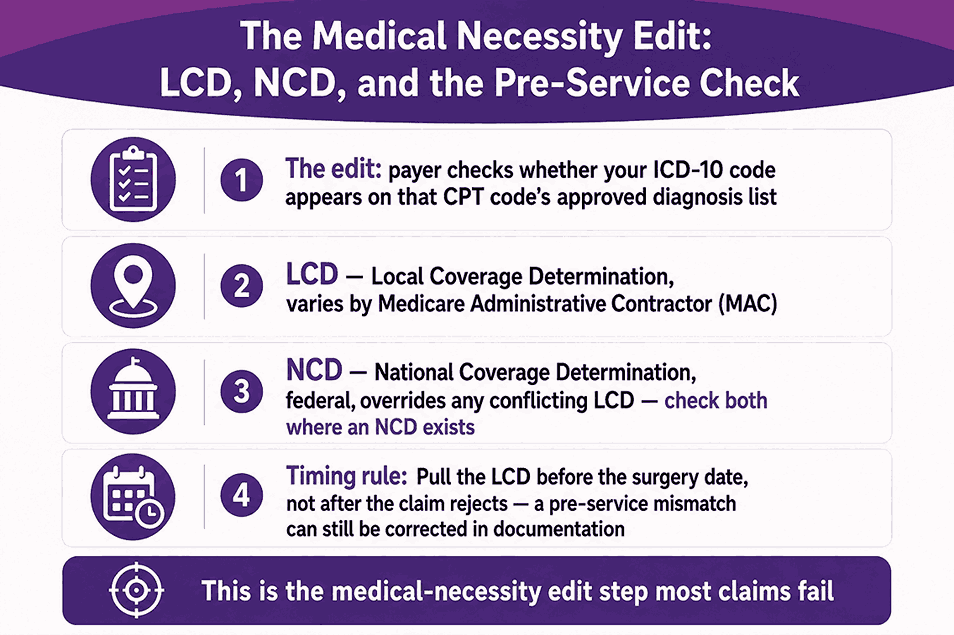
A payer’s medical necessity edit checks whether the ICD-10 code on the claim appears on that CPT code’s approved diagnosis list. This list is called a Local Coverage Determination, or LCD, and it varies by Medicare Administrative Contractor (MAC).
National Coverage Determinations (NCDs) apply the same logic at the federal level for a smaller set of procedures, and they override any conflicting LCD. Coders need to check both, not just the MAC’s LCD, for procedures where an NCD exists.
In practice, coders pull the LCD for a procedure before the surgery date, not after the claim rejects. Verifying the pairing pre-service catches a mismatch while the documentation can still be corrected.
ASC Accreditation and Its Coding Compliance Link
Most ASCs carry accreditation from AAAHC, the Joint Commission, or a comparable body, and Medicare certification depends on maintaining it. Accreditation surveys increasingly review coding and documentation practices alongside clinical and safety standards.
A surveyor finding a pattern of unspecified ICD-10 codes or missing LCD verification can flag it as a documentation deficiency, not just a billing inefficiency. Coding compliance has become part of the accreditation conversation, not a separate track from it.
How Do You Code a Same-Day Surgery Encounter From Start to Finish?
Coding an ASC encounter runs through a fixed sequence, and skipping a step is the most common source of preventable denials. Coding an ASC encounter runs through a fixed sequence, and skipping a step is the most common source of preventable denials. The steps below focus on the diagnosis-linkage portion; our ASC procedure coding guide walks through CPT selection, modifier logic, and NCCI edit handling in full detail.
- Pull the operative report and pre-op documentation. Confirm the physician’s stated diagnosis matches what the payer’s LCD requires for the planned CPT code.
- Assign the ICD-10-CM code to the highest level of specificity. Laterality, encounter type, and severity all affect code selection and reimbursement.
- Assign the CPT code and any required modifiers. Bilateral, laterality, and distinct-service modifiers (-50, -LT, -RT, -59) attach here.
- Cross-check the diagnosis against the CPT on the payer’s LCD or NCD. This is the medical necessity edit step most claims fail.
- Confirm the procedure sits on the current ASC Covered Procedures List. Non-covered procedures deny outright regardless of diagnosis accuracy.
- Run the claim through NCCI edits before submission. This catches bundling conflicts between component and comprehensive codes.
- Submit the facility claim on a UB-04 with Place of Service 24 and bill type 083x.
FY2026 ICD-10-CM Updates ASCs Need to Know
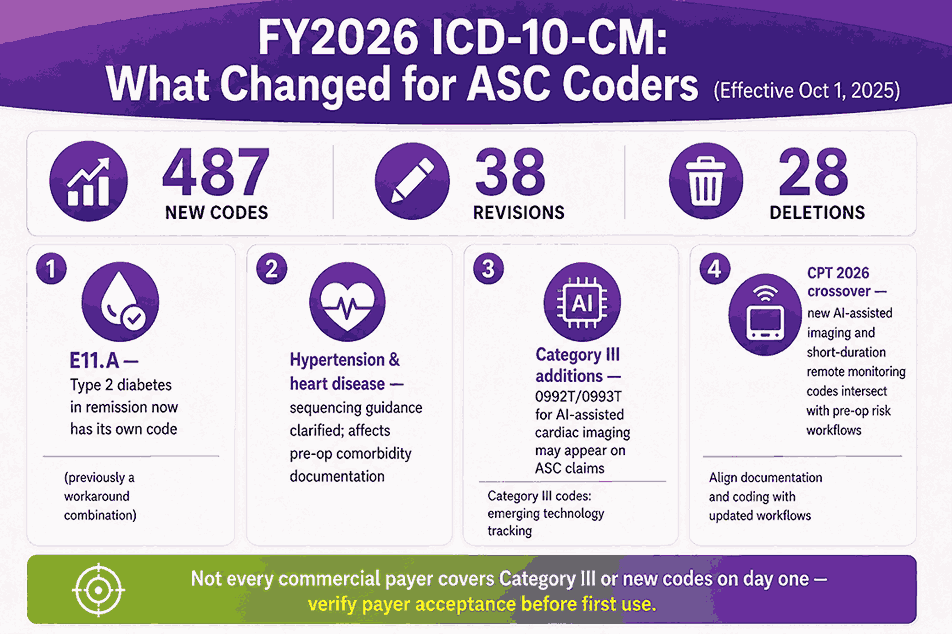
CMS added 487 new diagnosis codes effective October 1, 2025, alongside 38 revisions and 28 deletions. ASC coding teams need to review these against their most-billed code lists before claims start rejecting.
- E11.A now separately identifies Type 2 diabetes in remission, a distinction that previously required a workaround combination code.
- Hypertension and heart disease coding guidance was clarified, affecting how comorbidities get sequenced on pre-op risk documentation.
- New Category III codes, including 0992T and 0993T for AI-assisted cardiac imaging analysis, may appear on ASC claims tied to emerging diagnostic technology.
- CPT 2026 added new codes for AI-assisted imaging and shorter-duration remote monitoring, which intersect with pre-op risk assessment workflows at some ASCs.
Not every commercial payer covers Category III or newly added codes on day one. Verify payer-specific acceptance before billing a new FY2026 code for the first time.
Common ASC ICD-10 Denial Reasons and How to Prevent Them
| Denial Reason | Root Cause | Prevention |
|---|---|---|
| Medical necessity not met | ICD-10 code isn’t on the CPT’s LCD list | Verify LCD pairing pre-service, not post-denial |
| Unspecified code used | Documentation lacks laterality or severity detail | Query the physician before finalizing the code |
| Procedure not on CPL | CPT isn’t Medicare-approved for ASC setting | Check current-year Covered Procedures List before scheduling |
| Missing modifier | Bilateral or distinct-service modifier omitted | Build modifier checks into pre-submission scrubbing |
| NCCI bundling conflict | Component and comprehensive codes billed together | Run claims through NCCI edits before submission |
| Site-of-service mismatch | ASC-eligible procedure billed at HOPD rate logic | Confirm POS and bill type match the facility type before submission |
| Prior authorization gap | High-cost procedure scheduled without payer approval | Verify authorization requirements at scheduling, not pre-op |
ASC Coding Compliance Best Practices
- Keep an internal reference list of your ASC’s top 50 ICD-10 and CPT pairings by specialty, refreshed every time CMS publishes annual updates.
- Build LCD verification into scheduling, not into the billing queue after the surgery has already happened.
- Audit a sample of claims monthly against documentation to catch unspecified-code drift before a payer audit does.
- Train coders on payer-specific rules separately from CMS rules, since commercial LCDs frequently diverge from Medicare’s.
- Support coders pursuing a CASCC (Certified Ambulatory Surgery Center Coder) credential through AAPC, since ASC-specific certification correlates with lower denial rates than general CPC credentialing alone.
- Evaluate AI-assisted coding tools for high-volume specialties, where pattern-matching against LCDs can flag mismatches before submission rather than after denial.

Frequently Asked Questions
What ICD-10 Code is Used for a Screening Colonoscopy in an ASC?
Z12.11 is the primary diagnosis for a screening colonoscopy with no prior symptoms or history. If polyps are found and removed during the same procedure, the CPT code shifts to a therapeutic code, but Z12.11 typically remains the primary diagnosis under current CMS guidance.
Do ASCs Use the Same ICD-10 Codes as Hospitals?
Yes. ICD-10-CM is not setting-specific. The difference is which codes ASCs bill most often, since ASC procedure volume skews toward orthopedics, ophthalmology, GI, and pain management rather than inpatient-only surgical categories.
Why Does an Accurate ICD-10 Code Still Get Denied?
The code can be clinically accurate but still fail if it doesn’t appear on the specific payer’s LCD for that CPT code, or if the procedure itself isn’t on the ASC Covered Procedures List for that payer year.
How Often Do ASC-Relevant ICD-10 Codes Change?
CMS updates the full ICD-10-CM code set once a year, effective October 1. FY2026 added 487 new codes, so ASC coding references need an annual refresh at minimum.
What’s the Most Audited ICD-10 and CPT Pairing in ASC Billing?
Cataract removal (66984) paired with a cataract diagnosis code draws frequent pre-payment review, since Medicare scrutinizes visual acuity documentation closely before approving the procedure.
Does a Multi-Specialty ASC Need Different Coding Workflows Per Specialty?
Yes. Each specialty carries distinct LCDs, modifier conventions, and documentation norms, so a single generic coding checklist tends to under-perform specialty-tagged checklists in multi-specialty centers.
Is ICD-10-PCS Ever Used in ASC Billing?
No. ICD-10-PCS is reserved for inpatient hospital procedure coding. ASCs report CPT codes for procedures and ICD-10-CM codes for diagnoses only.
Does Medicare Advantage Require Different Diagnosis Documentation Than Traditional Medicare?
The underlying ICD-10 code requirements stay the same, but MA plans often layer additional prior authorization and medical policy criteria on top, so a code that satisfies Traditional Medicare’s LCD may still need separate MA approval.
What Is a Device-Intensive Procedure, and Does It Change Diagnosis Coding?
CMS designates certain ASC procedures as device-intensive when implant costs exceed a set payment threshold, which affects the facility payment calculation rather than the ICD-10 code itself. The diagnosis still needs to independently support medical necessity regardless of device classification.