Helicobacter pylori drives most peptic ulcer disease and a large share of chronic gastritis, yet the code that captures it is one of the most miscoded entries in gastroenterology billing. B96.81 identifies H. pylori as the causal organism, but it never describes the disease itself. Coders who treat B96.81 as a standalone diagnosis trigger denials, downcoding, and audit exposure.
This guide covers the descriptor, the sequencing rule every primary code B96.81 pairs with, documentation requirements, associated CPT codes, and the errors that cost GI practices revenue.

What Is ICD-10 Code B96.81?
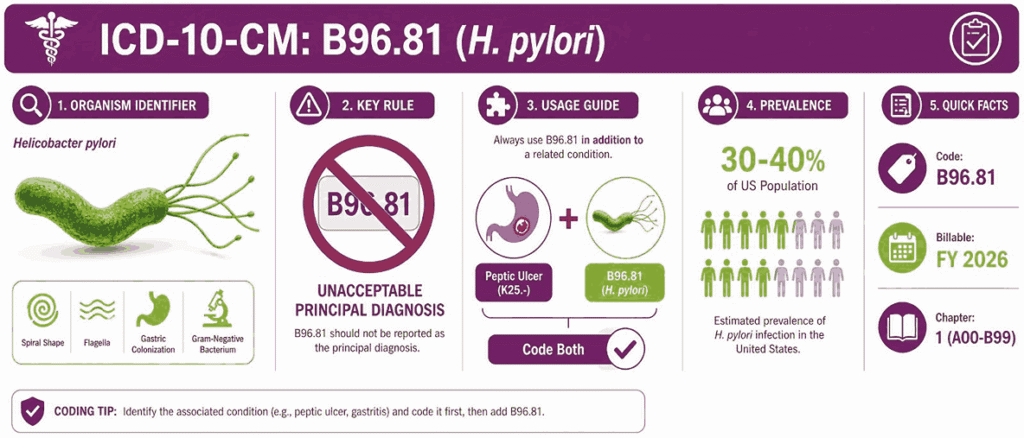
B96.81 is the ICD-10-CM code for Helicobacter pylori [H. pylori] as the cause of diseases classified elsewhere. The code sits in Chapter 1 (Certain infectious and parasitic diseases, A00 to B99), within the B95 to B97 section for bacterial and viral infectious agents. B96.81 is valid and billable for the current fiscal year, effective October 1, 2025, through September 30, 2026, with no descriptor change for FY 2026.
H. pylori infects an estimated 30% to 40% of the United States population, and it is the leading cause of peptic ulcer disease. That prevalence makes B96.81 a high-frequency code in any GI practice, which also makes its error rate expensive at scale.
B96.81 functions as an organism identifier, not a condition. The code answers one question: which bacterium caused the documented disease? It carries a specific technical status in the code set. B96.81 is an unacceptable principal diagnosis. The medical claim that lists B96.81 in the primary position fails edits at most payers because the code describes a causal agent rather than a treatable condition.
That single attribute governs everything about how B96.81 is used. The code exists only to add specificity to another diagnosis.
Why can B96.81 not Stand Alone?
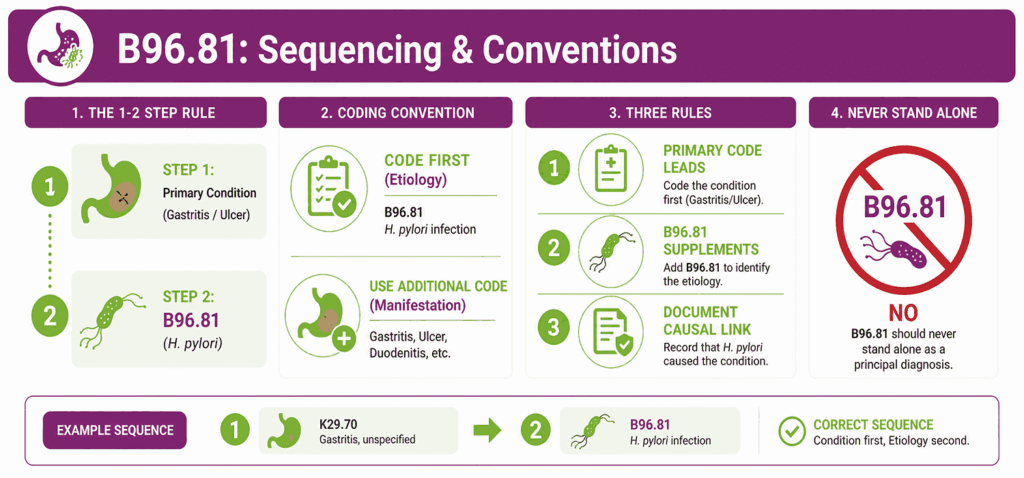
B96.81 requires a primary condition code sequenced ahead of it. The B95 to B97 codes exist as supplementary codes that identify the infectious agent in diseases classified elsewhere. They are additional codes by design. The disease gets coded first. The organism gets coded second.
This reflects the ICD-10-CM etiology and manifestation convention. When a condition has an underlying cause and a body-system effect, the manifestation carries a “code first” instruction, and the agent carries a “use additional code” relationship. For H. pylori disease, the gastric or duodenal condition is the reportable diagnosis. B96.81 attaches the organism to that condition.
Three rules follow directly:
- Sequence a primary condition code first. The gastritis, ulcer, or neoplasm code leads the claim.
- List B96.81 second. B96.81 supplements the primary code and never replaces it.
- Document the causal link. The record must state that H. pylori caused the documented condition, not merely that both are present.
A patient with a positive H. pylori test and no documented disease presents a different coding situation. B96.81 has no primary condition to attach to in that scenario, which is a documentation and code-selection problem covered later in this guide.
Primary Codes That Pair With B96.81
B96.81 attaches to conditions across two chapters: digestive diseases (K codes) and neoplasms (C codes). The following table maps the primary codes gastroenterology practices report most often alongside B96.81, with the specific manifestation each captures.
| Primary Code | Condition | When It Pairs With B96.81 |
|---|---|---|
| K25.- | Gastric ulcer | H. pylori confirmed as the cause of a stomach ulcer |
| K26.- | Duodenal ulcer | H. pylori confirmed as the cause of a duodenal ulcer |
| K27.- | Peptic ulcer, site unspecified | Ulcer confirmed, site not documented |
| K28.- | Gastrojejunal ulcer | H. pylori is linked to a gastrojejunal ulcer |
| K29.70 | Gastritis, unspecified, without bleeding | H. pylori gastritis, no documented hemorrhage |
| K29.71 | Gastritis, unspecified, with bleeding | H. pylori gastritis with documented bleeding |
| C16.- | Malignant neoplasm of the stomach | H. pylori linked to gastric adenocarcinoma |
| C88.4 | Gastric MALT lymphoma | H. pylori-associated mucosa-associated lymphoid tissue lymphoma |
The K25 through K28 ulcer categories each expand into fourth and fifth characters that specify acute versus chronic status and the presence of hemorrhage or perforation. K25.9, for example, reports a gastric ulcer that is unspecified as acute or chronic and without hemorrhage or perforation.
Coders select the highest level of specificity the record supports before appending B96.81. For a fuller map of digestive diagnosis codes across the specialty, this reference on Gastroenterology ICD 10 codes covers the broader K-chapter families that intersect with H. pylori disease.
How to Code H. pylori Gastritis
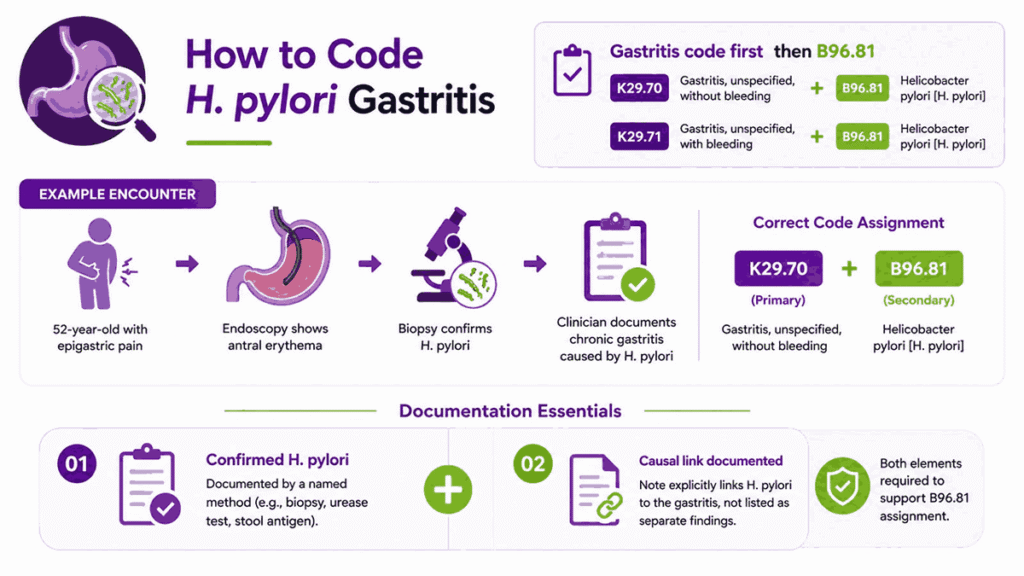
H. pylori gastritis codes as K29.70 plus B96.81 when the record documents gastritis without bleeding. The gastritis code leads. B96.81 follows to name the organism. K29.71 replaces K29.70 when the documentation records active bleeding.
Consider a representative encounter. A 52-year-old presents with epigastric pain. Endoscopy shows antral erythema, and biopsy confirms H. pylori. The clinician documents chronic gastritis caused by H. pylori. The correct code assignment is K29.70 (gastritis, unspecified, without bleeding) sequenced first, then B96.81 to identify H. pylori as the cause.
Two documentation elements make this assignment defensible. First, the record confirms H. pylori through a named method, biopsy in this case. Second, the note explicitly links the organism to the gastritis rather than listing them as separate findings. Without both elements, the B96.81 assignment is unsupported.
How to Code H. pylori Peptic Ulcers?
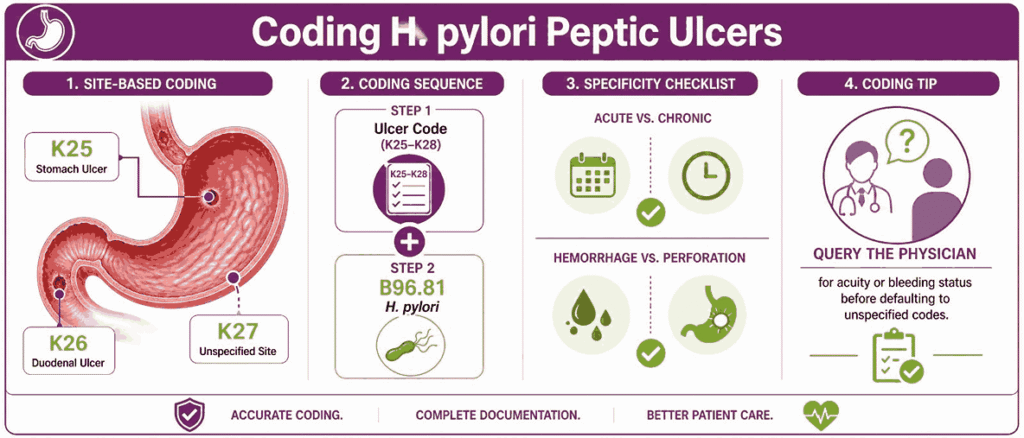
H. pylori peptic ulcers code as the specific K25, K26, K27, or K28 ulcer code plus B96.81. Site drives the primary code. A stomach ulcer takes K25, a duodenal ulcer takes K26, and an ulcer without a documented site takes K27.
A 56-year-old with epigastric pain undergoes EGD that reveals a gastric ulcer. Biopsy returns positive for H. pylori. The clinician documents a gastric ulcer due to H. pylori. The assignment is K25.9 first, then B96.81. If the same ulcer showed documented hemorrhage, the coder would move from K25.9 to the K25 subcategory that reports hemorrhage, then append B96.81.
Ulcer coding rewards specificity. The K25 through K28 categories distinguish acute from chronic ulcers and flag hemorrhage and perforation separately. Each of those distinctions changes the fifth character and can change the DRG on the inpatient side.
Coding K25.9 when the record supports an acute ulcer with hemorrhage understates severity and risks downcoding. Query the physician when the ulcer’s acuity or bleeding status is unclear before defaulting to the unspecified code. The full workflow for handling these queries and the rest of the specialty’s coding load sits in this Gastroenterology Billing Guide.
H. pylori, Gastric Cancer, and MALT Lymphoma
B96.81 also attaches to malignancies with an established H. pylori link. Two neoplasms qualify. Gastric adenocarcinoma codes to a C16 subcategory, and gastric MALT lymphoma codes to C88.4. In both cases, the neoplasm code sequences first, and B96.81 follows when the record documents H. pylori as a contributing cause.
The clinical basis is direct. Chronic H. pylori infection produces sustained gastric inflammation, and that inflammation is a recognized driver of both gastric carcinoma and MALT lymphoma. Coding B96.81 alongside the neoplasm captures that causal relationship for risk-adjustment and quality-reporting purposes. The neoplasm remains the reportable diagnosis, and B96.81 never substitutes for it.
Documentation Requirements for B96.81
B96.81 requires two documentation elements: a confirmed H. pylori diagnosis and an explicit causal link to the primary condition. Missing either element makes the code indefensible on audit.
Confirmation method. The record must state how H. pylori was identified. Acceptable methods include the urea breath test, stool antigen test, and endoscopic biopsy with histology or rapid urease test. Serology confirms exposure but does not confirm active infection on its own, which matters for both coding and treatment decisions.
Causal language. The note must connect H. pylori to the documented disease. “Gastric ulcer due to H. pylori” supports B96.81. “Gastric ulcer. H. pylori positive.” lists two findings without linking them, and does not support the code on its own. Coders assign B96.81 only when the provider establishes causation.
Weak documentation is the single largest source of B96.81 denials. Encounters that name the organism and the disease but never connect them force a coder to either query the physician or drop B96.81.
The specialty-specific Documentation issues that generate these denials tend to repeat across GI practices, and fixing the templates at the point of documentation removes most of them before a claim ever goes out. Two fixes prevent most of them: provider education on causal phrasing, and EHR prompts that flag a positive H. pylori result without a linked condition.
CPT Codes Tied to H. pylori Diagnosis and Treatment
B96.81 supports medical necessity for the procedures that diagnose and monitor H. pylori. The diagnostic CPT codes gastroenterology practices report most often include the following.
- 78267 and 78268 report the urea breath test. 78267 covers drug administration and sample collection for the C-14 or C-13 study, and 78268 reports the breath test analysis.
- 83013 and 83014 report the H. pylori breath test performed with a non-radioactive isotope, covering the urease activity analysis and the specimen collection.
- 43239 reports upper GI endoscopy with biopsy, the procedure that confirms H. pylori through histology or rapid urease testing during an EGD.
- Stool antigen immunoassay detects active infection and confirms eradication after treatment.
Payers frequently attach coverage rules to these tests. Some plans do not accept B96.81 alone as a medical necessity for the breath test CPT codes and require a symptom or condition code, such as an ulcer or dyspepsia diagnosis, paired with the claim.
Verify each payer’s diagnosis-to-procedure requirements before submission. The complete diagnostic and procedural set for the specialty, including post-treatment confirmation testing, is mapped in this reference on Gastroenterology CPT codes.
Treatment does not carry a diagnosis code of its own. H. pylori eradication uses triple therapy, a proton pump inhibitor with two antibiotics such as clarithromycin and amoxicillin, or quadruple therapy that adds bismuth. The condition and organism codes remain the same through the treatment course.
Common B96.81 Coding Errors and Denials
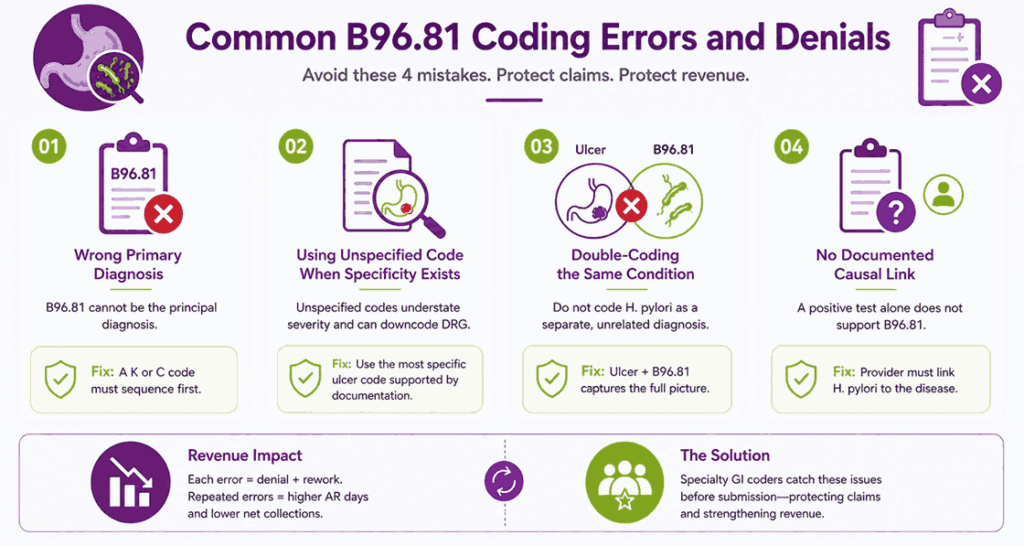
Four errors account for most B96.81 denials and audit findings. Each one is preventable at the coding or documentation stage.
Error 1: Using B96.81 as the primary diagnosis
B96.81 is an unacceptable principal diagnosis. A claim that leads with B96.81 fails payer edits. The fix is structural: a K or C condition code always sequences first.
Error 2: Coding an unspecified condition when the record supports specificity
Assigning K25.9 when the documentation describes an acute gastric ulcer with hemorrhage understates severity and can downcode the DRG. Coders read the full operative and pathology details before selecting the ulcer’s fifth character.
Error 3: Double-coding the organism and the disease as separate conditions
When documentation shows the ulcer is due to H. pylori, the ulcer plus B96.81 captures the full picture. Reporting H. pylori as an independent, unrelated diagnosis inflates the record and misrepresents the encounter.
Error 4: Assigning B96.81 without a documented causal link
A positive test alone does not support B96.81. The code requires a provider language that ties the organism to the disease.
The revenue impact compounds across a busy GI practice. A single miscoded encounter produces a denial and a rework cycle. The same error repeated across hundreds of H. pylori encounters per quarter produces a measurable drag on net collections and days in AR.
Specialty coders who work GI volume daily catch these patterns before submission, which is a core reason practices route this work to dedicated Gastroenterology Billing Services rather than absorb the denial rate in-house.
Coding a Positive H. pylori Test Without Documented Disease
A positive H. pylori test with no documented condition does not support B96.81. B96.81 requires a disease to attach to, and a lab result alone provides no primary condition to sequence first. This scenario appears often in GI billing and produces a predictable denial when coders force B96.81 onto a claim that has nothing for it to modify.
Three paths resolve the situation. First, review the full record for a documented condition. A positive test frequently accompanies dyspepsia, gastritis, or an ulcer that the coder can identify and sequence first, with B96.81 following.
Second, query the provider when the clinical picture suggests a condition that the note failed to state explicitly. Third, when the encounter genuinely involves only a test result with no disease and no symptoms, the coder reports the symptom or reason for the encounter that the record supports rather than defaulting to B96.81.
The principle holds across every H. pylori scenario. B96.81 never leads, and B96.81 never appears without a documented disease it explains.
Frequently Asked Questions
What is the ICD-10 code for H. pylori?
B96.81 is the ICD-10-CM code for Helicobacter pylori as the cause of diseases classified elsewhere. B96.81 identifies the organism and pairs with a primary condition code, such as a gastritis or ulcer diagnosis.
Can B96.81 be used as a primary diagnosis?
B96.81 cannot be used as a principal diagnosis. B96.81 is an unacceptable principal diagnosis in ICD-10-CM and requires a condition code sequenced first.
How do you code H. pylori gastritis?
H. pylori gastritis codes as K29.70 first, then B96.81. K29.71 replaces K29.70 when the record documents bleeding.
How do you code an H. pylori gastric ulcer?
An H. pylori gastric ulcer codes as the specific K25 ulcer code first, then B96.81. The K25 fifth character specifies acute or chronic status and hemorrhage or perforation.
Is B96.81 still valid in 2026?
B96.81 is valid and billable for FY 2026, effective October 1, 2025, through September 30, 2026, with no change to the descriptor.
What documentation supports B96.81?
B96.81 requires a confirmed H. pylori diagnosis by a named method and explicit provider language linking the organism to the documented condition.
Key Takeaways
B96.81 is a causal-organism code, not a diagnosis. Correct use rests on three points. First, sequence a primary condition code, such as a K25 ulcer or K29.70 gastritis, ahead of B96.81. Second, document both the confirmation method and the causal link between H. pylori and the disease.
Third, code the primary condition to the highest specificity the record supports before appending the organism. Practices that enforce these three points remove the denials, downcoding, and audit exposure that follow from treating B96.81 as a standalone code.