Before 2017, one in five California patients who underwent elective surgery at an in-network hospital still received a surprise out-of-network bill, according to a 2020 JAMA study. It also showed that most of these bills came from anesthesiologists, averaging more than $2,000 on top of what insurance paid.
The law that changed this is Assembly Bill 72. Since July 2017, when a patient gets non-emergency care at an in-network facility in California, an out-of-network provider can no longer bill them beyond their normal in-network cost-sharing.
The provider gets paid by the health plan under a set formula. If you bill the patient directly for out-of-network providers, it violates state law.

To help you stay compliant, we cover California’s balance billing regulations under AB 72 in the sections ahead. It also includes who the law covers, the out-of-network payment standard, how to dispute an underpayment, and how AB 72 fits with the federal No Surprises Act.
What Is Balance Billing in California?
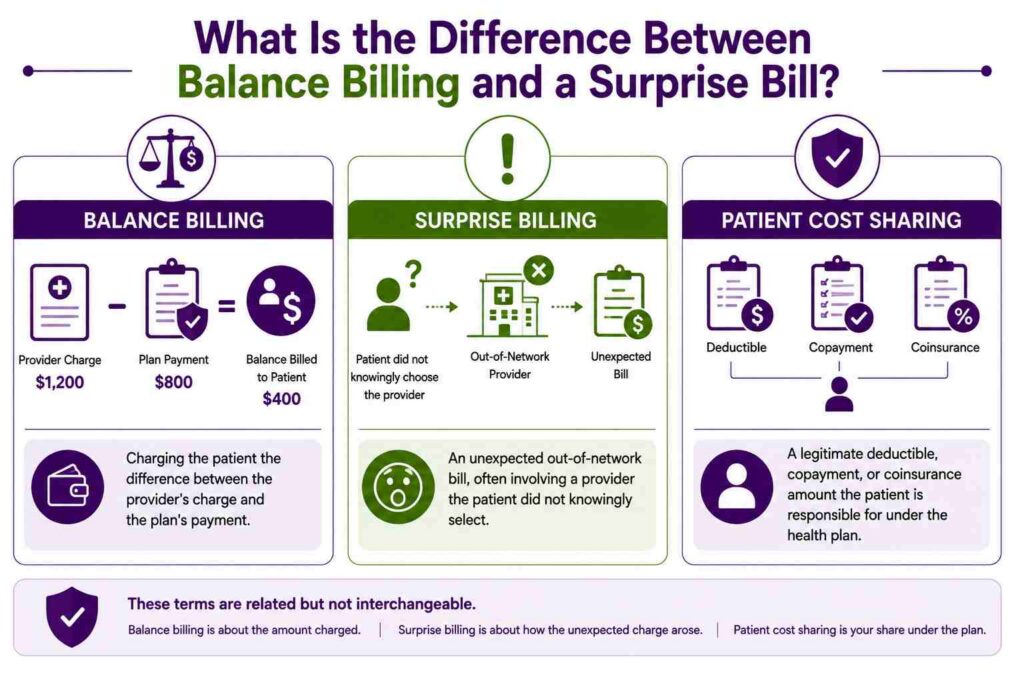
Balance billing occurs when a healthcare provider bills a patient for the difference between the provider’s full charge and the amount paid by the patient’s health plan. Hypothetically, if a provider charges $500 and the health plan pays $300, the provider may attempt to bill the patient for the remaining $200.
In California, however, providers cannot always collect that difference from the patient. State and federal protections restrict balance billing for certain emergency services and for covered care provided by an out-of-network provider at an in-network facility.
The amount a patient can legally owe depends on the type of insurance, service, provider, facility, and circumstances of the care.
What Is the Difference Between Balance Billing and a Surprise Bill?
Balance billing refers to the amount charged, while a surprise bill refers to how the unexpected charge arose. A surprise bill commonly occurs when a patient receives care from an out-of-network provider without knowingly choosing that provider.
Even though the terms are related, they are not interchangeable.
- Balance Billing: Charging the patient the difference between the provider’s charge and the plan’s payment.
- Surprise Billing: An unexpected out-of-network bill, often involving a provider the patient did not knowingly select.
- Patient Cost Sharing: A legitimate deductible, copayment, or coinsurance amount the patient is responsible for under the health plan.
Is Balance Billing Legal in California?
Balance billing is not completely illegal in CA, but California billing laws restrict when providers can charge patients more than their health plan’s payment. The restrictions are particularly important for covered emergency services and certain non-emergency services.
Generally Prohibited: A provider cannot balance bill a health plan member for covered emergency services solely because the provider is out-of-network. Similar protections can apply when a patient receives covered services from a noncontracting provider at an in-network facility without knowingly selecting that provider.
Potentially Permitted: Patients may still be responsible for legitimate cost-sharing, including deductibles, copayments, and coinsurance. Balance billing may also be permitted in situations that fall outside the applicable state or federal protections.
What Is AB 72, California’s Surprise Billing Law?
AB 72 is California’s 2016 surprise billing law that limits balance billing for certain non-emergency services received at an in-network facility. It protects patients with qualifying state-regulated health plans when they receive covered services from an out-of-network individual provider at an in-network facility.
In these situations, the patient generally owes only the in-network cost-sharing amount, such as the applicable deductible, copayment, or coinsurance.
What Does AB 72 Require Providers to Do?
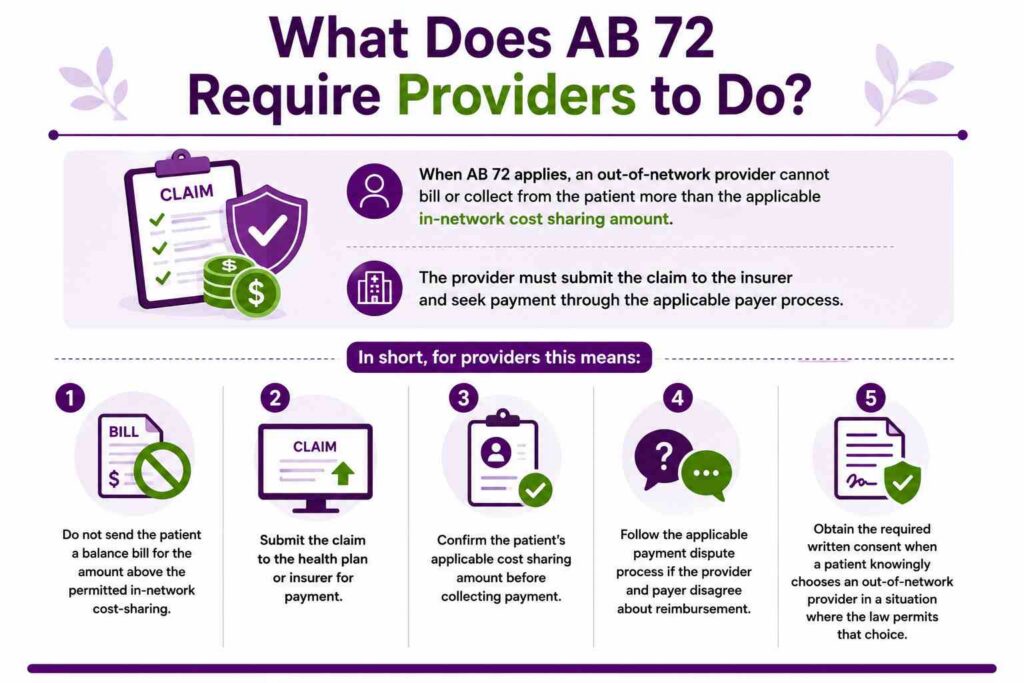
When AB 72 applies, an out-of-network provider cannot bill or collect from the patient more than the applicable in-network cost sharing amount. The provider must submit the claim to the insurer and seek payment through the applicable payer process.
In short, for providers this means:
- Do not send the patient a balance bill for the amount above the permitted in-network cost-sharing.
- Submit the claim to the health plan or insurer for payment.
- Confirm the patient’s applicable cost-sharing amount before collecting payment.
- Follow the applicable payment dispute process if the provider and payer disagree about reimbursement.
- Obtain the required written consent when a patient knowingly chooses an out-of-network provider in a situation where the law permits that choice.
AB 72 also provides a mechanism for eligible noncontracting providers to challenge the payer’s reimbursement through an Independent Dispute Resolution Process (IDRP). It’s better than attempting to recover the disputed amount from the patient.
Which Law Codifies AB 72?
AB 72 is codified in two California statutes, depending on which state regulator governs the health coverage:
- California Health and Safety Code § 1371.9 applies to health care service plans regulated by the Department of Managed Health Care (DMHC).
- California Insurance Code § 10112.8 applies to health insurance policies regulated by the California Department of Insurance (CDI).
Both provisions establish the same core patient protection: when the law applies, the patient cannot be required to pay more than the in-network cost-sharing amount for the covered services.
Who Does California’s Balance Billing Law Apply To?
California’s balance billing applies to HMO and PPO plans, but differs based on the plan and regulator.
First are DMHC-regulated plans, which include most California HMOs, and are subject to California’s balance billing protections under the Knox Keene Act and AB 72. DMHC explains that it oversees all HMOs and certain other health plans.
The other one is CDI-regulated insurance, which commonly includes PPO products. It is governed by the California Insurance Code. PPO plans require additional attention because some products provide out-of-network benefits.
So, if a patient knowingly and voluntarily consents to receive care from that provider and the consent rules are followed, the provider can balance bill the patient. But having a PPO does not mean every out-of-network bill is valid. Consent and the required conditions must be met.
Does It Cover Emergency Services?
Emergency balance billing was already prohibited in California before AB 72.
In Prospect Medical Group, Inc. v. Northridge Emergency Medical Group (2009), the California Supreme Court confirmed that emergency providers could not balance bill an enrollee of a Knox-Keene health plan for amounts beyond the patient’s applicable cost sharing.
California health plan members cannot be balance billed for protected emergency services simply because the emergency provider is out-of-network. The patient, however, remains responsible for the applicable in-network cost sharing, such as a deductible or copayment.
Which Providers Are Affected by Balance Billing Law in CA?
AB 72 mainly affects noncontracting individual health professionals who provide covered, non-emergency services at a contracting facility. Common examples include the following out-of-network providers:
- Anesthesiologists treating patients during procedures
- Radiologists interpreting imaging performed at an in-network facility
- Pathologists providing laboratory or tissue interpretation services
- Emergency physicians — subject to the separate emergency-service protections
- Other individual specialists involved in a patient’s care without the patient knowingly selecting them
Important: AB 72 does not apply to every provider, every facility, or every California health plan. For example, DMHC states that its AB 72 dispute process excludes Medi-Cal managed care plans, and AB 72 itself does not apply to emergency services or dental providers.
Can a Provider Ever Balance-Bill a Patient in California?
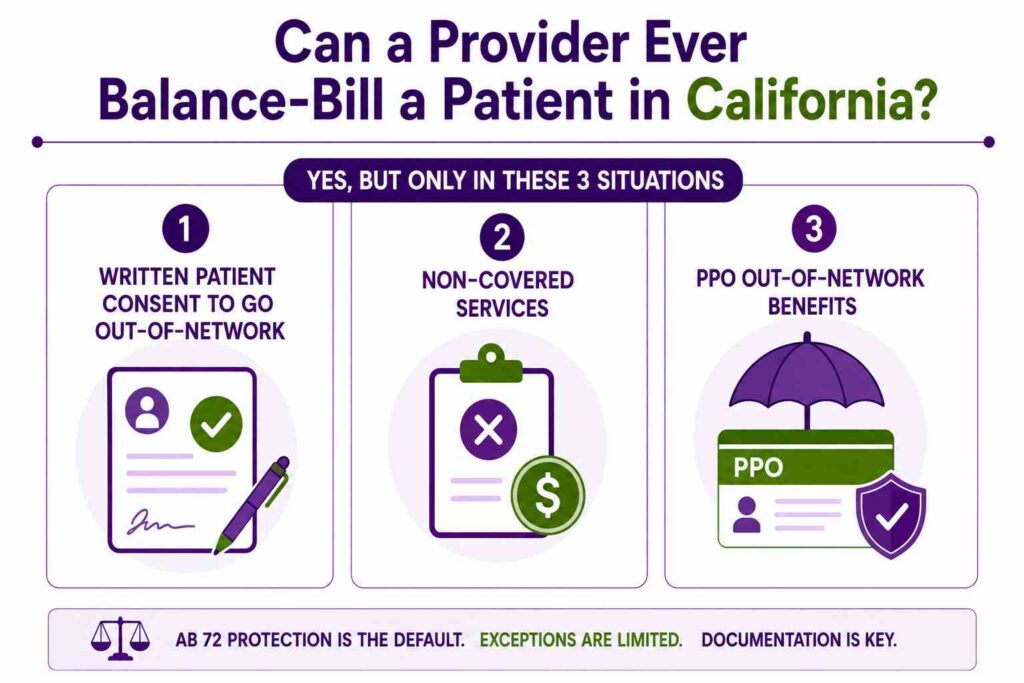
In some cases, a provider can bill a CA patient beyond in-network cost sharing, but only when a specific exception clearly applies. AB 72’s protection is the default, and the exceptions are limited and easy to get wrong.
The three main situations where exceptions apply include:
- Written Patient Consent to Go Out-of-Network: A patient may knowingly choose an out-of-network provider and agree in advance, in writing, to be billed at out-of-network rates. Consent must be genuine and properly documented.
- Non-Covered Services: If a service is not a covered benefit under the patient’s plan, the AB 72 payment framework does not apply, and the patient may be billed. The provider still has to be sure the service is genuinely non-covered.
- PPO Out-of-Network Benefits: A PPO patient who intentionally uses their out-of-network benefit. In this case, the patient is knowingly using a benefit and is not protected under AB 72.
Can You Balance Bill a Medi-Cal Patient in CA?
No, Medi-Cal regulations are governed by federal Medicaid law, and it bans balance billing outright. Once a provider accepts Medi-Cal, the program’s payment is payment in full, and the patient cannot be billed the difference on a covered service.
This is a stricter, separate protection from AB 72, which applies to commercial plans. For the full rules, see our Medi-Cal billing regulations guide.
How Much Can an Out-of-Network Provider Be Paid Under AB 72?
An out-of-network provider is paid the greater of the health plan’s average contracted rate or 125% of the Medicare rate for that service. This is called the interim payment, and the plan pays it directly to the provider.
The table below shows how the interim payment is determined.
| Benchmark | What It Means | Applies When |
|---|---|---|
| Average contracted rate (ACR) | The plan’s average rate paid to in-network providers for the same service in the same region | Used when it is higher than 125% of Medicare |
| 125% of Medicare | 1.25 times the Medicare-allowed amount for that service | Used when it is higher than the ACR |
| The greater of the two | Whichever benchmark pays more | This is the interim payment the plan owes |
What Is the Average Contracted Rate (ACR)?
The average contracted rate is the average amount a health plan pays its in-network providers for a given service in a given geographic region. It is calculated from its own contracted rates for that specific service code, so it reflects the local market.
Because the ACR is built from the plan’s in-network contracts, it is often higher than the Medicare benchmark. This is exactly why AB 72 requires the plan to pay the greater of the two benchmarks.
Practices also work with experienced medical billing companies in California to manage these payment rules and disputes.
How Does AB 72 Interact With the Federal No Surprises Act?
AB 72 and the federal No Surprises Act cover the same problem through two systems, and which one applies depends on how the patient’s plan is regulated. The federal No Surprises Act took effect January 1, 2022, years after AB 72.
It protects patients nationwide from the same surprise out-of-network bills, but they do not stack on the same claim. For any given patient, one framework governs, and using the wrong one to price or dispute a claim is a common and costly mistake.
Which Law Applies to Which Plan?
For California state-regulated plans, the fully insured HMO and PPO plans are overseen by the DMHC and CDI, and AB 72 controls. The DMHC confirmed in March 2022 that AB 72 still governs these plans, not the federal law.
For self-funded employer plans, the federal No Surprises Act applies instead. These are ERISA plans regulated by the U.S. Department of Labor, and state laws like AB 72 cannot reach them.
This matters enormously in practice, since roughly 6 million Californians are in self-funded plans that sit outside AB 72’s reach. Before pricing or disputing an out-of-network claim, the first question is always which type of plan the patient has.
What Is the Difference Between California’s IDRP and Federal IDR?
California and the federal government operate separate dispute resolution processes, and the claim’s governing law determines which one you use. The following table shows how the two compare.
| Feature | California IDRP (AB 72) | Federal IDR (No Surprises Act) |
|---|---|---|
| Applies To | State-regulated fully insured plans (DMHC, CDI) | Self-funded ERISA and federally regulated plans |
| Administered By | The state through DMHC or CDI | Federal government through certified IDR entities |
| Payment Benchmark | Greater of average contracted rate or 125% of Medicare | Qualifying Payment Amount (QPA), the plan’s median contracted rate |
| Structure | Binding “final offer” review | Binding “baseball-style” final-offer arbitration |
| Governing Rules | California AB 72 procedures | Federal No Surprises Act regulations |
What Are the Consequences of Illegal Balance Billing in California?
Illegally balance billing a patient in California exposes the provider to refund obligations, regulatory action, and, in a pattern, unfair-billing liability. AB 72 does not treat an improper balance as a private matter between provider and patient.
It routes the patient’s protection through state regulators, so a violation becomes a compliance problem the provider answers to the state for. This is why many practices rely on CA medical billing services to keep payer requirements and billing procedures aligned.
What Are the Refund and Penalty Requirements?
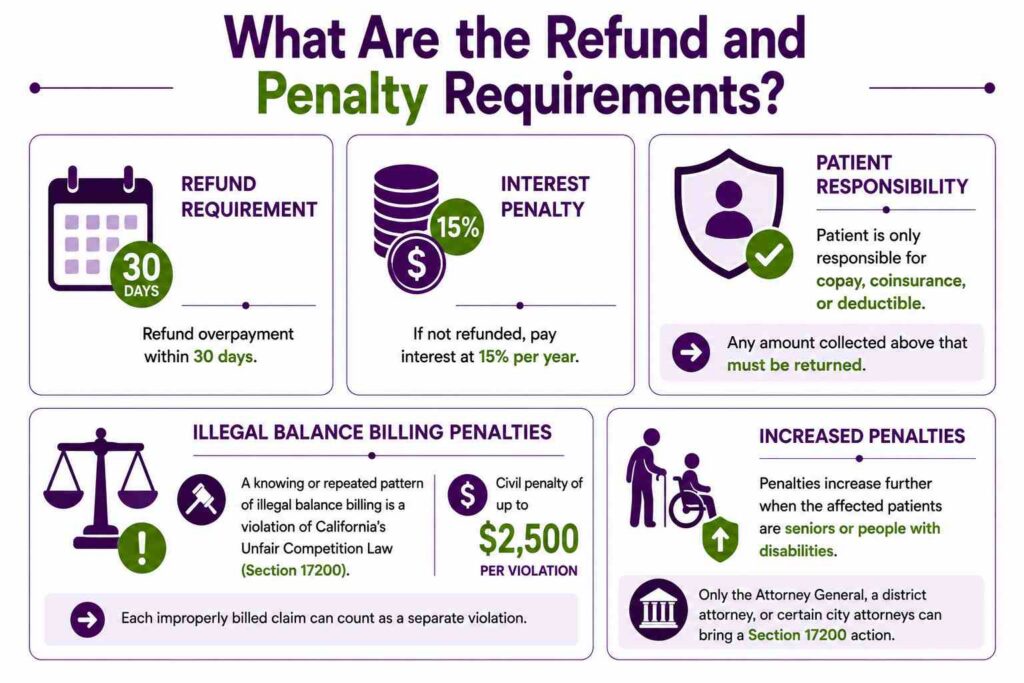
When a provider collects more than the patient’s in-network cost sharing, the provider must refund the overpayment within 30 days. If not, the provider has to pay interest at 15% per year on the unrefunded balance.
The patient is only responsible for their copay, coinsurance, or deductible, so any amount collected above that must be returned.
A knowing or repeated pattern of illegal balance billing can be prosecuted as a violation of California’s Unfair Competition Law (Section 17200). It carries a civil penalty of up to $2,500 per violation, and each improperly billed claim can count as a separate violation.
Penalties increase further when the affected patients are seniors or people with disabilities, a common occurrence in medical practice. However, only the Attorney General, a district attorney, or certain city attorneys can bring a Section 17200 action.
How Does the Independent Dispute Resolution Process (IDRP) Work?
When a provider believes AB 72 underpaid a claim, the dispute goes to an independent third party through the state’s IDRP. AB 72 created this process so a payment fight never lands on the patient again.
The DMHC runs the IDRP for its plans through an independent organization, and the California Department of Insurance runs a parallel process for the plans it regulates.
Once a provider or payer files, the other side is required by law to participate, and the decision is binding. If the review finds the plan owes more, the plan must pay the additional amount within 15 days.
When Can a Provider File for IDRP?
A provider can file for IDRP only after exhausting the plan’s own dispute process first, and only on an eligible claim.
Before filing, the provider must submit the claim through the payer’s internal Provider Dispute Resolution (PDR) process and then wait for a response or until the response window lapses. To qualify for the AB 72 IDRP, the claim must meet all of these conditions:
- Service was rendered on or after July 1, 2017
- Service was non-emergency (emergency claims use a separate process)
- Care was provided at a contracting facility by a non-contracting provider
- Provider is not a dentist
- Payer is not a Medi-Cal managed care plan
If any condition fails, the claim falls outside the AB 72 IDRP and has to be pursued another way. The most common eligibility trip-up is filing before completing the plan’s PDR step, so that internal appeal is a required first move.
How Much Does IDRP Cost and How Long Does It Take?
IDRP fees start at $315 per review and scale down per claim when multiple similar claims are bundled together. The overall current California DMHC fee schedule is:
| Number of Claims | Standard Rate | With Coding Review |
|---|---|---|
| 1 claim | $315 | $330 |
| 2 – 10 similar claims | $315 | $330 |
| 11 – 25 similar claims | $340 | $355 |
| 26 – 50 similar claims | $395 | $415 |
These are per-review fees, and the IDRP review fee is split equally between the parties. Fees must be paid before the independent organization begins its review.
The timing can be more significant than the review fee itself. The process involves several stages, added in the table below.
| IDRP Phase | Required Timeline |
|---|---|
| Open Negotiation Period | 30 business days (about 42 calendar days) |
| IDR Initiation Window | 4 business days after open negotiations fail |
| Selection and Submission | Around 10 business days to agree on a certified IDR entity |
| Independent Review | Up to 30 business days after the required payment is received |
| Final Payment | 30 calendar days for the losing party to pay the determined amount |
Because these stages occur sequentially, the overall process can take roughly 2 to 6 months in some cases.
One thing to remember here is that the review is often “all or nothing.” It means each side submits a final offer and the reviewer picks one, so a well-documented reasonable offer beats an inflated one.
How Can Providers Stay Compliant With California’s Balance Billing Rules?
Staying compliant with AB 72 comes down to catching the risk before the claim goes out. Providers can manage this in-house with disciplined front-end checks, or work with a billing partner who already builds AB 72 compliance into every claim.
How Can a Billing Partner Help With AB 72 Compliance?
Transcure is a medical billing partner that builds AB 72 and No Surprises Act compliance directly into a practice’s billing workflow.
That means verifying the plan type and network status before the claim goes out. It also means confirming the patient owes only in-network cost-sharing, and pursuing underpaid claims through IDRP or federal IDR.
For practices juggling claims across multiple payer types, this removes the guesswork that leads to refunds, interest, and Section 17200 exposure.
Frequently Asked Questions about Balance Billing in California
Does the No Surprises Act or AB 72 Apply to My Plan?
It depends on the plan type. AB 72 governs California’s state-regulated fully insured HMO and PPO plans. The federal No Surprises Act instead governs self-funded ERISA employer plans, since state law cannot reach them. Identify the plan type first.
Can You Balance Bill a PPO Patient in California?
Only if the patient knowingly and voluntarily uses their plan’s out-of-network benefit, with proper consent. If a PPO patient was simply treated by an out-of-network provider at an in-network facility without choosing them, AB 72’s protection still applies.
What Practices Reduce Balance Billing Risk?
Verify network status and plan type before billing, document any out-of-network consent in writing and in advance, confirm cost-sharing amounts before collecting payment, and route payment disputes through IDRP rather than the patient. Regular staff training on AB 72 also helps.
How Long Do You Have to Refund an Improper Balance Bill?
Within 30 days of collecting more than the patient’s in-network cost-sharing. If the overpayment is not refunded within that window, the provider owes the patient interest at 15% per year on the outstanding balance.
What Other CA Laws Should Providers Worry About with AB 72?
AB 72 works alongside the Knox-Keene Act (which governs HMO conduct and enforcement), the federal No Surprises Act (for self-funded plans), and California’s Unfair Competition Law (Section 17200, which penalizes repeated violations). All three intersect with balance billing compliance.