CPT code 11719 reports the trimming of nondystrophic nails, any number, as a single service. Nondystrophic means the nails are structurally normal and merely elongated, which is precisely what makes this code hard to defend without careful documentation.
CPT 11719 sits inside the routine foot care exclusion. Trimming healthy nails is hygiene, and it becomes a covered medical service only when a systemic condition makes self-care hazardous for the patient.
The code pays about the price of a copay, so the compliance risk is never a single claim. Routine foot care is high-frequency work, and exposure accumulates across a panel. Keeping that pattern clean across a full panel is the real work, and it is why some groups hand routine foot care to podiatry revenue cycle management.
What Is the Description of CPT Code 11719?
The 11719 CPT code description, as defined by the AMA, is: “Trimming of nondystrophic nails, any number.”
This code reports the trimming of structurally normal nails as a routine foot care service. CPT code 11719 turns on the condition of the nail rather than the number treated or the effort involved. Normal nails that are simply too long fall here.
The nail’s condition is the whole code. Procedure code 11719 describes trimming healthy nails, and the moment those nails are diseased, thickened, or deformed, a different code applies.
What Does CPT Code 11719 Cover, and Why Is It Billed Once Regardless of Nail Count?
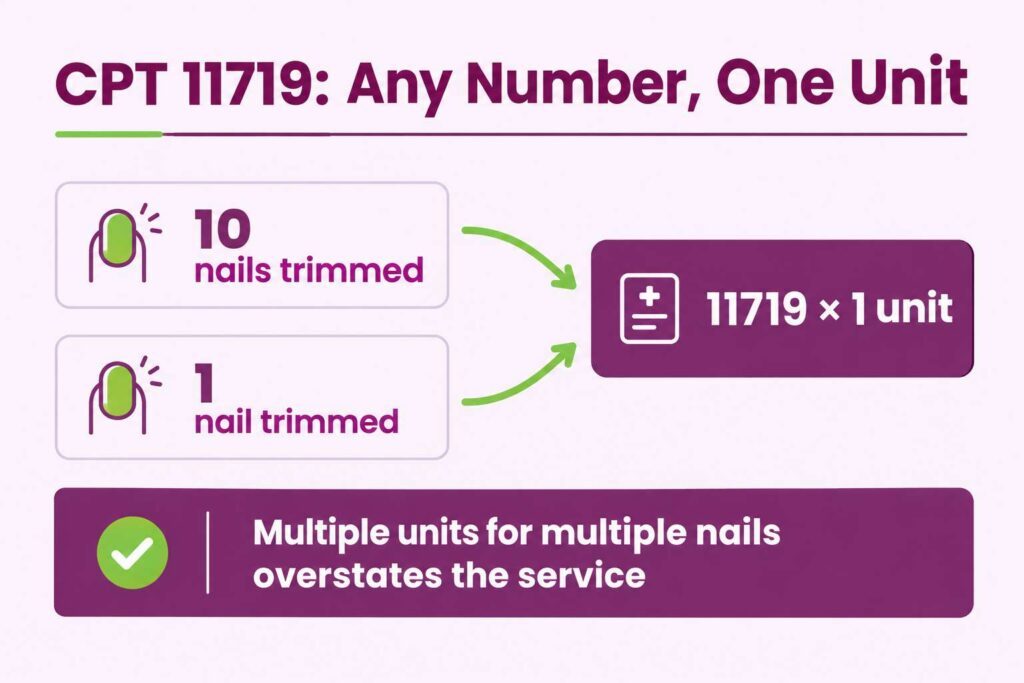
CPT code 11719 covers the trimming of nondystrophic nails as one service per encounter. The descriptor phrase “any number” means a single unit applies whether one nail or ten are trimmed.
The unit rule works as follows:
- Report one unit of 11719 per date of service, regardless of the nail count
- There is no per-nail multiplier, so ten nails and two nails both produce one unit
- The note should still identify which nails were treated and confirm their condition
- Reporting multiple units for multiple nails overstates the service
The all-inclusive structure keeps the claim simple and the payment flat. CPT 11719 pays the same amount for a full set of toenails as for a single nail, so the documentation effort rather than the nail count drives whether the claim survives.
What Makes a Nail Nondystrophic, and Why the Nail’s Condition Determines the Code
A nondystrophic nail is structurally normal, merely elongated. It shows no thickening, no fungal change, no discoloration, and no deformity from disease.
Describing the nail rather than defining it is what protects the claim:
- Record that the nails are normal in thickness, color, and contour, with growth as the only issue
- Note the absence of onychomycosis, subungual debris, and dystrophic change
- Avoid the phrase “nails trimmed” on its own, since it establishes nothing about condition
- Connect the description to the code selected, so the record explains the choice
A bare notation that nails were trimmed leaves the code indefensible in either direction. That same phrase would equally support the dystrophic trimming code, the debridement codes, or no covered service at all, which means an auditor can read it any way they choose.
How Does CPT Code 11719 Differ From G0127, and Why the Two Can Never Be Billed Together
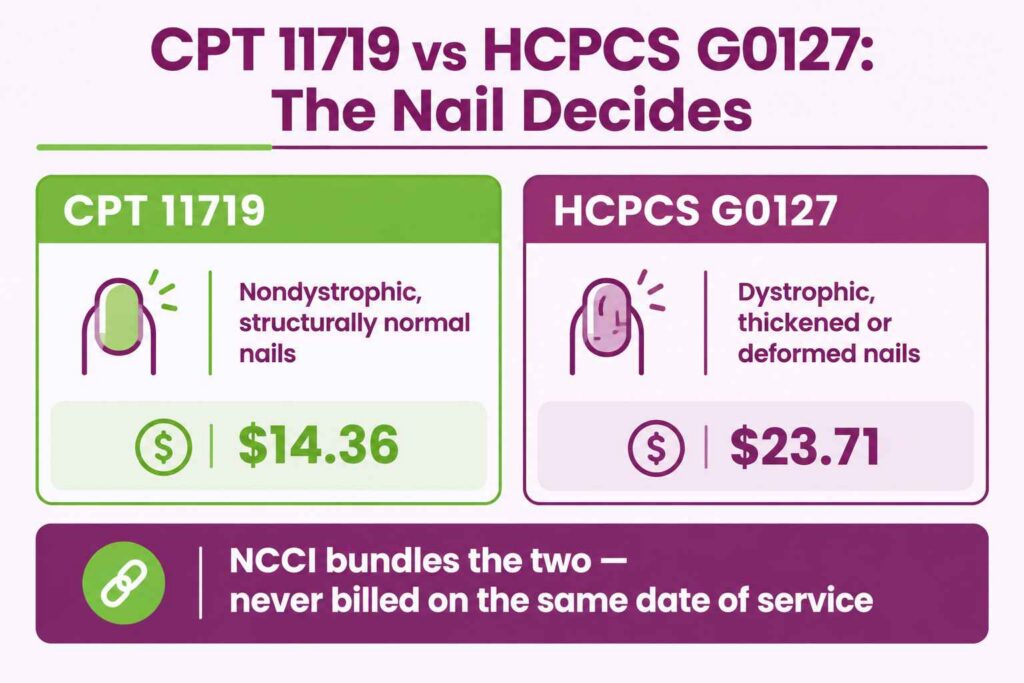
CPT code 11719 trims nondystrophic nails and G0127 trims dystrophic nails. The nail’s condition, not the technique, separates them, and NCCI bundles the two so they never share a date of service.
The relationship works as follows:
- 11719 applies when the nails are structurally normal and merely long
- G0127 applies when the nails are thickened, discolored, or deformed from fungal infection, trauma, or age
- NCCI bundles G0127 into 11719, so the two trimming codes cannot be billed on the same date
- G0127 pays $23.71 against $14.36 for 11719, a difference of roughly $9 per claim
That payment gap is why the direction of the error matters. Billing HCPCS code G0127 for nondystrophic nails to capture the higher-paying code is a documented upcoding pattern, and the only evidence separating the two is the nail description in the note.
This bundling mechanic differs from the one governing the debridement codes. G0127 and 11719 are bundled because they describe the same service on differently conditioned nails, while 11720 and 11721 are mutually exclusive because they turn on nail count.
How Does Trimming Under 11719 Differ From Nail Debridement (11720 and 11721)?
Trimming cuts the nail back, while debridement removes nail plate material to reduce thickness. The service performed decides the code, and the payment difference is substantial.
The trimming and debridement codes compare as follows:
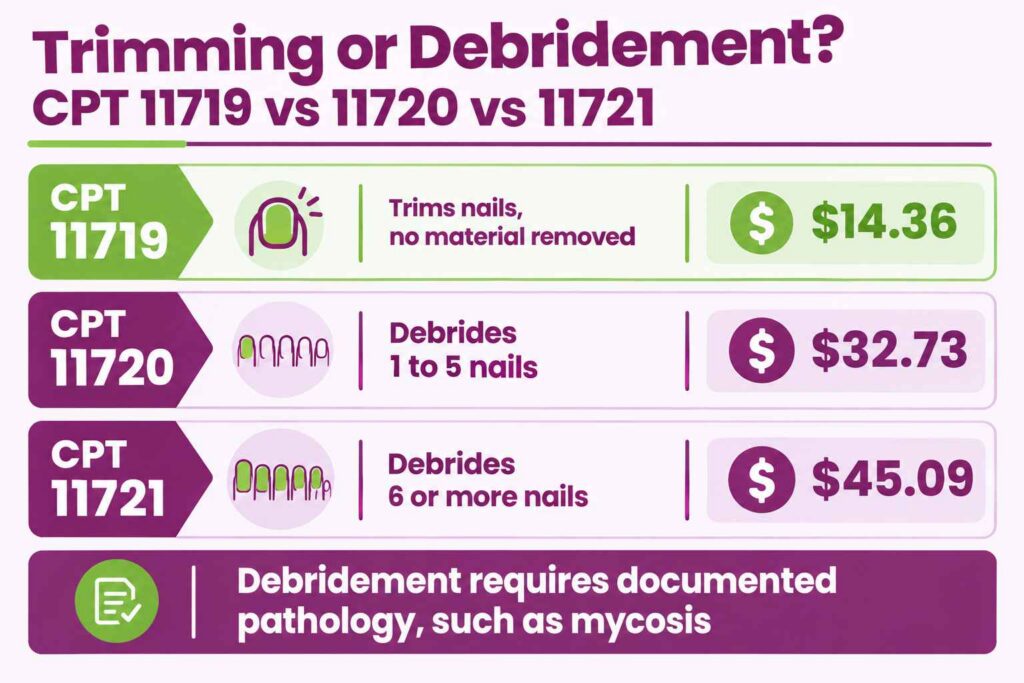
- 11719 trims nondystrophic nails, any number, at $14.36
- 11720 CPT code debrides one to five nails at $32.73
- CPT code 11721 debrides six or more nails at $45.09
- Debridement reduces thickness as well as length, and it requires documented pathology such as mycosis
The operative distinction is material removal. Shortening a normal nail is trimming under CPT code 11719, while reducing a thickened, mycotic nail plate is debridement. Reflexively coding debridement without documenting the pathology is exactly the failure nail debridement billing services are built to catch.
Why Trimming Normal Nails Is Payable Only Under the At-Risk Foot Exception
Trimming healthy nails is hygiene, which Medicare does not cover. CPT code 11719 becomes a covered medical service only because an at-risk patient attempting self-care faces genuine danger.
The at-risk rationale works as follows:
- Routine foot care, including nail trimming, is statutorily excluded from Medicare coverage
- The exception applies when a systemic condition impairs circulation or sensation in the feet
- For such a patient, self-trimming or trimming by an untrained family member risks infection or limb loss
- Professional trimming becomes medically necessary because the alternative is hazardous, not because the nails are unusual
Understanding that logic makes the class finding requirement feel like a rule rather than paperwork. The Q modifier exists to prove the patient is genuinely at risk, since that risk is the entire basis for paying for an otherwise excluded service.
What ICD-10 Codes and Medical Necessity Criteria Support CPT Code 11719?
Medical necessity for CPT code 11719 requires a qualifying systemic condition sequenced first, plus a diagnosis describing the nail or skin condition treated. Three diagnosis codes belong specifically to this pathway. Sequencing the systemic condition ahead of the nail diagnosis follows the same logic used across podiatry ICD-10 sequencing generally.
The diagnosis structure works as follows:
- Sequence the qualifying systemic condition first, such as a diabetes code with complications or a peripheral vascular disease code
- L60.8, other nail disorders, is appropriate with 11719 when a qualifying systemic condition is present, and the nails are not dystrophic
- L84, corns and callosities, and L98.7, excessive and redundant skin, also belong to the 11719 pathway
- Those same three codes are inappropriate with G0127, which is reserved for dystrophic nails
This reservation runs in both directions and is the mirror image of the rule on the dystrophic code. Effective June 19, 2022, L60.8 is billed with 11719 only when a qualifying systemic condition is present, and the patient does not have dystrophic nails, and it is inappropriate with G0127 entirely.
What Are the Modifiers for CPT Code 11719?
CPT 11719 relies on class-finding modifiers to establish at-risk status, plus a distinct-service modifier for the mixed-presentation case and the liability modifiers. These same class-finding modifiers attach across the podiatry HCPCS code family, since the coverage exception, not the code type, drives them.
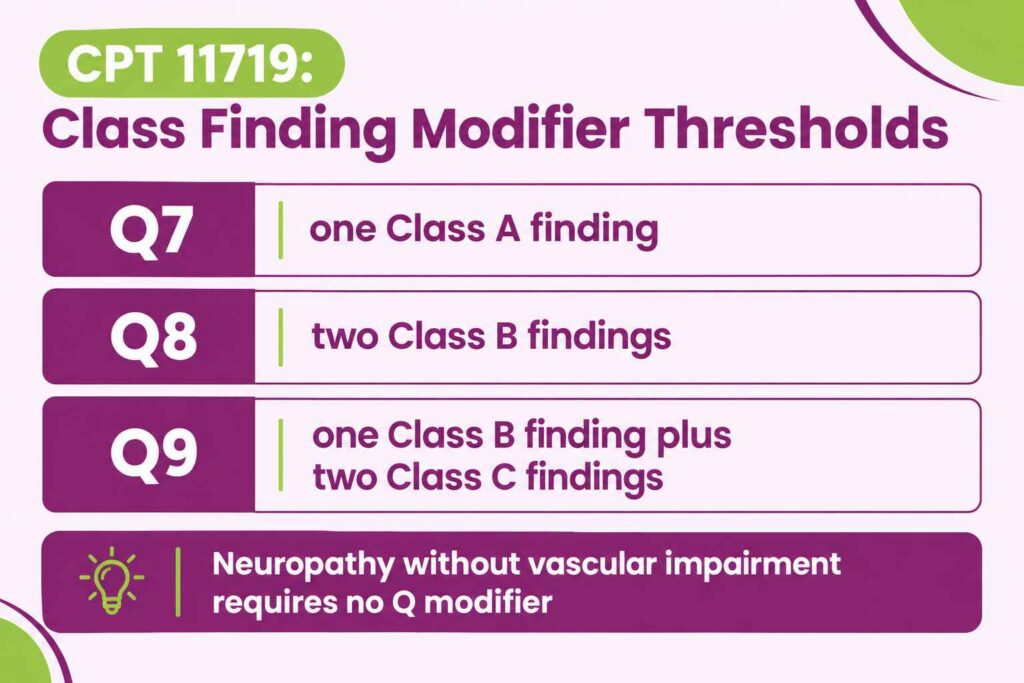
Modifier Q7: One Class A Finding
Modifier Q7 reports one Class A finding, which is a nontraumatic amputation of the foot or an integral skeletal portion of it. Append Q7 to CPT code 11719 when the examination documents this finding alongside a qualifying systemic condition.
Modifier Q8: Two Class B Findings
Modifier Q8 reports two Class B findings. The Class B findings are an absent posterior tibial pulse, an absent dorsalis pedis pulse, and advanced trophic changes. Advanced trophic changes require three documented signs from decreased hair growth, nail thickening, pigmentary discoloration, thin shiny skin texture, and rubor. Append Q8 to 11719 when two Class B findings are documented.
Modifier Q9: One Class B Finding and Two Class C Findings
Modifier Q9 reports one Class B finding with two Class C findings. Class C findings include claudication, temperature change such as a cold foot, edema, paresthesia, and burning. Append Q9 to CPT code 11719 when the examination documents that combination.
Modifier 59 or XS: Distinct Nails Treated by a Different Method
Modifier 59, or the more specific XS, identifies a distinct service on separate anatomic structures. Append it to 11719 when some nails were debrided under 11720 CPT code, and different nails were trimmed at the same visit. The note must identify which nails received which service, because the modifier claims that two different sets of nails were treated by two different methods.
Modifier GA: ABN on File When Coverage Criteria Are Not Met
Modifier GA reports that an Advance Beneficiary Notice of Noncoverage is on file for an expected denial. Append GA to CPT code 11719 when the patient lacks a qualifying condition and accepted liability in writing before the service. The ABN converts the denial into billable patient responsibility.
Modifier GZ: No ABN, Denial Expected
Modifier GZ reports an expected denial with no ABN on file. Append GZ to 11719 when coverage criteria are not met, and no waiver was obtained before the service. The line denies with provider liability, so the practice absorbs the cost.
Which Documents Are Required For CPT Code 11719?
Documentation for CPT code 11719 must establish that the nails were normal, that the patient is at risk, and that the at-risk condition is under active care. The nail description is the element most often missing.
The required documentation includes:
- A description confirming the nails were nondystrophic, with normal thickness, color, and contour
- The qualifying systemic condition, named in the physician’s own note rather than inferred from the problem list
- The specific class findings observed at this visit, described in enough detail to support the modifier
- A statement of why self-care or family assistance would be unsafe for this patient
- The name of the physician managing the systemic condition and the date last seen
- For the neuropathy pathway, the sensory testing performed and its result
- The signature and credentials of whoever performed the service
What Is the Cost of CPT Code 11719?
CPT code 11719 pays roughly the price of a copay, and that low value shapes the entire compliance picture. No single claim is worth appealing hard, which is exactly why the pattern matters more than the claim.
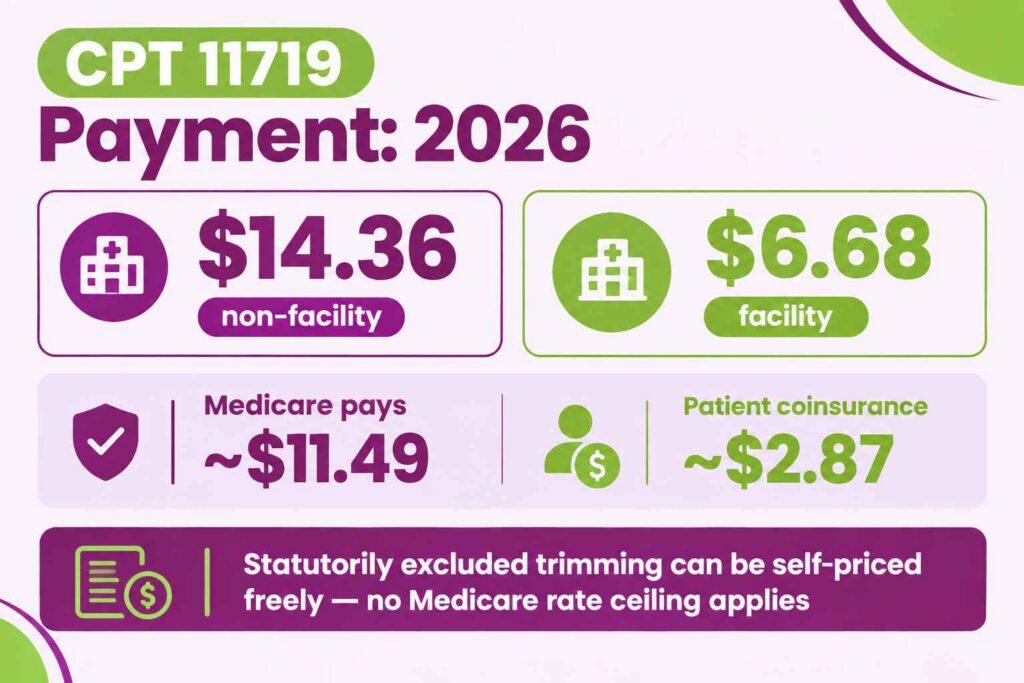
RVUs and Medicare Payment for CPT Code 11719
Medicare prices CPT code 11719 through the Physician Fee Schedule. The office setting pays more than twice the facility rate because the practice expense component carries the instruments and staff time.
| Component | Non-Facility (Office) | Facility |
|---|---|---|
| Work RVU | 0.17 | 0.17 |
| Practice Expense RVU | 0.25 | 0.02 |
| Malpractice RVU | 0.01 | 0.01 |
| Total RVU | 0.43 | 0.20 |
| National payment | $14.36 | $6.68 |
These amounts apply the CY 2026 nonqualifying APM conversion factor of $33.4009. Qualifying APM participants use $33.5675, which raises the office amount to roughly $14.43. The code carries a 000 global period and a status indicator of R for restricted coverage.
Locality adjustment moves the figure modestly:
- The national office amount is $14.36, and high-cost localities reach roughly $18
- Medicare pays 80 percent of the allowed amount, about $11.49, after the deductible
- The patient owes roughly $2.87 in coinsurance on a covered claim
- Rework on a denied claim costs more staff time than the claim itself pays
Commercial Payers and Medicare Advantage Variability
Commercial and Medicare Advantage plans set their own routine foot care terms, and coverage varies widely. Some follow the Medicare class findings framework closely, while others apply different criteria or exclude routine foot care entirely.
Coverage considerations include:
- Medicare Advantage plans often mirror the Medicare framework but may add authorization or documentation steps
- Some Medicaid managed care plans instruct providers to bill differently than the nail condition supports, which is not a reason to miscode
- A payer directing a practice to submit G0127 for nondystrophic nails is asking for an incorrect claim, and the correct response is to code the service actually performed
- Confirm the plan’s frequency interval, since it does not always match the Medicare 60-day expectation
Patient Responsibility and ABN Workflows for Non-Covered Trimming
Nail trimming for a patient without a qualifying condition is a legitimate cash-pay service. The ABN is what makes that arrangement compliant, and it must be signed before the service.
The patient responsibility rules are:
- Execute the ABN before performing the trimming, never after the denial arrives
- The notice must describe the service and the estimated cost so the patient can decide
- Append modifier GA when the ABN is signed, which supports billing the patient after the denial
- Without an ABN, modifier GZ applies, and the practice absorbs the cost
Non-qualifying routine foot care is statutorily uncovered, which means the practice can set its own self-pay price rather than being bound to the Medicare amount. Many practices find the cash price for routine trimming exceeds what Medicare would have paid. A statutorily excluded service can be self-priced freely, a pricing freedom that sits outside the CPT fee-setting framework entirely.
What Are Example Clinical Scenarios or Use Cases for CPT Code 11719?
CPT code 11719 appears in covered at-risk cases, the neuropathy exception, the mixed-method visit, and self-pay conversions. The scenarios below show each.
Scenario 1: Diabetic Patient With Normal Nails and Documented Class B Vascular Findings
ICD-10: E11.51 (Type 2 diabetes mellitus with diabetic peripheral angiopathy without gangrene) and L60.8 (Other nail disorders)
A patient with diabetes and peripheral vascular disease presents with overgrown but otherwise normal toenails. The examination documents an absent posterior tibial pulse and an absent dorsalis pedis pulse on the treated foot. The podiatrist trims the nails and records that they are normal in thickness and color, with no fungal change. The practice reports one unit of CPT code 11719 with modifier Q8, and the note names the endocrinologist managing the diabetes and the date last seen.
Scenario 2: Mixed Presentation With Three Mycotic Nails Debrided and Seven Normal Nails Trimmed
ICD-10: E11.51 (Type 2 diabetes with diabetic peripheral angiopathy), B35.1 (Tinea unguium), and L60.8 (Other nail disorders)
A patient has three thickened mycotic nails and seven structurally normal nails. The podiatrist debrides the three diseased nails and trims the remaining seven. The practice reports 11720 for the debridement of one to five nails and CPT code 11719 with modifier XS for the trimming, documenting which specific nails received each service.
This is the only routine foot care situation where two nail codes coexist on one claim, and it is the reason a distinct-service modifier appears in the modifier list at all. The pairing works because the NCCI edit between 11719 and 11720 carries a modifier indicator of 1, which a documented distinct service can bypass.
The same approach fails with the higher debridement code. The edit between 11719 and CPT code 11721 is a hard bundle with a modifier indicator of 0, so when six or more nails are debrided, no modifier permits billing 11719 for the remaining nails. That result is clinically sensible, since debriding six or more of ten nails leaves few nails for separate trimming.
Scenario 3: Peripheral Neuropathy Without Vascular Impairment
ICD-10: E11.42 (Type 2 diabetes mellitus with diabetic polyneuropathy) and L60.8 (Other nail disorders)
A patient with diabetic peripheral neuropathy has intact pulses and no vascular impairment. Sensory testing documents loss of protective sensation, with absent sensation at two or more of five sites tested using the 5.07 Semmes-Weinstein monofilament. The podiatrist trims the normal nails and the practice reports CPT 11719 with no Q modifier. Appending a class finding modifier by reflex is the common error here, because the neuropathy pathway does not require one.
Scenario 4: Normal Nails With No Qualifying Systemic Condition
ICD-10: L60.8 (Other nail disorders)
An older patient with normal toenails and no qualifying systemic condition requests nail trimming because reaching the feet has become difficult. Difficulty reaching is not a covered indication, so no coverage exception applies. The practice executes an ABN before the visit, trims the nails, and reports CPT code 11719 with modifier GA. The expected denial converts the service to patient responsibility, supported by the signed waiver.
What Are the CPT Code 11719 Rules To Ensure Successful Reimbursement?
Follow the class findings rules and their exception, the frequency interval, the active care requirement, and the bundling edits. Meeting these rules protects CPT code 11719 claims from denial and from the pattern-level audit exposure that matters more.
When Class Finding Modifiers Are Required and When They Are Not
A Q modifier is required when coverage rests on a qualifying systemic condition, and it is not required where neuropathy exists without vascular impairment. Stating the rule with its exception prevents the most common modifier error.
The class findings rules are:
- Report Q7, Q8, or Q9 with CPT code 11719 when coverage rests on a qualifying systemic condition with vascular findings
- Omit the class finding modifiers when the patient has documented neuropathy without vascular impairment
- The modifier must match the findings documented, since Q8 on a record supporting only Q9 is incorrect coding
- Class findings belong in the physician’s own note, because a nursing note alone will not carry the modifier through an audit
- Jurisdictional variation exists, so the governing MAC article controls
Frequency Limits and the Sixty-Day Rule
Medicare generally covers routine foot care about once every 60 days. More frequent trimming requires documented justification tied to the individual patient.
The frequency rules are:
- Expect coverage for 11719 at approximately 60-day intervals under most MAC policies
- Claims inside that interval are denied unless documentation supports the added frequency
- Track the last date of service per patient, since this is the most mechanical denial on the code
- Confirm the interval with the governing MAC article, since policies vary by jurisdiction
Active Care Documentation by the Physician Treating the Systemic Condition
The record must show the patient is under the active care of the physician treating the qualifying systemic condition. The date of the most recent visit is what evidences that relationship.
The active care requirements are:
- Document the name of the doctor of medicine or osteopathy who diagnosed and manages the systemic condition
- Record the approximate date the patient was last seen by that physician
- Submit this information with the claim where the governing article requires it
- Refresh the date periodically, since a stale record undermines an entire series of claims
Bundling Rules for 11719 With G0127, G0247, and Same-Day Evaluation and Management
Several codes cannot accompany CPT code 11719 on the same date. Each has its own mechanism, and the differences matter when deciding whether a modifier can help. Bundling logic like this runs throughout podiatry’s foot care CPT codes, where the modifier indicator, not the modifier itself, decides whether a pair can ever share a claim.
The bundling rules are:
- G0127 is bundled into 11719 under NCCI, so the two trimming codes never share a date of service
- 11721 is a hard bundle with 11719, carrying a modifier indicator of 0 that no modifier bypasses
- 11720 carries a modifier indicator of 1, so a documented mixed-method visit supports both codes with modifier 59 or XS
- G0247 covers routine foot care for a diabetic patient with loss of protective sensation and already includes trimming and debridement of nails, which makes separate 11719 billing on the same date inappropriate
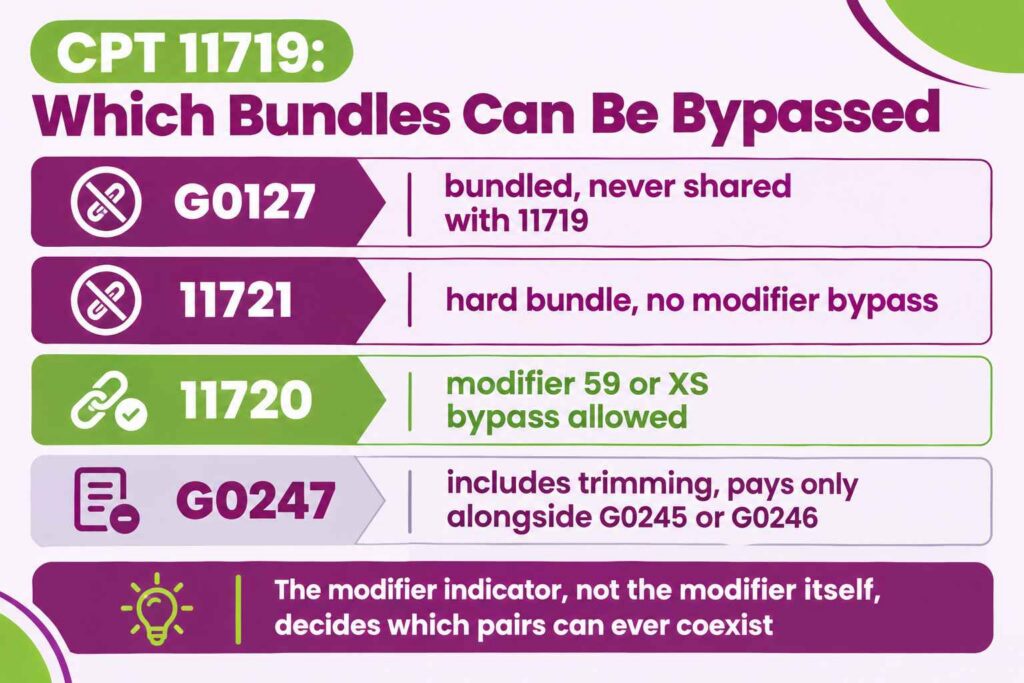
Two further points govern G0247. It pays only on the same date as G0245 or G0246, the two LOPS foot examination codes, and it is specific to a diabetic patient with diabetic sensory neuropathy. A same-day evaluation and management service is separately billable only when a significant, separately identifiable service is documented, with modifier 25 on the E/M code rather than on 11719.
Top Reasons For Denials Specific To 11719 & Quick Remedies
- Nail Condition Not Described: Prevent by recording that the nails were normal in thickness, color, and contour, since “nails trimmed” supports no code and defends nothing on audit.
- Missing or Unsupported Q Modifier: Prevent by appending the modifier that matches the documented findings, and omitting it on the neuropathy without vascular impairment pathway.
- Class Findings Not in the Physician Note: Prevent by documenting the findings in the physician’s own record, since a nursing note alone will not carry the modifier through review.
- G0127 or 11721 Billed on the Same Date: Prevent by removing the bundled line, since G0127 is bundled into 11719 and the 11721 pair is a hard bundle no modifier can bypass.
- Frequency Exceeded, or Active Care Missing: Prevent by tracking the 60-day interval per patient and recording the treating physician’s name and the date last seen.
- Dystrophic Nails Billed as 11719: Prevent by routing thickened, discolored, or deformed nails to G0127, or to the debridement codes when nail plate material is removed.