
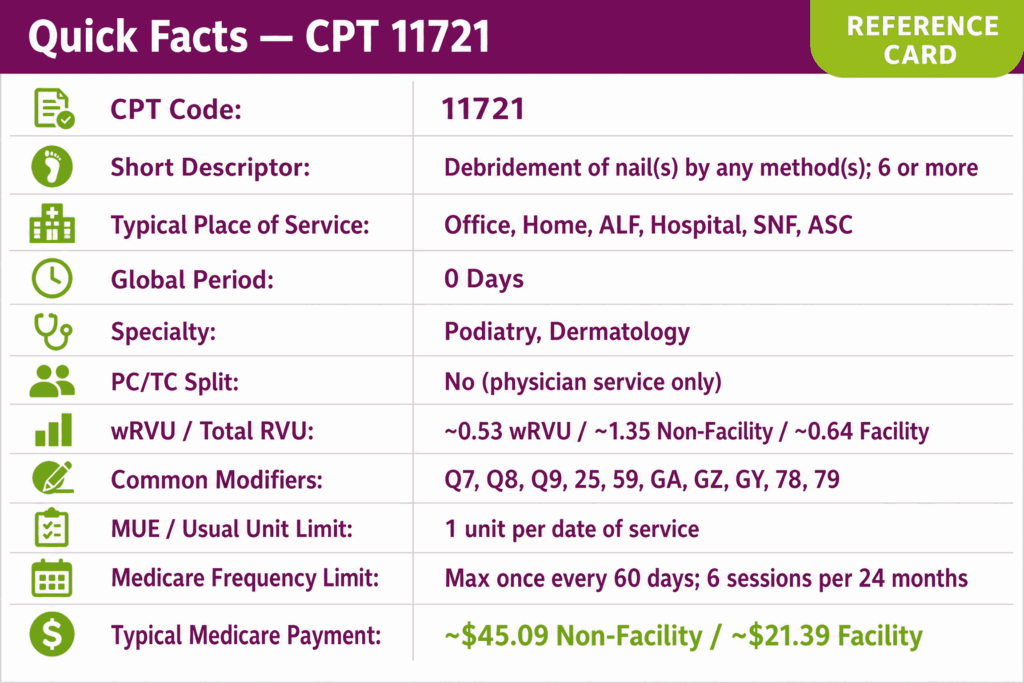
CPT code 11721 is a surgical procedure code used to report debridement of six or more nails by any method in a single encounter. Procedure code 11721 covers the mechanical, chemical, or instrumental removal of dystrophic, mycotic, thickened, or otherwise abnormal nail material.
Under Medicare, the 11721 CPT code is classified as routine foot care and is covered only when the patient has a qualifying systemic condition, and the applicable class finding modifiers are appended. Absent these requirements, the service is considered a non-covered routine service. The class-finding and frequency rules make this one of the more denial-prone foot care codes, which is why many practices demand tight documentation when getting dedicated podiatry medical billing services.
What Is the Description of CPT Code 11721?
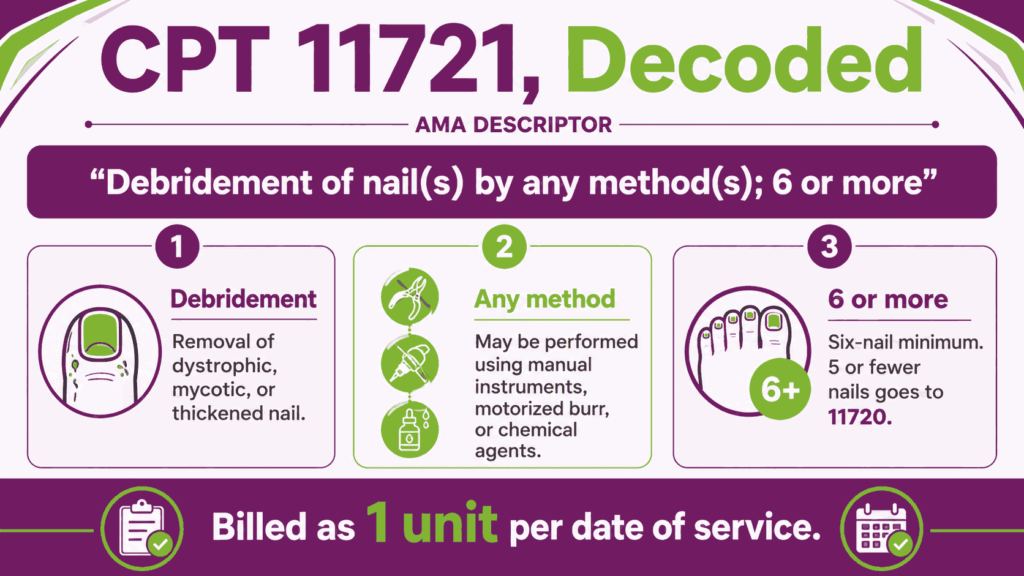
CPT code 11721 is defined by the AMA as: “Debridement of nail(s) by any method(s); 6 or more.”
Code 11721 CPT covers debridement of a minimum of six nails in a single encounter, regardless of the method used, manual, motorized burr, chemical softening, or any combination thereof. When five or fewer nails are debrided, CPT 11720 is the correct code. Per CMS Billing and Coding Article A57193, procedure code 11721 must be billed as one unit per date of service, regardless of the number of nails actually treated above the six-nail minimum. Hence, make sure to choose a provider with expertise in nail debridement billing support when opting to outsource your podiatry billing.
What Methods of Nail Debridement Are Covered Under CPT Code 11721?
CPT code 11721 covers any method of nail debridement, including manual filing and trimming of thickened nail plate, motorized rotary burr or drill reduction of dystrophic or hypertrophic nail tissue, chemical softening agents applied to reduce abnormal nail thickness, and any combination of these methods within a single encounter.
The specific method used does not change the code reported. Documentation must describe the clinical condition of the nails treated and reflect the work performed, including confirmation that six or more nails were debrided.
How Does CPT Code 11721 Differ From CPT 11720?
CPT 11720 and podiatry code 11721 are distinguished solely by the number of nails debrided:
- CPT Code 11720: Debridement of nail(s) by any method(s); 1 to 5 nails. Used when five or fewer nails are treated in a single encounter
- CPT Code 11721: Debridement of nail(s) by any method(s); 6 or more nails. Used when six or more nails are treated in a single encounter
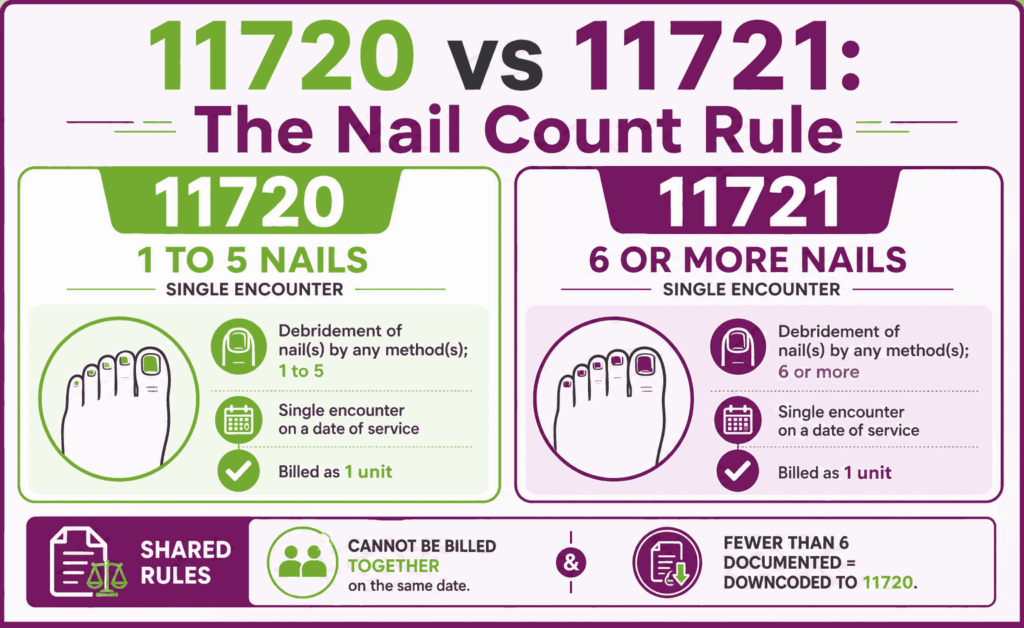
Per CMS Billing and Coding Article A57193, CPT codes 11720 and 11721 cannot be billed together on the same date of service. Only one code applies per encounter based on the total nail count. Both codes sit within the wider set of podiatry CPT codes that govern routine and surgical foot care reporting. For the 11721 CPT code, documentation must support that a minimum of six nails were debrided; if documentation supports fewer than six, the claim is downcoded to the 11720 CPT code.
What Are the Modifiers for CPT Code 11721?
Podiatry CPT code 11721 requires specific Medicare class finding modifiers for coverage under the routine foot care exception and uses additional modifiers to indicate coverage status, global period circumstances, and distinct procedural services.
Modifier 25: Significant, Separately Identifiable E/M on Same Day
Modifier 25 is appended to the E/M service, not to CPT code 11721, when a significant, separately identifiable evaluation and management service is performed on the same day as the nail debridement. The E/M must be documented separately and represent a service beyond the routine foot care visit. Append modifier 25 to the E/M code to support separate reimbursement.
Modifier 59: Distinct Procedural Service
Modifier 59 is used when the 11721 CPT code is performed as a distinct and separately identifiable service from another procedure on the same date. Append modifier 59 only when documentation supports the distinct nature of the service and an NCCI edit would otherwise bundle the procedures.
Modifier Q7: One Class A Finding (Systemic Condition Qualifier)
Modifier Q7 is appended to CPT code 11721 when the patient has one Class A finding, the most severe category of systemic manifestation. This supports the medical necessity for nail debridement under the Medicare routine foot care exclusion exception.
Class A findings include: nontraumatic amputation of foot or integral skeletal portion; absent posterior tibial pulse; advanced trophic changes (at least three of: hair growth loss, nail changes, pigmentation changes, dry skin, atrophy of skin), heat absent, redness, or cyanosis; claudication; temperature changes in the leg; edema; and paresthesias and burning. Modifier Q7 requires documentation of the Class A finding in the medical record.
Modifier Q8: Two Class B Findings (Systemic Condition Qualifier)
Modifier Q8 is appended to CPT code 11721 when the patient has two Class B findings. Class B findings include: absent dorsalis pedis pulse; absent posterior tibial pulse; advanced trophic changes (two of the criteria listed above); claudication; temperature changes. Modifier Q8 requires documentation of both Class B findings in the medical record.
Modifier Q9: One Class B and Two Class C Findings (Systemic Condition Qualifier)
Modifier Q9 is appended to procedure code 11721 when the patient has one Class B finding and two Class C findings. Class C findings are the systemic conditions themselves, like diabetes mellitus, arteriosclerosis obliterans, Buerger’s disease, chronic thrombophlebitis, and other peripheral neuropathies, including those associated with malnutrition, pernicious anemia, carcinoma, toxins, and hereditary disorders. Modifier Q9 requires documentation of the qualifying systemic condition(s) and Class B finding in the medical record.
Modifier GZ: Item or Service Expected to Be Denied as Not Medically Necessary
Modifier GZ is appended to CPT code 11721 when the provider expects Medicare to deny the service as not medically necessary, and no Advance Beneficiary Notice (ABN) has been obtained from the patient. Signals the provider does not expect Medicare payment, and the patient cannot be billed. The service is still documented and reported as modifier GZ serves as an acknowledgment of expected non-coverage without beneficiary notification on file.
Modifier GY: Statutorily Non-Covered Service
Modifier GY is appended when podiatry code 11721 is a service that is not covered by Medicare by statute. For example, when performed on a patient who does not have a qualifying systemic condition and is not eligible for the routine foot care exclusion exception. No ABN is required for GY denials. Claims submitted with the modifier GY will automatically be denied.
Modifier GA: Waiver of Liability Statement on File
Modifier GA is appended to CPT code 11721 when the provider expects Medicare may deny the service and has obtained a signed ABN from the patient. Append modifier GA when the nail debridement may not meet medical necessity requirements, but the patient has been notified and has signed the ABN. The beneficiary may be billed if the claim is denied when the modifier GA is on file.
Modifier 78: Unplanned Return to Operating Room During Global Period
Modifier 78 applies to the 11721 CPT code in the rare circumstance where an unplanned return to a procedure room for a complication related to a prior nail procedure is required during that procedure’s global period. Append modifier 78 to indicate the unplanned return to the procedure room.
Modifier 79: Unrelated Procedure During Global Period
Modifier 79 is appended when procedure code 11721 is performed during the global period of a prior unrelated surgical procedure. Since CPT code 11721 itself carries a 0-day global period, modifier 79 applies only when the nail debridement falls within the global period of another code. Append modifier 79 and document that the nail debridement is unrelated to the prior surgical service.
Why Medicare Class Finding Modifiers (Q7, Q8, Q9) Are Critical for CPT Code 11721
Under Medicare, routine foot care, including nail debridement, is excluded from Part B coverage unless the patient has a systemic condition that creates the risk of complications from routine care. Per CMS Billing and Coding Article A57193 and the Novitas LCD L35013, CPT code 11721 is payable under Medicare only when one of three class finding modifier conditions is met and documented:
- Modifier Q7: One Class A finding present
- Modifier Q8: Two Class B findings present
- Modifier Q9: One Class B and two Class C findings present
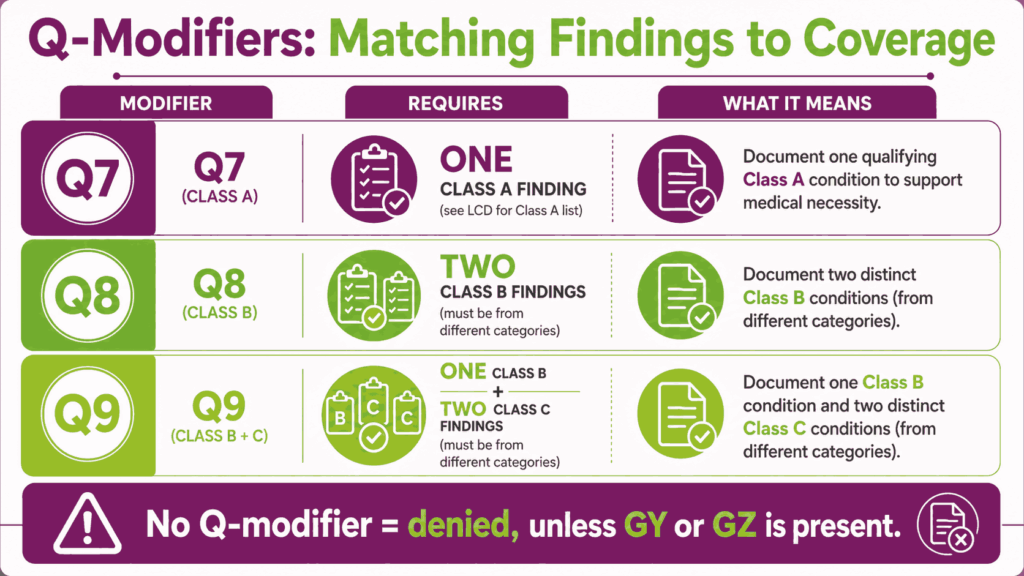
Claims for procedure code 11721 submitted to Medicare without one of these three modifiers, unless billed with modifier GY or modifier GZ, will be denied. The class finding modifier must be supported by clinical documentation in the medical record at the time of billing.
For mycotic (fungal) nail debridement specifically, per CMS Billing and Coding Article A56640, ICD-10 code B35.1 (Tinea unguium) must appear on the claim in addition to a secondary diagnosis code indicating secondary infection, pain, or difficulty in ambulation.
Which Documents Are Required For CPT Code 11721?
Documentation for CPT code 11721 must support the number of nails treated, the clinical condition, and the medical necessity basis for coverage under the routine foot care exclusion exception.
Required documents checklist:
- Clinical note documenting the condition and appearance of each nail debrided, with confirmation that six or more nails were treated
- Diagnosis supporting the systemic condition qualifying the patient for the routine foot care exception (diabetes, PVD, peripheral neuropathy, etc.)
- Documented Class A, B, or C finding(s) supporting the Q modifier appended on the claim
- Physician examination findings confirming peripheral vascular or neurological involvement consistent with the class finding reported
- For mycotic nail debridement: ICD-10 code B35.1 on the claim plus a secondary diagnosis indicating secondary infection, pain, or difficulty in ambulation per CMS A56640
- Signed ABN (if modifier GA is appended)
- Date of last nail debridement to support compliance with the 60-day frequency limitation
- For primary care or non-podiatric providers ordering foot care: documentation of the ordering or treating physician’s assessment
What is the Cost of CPT Code 11721?
Like any other type of CPT code, the cost for CPT code 11721 varies by payer, place of service, and geographic location.
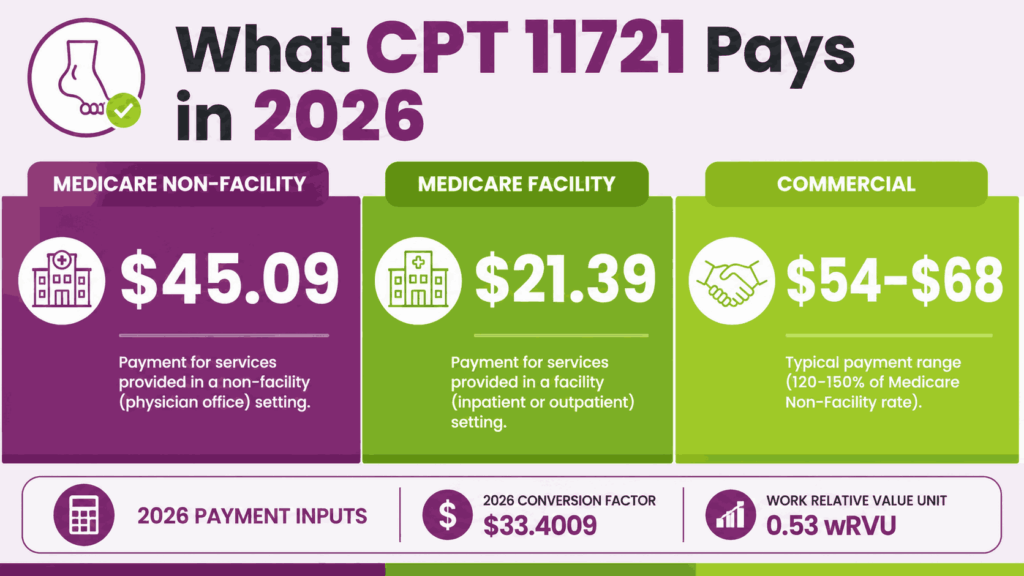
RVUs & Medicare Payment
Medicare’s resource-based relative value scale assigns a specific weight to podiatry code 11721 when calculating its national unadjusted price. For 2026, the Work RVU (wRVU) sits at 0.53, following a finalized -2.5% efficiency reduction to all non-time-based therapeutic procedures. In a private office or independent clinic, the Total Non-Facility RVU is valued at 1.35.
Multiplied by the standard 2026 conversion factor of $33.4009, Medicare’s base allowance is $45.09 for an office visit. If performed within a facility setting, the overhead weight drops drastically, reducing the Total Facility RVU to 0.64 and yielding a lower physician payment of $21.39.
Commercial Payers
Commercial health insurance plans usually establish their fee schedules for 11721 CPT at 120% to 150% of the standard Medicare rate. This pushes the typical commercial allowable amount for an office-based nail debridement into a range of $54 to $68.
Unlike Medicare, which relies on a strict 60-day frequency limitation and mandates specific Q-modifiers (such as Q7, Q8, or Q9) to signal qualifying clinical class findings, private insurers often impose unique capitated limits or bundle nail debridement into broader evaluation and management (E/M) codes.
Place-of-Service & Geographic Adjustments
The final local price for CPT code 11721 is adjusted by the Geographic Practice Cost Index (GPCI), which scales the payment upward in expensive metropolitan areas to match local commercial real estate and staffing costs.
In a private practice setting (POS 11), the provider collects the maximum $45.09 to cover both their time and the practice overhead. In a hospital outpatient clinic or skilled nursing facility (POS 22 or 31), the practitioner only receives the $21.39 professional fee.
What Are Example Clinical Scenarios or Use Cases for CPT Code 11721?
CPT code 11721 applies when six or more nails are debrided by any method in a single encounter, supported by a qualifying systemic condition and documented class findings meeting Medicare coverage criteria.
Scenario 1: Severe Onychomycosis With Dystrophic Nails in a Diabetic Patient
ICD-10: B35.1 (Tinea unguium) / E11.621 (Type 2 diabetes mellitus with foot ulcer)
A patient with type 2 diabetes mellitus presents with severe onychomycosis affecting eight toenails. Nails are thickened, discolored, and brittle, creating difficulty with footwear and ambulation. The podiatrist documents peripheral neuropathy as a Class C finding and an absent dorsalis pedis pulse as a Class B finding, supporting modifier Q9. Six or more nails are debrided by a motorized burr. CPT code 11721 is reported with modifier Q9, ICD-10 B35.1, and E11.621 as a secondary diagnosis.
Scenario 2: Thickened and Incurvated Nails Due to Peripheral Vascular Disease
ICD-10: I73.9 (Peripheral vascular disease, unspecified)
A patient with documented peripheral vascular disease presents with seven toenails that are severely thickened, incurvated, and causing pain on weight-bearing. Examination reveals absent posterior tibial pulse bilaterally and advanced trophic changes across the foot, documenting two Class B findings. The podiatrist deburrs all seven nails manually and by burr. 11721 CPT code is reported with modifier Q8 supported by documented vascular examination findings.
Scenario 3: Multiple Nail Debridement in a Patient With Peripheral Neuropathy and Limited Mobility
ICD-10: G63 (Polyneuropathy in diseases classified elsewhere)
An elderly patient with peripheral neuropathy secondary to chronic alcohol use disorder presents unable to perform self-nail care due to limited mobility and sensory deficits. Examination documents peripheral neuropathy (Class C finding), one absent dorsalis pedis pulse (Class B finding), and dry atrophic skin changes (contributing to Class B criteria). Six nails are debrided. Procedure code 11721 is reported with modifier Q9 and supporting clinical documentation.
What Are the CPT Code 11721 Rules To Ensure Successful Reimbursement?
Follow CMS, MAC, and payer-specific rules for frequency, class findings, documentation, and bundling. Meeting these rules reduces denials and ensures correct payment for podiatry code 11721.
Bundling / NCCI / Same-Day Procedure Rules
CPT code 11721 and CPT 11720 must not be billed together on the same date of service. Only one of these two codes applies per encounter based on the total nail count. If an E/M service is also performed on the same date, modifier 25 must be appended to the E/M code, not to the 11721 CPT code, to support separate reimbursement. Verify NCCI edits before billing procedure code 11721 alongside other integumentary procedure codes on the same claim.
Units, MUEs & Minimum Nail Count Requirements
CPT code 11721 is billed as one unit per date of service, regardless of how many nails above six are debrided, per CMS Billing and Coding Article A57193. Billing multiple units is incorrect and will be denied.
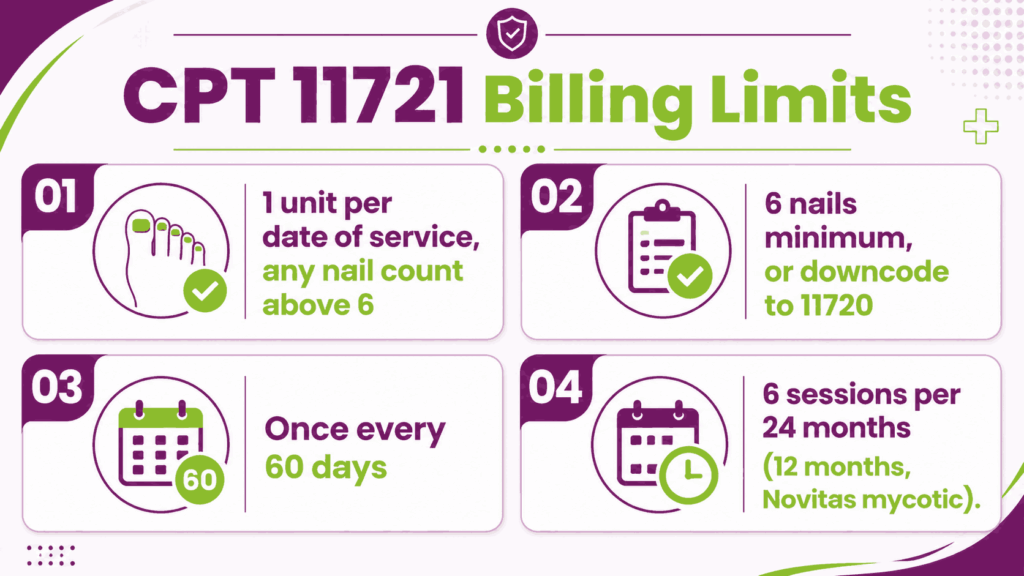
- Documentation must specifically confirm that at least six nails were debrided. Claims for 11721 CPT code, where the note describes fewer than six nails, are subject to downcoding to CPT 11720
- Medicare covers the 11721 CPT code no more than once every 60 days. Claims submitted within 60 days of a prior covered encounter for the same service will be denied on frequency grounds
- Per CMS A57193, coverage is also limited to no more than six sessions per 24 months, absent medical review demonstrating continuing medical necessity
- Novitas LCD A56640 applies a 6 sessions per 12 months frequency limitation for mycotic nail debridement, specifically. Providers in Novitas jurisdictions should apply the more restrictive 12-month limit
Medicare Routine Foot Care Exclusions and How to Establish Medical Necessity
Medicare classifies nail debridement as routine foot care, which is statutorily excluded from Part B coverage under Section 1862(a)(12) of the Social Security Act. CPT code 11721 is payable under Medicare only when the patient qualifies for the routine foot care exclusion exception. That is, when the patient has a systemic condition that creates the risk of complications without professional nail care.
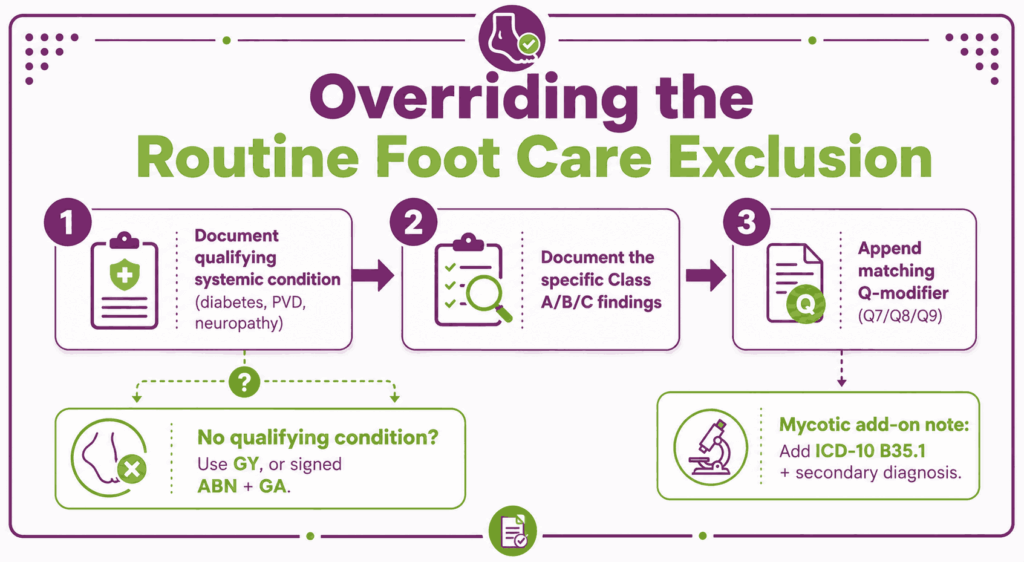
To establish medical necessity and override the routine foot care exclusion for procedure code 11721:
- Document the qualifying systemic condition (diabetes mellitus, peripheral vascular disease, peripheral neuropathy, Buerger’s disease, arteriosclerosis obliterans, or other listed conditions per CMS coverage policy)
- Document the specific Class A, B, or C findings present on examination. Findings must be consistent with the class finding modifier appended to the claim
- Append the correct class finding modifier, Q7, Q8, or Q9, on every Medicare claim for podiatry code 11721
- For mycotic nail debridement, include ICD-10 B35.1 as a primary or co-primary diagnosis and a secondary diagnosis confirming secondary infection, pain, or ambulation difficulty per CMS A56640
- When the patient does not have a qualifying systemic condition, use modifier GY (statutorily excluded) or obtain a signed ABN and append modifier GA when the provider is uncertain about coverage
Top Reasons For Denials Specific To 11721 & Quick Remedies
- Missing Class Finding Modifier (Q7, Q8, or Q9): Prevent by confirming the appropriate modifier is appended to every Medicare claim before submission. Per CMS A57193, CPT code 11721 submitted without a class finding modifier will be denied unless GY or GZ is present.
- Frequency Violation (Less Than 60 Days Since Last Service): Prevent by tracking the date of the last covered nail debridement encounter and confirming the 60-day interval has elapsed before scheduling and billing the next session.
- Nail Count Below Six Billed as 11721: Prevent by confirming the procedure note documents six or more nails debrided before selecting procedure code 11721. If fewer than six are documented, report CPT 11720.
- 11720 and 11721 Billed Together on Same Date: Prevent by confirming only one of these two codes is reported per date of service per CMS A57193. They cannot be billed on the same claim.