ICANotes and Tebra both sell EHR and billing software to behavioral health practices. ICANotes serves behavioral health exclusively. Tebra serves independent practices across many specialties and publishes a dedicated therapist pricing tier.
The two platforms build from opposite ends. ICANotes starts with clinical documentation and connects billing to the note. Tebra started as Kareo, a billing platform, and added clinical tools later.
That origin shapes pricing, documentation depth, and who handles billing work. This guide compares ICANotes and Tebra on all three, then sets out what each platform costs by clinician role.

What Is ICANotes?
ICANotes is a cloud EHR built exclusively for behavioral health practices. Psychiatrists, therapists, psychiatric nurse practitioners, and substance use programs make up its core users. The platform holds ONC Cures certification and combines charting, e-prescribing, scheduling, telehealth, and billing.
Capterra reports that 99% of ICANotes reviewers work at small businesses. Among those reviewers, 65% work in mental health care.
Who Owns ICANotes?
ICANotes is a portfolio company of funds advised by Sheridan Capital Partners. Brothers Ira and Don Morganstern founded the company in Annapolis, Maryland, in 1999. Jamie Morganstern leads it today as chief executive officer.
ICANotes states that a practicing psychiatrist designed the platform. That origin explains the documentation-first structure running through every plan.
What Separates ICANotes+ From ICANotes Classic?
ICANotes runs two active platforms with different billing capabilities. ICANotes+ is the newer, go-forward product. ICANotes Classic remains available for practices that prefer established workflows. ICANotes+ is the newer platform, while ICANotes Classic remains available for practices using established workflows.
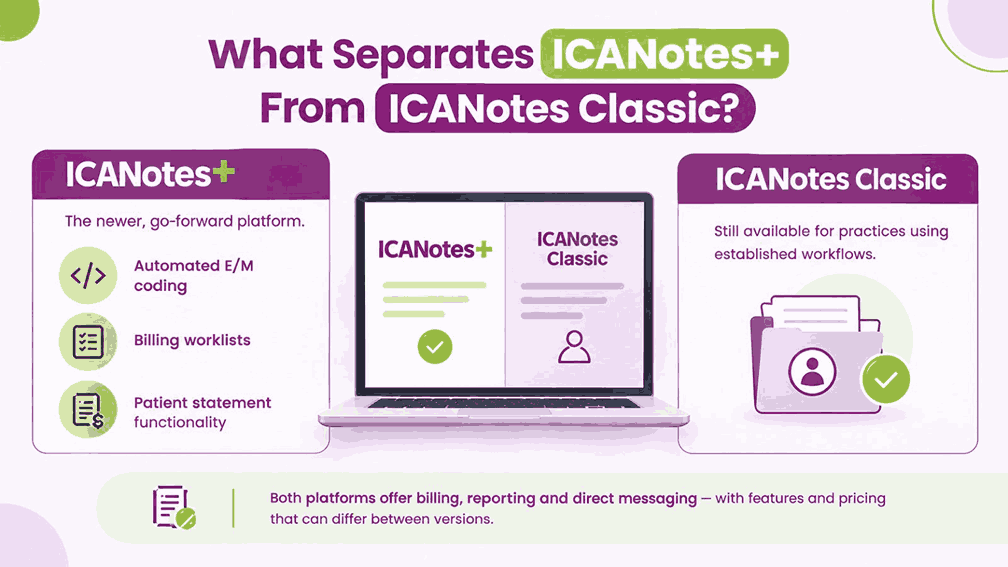
ICANotes+ now includes automated E/M coding, billing worklists, and patient statement functionality, although specific billing features and pricing can differ between platforms. ICANotes+ and Classic billing differences extend beyond those functions into reporting and direct messaging.
Is ICANotes Built Only for Behavioral Health?
Yes. ICANotes serves psychiatry, psychotherapy, counseling, social work, and substance use treatment, and no other specialty. Templates, rating scales, and billing workflows all assume behavioral health encounters. Integrated primary care practices weigh that scope carefully before committing.
How Does ICANotes Pricing Work?
ICANotes prices per clinician, by prescribing status and working hours. Full-time plans run $55 for Notes Only, $75 for Non-Prescribing, and $213 for Prescribing, per clinician monthly.
Part-time plans cost less and cap monthly note volume. Part-time Notes Only runs $35 with 60 notes. Non-Prescribing runs $45 with 60 notes. Prescribing runs $138 with 100 notes.
How Does Prescribing Status Set the Rate?
Prescribing authority is the main price driver. A full-time prescriber pays $213, nearly three times the $75 non-prescriber rate. The Prescribing plan adds e-prescribing, medication management, and lab ordering.
License type does not change the rate. A psychiatrist and a psychiatric nurse practitioner who both prescribe pay the same $213. That rule becomes the central pricing difference against Tebra.
Which Costs Sit Outside the Clinician Subscription?
Several costs can sit outside the core clinician subscription:
- A one-time $99 activation fee, charged on prescribing plans only
- $25 monthly per non-clinical user, after one free user
- AI Scribe at $49 per user monthly
- Telehealth as a paid per-user add-on
- The clearinghouse connection, which ICANotes lists as an optional add-on
ICANotes+ also carries a three-month minimum commitment. After 90 days, practices can cancel with 15 days’ notice.
Does the Notes Only Plan Include Billing?
No. Notes Only covers clinical documentation and nothing else. Scheduling, the client portal, and billing tools start at the $75 Non-Prescribing plan. Any practice billing insurance through ICANotes compares costs from $75, not $55.
How Does ICANotes Documentation Support Billing?
Documentation carries unusual billing weight in behavioral health. Payers expect each session to justify its own medical necessity. A thin progress note becomes a denial risk on its own. ICANotes builds claims directly from completed notes.
When a clinician creates a note, the encounter can appear in ICANotes+’s Unbilled Encounters worklist for billing review. Staff can then review the encounter, mark it as billed, or submit the claim.
How Do Menu-Driven Templates Document Medical Necessity?
ICANotes templates generate narrative notes from structured selections rather than free typing. Clinicians select symptoms, interventions, progress, and plan elements. The system writes those selections into a readable clinical narrative.
Structure is the billing argument. Every note captures the same medical necessity elements in a consistent order, which supports payer review and audit defense. ICANotes also reports more than 100 built-in rating scales for tracking symptom change.
What Does Code for Me Calculate?
Code for Me calculates an E/M code level from the documentation inside a note. The button sits at the end of the note and recommends the highest level the documentation supports.
Two limits apply. ICANotes provides automated E/M coding support based on documented medical decision-making. E/M automation separates many psychiatry-specific EMR platforms from general ones, because prescribers bill E/M with psychotherapy add-ons daily.
Does ICANotes Code Psychotherapy Sessions Automatically?
No. Psychotherapy codes depend on documented session time, and ICANotes leaves that selection to the clinician. A 38- to 52-minute session supports 90834, while 53 minutes or more supports 90837. Code selection against documented time stays manual on both ICANotes platforms.
Who Handles Billing Work on ICANotes?
ICANotes supports two billing models: in-house billing on the platform, or outsourced billing through ICANotes itself. The billing module works the same way under either arrangement. Billing staff use the ICANotes+ Billing Worklist to review unbilled encounters, correct billing information, mark encounters as billed, and submit claims.
How Do Claims Route Through ICANotes?
ICANotes+ supports multiple clearinghouses, including Inovalon and Waystar, along with Availity, Etactics, ClaimMD, TriZetto, and other supported connections. Practices work with ICANotes to configure the appropriate clearinghouse for claim submission and related billing workflows.
ICANotes lists the clearinghouse connection as an optional add-on rather than a standard inclusion. Waystar adds real-time eligibility requests. Practices complete a required training session before submitting their first claims batch through the default connection.
Does ICANotes Sell Its Own Billing Service?
Yes. ICANotes offers full-service revenue cycle management covering eligibility, claims submission, denial follow-up, and accounts receivable. The software vendor and the billing vendor become the same company under that arrangement. A practice hiring an independent biller works alongside a service that ICANotes also sells.
What Is Tebra (Kareo)?
Tebra is a cloud EHR and practice management platform for independent outpatient practices. Kareo and PatientPop merged on 2 November 2021 and took the Tebra name. Dan Rodrigues, who founded Kareo, serves as chief executive officer.
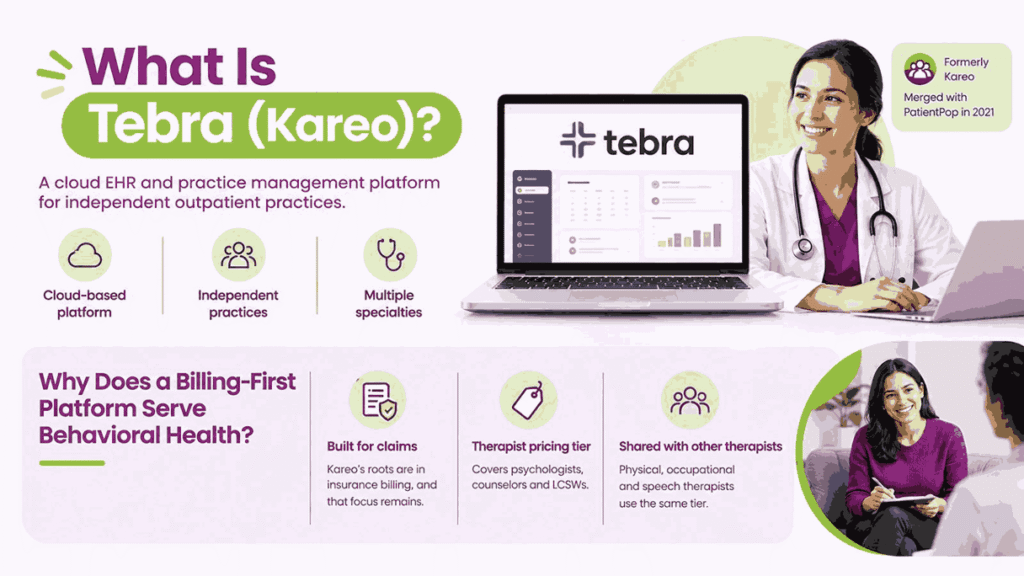
Tebra serves several specialties rather than one. Tebra serves independent practices across dozens of specialties, including mental health, psychiatry, psychology, physical therapy, cardiology, and many other clinical fields.
Why Does a Billing-First Platform Serve Behavioral Health?
Kareo built insurance billing software before it built an EHR. That lineage still shapes Tebra, which carries the partner base and billing tooling of a platform designed around the claim.
Behavioral health fits through pricing. Tebra publishes a separate therapist tier covering psychologists, counselors, and licensed clinical social workers. Physical, occupational, and speech therapists share that same tier.
Is Tebra Built Specifically for Behavioral Health?
No. Tebra serves independent practices across specialties, with behavioral health as one concentration among several. Specialty templates cover mental health visits, but the platform architecture is general ambulatory. The contrast with ICANotes is scope rather than quality.
How Does Tebra Pricing Work for Behavioral Health Practices?
Tebra prices per provider, by license category and claim volume. Practice Essentials bundles charting, billing, and telehealth. At standard volume, it runs $599 per physician, $399 per non-physician provider, and $225 per therapist monthly.
Which Tebra Tier Applies to Each Clinician Role?
License category sets the tier. A psychiatrist falls in the physician tier at $599. A psychiatric nurse practitioner falls in the non-physician tier at $399. Therapists, psychologists, counselors, and licensed clinical social workers fall in the therapist tier at $225.
Prescribing authority does not change the Tebra rate. That reverses the ICANotes rule, and the gap between the two systems lands on the nurse practitioner.
What Happens Above 100 Claims per Month?
Tebra publishes lower starter rates for practices submitting fewer than 100 claims per month. Low-volume Practice Essentials starts at $349 per physician and $199 per non-physician provider. Tebra publishes no low-volume therapist rate.
Practices exceeding 100 claims for three consecutive months move to standard rates. Therapy-heavy groups have no low-volume discount to lose. Tebra pricing tiers and the claim threshold matter most for groups carrying physicians and nurse practitioners.
Does Tebra Charge for Non-Clinical Staff?
No. Tebra includes unlimited non-clinical seats at every tier. Front desk staff, billers, schedulers, and administrators access the platform without raising the bill. ICANotes charges $25 monthly for each non-clinical user after the first.
How Does Tebra Handle Behavioral Health Documentation?
Tebra documents behavioral health visits through specialty templates, reusable macros, and AI-assisted charting. Notes feed charge capture directly, so finalized documentation flows straight into the claim. The charting engine serves many specialties at once. Behavioral health templates sit alongside medical ones rather than defining the platform.
What Does AI Note Assist Change for Therapy Notes?
AI Note Assist converts patient conversations into organized clinical notes. Tebra rolled the tool out to Clinical subscribers in phases through May 2026, priced per note or by subscription. For therapy notes, the tool cuts drafting time rather than adding clinical structure.
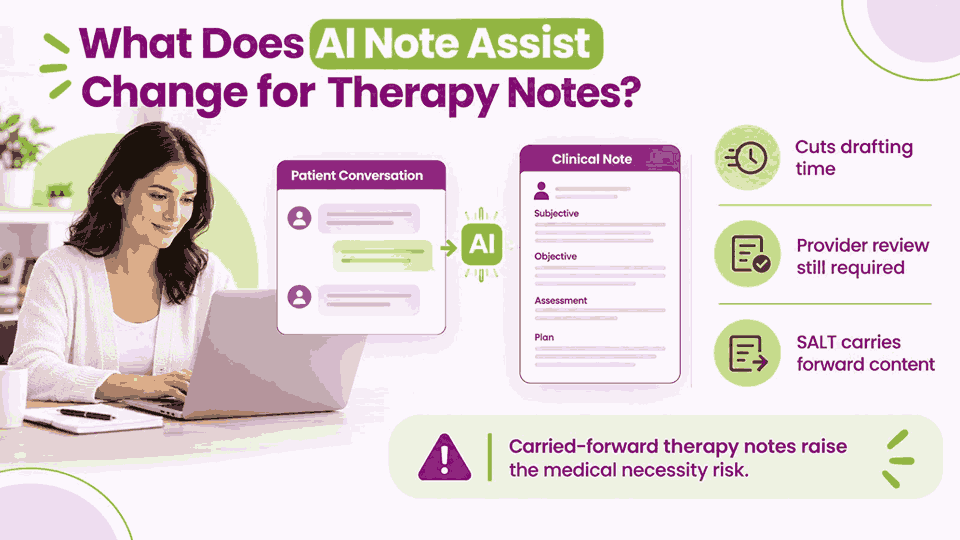
Provider review before signing remains required. Tebra AI Note Assist and charting tools also include SALT, which carries content forward from a prior visit. Carried-forward therapy notes raise the medical necessity risk ICANotes templates are built to avoid.
Does Tebra Support Controlled Substance Prescribing?
Yes. Tebra supports electronic prescribing of controlled substances, with identity verification required for each prescriber. Psychiatrists and psychiatric nurse practitioners complete that verification before the feature works. Both platforms support EPCS, so prescribing capability does not separate them.
Who Handles Billing Work on Tebra?
Tebra exited medical billing services to concentrate on software. The company states that it does not compete with its partners. More than 1,600 billing companies run client practices on the platform. That makes Tebra a software-only vendor. Billing work stays in-house or goes to an independent biller the practice chooses.
How Do Claims Route Through Tebra?
Tebra uses TriZetto as its primary clearinghouse for electronic claims, eligibility, and remittance services. Jopari supports workers’ compensation and auto claims and certain electronic attachment workflows. Before submission, a rules engine scrubs each claim, and AI Claim Review scores denial risk. Tebra denial and AR follow-up falls to whoever runs the practice’s billing, since Tebra no longer does that work.
Does Tebra Sell Its Own Billing Service?
No. Tebra discontinued its revenue cycle service and hosts independent billing companies instead. A practice on Tebra faces no vendor competition when choosing a biller. ICANotes, the software vendor, also sells full-service billing.
Where Do ICANotes and Tebra Overlap and Diverge?
ICANotes and Tebra overlap on core behavioral health functions and diverge on specialization, pricing, and billing ownership. Both support therapy documentation, e-prescribing, telehealth, and insurance billing.
What Do Both Platforms Handle Equally?
Both platforms deliver six shared functions. Eligibility checks, documentation-driven claims, and electronic submission through a third-party clearinghouse come first. Remittance posting, controlled substance prescribing, and a patient portal complete the set.
Both platforms connect their billing workflows to external clearinghouse networks rather than making clearinghouse ownership a core part of the EHR subscription. How Tebra compares to AdvancedMD turns on exactly that clearinghouse point, because AdvancedMD owns its own.
How Do the Two Platforms Differ Structurally?
The table below compares the two platforms on the factors that move behavioral health collections.
| Factor | ICANotes | Tebra |
|---|---|---|
| Specialization | Behavioral health only | Multiple specialties, therapist tier |
| Pricing Basis | Prescribing status and hours | License category and claim volume |
| Platform Versions | ICANotes+ and ICANotes Classic | One platform |
| E/M Auto-coding | Code for Me, Classic only | No code selection |
| Telehealth | Paid add-on | Included in Practice Essentials |
| Non-clinical Seats | First free, $25 each after | Unlimited |
| Clearinghouse | Inovalon default, Waystar option | TriZetto |
| Vendor RCM Service | Yes, full-service | Exited |
| Certified Coders Included | No | No |
Two rows decide most behavioral health evaluations. The pricing basis sets cost by staff mix. The vendor RCM row determines whether the software vendor competes with an independent biller.
Does Documentation Depth or Billing Depth Matter More?
Neither, universally. Behavioral health denials cluster in two places: eligibility and authorization before the session, and medical necessity documentation after it.
ICANotes addresses the second point more directly through structured narrative notes. Tebra addresses the first more directly through a billing partner base built around claims work. The better platform follows whichever failure point costs a practice more.
What Does Each Platform Cost by Clinician Role?
Cost depends on staff mix, because the two platforms price clinicians by different rules. The figures below use full-time ICANotes plans against Tebra Practice Essentials at standard volume, at published list rates.
Why Do the Two Pricing Systems Split at the Nurse Practitioner?
ICANotes prices by prescribing authority, and Tebra prices by license. The two rules agree on therapists and psychiatrists, then diverge on psychiatric nurse practitioners.
| Clinician | ICANotes Rule | ICANotes Rate | Tebra Rule | Tebra Rate |
|---|---|---|---|---|
| Therapist, Psychologist, LCSW | Non-prescriber | $75 | Therapist tier | $225 |
| Psychiatric Nurse Practitioner | Prescriber | $213 | Non-physician tier | $399 |
| Psychiatrist | Prescriber | $213 | Physician tier | $599 |
On ICANotes, a psychiatric nurse practitioner costs the same as a psychiatrist. On Tebra, that clinician costs $200 less. A practice replacing psychiatrist capacity with nurse practitioners saves $200 per seat on Tebra and nothing on ICANotes.
What Does a Six-Clinician Group Pay on Each?
Take a group running one psychiatrist, one psychiatric nurse practitioner, four therapists, and three non-clinical staff. That group pays $776 monthly on ICANotes against $1,898 on Tebra.
The ICANotes total includes $50 for two non-clinical users beyond the free first seat. Tebra charges nothing for non-clinical staff. ICANotes also charges $198 once to activate the two prescribers.
Assumptions: Published list rates, full-time ICANotes plans, and Tebra Practice Essentials at standard volume. The model excludes implementation, negotiated discounts, and AI documentation tools on both sides. Rerun the figures with your own staff mix.
Which Add-Ons Change the Total?
Telehealth and the clearinghouse connection raise the ICANotes figure. Both are separate ICANotes charges, while Tebra Practice Essentials includes telehealth.
Neither add-on closes a monthly gap above $1,100 for a group this size. On published rates, ICANotes stays the lower-cost platform at every behavioral health role. Tebra’s higher rate buys billing infrastructure and a vendor that does not compete with your biller.
What Does Switching Between Them Cost?
Platform migration costs more than the subscription difference suggests. Four categories carry the cost, and none appear on a pricing page.
What Does Not Transfer Between Platforms?
Template structure does not transfer. ICANotes narrative templates and Tebra specialty templates use different architectures, so note formats get rebuilt in either direction. Open accounts receivable, clearinghouse enrollments, and prior authorization tracking also resist clean migration.
Prior authorizations matter most here, because ongoing therapy depends on renewals and session limits. Moving to Tebra means TriZetto enrollment payer by payer. Moving to ICANotes+ starts a three-month minimum commitment.
Is There a Fee to Export Practice Data?
Reportedly, on both platforms. Several.com reports ICANotes charging $150 to export practice data to a USB drive on termination. Capterra reviewers describe Kareo charging roughly $2,000 for a database export. Confirm exit terms in writing at contract stage, not at departure.
How Does Transcure Support Billing on ICANotes and Tebra?
Certified coders and billers work inside the platform a practice already runs. That work runs under a business associate agreement per 45 CFR §164.502(e). No platform change is required, and patient data stays in the existing environment.
On ICANotes, the work centers on time-based code selection and the Code for Me gap. Psychotherapy sessions get coded against documented time, and E/M levels get validated on ICANotes+ where automation is not yet available. On Tebra, effort shifts to payer enrollment, prior authorization tracking, and denial follow-up.
Behavioral health denials often trace to managed behavioral health organizations. Optum Behavioral Health, Magellan, Carelon, and Evernorth each apply their own payer IDs and rules. Coverage spans more than 40 specialties across 1,100 AAPC-certified staff, with onboarding under 14 days.
Prior authorizations and session-limit renewals get tracked before clinicians reach the cap. ICANotes claims and prior authorization work run through the integrated clearinghouse the practice already uses.
Frequently Asked Questions
Is ICANotes Cheaper Than Tebra?
Yes, at published list rates for every behavioral health role. Full-time ICANotes plans run $75 per therapist and $213 per prescriber. Tebra runs $225 per therapist, $399 per non-physician provider, and $599 per physician. Tebra includes telehealth and unlimited non-clinical seats, which narrows the gap without closing it.
How Do ICANotes and Tebra Price Psychiatric Nurse Practitioners?
ICANotes charges any prescriber $213, the same rate as a psychiatrist. Tebra charges the $399 non-physician rate, which sits $200 below its physician rate. ICANotes still costs less in absolute terms.
Does ICANotes Offer Billing Services?
Yes. ICANotes sells full-service revenue cycle management covering eligibility, claims, denial follow-up, and accounts receivable. Tebra exited billing services and does not compete with the billing companies on its platform.
What Is the Difference Between ICANotes+ and ICANotes Classic?
ICANotes+ is the newer platform, and ICANotes Classic is the legacy one. E/M coding automation and batch patient statements currently run on Classic only. ICANotes+ adds client portal payments and Google Calendar sync.
Does Tebra Offer a Low-Volume Rate for Therapists?
No. Tebra publishes low-volume rates for physicians and non-physician providers below 100 claims monthly. For therapists, Tebra publishes only the $225 standard Practice Essentials rate.
Can ICANotes Code Psychotherapy Sessions Automatically?
No. Code for Me calculates E/M levels only. Psychotherapy codes such as 90834 and 90837 depend on documented session time, and clinicians select them manually.
Do ICANotes or Tebra Include Certified Medical Coders?
No. Both platforms supply coding tools without assigning certified coders. ICANotes automates E/M leveling on Classic, and Tebra AI Claim Review scores denial risk, but neither replaces a coder.