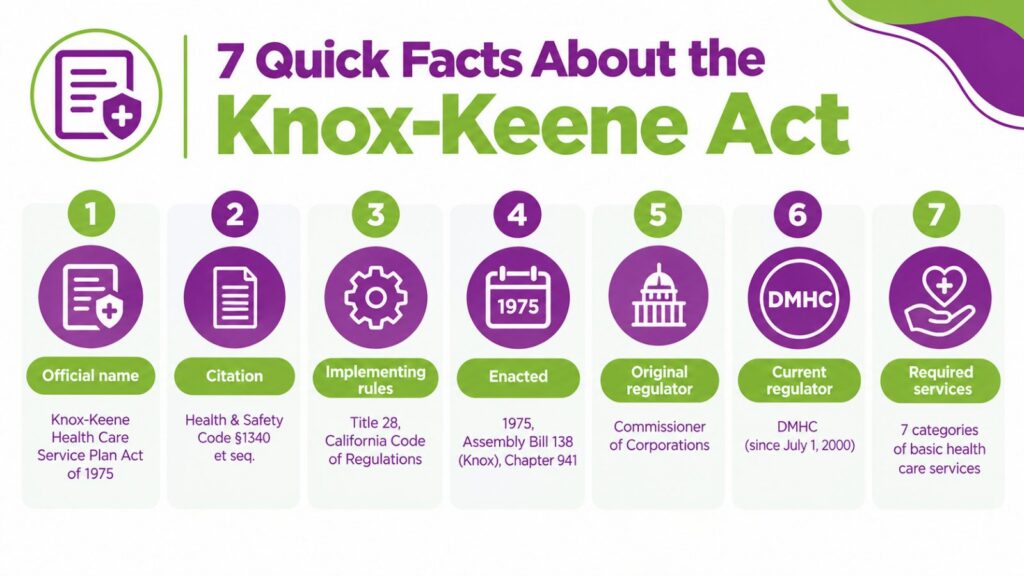
The Knox-Keene Health Care Service Plan Act of 1975 is the California law that licenses and regulates health care service plans. Health and Safety Code section 1340 and following codifies the Act, which the Department of Managed Health Care (DMHC) administers.
Since January 1, 2026, California law requires health plans to reimburse complete claims within 30 calendar days. Before that date, HMOs had 45 working days and other plans had 30 working days.
This guide covers 13 parts of the Knox-Keene Act that affect California medical billing laws, from claim deadlines to patient privacy.
What Is the Knox-Keene Act?
The Knox-Keene Act is California’s licensing and oversight law for health care service plans. Assembly Bill 138 (Knox), Chapter 941, Statutes of 1975, enacted the law.
According to Health Access, Assemblymembers John T. Knox and Barry Keene co-authored the Act in 1975, and the law carries both names. Health Access states that the Act began as the regulatory framework for HMOs. The Act now serves as the basis for regulating 95 percent of health coverage in California.
AB 138 transferred regulation of health care service plans from the Attorney General to the Commissioner of Corporations. According to the Legislative Analyst’s Office, AB 78 (Gallegos, 1999) later created the DMHC, which began operations July 1, 2000.
What Does the Knox-Keene Act Cover?
The Knox-Keene Act covers the licensing, financial solvency standards, and consumer protections for health care service plans in California. Title 28 of the California Code of Regulations holds the rules that implement the Act.
According to Practical Law, the Knox-Keene Act requires plans to cover 7 categories of basic health care services.
These are physician services, hospital inpatient and ambulatory care, diagnostic laboratory and radiologic services, home health services, preventive health services, emergency care, and hospice care.
Who Enforces the Knox-Keene Act?
The DMHC enforces the Knox-Keene Act under the California Health and Human Services Agency. The department oversees all California HMOs, some PPOs, and specialized plans such as dental and vision plans.
DMHC states that the department protects the health care rights of over 29.8 million Californians. Health insurers fall under the California Department of Insurance (CDI) and the Insurance Code.
This table compares the 2 regulators of California health coverage by plans overseen, governing law, and late-claim interest rate.
| Regulator | Plans overseen | Governing law | Interest on late claims |
|---|---|---|---|
| DMHC | HMOs, some PPOs, specialized plans | Knox-Keene Act, Health and Safety Code section 1340 and following | 15 percent per year |
| CDI | Health insurers | Insurance Code sections 10123.13 and 10123.147 | 10 percent per year |
Medicare Advantage plans without commercial or Medi-Cal lines of business fall outside the DMHC guidance on AB 3275.
What Are the Knox-Keene Claim Payment Deadlines in 2026?
According to DMHC All Plan Letter 25-007, health plans must reimburse a complete claim within 30 calendar days after receipt. The rule applies to claims received on or after January 1, 2026.
AB 3275 (Soria, 2024) created the rule by amending Health and Safety Code sections 1371 and 1371.35. The deadline applies to commercial and Medi-Cal managed care plans, including specialized plans.
There are 5 core payment rules under Section 1371.
- Reimburse complete claims within 30 calendar days of receipt.
- Notify the claimant in writing within 30 calendar days when a claim is contested or denied.
- Pay 15 percent per year interest beginning on day 31, included automatically with the payment.
- Add the greater of $15 or 10 percent of accrued interest when interest is not paid.
- Complete reconsideration within 30 calendar days after receiving requested information.
AB 3275 sets the same 30-calendar-day rule for health insurers under Insurance Code sections 10123.13 and 10123.147, with 10 percent interest.
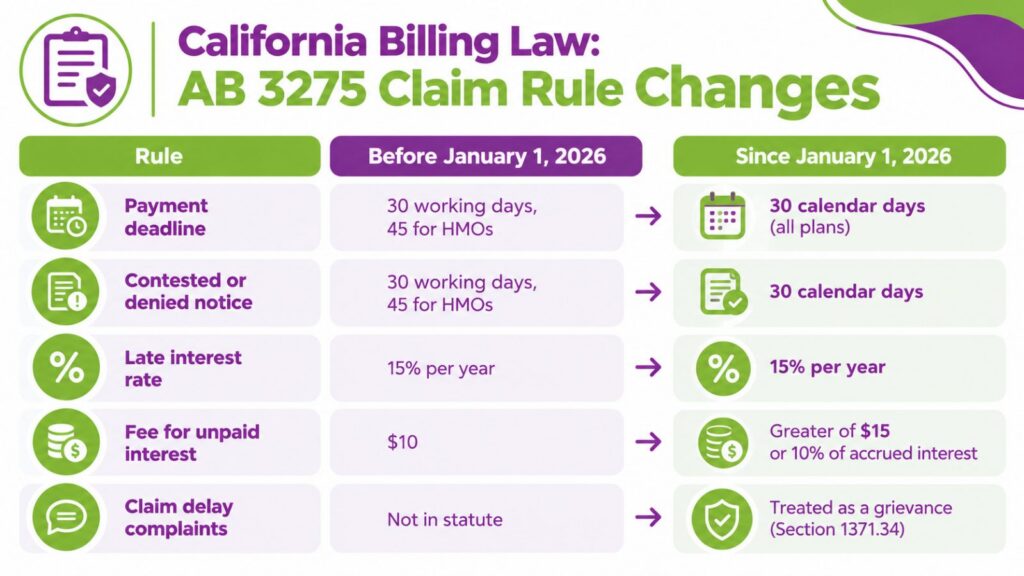
The 2026 change removes the 45-working-day HMO period and applies a single 30-calendar-day deadline to all Knox-Keene plans.
How Much Interest Does a Late California Claim Earn?
A late complete claim earns 15 percent per year interest, about $0.99 per day on a $2,400 claim. According to DMHC All Plan Letter 25-007, interest starts on the first calendar day after the 30-calendar-day period.
This table compares one $2,400 claim received January 5, 2026, and paid February 20, 2026, under the 2025 HMO rule and the 2026 rule.
| Item | 2025 HMO rule | 2026 rule |
|---|---|---|
| Payment deadline | Mid-March 2026 (45 working days) | February 4, 2026 (30 calendar days) |
| Days late | 0 | 16 |
| Interest at 15 percent | $0.00 | $15.78 |
| Fee if interest is not paid automatically | $0 | $15 (greater of $15 or $1.58) |
| Total owed | $0.00 | $30.78 |
The same payment date moves from on time to late because the 2026 clock counts calendar days.
What Must a Contested or Denied Claim Notice Include?
According to DMHC All Plan Letter 25-007, a contested claim notice must identify the contested portion by procedure or revenue code. The notice must also list the specific information needed to reconsider the claim.

A denial notice identifies the denied portion by procedure or revenue code and states the specific reasons, including any defect or impropriety. Plans may not contest a claim that matches the codes and services approved by prior authorization with appropriate documentation.
How Do Providers Dispute a Claim Under the Knox-Keene Act?
Providers dispute a claim through the plan’s provider dispute resolution mechanism, required by Health and Safety Code section 1367 and Rule 1300.71.38. The mechanism covers contracted and non-contracted providers.
A plan that denies a claim as filed late must accept and adjudicate the claim when the provider shows good cause in a provider dispute. Section 1371.37 prohibits an unfair payment pattern, defined as repeated delays in adjudicating and paying claims correctly.
This table lists 6 deadlines in the provider dispute process under Rule 1300.71.38.
| Step | Deadline |
|---|---|
| File a provider dispute | Within 365 days after the plan action |
| Acknowledge an electronic dispute | 2 working days from receipt |
| Acknowledge a paper dispute | 15 working days from receipt |
| Submit an amended dispute | 30 working days after receiving the returned dispute |
| Issue a written determination | 45 working days from receipt |
| Pay amounts due, with interest and penalties | 5 working days after the written determination |
What Must a Provider Dispute Include?
According to Rule 1300.71.38, a provider dispute about a claim must contain 6 items.
- Name the provider.
- Add the provider identification number.
- List contact information.
- Identify the disputed item.
- State the date of service.
- Explain why the payment, contest, or denial is incorrect.
Providers submit the dispute under the same number assigned to the original claim. The plan tracks the dispute against that claim number. Plans may not set a filing deadline under 365 days after the claim action. When a plan takes no action, the 365 days start after the period to contest or deny the claim ends.
A plan may return an incomplete dispute, and the provider then has 30 working days to submit an amended dispute. Plans may not retaliate against a provider for filing a dispute. The dispute process is free of charge to the provider.
Whenever a plan contests, adjusts, or denies a claim, the plan informs the provider how to file a dispute.
What Has the DMHC Fined Plans for Claims and Provider Disputes?
The table lists 4 DMHC claim and dispute penalties between 2023 and 2026, from $225,000 to $475,000.
| Date | Plan | Penalty | Violation |
|---|---|---|---|
| March 27, 2023 | Health Net of California | $225,000 | Failed to accurately reimburse $1.2 million in provider claims, including interest and penalties |
| May 22, 2025 | Blue Shield of California | $300,000 | Mishandled claims payments for medical care |
| December 18, 2025 | UnitedHealthcare Benefits Plan of California | $475,000 | Delayed medical care and payments |
| February 4, 2026 | Health Net of California | $450,000 | Late provider dispute handling, with 15,368 late resolutions and 19,048 late acknowledgments among more than 544,000 disputes |
Dividing the cited counts by 544,000 gives about 2.8 percent late resolutions and 3.5 percent late acknowledgments. According to DMHC, failing to reimburse at least 95 percent of complete claims correctly over any three months is an unfair payment pattern.
How Can Providers Document Plan Violations?
According to Davis Wright Tremaine, providers can document plan violations in 5 steps.
- Track late acknowledgments beyond 15 working days.
- Track late determinations beyond 45 working days.
- Label payment disputes as formal provider disputes.
- Retain written correspondence showing plan noncompliance.
- Follow up when a plan classifies a dispute as an inquiry.
How Does the California Surprise Billing Law Work?
AB 72 sets the payment rate for noncontracting individual health professionals at contracting facilities. Plans pay the greater of the average contracted rate or 125 percent of the Medicare rate. The rule took effect July 1, 2017.
Under Health and Safety Code section 1371.9, the enrollee owes only the in-network cost-sharing amount. DMHC runs the AB 72 independent dispute resolution process, and the independent organization has a maximum of 30 calendar days to issue a determination.
According to DMHC All Plan Letter 22-011, the federal No Surprises Act applies to hospitals and ambulatory surgery centers. AB 72 defines in-network facilities beyond those 2 types. Both the California surprise billing law and the California balance billing law refer to AB 72 for non-emergency care at contracting facilities.
How Does the California Confidentiality of Medical Information Act Apply to Billing?
According to Civil Code section 56.10, no provider of health care, health care service plan, or contractor may disclose patient medical information without authorization. The California Confidentiality of Medical Information Act (CMIA) sits in Civil Code section 56 and following.
A health care service plan under the CMIA means any entity regulated under the Knox-Keene Act. Civil Code section 56.36 sets 3 penalty tiers for violations.
| Violation | Maximum Penalty |
|---|---|
| Negligent disclosure | $2,500 per violation |
| Knowing and willful disclosure by a person other than a licensed health care professional | $25,000 per violation |
| Knowing and willful use or disclosure for financial gain | $250,000 per violation |
How Do Other California Billing Deadlines Compare?
California billing deadlines differ by payer type. This table lists 4 deadlines, 2 for payment and 2 for claim filing.
| Payer | Deadline | Type |
|---|---|---|
| Commercial plans and insurers | 30 calendar days | Payment |
| Workers’ compensation insurers | 45 working days | Payment |
| Medi-Cal | 6 months | Claim filing |
| Medicare | 12 months | Claim filing |
Frequently Asked Questions
Which Medi-Cal Plans Fall Under the Knox-Keene Act?
According to Medi-Cal billing regulations, all managed care plans except County Organized Health Systems (COHS) hold a Knox-Keene license for Medi-Cal lines of business. According to DMHC, COHS plans are exempt from Knox-Keene licensure for Medi-Cal but hold licenses for other lines.
The Department of Health Care Services (DHCS) shares regulatory authority over Medi-Cal plans with DMHC.
According to the National Health Law Program, certain Knox-Keene provisions apply to all Medi-Cal managed care plans, with or without a DMHC license. DMHC reports that Local Plans serve about 9.3 million enrollees in 49 counties.
What Is the Knox-Keene Timely Filing Limit for Provider Claims?
Plans may not set a timely filing deadline under 90 days for contracted providers or 180 days for non-contracted providers after the date of service. Rule 1300.71(b)(1) sets both minimums. Secondary payers may not set a filing deadline under 90 days from the primary payer’s payment, contest, or denial.
The date of service is the delivery date for outpatient and emergency services and the discharge date for inpatient services. When a claim reaches the wrong party, the date of receipt becomes the day the correct party receives the claim.
A plan that sets a deadline below these minimums on at least 3 claims in any 3 months risks an unfair payment pattern finding.
Does the Knox-Keene Act Bar Balance Billing by Contracted Providers?
Rule 1300.71(g)(4) requires every plan contract with a provider to prohibit balance billing enrollees for the difference between the provider’s billed charges and the plan’s payment. The only amounts that may be collected from the enrollee are applicable copayments and deductibles.
The bar applies to any covered benefit. Contracted providers with a written contract receive the agreed contract rate. Non-contracted providers receive the reasonable and customary value, based on statistically credible data updated at least annually.
For non-emergency services from non-contracted providers to PPO and POS enrollees, the amount in the enrollee’s Evidence of Coverage applies.
What Is California Independent Medical Review?
California independent medical review (IMR) lets health plan enrollees seek an independent review of disputed medical decisions. The DMHC IMR system was created in Health and Safety Code section 1374.30 and following.