AdvancedMD and Tebra compete for the same independent practices. Both run cloud practice management and EHR software. Both target outpatient groups rather than hospitals.
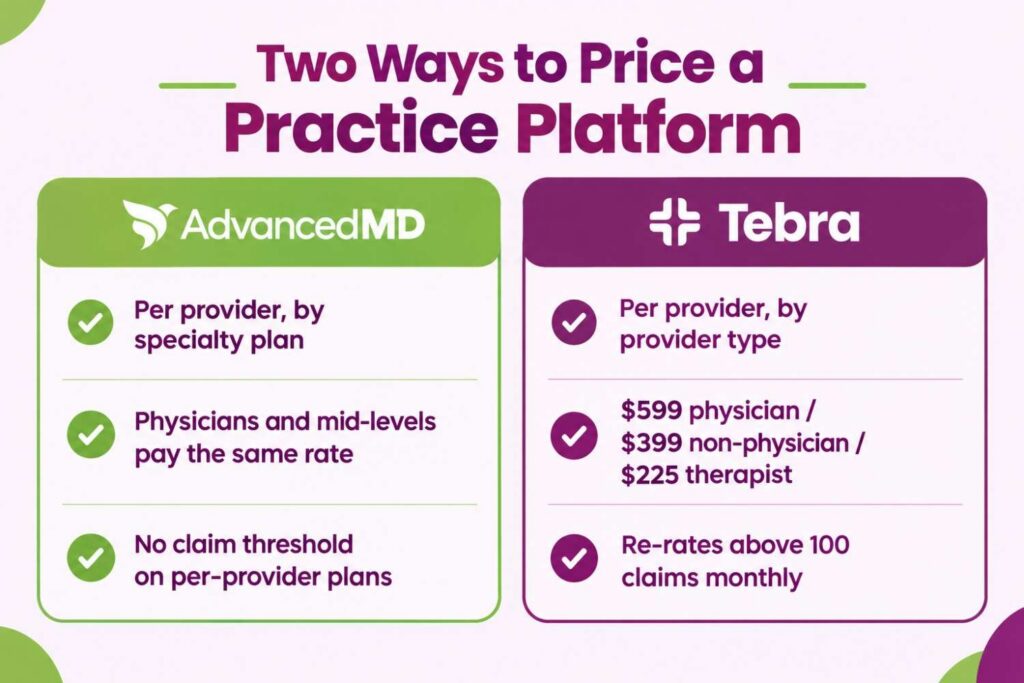
The platforms price on different logic. AdvancedMD charges one rate per provider, whether physician or mid-level clinician. Tebra varies its rate by provider type and applies a claim-volume threshold. That lowers entry cost and adds a growth penalty AdvancedMD’s per-provider plans do not carry.

The two vendors also answer one question in opposite directions. AdvancedMD sells its own revenue cycle service. Tebra exited that business. This guide covers pricing structure, claim routing, and billing ownership across both platforms.
What Is AdvancedMD?
AdvancedMD is a cloud practice management and EHR platform for independent outpatient practices. The platform runs on AWS with no on-premise hardware. Practice management, charting, patient engagement, and payments share one database.
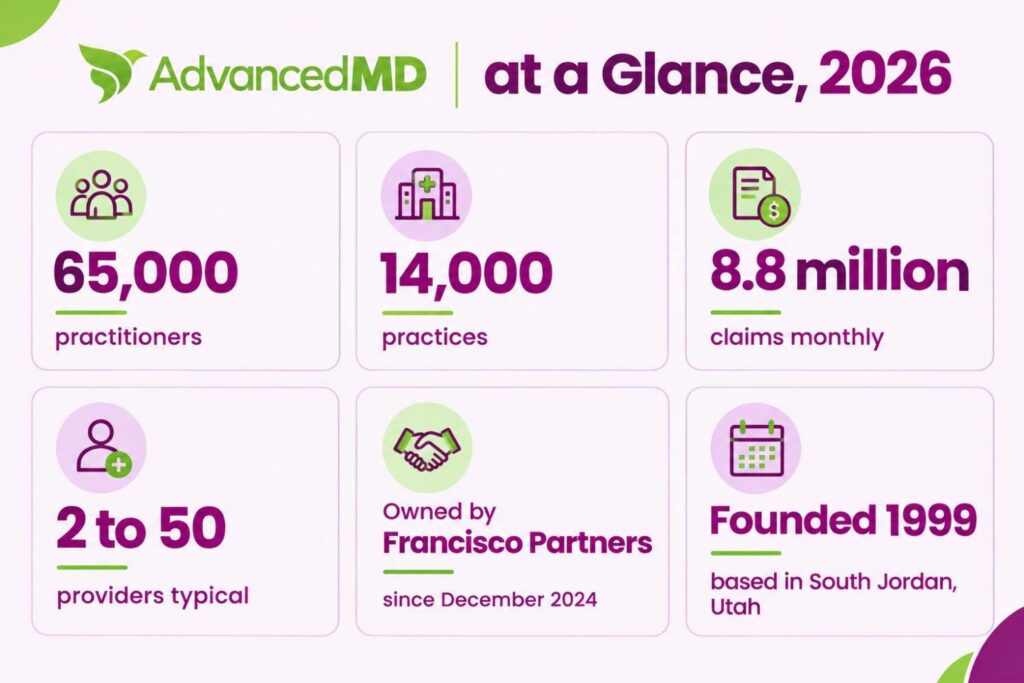
AdvancedMD started as Perfect Practice.MD in 1999 and operates from South Jordan, Utah. According to AdvancedMD, the platform serves 65,000 practitioners across 14,000 practices and 900 independent billing companies. Those practices process 8.8 million claims monthly.
Who Owns AdvancedMD?
Francisco Partners owns AdvancedMD. The firm acquired the company from Global Payments for $1.125 billion, announced 30 October 2024 and closed 16 December 2024. Amanda Sharp serves as chief executive officer.
AdvancedMD has changed hands five times since 2008. Francisco Partners, ADP, Marlin Equity Partners, and Global Payments each owned it before Francisco Partners returned.
Which Practices Run on AdvancedMD?
AdvancedMD supports typical deployments between 2 and 50 providers. Specialty templates cover more than 20 medical specialties. The platform holds ONC and Drummond certification.
A multi-site practice works every location from one login through Central Billing Office. More than 900 independent billing companies already work inside AdvancedMD, so practices that outsource keep a wide choice of billers.
Is AdvancedMD Still Owned by ADP?
AdvancedMD is no longer owned by ADP. ADP held AdvancedMD between 2011 and 2015. Francisco Partners has owned the company since December 2024. Several software directories still list ADP as the current owner, which dates their comparison data by more than a decade.
How Does AdvancedMD Pricing Work?
AdvancedMD prices per provider per month, counting any mid-level clinician or higher as a provider. Medical specialty plans start at $429 for practice management with billing and $729 for EHR plus practice management. The full bundle with patient engagement starts at $999 per month.
Pricing also varies by specialty plan. Mental health plans run $130 to $399 per provider, with AdvancedMD Now at the $130 entry point. Physical medicine runs $399 per provider. AdvancedMD also publishes claims-based pricing of $0.87 to $2.17 per claim and offers multi-provider discounts.
What Sits Outside the Base Subscription?
Several capabilities carry separate line items rather than sitting inside a tier. Add-ons include advanced reporting, appointment reminders, telehealth, patient engagement, API access, and lab interfaces. Electronic faxing bills per transmission.
Telehealth matters for the comparison that follows, because Tebra bundles it into Practice Essentials while AdvancedMD licenses it separately. Full add-on structure sits in what AdvancedMD costs beyond the subscription.
Does AdvancedMD Charge the Same Rate for Non-Physician Providers?
AdvancedMD charges mid-level clinicians the same rate as physicians. AdvancedMD defines a provider as any mid-level clinician or higher. Nurse practitioners and physician assistants therefore pay the full per-provider rate. Therapists in mental health practices fall under separate plans priced from $130 to $399.
How Do Claims Route in AdvancedMD?
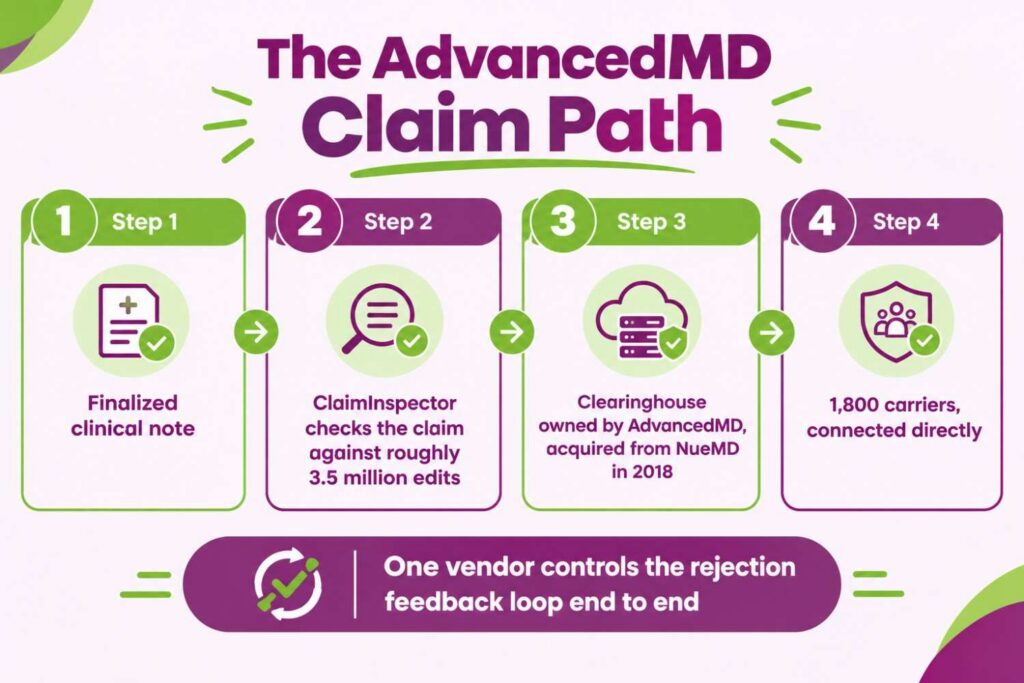
AdvancedMD routes claims through a clearinghouse it owns, acquired from NueMD in 2018. That clearinghouse connects directly to 1,800 United States carriers. Rejection feedback returns into Practice Management in near real time.
Charges generate from finalized clinical notes rather than through separate charge entry.
What Does ClaimInspector Screen Before Submission?
ClaimInspector checks each claim against roughly 3.5 million edits before submission. Only the edits matching a claim’s codes, payer, and fields actually trigger. AdvancedMD sources its edit knowledge base through Optum.
Each edit is individually controlled, so a billing team switches rules on and off against its own payer mix. That control carries a labor cost, because default configurations never anticipate a specific payer profile. Configuration mechanics sit in ClaimInspector edit control.
Does AdvancedMD Include Coding?
AdvancedMD does not include coding in any tier. The platform supplies coding tools, specialty templates, and bundling edits, but assigns no coders. The AdvancedMD managed revenue cycle service excludes coding as well. Practices staff coding separately regardless of tier.
Who Owns Billing Work on AdvancedMD?
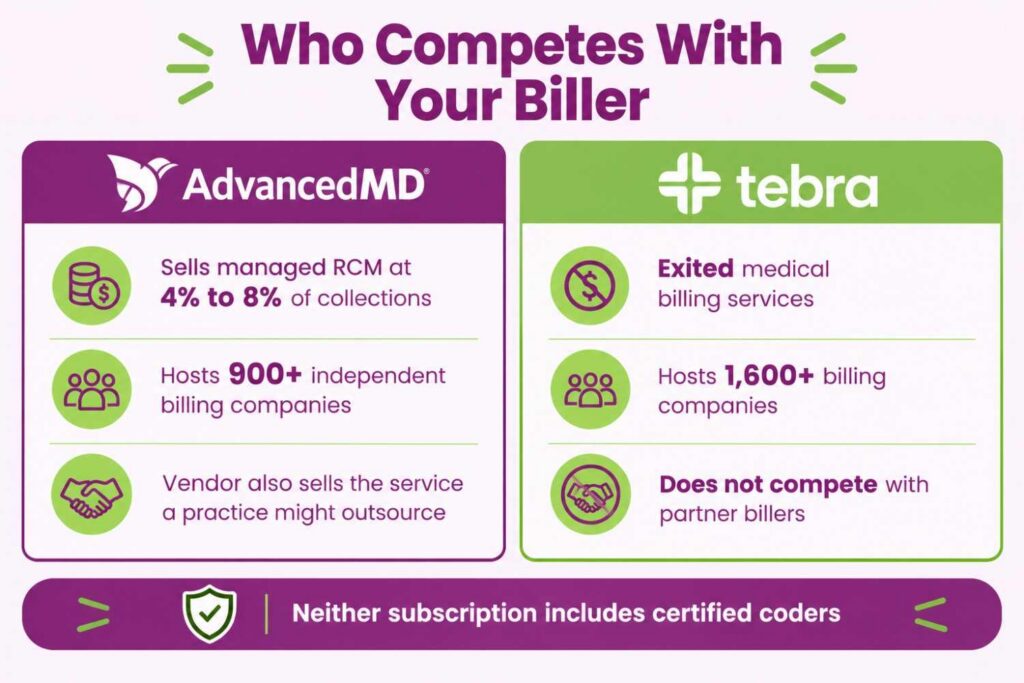
AdvancedMD sells its own managed revenue cycle service at 4% to 8% of monthly collections. The software vendor and the billing vendor are the same company under that arrangement.
AdvancedMD also hosts more than 900 independent billing companies on Central Billing Office. The platform serves both models at once. A practice choosing an independent biller works alongside a service the vendor also sells.
Can a Practice Use an Independent Biller on AdvancedMD?
A practice on AdvancedMD can use an independent biller instead of the vendor’s own service. More than 900 independent billing companies work inside AdvancedMD through Central Billing Office. The biller works in the practice’s existing system, so no platform change is needed.
What Is Tebra (Kareo)?
Tebra is a cloud EHR and practice management platform for independent outpatient practices, operated by Tebra Technologies, Inc. from Newport Beach, California. Dan Rodrigues, who founded Kareo in 2004, serves as chief executive officer.
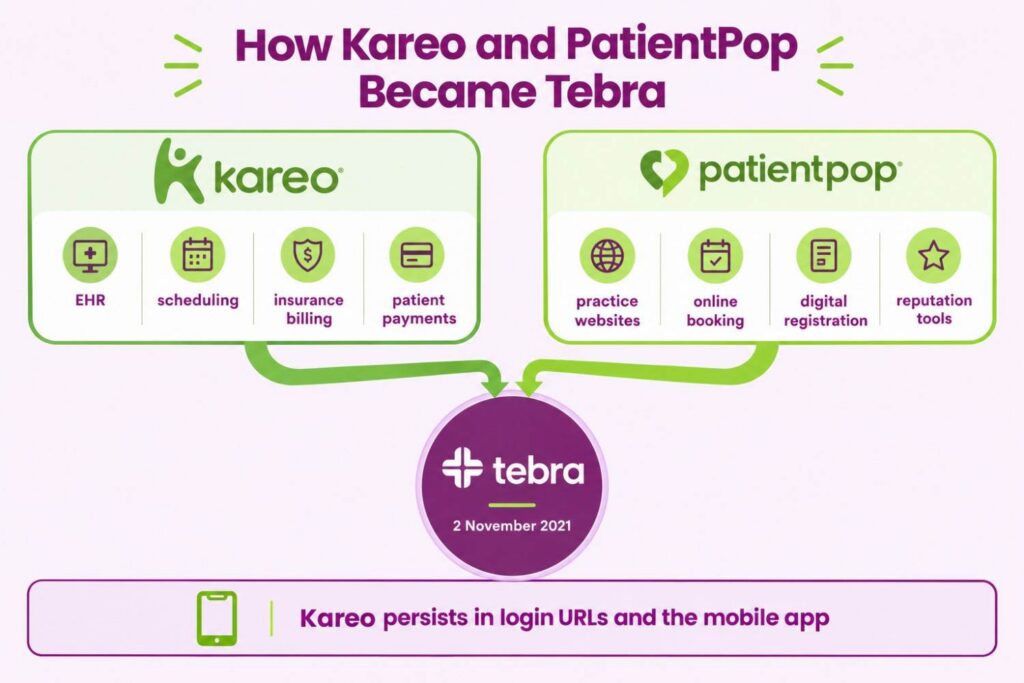
Kareo and PatientPop closed their merger on 2 November 2021, and the combined company took the name Tebra. PatientPop retired its own website on 2 April 2024. Tebra holds ONC certification.
How Did Kareo Become Tebra?
Kareo contributed the EHR, scheduling, insurance billing, and patient payment technology. PatientPop contributed practice websites, online booking, digital registration, and reputation tools.
Kareo processed $25 billion in insurance claims during 2019, before the merger. The Kareo name persists in login URLs and in the mobile app title. Billing teams still use it daily for that reason.
Which Practices Run on Tebra?
Tebra serves independent outpatient practices at the smaller end of the ambulatory market. Dedicated specialty pages cover five concentrations: family medicine, primary care, pediatrics, mental health, and nurse practitioners.
Behavioral health carries unusual weight. Tebra publishes a separate therapist pricing tier covering psychologists, counselors, licensed clinical social workers, and physical, occupational, and speech therapists. No other provider category receives its own tier.
Are Kareo and Tebra the Same Platform?
Kareo and Tebra are the same platform. Kareo operates as a legacy name inside Tebra rather than as a separate product. Tebra states on its pricing overview that practices researching Kareo pricing are evaluating the Tebra platform. Comparison research treating them as two products is comparing one system to itself.
How Does Tebra Pricing Work?
Tebra prices on provider type and a claim-volume threshold. Published rates run between $49 and $799 per provider per month across tiers.
Tebra sorts providers into physicians, non-physician providers, and therapists. Nurse practitioners and physician assistants count as non-physician providers. A separate rate applies to practices submitting 100 claims per month or fewer.
How Does Tebra Price by Provider Type?
The rates below come from Tebra’s published pricing overview. All figures are per provider, per month.
| Practice Type | Volume Tier | Practice Essentials | Practice Automation |
|---|---|---|---|
| Physician | Standard | $599 | $799 |
| Physician | Low volume | from $349 | from $399 |
| Non-physician | Standard | $399 | $449 |
| Non-physician | Low volume | from $199 | from $249 |
| Therapist | Standard | $225 | $299 |
Practice Essentials bundles clinical charting, billing, and telehealth. Practice Automation adds the patient engagement tools, and what each Tebra bundle includes differs by more than those headline items. The therapist tier costs 62% less than the standard physician rate. That gap helps explain the density of behavioral health practices on Tebra.
What Happens When a Practice Passes 100 Claims per Month?
Pricing re-rates to the standard tier. Tebra applies low-volume rates only below 100 claims monthly. Practices exceeding that threshold for three consecutive months transition to standard pricing.
A physician on low-volume Practice Essentials moves from roughly $349 to $599 per provider per month. That is a 72% increase triggered by growth rather than by any change in configuration. AdvancedMD’s per-provider plans carry no equivalent threshold.
Does Tebra Publish Pricing?
Tebra publishes per-tier dollar figures rather than quoting privately. AdvancedMD publishes its rates too. A direct cost comparison is therefore possible without a sales conversation.
How Do Claims Route in Tebra?
Tebra routes claims through TriZetto, a third-party clearinghouse, with enrollment handled payer by payer on a self-service model. Each payer approves claims, eligibility, and remittance transactions on its own timeline.
Claims carrying attachments route separately through Jopari rather than TriZetto, under a distinct registration covering the 275 transaction set.
How Does Tebra Scrub Claims Before Submission?
Tebra runs a rules engine applying payer-specific edits before claims reach the clearinghouse. Users can customize billing rules by provider or payer on top of that engine. Eligibility verification runs on the ANSI X12 standard, sending a 270 inquiry to more than 2,700 payers.
A second layer sits alongside the rules engine. AI Claim Review returns a numeric denial probability on an encounter, with the reasons behind it. The tool supports triage rather than replacing the scrubbing pass.
Billing work splits across a Web Platform and a Windows-only Desktop Application. Clearinghouse reports, rejection codes, payment posting, and analytics all sit on the desktop side. Full setup and workflow detail sits in Tebra EMR setup and billing workflow.
Does Tebra Include Coding?
Tebra does not include coding in its subscription. Tebra supplies charge capture from clinical documentation and a scrubbing engine, but assigns no certified coders. AI Claim Review ranks denial risk without selecting CPT or ICD-10 codes. Coding sits outside scope on both platforms in this comparison.
Who Owns Billing Work on Tebra?
Tebra exited medical billing services to concentrate on software. The company states on its billing companies page that it does not compete with its partners.
That exit is unusual. AdvancedMD, athenahealth, and ICANotes all sell revenue cycle services alongside their software. Billing companies working on Tebra join its partner program automatically, so practices choose among them without a competing vendor service.
Tebra publishes three figures on that partner base. More than 1,600 medical billing companies work on the platform, processing over $20 billion in claims annually. Those billers serve more than 50,000 providers.
Does Tebra Sell a Managed Billing Service?
Tebra no longer sells a managed billing service. Tebra discontinued its own revenue cycle service. Legacy Kareo Managed Billing accounts also lose at least one function: proof of timely filing is unavailable on them.
Where Do AdvancedMD and Tebra Overlap?
AdvancedMD and Tebra overlap on market segment and core revenue cycle function. Both serve independent outpatient practices. Both capture charges from documentation, scrub claims, post remittances, and route denials.
The divergence runs along pricing logic, clearinghouse control, and vendor conflict.
What Do Both Platforms Do Equally Well?
Both platforms deliver six identical revenue cycle functions. Eligibility verification, documentation-driven charge capture, and pre-submission scrubbing come first. Electronic remittance posting, denial routing, and patient payment capture complete the set.
Both hold ONC certification. Also, both publish pricing. Both support independent billers working inside the practice’s own system. Neither subscription includes certified coders. Platform-specific breakdowns sit across the EMR platform guides by vendor.
How Do the Two Platforms Differ Structurally?
The table below sets the platforms against each other on the factors that move collections.
| Factor | AdvancedMD | Tebra |
|---|---|---|
| Pricing Basis | Per provider by specialty plan; mid-levels priced as physicians | Per provider by type: physician, non-physician, therapist |
| Volume Threshold | None on per-provider plans | Re-rates above 100 claims monthly |
| Clearinghouse | Owned, 1,800 direct carriers | TriZetto, third party |
| Claim Attachments | Same clearinghouse | Jopari, separate registration |
| Scrubbing Engine | ClaimInspector, ~3.5M-edit library | Rules engine plus AI Claim Review |
| Rule Configurability | Individual edits switched on or off | Custom rules by provider or payer |
| Interfaces | Single cloud platform | Web platform plus Windows desktop |
| Telehealth | Add-on | Included in Practice Essentials |
| Vendor RCM Service | Yes, 4% to 8% of collections | Discontinued |
| Certified Coders in Subscription | No | No |
Two rows decide most evaluations. The pricing basis sets cost by staff mix and growth. The vendor RCM row shows whether the software vendor also sells the billing service a practice might outsource.
Does a Vendor Selling Billing Services Create a Conflict?
A vendor that sells billing services has a stake in which biller a practice picks. AdvancedMD sells managed RCM at 4% to 8% while hosting 900 independent billing companies. Tebra removed that stake by leaving the billing business entirely. Practices comparing billers weigh vendor neutrality alongside price.
What Does Each Platform Cost by Provider Type and Volume?
Cost depends on staff composition, because Tebra prices non-physician providers below physicians and AdvancedMD does not. The figures below use published list rates at standard volume.
How Does Provider Type Change the Comparison?
| Provider Type | AdvancedMD | Tebra | AdvancedMD Multiple |
|---|---|---|---|
| Physician | $729 | $599 | 1.2× |
| Non-physician provider | $729 | $399 | 1.8× |
| Therapist, mental health plan | $130 to $399 | $225 | 0.6× to 1.8× |
A six-provider medical practice running 4 physicians and 2 nurse practitioners pays $3,194 monthly on Tebra against $4,374 on AdvancedMD. That is a gap of roughly $14,200 per year. A physician-only practice of the same size sees the gap narrow to about $9,400 annually.
Tebra states that non-clinical staff seats are unlimited at every tier, covering front desk, medical assistants, billers, and administrators.
Assumptions: AdvancedMD EHR plus practice management at $729 and Tebra Practice Essentials, both at list price. The model excludes implementation, add-ons, and negotiated rates. AdvancedMD offers multi-provider discounts, so its effective rate can sit below list. Rerun the figures with your own staff mix.
Where Does AdvancedMD Cost Less?
AdvancedMD costs less at the entry tier for behavioral health. AdvancedMD Now runs $130 per provider against Tebra’s $225 therapist rate. A six-therapist practice pays $780 monthly on AdvancedMD Now versus $1,350 on Tebra Practice Essentials.
AdvancedMD mental health plans reach $399, so the advantage holds only at the entry plan. The wider point stands: neither platform is categorically cheaper, and staff composition decides the answer more than the platform does.
What Does the Volume Threshold Change?
It reverses the direction of travel for growing practices. Tebra’s low-volume rates undercut AdvancedMD substantially below 100 claims monthly. Crossing that threshold for three consecutive months moves a physician from roughly $349 to $599.
AdvancedMD’s per-provider plans charge the same rate at 50 claims and at 5,000. A practice projecting growth models the post-threshold Tebra rate, not the entry rate. The entry rate expires on success.
What Does Switching Between Them Cost?
Platform migration costs more than the rate difference in the first year. Four categories carry the cost, and none appear in a pricing comparison.
What Does Not Transfer Between Platforms?
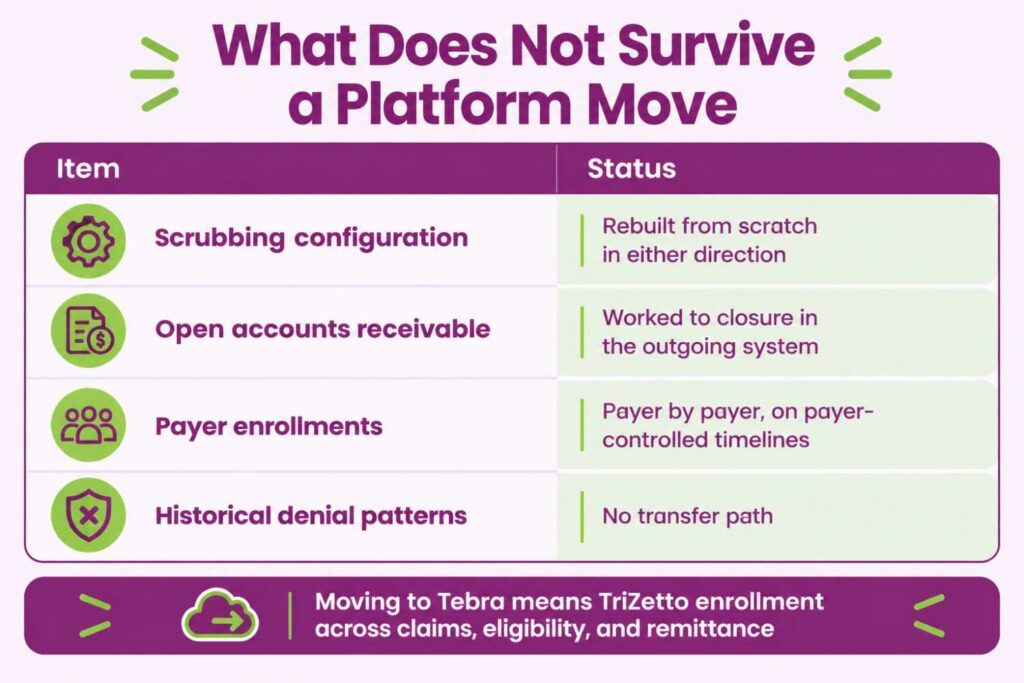
Scrubbing configuration does not transfer at all. ClaimInspector logic and Tebra’s rules engine use different architectures, so payer-specific tuning gets rebuilt from scratch in either direction.
Three further categories resist clean migration: open accounts receivable, payer enrollments, and historical denial patterns. Payer enrollment is the slowest. Moving to Tebra means completing TriZetto enrollment payer by payer across claims, eligibility, and remittance. Each payer controls its own approval.
Is There a Fee to Export Practice Data?
Users report an export fee on the Kareo side. Users posting verified reviews on Capterra describe a charge of roughly $2,000 to export a practice database. They report the export format as incompatible with most systems. Tebra publishes no export fee schedule, so practices confirm exit terms in writing at contract stage rather than at migration. Legacy accounts continue to work claims during the transition regardless. Denial and aging work through that window is covered under AdvancedMD denial and AR work.
How Does Transcure Support Billing on AdvancedMD and Tebra?
Certified coders and billers work inside the platform a practice already runs. That work runs under a business associate agreement executed per 45 CFR §164.502(e). No platform change is required, and patient data stays inside the existing environment.
The work splits along the configurability line. On AdvancedMD, default ClaimInspector rules get rebuilt against actual payer mix, edit by edit. On Tebra, custom rules get set by provider and payer on top of the engine. Effort also extends to payer enrollment, charge capture accuracy, and denial follow-up across both interfaces.
Neither subscription includes certified coders. AAPC-certified coders validate CPT, ICD-10, and HCPCS assignment against bundling edits and frequency limits before charges reach either scrubbing engine. Coverage spans more than 40 specialties across 1,100 certified staff, with onboarding completed in under 14 days.
Denial work follows the same pattern on both platforms. Root causes get traced by CARC and RARC code, including CO-4, CO-16, CO-50, and PR-96. Appeals get filed inside the platform rather than through external tools. Scope on the Tebra side sits under independent billing coverage on Tebra.
Frequently Asked Questions
Is Tebra Cheaper Than AdvancedMD?
Tebra is cheaper at list price for physicians and nurse practitioners. Tebra Practice Essentials runs $599 per physician and $399 per non-physician provider, against $729 on AdvancedMD EHR plus practice management. For therapists, AdvancedMD mental health plans run $130 to $399 against Tebra’s $225.
What Is the 100-Claim Threshold on Tebra?
Tebra applies low-volume pricing only to practices submitting 100 claims per month or fewer. Exceeding that for three consecutive months moves the practice to standard rates. A physician seat then rises from roughly $349 to $599. AdvancedMD’s per-provider plans have no equivalent threshold.
Does Tebra Offer Its Own Billing Service?
Tebra does not offer its own billing service. Tebra exited medical billing services and states that it does not compete with its partners. More than 1,600 billing companies operate on the platform. AdvancedMD sells managed revenue cycle at 4% to 8% of collections.
Can a Practice Run Tebra Billing on a Mac?
A practice cannot run every Tebra billing task on a Mac. The Tebra Desktop Application is a Windows program. Clearinghouse reports, rejection codes, payment posting, and analytics all sit on the desktop side. Mac practices run a virtual machine or route desktop tasks to a Windows workstation.
Which Platform Has Better Claim Scrubbing?
Neither scrubs better by default. AdvancedMD gives edit-level control over a library of roughly 3.5 million edits, and the practice supplies the tuning labor. Tebra applies payer rules automatically, accepts custom rules by provider or payer, and adds AI Claim Review for triage. Configuration quality determines outcomes on both.
Are Kareo and Tebra Different Products?
Kareo and Tebra are not different products. Kareo merged with PatientPop in November 2021 to form Tebra. Also, Kareo persists as a legacy name in login URLs and the mobile app, but the underlying platform is one system.
Does Either Platform Include Medical Coding?
Neither platform includes certified medical coders in its subscription. Both supply coding tools and templates without assigning coders. AdvancedMD’s managed revenue cycle service excludes coding as well. Practices staff coding in-house or contract it separately on either platform.