
Tebra and eClinicalWorks compared on how each handles billing, what each charges by provider type, which AI tools touch claims, and which practices each platform fits best.
Tebra and eClinicalWorks both combine an electronic medical record, practice management, and billing tools in one cloud platform. Tebra still carries its legacy name, Kareo, inside many practices. eClinicalWorks is often shortened to eCW.
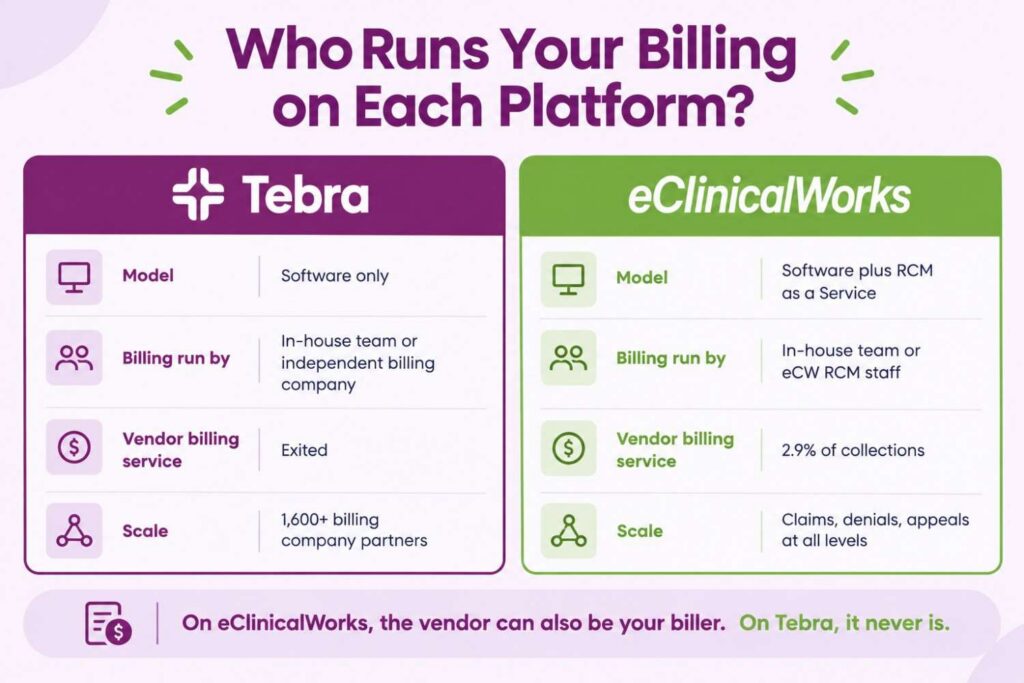
The largest difference between the two platforms is not a feature. eClinicalWorks sells revenue cycle management as a service, priced as a share of practice collections. Tebra exited medical billing services and sells software only.
This comparison covers billing models, claim tools, pricing by provider type, AI, interoperability, platform access, and specialty fit. Every figure comes from each vendor’s own published pricing, documentation, or press releases.

What Are Tebra and eClinicalWorks?
Tebra and eClinicalWorks are cloud-based EMR and practice management platforms built for outpatient care. The two vendors differ sharply in size, buyer, and how far each reaches into billing.
What Is Tebra (Formerly Kareo)?
Tebra is an EMR and practice management platform built for independent practices. Kareo and PatientPop merged in November 2021 to form Tebra. Kareo contributed the EHR and billing software, and PatientPop contributed patient acquisition and engagement tools.
Tebra sells software only. Tebra states on its billing companies page that it exited medical billing services and does not compete with its partners. More than 1,600 medical billing companies run client practices on the platform. Setup steps, payer enrollment, and published pricing are broken down in the Tebra EMR setup, billing, and pricing walkthrough.
What Is eClinicalWorks?
eClinicalWorks is a cloud EHR and practice management vendor founded in 1999. Its published pricing page cites more than 850,000 users and 180,000 physicians. eClinicalWorks describes its customers as ambulatory practices, specialists, health centers, urgent care facilities, and hospital systems.
eClinicalWorks sells both software and services. Practices choose between a self-service billing model and a full revenue cycle service run by eClinicalWorks staff. Practices already on the platform can trace how eClinicalWorks billing runs from charge entry through payment posting.
How Do Tebra and eClinicalWorks Compare at a Glance?
The table below sets the two platforms side by side on the attributes that change a billing decision. Prices are list rates per provider per month from each vendor’s published pricing page.
| Attribute | Tebra | eClinicalWorks |
|---|---|---|
| Built for | Independent practices | Ambulatory practices, health centers, hospital systems |
| Physician, EHR plus billing | $599 (Practice Essentials) | $599 (EHR with Practice Management) |
| Non-physician provider | $399 | $599, single per-provider rate |
| Therapist | $225 | $599, single per-provider rate |
| Low-volume tier | From $349 for physicians under 100 claims a month | Not published |
| Vendor billing service | Exited | RCM as a Service at 2.9% of collections |
| Clearinghouse | TriZetto, self-service enrollment | Built into eClinicalWorks RCM |
| AI scribe | AI Note Assist | Sunoh.ai |
| Claim AI | AI Claim Review with denial probability | Agentic AI across RCM |
| Patient engagement | Tebra Engage | healow |
| TEFCA QHIN | Not designated | Designated January 2025 |
| Platform access | Web platform plus Windows desktop app for billing | Chrome with eCW Web App plug-in, Windows-supported |
Physician pricing matches exactly. Every other row separates the platforms, and the billing-service row matters most for practices weighing outsourced billing.
How Do Tebra and eClinicalWorks Handle Medical Billing?
The two platforms take opposite positions on who runs a practice’s billing. eClinicalWorks will run it for you. Tebra provides the tools and leaves the work to in-house staff or an independent billing company.
Does Either Vendor Run Your Billing for You?
eClinicalWorks does, through RCM as a Service at 2.9% of practice collections. The published service covers claim creation, denial and rejection management, and appeals at all levels. Preventative claim edits, A/R visibility, and billing rules come included. eClinicalWorks lists no start-up cost for the tier.
Tebra does not offer an equivalent. Tebra exited medical billing services and automatically enrolls every billing company on the platform in its billing partner program. Tebra reports more than 1,600 billing companies in the program. Those companies process over $20 billion in claims each year for more than 50,000 providers.
The practical difference shows up when a practice wants to outsource. On eClinicalWorks, the software vendor is also a billing competitor. On Tebra, the software vendor and the billing partner never compete for the same contract.
How Do Claim Scrubbing and Charge Capture Compare?
Both platforms check claims against payer rules before submission, but each builds that check differently. Tebra puts validation inside charge capture, while eClinicalWorks applies preventative edits and billing rules across its RCM module.
Tebra charge capture carries three billing-specific controls:
- Check Codes validates the charge before it is saved
- SALT copies diagnosis and procedure codes from a previous charge
- Send To Billing hands the charge to the desktop application and locks it from further edits
The lock matters for corrections. Tebra documents that a charge sent to billing can no longer be edited. Coordination of benefits fixes then move into rework. More on each control sits in the breakdown of Tebra billing tools and features.
eClinicalWorks publishes automation for paper remittances through a feature it calls EOB to ERA. The tool generates electronic remittances when a payer offers none, which cuts manual posting. eClinicalWorks reports that customer Compass Health Systems manages 32,000 services and $7 million in monthly postings with two staff members.
How Do Clearinghouse and Eligibility Workflows Differ?
Tebra routes claims through TriZetto, with self-service enrollment completed payer by payer. Practices enroll separately for claims, eligibility, and electronic remittance for each payer. Claim attachments require a second registration with Jopari.
Tebra runs eligibility on the ANSI X12 standard against more than 2,700 payers. The web platform returns a status icon only: verified, not determined, or not eligible. The full eligibility report saves to the desktop application under the patient’s insurance case.
eClinicalWorks builds clearinghouse connectivity into its own RCM module. Eligibility checks run within practice management, and eClinicalWorks applies AI to eligibility work as part of its RCM automation.
How Does Pricing Compare Between Tebra and eClinicalWorks?
Pricing matches for physicians and splits sharply for everyone else. eClinicalWorks publishes one rate per provider. Tebra prices by provider type and by claim volume.
Which Platform Costs Less for Physician Practices?
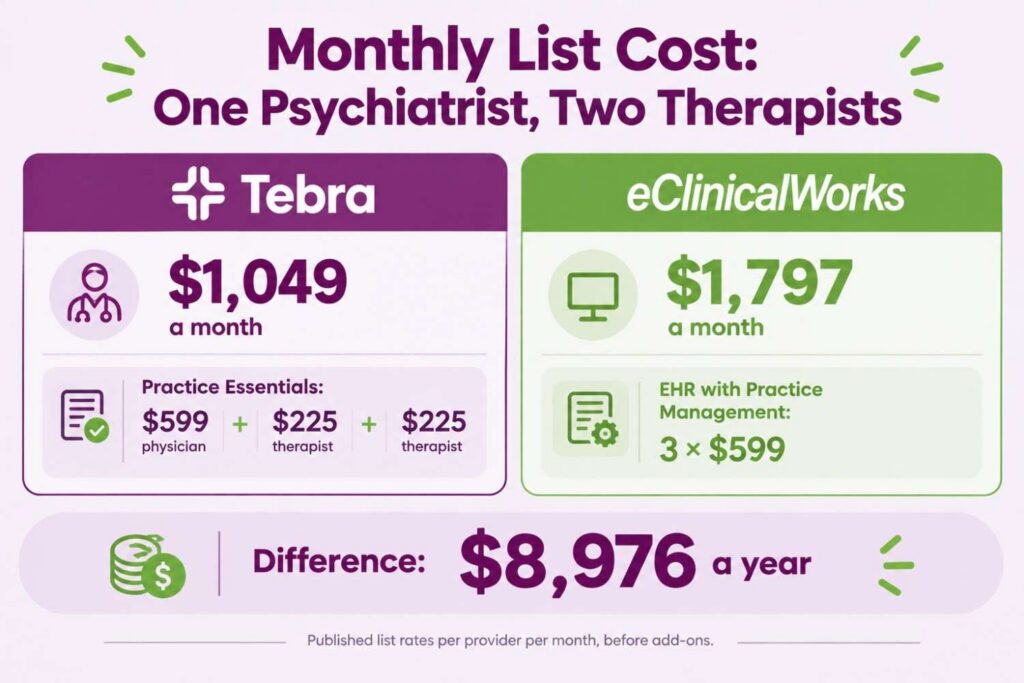
Physician practices pay the same $599 list rate on both platforms for EHR plus billing. eClinicalWorks sells EHR with Practice Management at $599 per provider per month. Tebra sells Practice Essentials, covering billing, clinical EHR, and telehealth, at $599 per physician per month.
The difference sits in what each rate includes. eClinicalWorks adds scanning, faxing, an E&M coder, clinical decision support, and clinical templates at no extra cost. Tebra includes unlimited non-clinical staff seats. Low-volume physician practices on Tebra can start at $349 for fewer than 100 claims a month.
Which Platform Costs Less for Behavioral Health and Nurse Practitioner Practices?
Tebra costs materially less for practices built around non-physician providers. Tebra prices therapists at $225 and non-physician providers at $399 on Practice Essentials. eClinicalWorks publishes no separate tier by provider type.
Consider a behavioral health practice with one psychiatrist and two licensed therapists. At published list rates, Tebra Practice Essentials costs $1,049 a month. Three providers on eClinicalWorks EHR with Practice Management cost $1,797 a month. The gap reaches $8,976 a year before any add-ons.
A nurse practitioner-led practice sees the same pattern at a smaller scale. Each nurse practitioner costs $399 a month on Tebra against $599 on eClinicalWorks. Practices should confirm how eClinicalWorks classifies each provider type on its quote. List rates set only the starting point.
What Fees Sit Outside the Monthly Subscription?
Each platform carries costs the headline rate does not show. The categories differ, so totals depend on practice size and claim volume.
eClinicalWorks publishes four charges beyond the subscription:
- Implementation fees for practices with more than nine providers
- Airfare for on-site services, billed separately
- Fees per patient statement
- Fees per eClinicalMessenger transaction
eClinicalWorks mandatory disclosures add two more for RCM contracts: a monthly fee per provider and a fee based on claim count.
Tebra’s extra costs come from structure rather than transactions. Practices on low-volume pricing re-rate to standard rates after three consecutive months above 100 claims. On starter plans, EHR Starter requires Billing Starter.
How Do Tebra and eClinicalWorks Compare on AI?
Both vendors ship AI across documentation, claims, and the front office. eClinicalWorks spreads AI across more products. Tebra concentrates its billing AI in one claim review tool.
How Do AI Note Assist and Sunoh.ai Compare for Documentation?
Both tools turn patient conversations into draft clinical notes for provider review. Neither replaces provider sign-off, and unreviewed AI text attached to a billed code creates audit exposure on either platform.
Sunoh.ai is an ambient scribe from the eClinicalWorks and healow family. eClinicalWorks describes it as EHR-agnostic, so practices outside eClinicalWorks can buy it too. Sunoh.ai sells as a separate per-user subscription. Dallas-based DFW Pulmonary and Sleep Clinic reported saving two to three hours a day with it, per an eClinicalWorks release.
Tebra rolled AI Note Assist out to Clinical subscribers in phases through May 2026. Tebra prices the tool either per note or by subscription. The wider eCW platform features set also covers fax automation and point-of-care evidence tools that Tebra does not match.
How Do AI Claim Review and eClinicalWorks Agentic RCM Compare?
Tebra AI Claim Review scores each encounter for denial risk before submission. The tool returns a numeric denial probability, names the likely causes, and shows similar denied claims. Tebra places it inside the encounter window of the desktop application.
Tebra attaches its own limit to the tool. The product states that AI suggestions do not guarantee claim approval, so staff still verify every claim detail. Scrubbing rules carry the first-pass outcome.
eClinicalWorks applies agentic AI across the revenue cycle rather than at one checkpoint. eClinicalWorks describes agents that handle eligibility and appeals work, including gathering documentation and preparing appeal packets.
Which Front-Office and Patient Engagement Tools Does Each Platform Offer?
Both platforms automate patient calls, scheduling, and intake. Front-office accuracy feeds billing directly, because demographic and coverage errors become denials later.
Tebra pairs its AI Voice Assistant with Tebra Engage. The voice tool answers calls, books appointments, and handles refill requests. Tebra Engage covers online scheduling, digital intake, reminders, two-way text, and reputation tools inherited from PatientPop.
eClinicalWorks runs patient engagement through healow, with healow Genie as its AI contact center. eClinicalWorks reports a 52-provider orthopedic practice cut its abandoned call rate by more than 50% with healow Genie.
How Do Interoperability and Platform Access Compare?
eClinicalWorks leads on network interoperability. Both platforms depend on Windows to some degree, so access comes down to which tasks need it.
Does Either Platform Operate a TEFCA QHIN?
eClinicalWorks does. The Sequoia Project, as TEFCA’s recognized coordinating entity, designated eClinicalWorks a Qualified Health Information Network on January 16, 2025. PRISMANet is its QHIN solution, and eClinicalWorks is one of 11 designated QHINs as of August 2026.
Tebra does not operate a QHIN. Tebra publishes SOAP APIs and partner integrations for connecting outside systems. Practices that exchange records heavily with hospitals or accountable care organizations should weigh this row closely.
Can Either Platform Run Without Windows?
Neither platform is fully independent of Windows, but billing staff on Tebra depend on it more. Tebra’s web platform runs in any modern browser. Clearinghouse reports, proof of timely filing, and AI Claim Review sit in the Windows desktop application. So does the older report suite.
eClinicalWorks runs V12 in the Chrome browser. Its May 2025 mandatory disclosures recommend access through the eCW Web App plug-in. The same disclosures state the software is designed for an eClinicalWorks-supported Windows operating system.
Which Platform Fits Your Specialty and Practice Size?
Fit depends on provider mix, claim volume, and whether the practice wants vendor-run billing. The table below ties each verdict to a published price, service, or designation.
| Practice Type | Better Fit | Basis |
|---|---|---|
| Solo or small behavioral health | Tebra | Therapist tier at $225 |
| Nurse practitioner-led practice | Tebra | Non-physician tier at $399 |
| Practice under 100 claims a month | Tebra | Low-volume tier from $349 |
| Practice outsourcing to an independent biller | Tebra | No vendor billing service |
| FQHC or community health center | eClinicalWorks | Dedicated health center solutions |
| Group wanting vendor-run billing | eClinicalWorks | RCM as a Service at 2.9% |
| Value-based care or ACO participant | eClinicalWorks | Population health tools and QHIN status |
| Physician-only primary care | Either | Identical $599 list rate |
Tebra wins on provider-type pricing and vendor neutrality. eClinicalWorks wins on scale, health center depth, and interoperability.
Where Does Each Platform Create Billing Friction?
Both platforms create friction that shows up in collections rather than in the demo. Each source below comes from vendor documentation or verified user reviews.
What Billing Friction Do Tebra Practices Report?
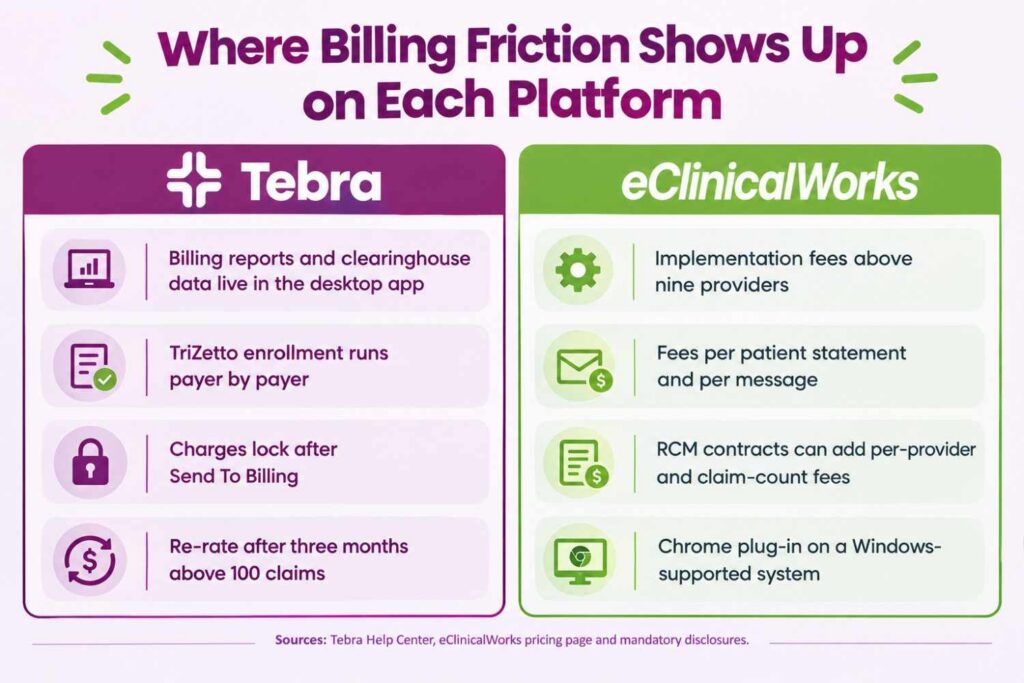
Tebra friction traces to documented platform behavior. Four issues appear consistently:
- Desktop-only billing functions keep browser-based staff out of reports and clearinghouse data
- TriZetto enrollment runs payer by payer, so charges age while approvals clear
- Charges lock on Send To Billing, pushing corrections into rework
- Low-volume pricing re-rates after three months above 100 claims
Accounts that came from the retired Kareo Managed Billing service also lack proof of timely filing, per Tebra documentation.
What Billing Friction Do eClinicalWorks Practices Report?
eClinicalWorks friction centers on cost structure and system weight. Implementation fees apply above nine providers, and statement and messaging fees grow with patient volume. RCM contracts can add per-provider and claim-count fees under the vendor’s own disclosures.
User reviews on Capterra cite an inefficient support ticket process and problematic updates as common complaints. The fuller record of documented eClinicalWorks challenges covers usability, support, and implementation learning curves.
Which Should Your Practice Choose?
The right platform follows provider mix and billing model, not feature counts. Feature parity is close across the independent practice segment.
Tebra suits practices where these conditions hold:
- Most providers are therapists, nurse practitioners, or other non-physician clinicians
- Monthly claim volume sits near or under 100 claims per provider
- Billing runs in-house or through an independent billing company
eClinicalWorks suits practices where these conditions hold:
- The organization is a health center, a multi-location group, or part of a value-based contract
- Leadership wants the EMR vendor to run billing as a service
- Record exchange with hospitals and networks is a daily requirement
Practices already committed to eClinicalWorks can still keep billing independent. Billing services for eClinicalWorks practices work inside the existing instance.
How Does Transcure Support Billing on Tebra and eClinicalWorks?
Transcure runs billing inside whichever platform a practice already uses. No migration, no new software, and no change to clinical workflows. Thousands of specialty practices trust Transcure across 43+ EHR integrations.
Problem: Enrollment and eligibility gaps create front-end denials. Payer enrollment completes before go-live. Eligibility agent ELIXA verifies coverage, copays, and deductibles before each visit. Outcome: a 98% first-pass clean claim rate and a denial rate under 1%.
Problem: Coding errors survive scrubbing. Coding agent CODIN checks codes against payer rules and the practice’s real payer mix. AAPC-certified coders review flagged charges before submission. Outcome: fewer rework cycles on locked or rejected claims.
Problem: Denials sit unworked past appeal windows. Denial agent DEXA works CARC and RARC codes such as CO-4, CO-16, CO-50, and PR-96. Appeals file at every level. Outcome: 80% recovery on denied claims.
More than 1,100 AAPC-certified billers support the work, under a BAA executed per 45 CFR 164.502(e). Transcure holds ISO 27001 certification, and onboarding completes in under 14 days. Scope details for Tebra practices sit with billing services built around Tebra.
What Is the Bottom Line on Tebra vs eClinicalWorks?
Tebra and eClinicalWorks reach the same physician price from opposite directions. eClinicalWorks bundles software with an optional vendor billing service. Tebra sells software alone and prices non-physician providers far lower. The better choice depends on provider mix, claim volume, and who should own billing. Both platforms sit alongside other options in EMR software for independent practices.
Frequently Asked Questions
Is Tebra Cheaper Than eClinicalWorks?
Tebra is cheaper for non-physician providers and matches eClinicalWorks for physicians. Both list EHR plus billing at $599 per physician per month. Tebra prices therapists at $225 and other non-physician providers at $399, while eClinicalWorks publishes one rate per provider.
Is Tebra the Same as Kareo?
Tebra and Kareo describe the same platform. Kareo merged with PatientPop in November 2021 to form Tebra. Kareo survives as a legacy product name, and many practices still use it daily.
Does eClinicalWorks Offer Medical Billing Services?
eClinicalWorks offers billing as a service through RCM as a Service. The published rate is 2.9% of practice collections, with no start-up cost. Practices can also choose a self-service billing model and run billing in-house.
Does Tebra Offer Medical Billing Services?
Tebra does not offer medical billing services. Tebra exited billing services and sells software only. Practices on Tebra bill in-house or work with one of more than 1,600 billing companies on the platform.
Which Platform Is Better for Behavioral Health Practices?
Tebra is the stronger fit for most small behavioral health practices. Its therapist tier costs $225 per provider per month against eClinicalWorks’ single $599 rate. Behavioral health groups inside a health center may still prefer eClinicalWorks for its health center tools.
Can an Independent Billing Company Work Inside Either Platform?
An independent billing company can work inside both platforms. On Tebra, billing companies join the vendor’s partner program automatically. On eClinicalWorks, the independent biller competes with the vendor’s own RCM service for the same practice.