Summary: “Tebra and athenahealth compared on pricing model, billing work, AI tools that touch claims, and what each platform allows when a practice leaves.”
Tebra and athenahealth both sell a cloud EMR with practice management and billing in one platform. Tebra still carries its legacy name, Kareo, inside many practices. athenahealth sells its platform as athenaOne.
The two vendors charge on different axes. Tebra publishes a flat monthly price per provider and performs no billing work. athenahealth charges a percentage of collections and pairs its software with billing support from its own teams.
This comparison covers pricing models, a method for comparing them, billing work, AI, platform access, interoperability, and exit terms. Every figure comes from each vendor’s own website, documentation, or press releases.

What Are Tebra and athenahealth?
Tebra and athenahealth are cloud-based EMR and practice management vendors built for outpatient care. The two differ most in how they charge and how much billing work each takes on.
What Is Tebra (Formerly Kareo)?
Tebra is an EMR and practice management platform built for independent practices. Kareo and PatientPop merged in November 2021 to form Tebra. Kareo brought the EHR and billing software, and PatientPop brought patient engagement tools.
Tebra sells software only. Tebra states on its billing companies page that it exited medical billing services and does not compete with its partners. Payer enrollment, the web and desktop split, and published rates sit in the walkthrough of billing workflow and pricing in Tebra EMR.
What Is athenahealth’s athenaOne?
athenaOne is athenahealth’s integrated EHR, medical billing and practice management, and patient engagement platform. athenahealth describes it as AI-native and built for ambulatory care. A separate edition, athenaOne for Hospitals and Health Systems, serves inpatient organizations.
athenahealth sells software alongside service. Its rules engine and billing experts work claims before submission, and optional add-on services extend into coding and authorizations. Claim workflows and setup from a practice’s side are laid out in a provider’s view of athenahealth billing.
How Do Tebra and athenahealth Compare at a Glance?
The table below sets the two platforms side by side on the attributes that change a billing decision. Each row comes from the vendor’s own published material.
| Attribute | Tebra | athenahealth |
|---|---|---|
| Pricing model | Flat monthly fee per provider | Percentage of collections |
| Published price | $599 per physician (Practice Essentials) | Not published; custom quote |
| Non-physician and therapist rates | $399 and $225 | Not published |
| Billing work in the base offering | None; software only | Rules engine plus billing expert support |
| Coding service | Not offered | athenaOne Medical Coding, optional add-on |
| Authorization service | Not offered | athenaOne Authorization Management, optional add-on |
| AI documentation | AI Note Assist | Ambient Notes |
| Claim AI | AI Claim Review with denial probability, select customers | Rules engine plus AI insurance selection and denial correction |
| Mac access | Browser only; billing needs the Windows desktop app | Full athenaOne in Chrome, Edge, or Safari |
| TEFCA | No QHIN | All eligible providers live via CommonWell since July 2025 |
| Exit terms | Export limited to patient and claim records | No long-term contracts; leave with all data |
Every row separates the platforms. The first four rows decide most purchases, because they set who pays for the billing labor.
How Do Tebra and athenahealth Price Their Platforms?
Tebra prices per provider per month, and athenahealth prices per dollar collected. That difference makes a straight price comparison misleading without a method.
What Does Tebra Charge?
Tebra publishes flat monthly rates by provider type on its pricing overview. Practice Essentials, covering billing, clinical EHR, and telehealth, costs $599 per physician, $399 per non-physician provider, and $225 per therapist.
Low-volume pricing starts at $349 per physician and $199 per non-physician provider. That tier applies to practices submitting 100 claims or fewer per month. Practices above 100 claims for three consecutive months move to standard rates. Unlimited non-clinical staff seats come included at every tier.
How Does athenahealth’s Percentage-of-Collections Model Work?
athenahealth states that athenaOne’s cost is based on a percentage of collections, so the vendor is paid when the practice is paid. athenahealth publishes no percentage and directs practices to request custom pricing.
The model ties cost to revenue rather than headcount. A month with higher collections costs more, and a slow month costs less. athenahealth also states the pricing carries no hidden fees. Third-party estimates of the rate circulate widely, but none trace to athenahealth. Cost components around the rate are broken down in what athenaOne costs.
How Can a Practice Compare a Flat Fee Against a Percentage?
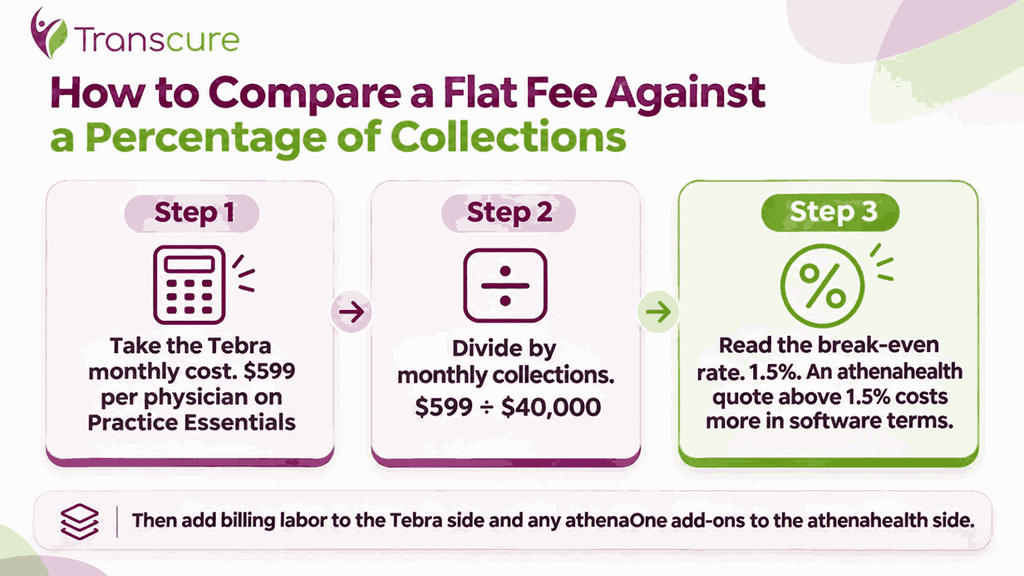
A practice can convert Tebra’s flat fee into a percentage of its own collections. Divide the monthly Tebra cost by monthly collections. The result is the athenahealth rate at which the two platforms cost the same.
Consider one physician collecting $40,000 a month. Tebra Practice Essentials at $599 equals 1.5% of those collections. Any athenahealth quote above 1.5% costs more in software terms alone.
The comparison is not complete at that point. athenahealth’s base offering includes rules engine and billing expert support, while Tebra includes no billing labor. A fair comparison adds the cost of in-house billing staff or an independent billing company to the Tebra side. It also adds any athenaOne add-on services the practice would buy.
Who Does the Billing Work on Each Platform?
athenahealth takes on part of the billing work inside its base offering, and Tebra takes on none. The split decides how much staff time or outside help each practice needs.
What Billing Work Does athenaOne Include?
athenahealth states that its rules engine and billing experts identify and resolve claim errors before submission. athenahealth also describes expert support teams that reduce routine revenue cycle work for practice staff. athenahealth reported a 99.3% median clean claim rate and a 5.3% median denial rate across athenaOne customers in June 2026.
Coding and authorizations sit outside that base. athenahealth’s help center lists athenaOne Medical Coding as an optional add-on service, and its service description lists Authorization Management the same way. The coding service uses AAPC- or AHIMA-certified coders with a two-day turnaround goal. athenahealth reports 99.4% coding accuracy for it.
athenahealth also sells Express Coding, an AI coder rather than a computer-assisted coding tool. It is an add-on as well. In June 2026, athenahealth reported it fully automated coding for nearly a third of claims in its beta group.
What Billing Work Stays With a Tebra Practice?
Every billing task stays with the practice on Tebra. Tebra exited medical billing services, so claims, posting, denials, and appeals run through practice staff or an outside billing company. Also, Tebra reports more than 1,600 billing companies on the platform, processing over $20 billion in claims each year.
Tebra supplies the tools rather than the labor. Check Codes validates a charge before it saves. SALT copies diagnosis and procedure codes from a previous charge. AI Claim Review, available to select Tebra customers, scores encounters for denial risk. Each tool is detailed among the billing features inside Tebra EMR.
Claims route through TriZetto, with enrollment completed payer by payer for claims, eligibility, and electronic remittance. A charge sent to billing locks against further edits, per Tebra documentation.
How Do Tebra and athenahealth Compare on AI?
Both vendors apply AI to documentation, claims, and patient contact. athenahealth spreads AI across more workflows. Tebra concentrates its billing AI in one claim review tool.
How Do AI Note Assist and Ambient Notes Compare?
Both tools turn patient conversations into draft clinical notes for provider review. Neither replaces provider sign-off. Unreviewed AI text attached to a billed code creates audit exposure on either platform.
athenahealth’s Ambient Notes runs inside the athenaOne Mobile app and offers multiple ambient models. athenahealth reports more than 2 million notes generated as of April 2026. athenahealth also reports a 91% reduction in document processing time through its Document Services AI workflows.
Tebra launched AI Note Assist in June 2025 and prices it per note or by subscription. In August 2026, Tebra added FDB Script Agent, which turns the visit conversation into structured prescriptions for clinician review. Ambient Notes and related tools are mapped among the athenaOne EHR and billing features.
How Does Each Platform Apply AI to Claims?
Tebra AI Claim Review returns a numeric denial probability for each encounter before submission. Tebra markets it as AI Billing Assistant and offers it to select customers. The tool names the likely causes and shows similar denied claims. Tebra states the suggestions do not guarantee approval, so staff still verify each claim.
athenahealth announced more than 80 AI revenue cycle features in June 2026, several already live. Automated Insurance Selection reads the insurance card image and cut insurance-related denials by nearly 16%. Expanded Denial Resolution Automation generates corrections for coding denials, lifting recovered payments by 30%.
athenahealth also uses AI to monitor every rejection and denial and update its claim rules the same day. Voice AI agents place more than 23,000 prior authorization calls a month, as part of the Authorization Management add-on. Payer surveillance and anomaly detection were scaling through 2026.
Which Front-Office Tools Does Each Platform Offer?
Both platforms automate scheduling, reminders, and patient communication. Front-office accuracy feeds billing directly, because demographic and coverage errors become denials later.
Tebra pairs its AI Voice Assistant with Tebra Engage. The voice tool answers calls, books appointments, and handles refill requests. Tebra Engage covers online scheduling, digital intake, reminders, and two-way text.
athenaOne includes a patient portal, a patient mobile app, embedded telehealth, and automated wellness outreach. Patients can manage appointments, view results, message the practice, and pay through those tools.
How Do Platform Access and Interoperability Compare?
athenahealth leads on both device flexibility and network exchange. Tebra’s constraint sits in the Windows desktop application its billing functions depend on.
Can Either Platform Run on a Mac?
athenaOne runs in Chrome, Edge, or Safari on macOS, per athenahealth’s November 2024 technical requirements. The one exception is athenaOne Device Manager, which connects card readers and select medical devices. That module runs on Windows only, and Chromebooks are unsupported.
Tebra’s web platform runs in any modern browser. Clearinghouse reports, proof of timely filing, and AI Claim Review sit in the Tebra Desktop Application, which is a Windows program. Mac-based billing staff on Tebra need a Windows workstation for those tasks.
How Do Tebra and athenahealth Connect to Outside Systems?
athenahealth moved all eligible athenaOne providers onto TEFCA in July 2025, through its partnership with CommonWell, a designated Qualified Health Information Network. athenahealth also lists more than 277,000 direct clinical integrations, including labs and pharmacies.
Tebra does not operate a QHIN. Tebra publishes SOAP APIs and a partner marketplace for connecting outside systems. Practices exchanging records daily with hospitals or accountable care organizations should weigh this difference closely.
How Do Contracts and Exit Terms Compare?
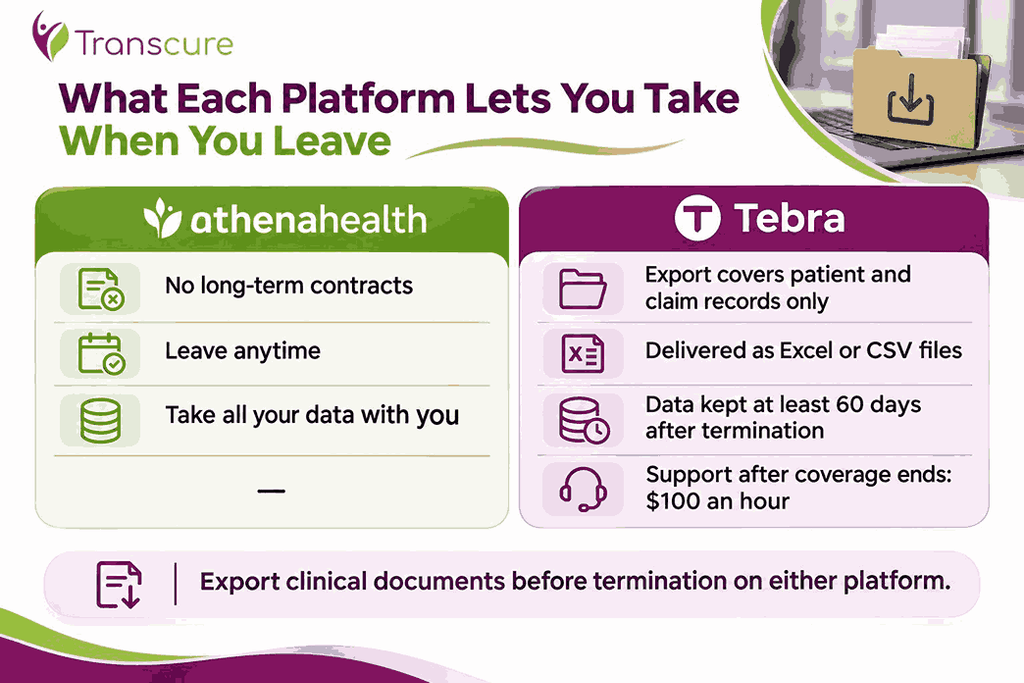
athenahealth publishes no long-term contracts and lets practices leave with all their data, citing section 2.3 of its Service Agreement. That promise appears directly on the athenaOne product page.
Tebra’s published exit terms are narrower. Tebra’s term and termination FAQ limits the data export to patient records and claim records, delivered in Excel or CSV format. Tebra retains data for a minimum of 60 days after termination.
Two more conditions apply on Tebra. Support requested after coverage ends costs $100 an hour, with a 30-minute minimum. Tebra also issues no refunds or credits for partial months or prepaid plans.
Practices should export clinical documents and notes before termination on either platform. Tebra’s stated export scope makes that step more pressing.
Which Platform Fits Your Specialty and Practice Size?
Fit depends on provider mix, claim volume, and who should perform the billing work. The table below ties each verdict to a published price, service, or ranking.
| Practice Type | Better Fit | Basis |
|---|---|---|
| Solo or small behavioral health | Tebra | Therapist rate at $225 |
| Nurse practitioner-led practice | Tebra | Non-physician rate at $399 |
| Practice under 100 claims a month | Tebra | Low-volume rate from $349 |
| Practice wanting a fixed, published monthly cost | Tebra | Flat subscription |
| Practice wanting billing support bundled with the software | athenahealth | Rules engine and billing experts in the base offering |
| Independent group of 11 to 75 physicians | athenahealth | 2025 Best in KLAS for practice management at that size, per athenahealth |
| Mac-based office | athenahealth | Full browser support on macOS |
| Heavy record exchange with hospitals | athenahealth | TEFCA live across its network |
Tebra wins where provider-type pricing and cost predictability matter most. athenahealth wins where bundled billing support, Mac access, and network exchange matter more. Practices outside both profiles can weigh other EMR software options for independent practices.
Where Does Each Platform Create Billing Friction?
Both platforms create friction that surfaces in collections rather than in the demo. Each item below comes from vendor documentation.
What Billing Friction Do Tebra Practices Face?
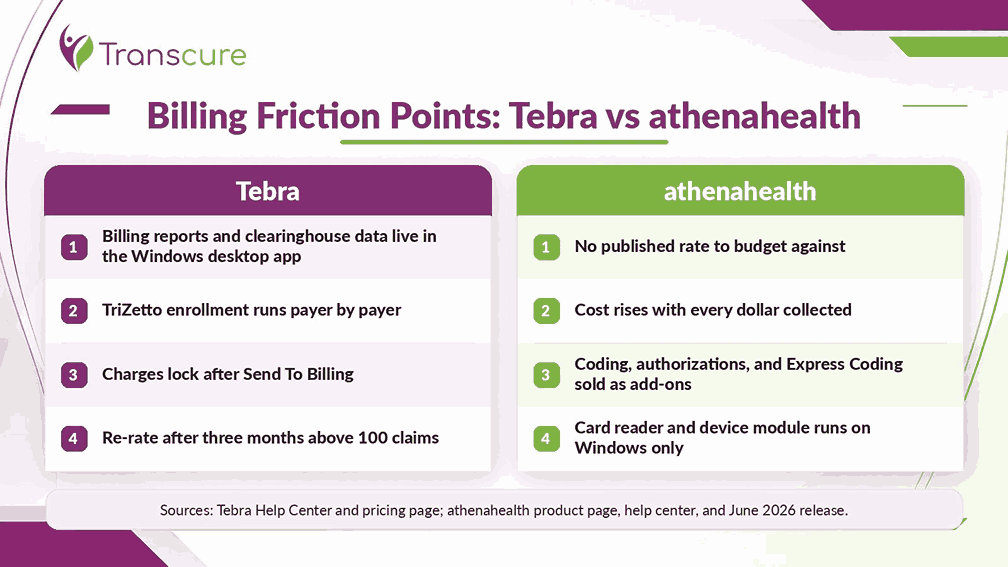
Tebra friction traces to documented platform behavior. Five issues stand out:
- Desktop-only billing functions keep browser-based staff out of reports and clearinghouse data
- TriZetto enrollment runs payer by payer, so charges age while approvals clear
- Charges lock on Send To Billing, pushing corrections into rework
- Low-volume pricing re-rates after three months above 100 claims
- Data export at exit covers patient and claim records only
What Billing Friction Do athenahealth Practices Face?
athenahealth friction centers on cost visibility and add-ons. No published rate exists to budget against, so every quote needs independent checking. Cost rises with every dollar collected, including in strong months.
Coding and authorization services are optional add-ons, so the base percentage does not cover them. Card readers and connected devices depend on a Windows-only module. Express Coding and Voice AI also sit inside paid add-ons rather than the base fee.
Which Should Your Practice Choose?
The right platform follows billing ownership and provider mix, not feature counts. Both platforms serve independent practices well under different conditions.
Tebra suits practices where these conditions hold:
- Most providers are therapists, nurse practitioners, or other non-physician clinicians
- Leadership wants a fixed, published software cost
- Billing runs in-house or through an independent billing company
athenahealth suits practices where these conditions hold:
- Leadership wants the EMR vendor to share the billing work
- The office runs on Mac hardware
- Record exchange with hospitals and networks is a daily requirement
Practices on athenaOne can still bring in outside expertise for the work the base offering leaves open. Independent athenahealth billing services operate inside the existing athenaOne account.
How Does Transcure Support Billing on Tebra and athenahealth?
Transcure runs billing inside whichever platform a practice already uses. No migration, no new software, and no change to clinical workflows. Thousands of specialty practices trust Transcure across 43+ EHR integrations.
Problem: Eligibility gaps create front-end denials. Eligibility agent ELIXA verifies coverage, copays, and deductibles before each visit. Payer enrollment completes before go-live on Tebra. Outcome: a 98% first-pass clean claim rate and a denial rate under 1%.
Problem: Coding gaps survive scrubbing. Coding agent CODIN checks codes against payer rules and the practice’s real payer mix. AAPC-certified coders review flagged charges before submission. Outcome: fewer rework cycles on locked or rejected claims.
Problem: Denials sit unworked past appeal windows. Denial agent DEXA works CARC and RARC codes such as CO-4, CO-16, CO-50, and PR-96. Appeals file at every level. Outcome: 80% recovery on denied claims.
More than 1,100 AAPC-certified billers support the work, under a BAA executed per 45 CFR 164.502(e). Transcure holds ISO 27001 certification, and onboarding completes in under 14 days. Scope and onboarding detail for Tebra practices sit with Tebra medical billing services.
Frequently Asked Questions
Is Tebra Cheaper Than athenahealth?
Tebra is cheaper whenever its flat fee works out below athenahealth’s quoted percentage of collections. A physician collecting $40,000 a month pays the equivalent of 1.5% on Tebra Practice Essentials. athenahealth’s base offering includes billing support that Tebra does not, so practices should add billing labor to the Tebra side before deciding.
Is Tebra the Same as Kareo?
Tebra and Kareo describe the same platform. Kareo merged with PatientPop in November 2021 to form Tebra. Kareo survives as a legacy product name that many practices still use daily.
Does athenahealth Include Billing Services?
athenahealth includes rules engine and billing expert support in its base athenaOne offering. Those teams identify and resolve claim errors before submission. Medical coding and authorization management are separate optional add-on services.
Does Tebra Offer Medical Billing Services?
Tebra does not offer medical billing services. Tebra exited billing services and sells software only. Practices on Tebra bill in-house or work with one of more than 1,600 billing companies on the platform.
Does athenaOne Work on a Mac?
athenaOne works on a Mac in Chrome, Edge, or Safari. athenahealth’s technical requirements list full support on macOS for the core application. Only athenaOne Device Manager, which connects card readers and select devices, requires Windows.
Can a Practice Keep Its Data After Leaving Tebra or athenahealth?
A practice can take data with it from either platform, but the scope differs. athenahealth states that practices can leave anytime with all their data. Tebra limits its export to patient and claim records in Excel or CSV format. Tebra keeps data for at least 60 days after termination.