CPT code 92014 reports a comprehensive eye exam for an established patient, and it anchors the visit mix of nearly every ophthalmology and optometry practice. Therefore, one wrong choice between 92014, 92012, and an E/M code changes the payment, the audit exposure, and the denial rate of every returning-patient visit.
Moreover, Medicare pays about $127.26 for the code in an office setting under the 2026 fee schedule, so small errors multiply across thousands of annual exams. However, most claims fail for avoidable reasons: a patient outside the three-year window, missing exam elements, or an E/M code billed on the same date. In addition, the CY 2027 conversion factor cut takes effect on January 1, 2027, which leaves less margin for rework. Consequently, accurate 92014 billing now acts as a direct lever on practice revenue.
This guide explains the descriptor, required exam elements, reimbursement, modifiers, diagnosis pairings, related CPT codes, and denial prevention. As a result, coders, billers, and practice managers can submit cleaner claims and protect every comprehensive exam.

What Is the 92014 CPT Code?
The 92014 CPT code reports a comprehensive ophthalmological service for an established patient. The American Medical Association (AMA) publishes the code in the Medicine section of CPT, under general ophthalmological services. Therefore, eye care providers use CPT 92014 for a medical eye exam that starts or continues a diagnostic and treatment program.
Additionally, the code carries fixed attributes that billers verify before every submission. The table summarizes the descriptor, code family, patient status, global indicator, and 2026 Medicare payment, so the claim data matches the code definition from the start.
| Attribute | Detail |
|---|---|
| CPT code | 92014 |
| Full descriptor | Ophthalmological services: medical examination and evaluation, with initiation or continuation of diagnostic and treatment program; comprehensive, established patient, 1 or more visits |
| Code family | General ophthalmological services (92002, 92004, 92012, 92014) |
| Patient status | Established |
| Exam level | Comprehensive |
| Global period | XXX |
| 2026 Medicare national payment | $127.26 non-facility, $62.13 facility |
Notably, the XXX indicator means the global surgery concept does not apply to 92014. Therefore, the code carries no pre-operative or post-operative window of its own. However, payers still apply their own edits when a same-day service appears on the same claim.
What Does the 92014 Description Mean in Plain Terms?
The 92014 description means a full medical evaluation of the visual system for a returning patient. The word comprehensive sets the exam level, while established sets the patient status. Moreover, the phrase one or more visits allows the exam to be completed across more than one session.
Which Providers Bill CPT 92014?
Ophthalmologists and optometrists bill CPT 92014 when the exam is medically necessary. Medicare Part B covers the service for optometrists under the physician fee schedule. Therefore, the 92014 code appears on claims from eye surgeons, retina specialists, glaucoma specialists, and optometry practices alike.
What Does CPT 92014 Require for a Comprehensive Eye Exam?
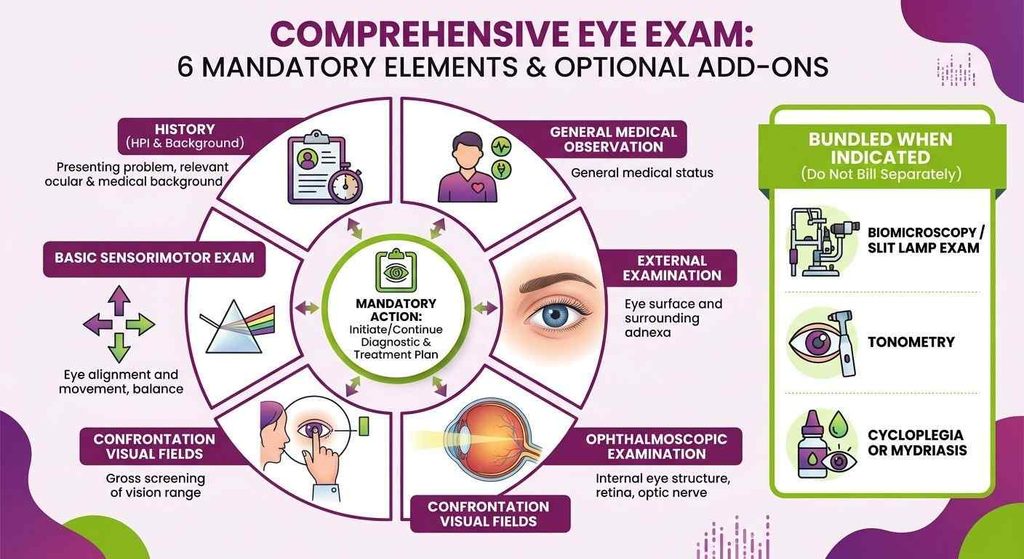
CPT 92014 requires a general evaluation of the complete visual system plus initiation or continuation of a diagnostic and treatment program. The AMA definition lists six core components. Therefore, a visit missing any one of them does not meet the comprehensive level that the 92014 eye exam code describes.
The required components are:
- History of the presenting problem and relevant ocular and medical background
- General medical observation of the patient
- External examination of the eye and adnexa
- Ophthalmoscopic examination of the internal eye
- Gross visual fields screened by confrontation
- Basic sensorimotor examination of eye alignment and movement
Moreover, the exam must include initiation or continuation of a diagnostic and treatment program. Consequently, a note that records findings without a plan fails the descriptor, even when every exam element is present.
Which Optional Elements Are Included When Indicated?
The AMA definition adds biomicroscopy, examination with cycloplegia or mydriasis, and tonometry when indicated. Therefore, slit lamp examination, dilation, and intraocular pressure measurement belong to the exam, not to separate charges. Moreover, dilation is not mandatory, so a comprehensive exam can qualify without it.
Can CPT 92014 Be Completed Across More Than One Visit?
CPT 92014 can be completed across more than one visit because the descriptor reads one or more visits. The comprehensive service forms a single service entity that need not occur at one session. Consequently, the practice reports one unit of 92014 for the complete evaluation.
How Does 92014 Differ From 92004, 92002, and 92012?
CPT 92014 differs from the other three general ophthalmological codes by patient status and exam level. Codes ending in 4 are comprehensive, and codes ending in 2 are intermediate. Therefore, the right code depends on two facts: whether the patient is new or established and how complete the exam was.
Moreover, the 92000 series continues beyond these four visit codes into special services such as visual fields and imaging, and each of those ophthalmology CPT codes follows its own reporting rules. The table below compares the four visit codes side by side.
| Code | Patient Status | Exam Level | Program Language in Descriptor |
|---|---|---|---|
| 92002 | New | Intermediate | Initiation of diagnostic and treatment program |
| 92004 | New | Comprehensive | Initiation of diagnostic and treatment program, 1 or more visits |
| 92012 | Established | Intermediate | Initiation or continuation of diagnostic and treatment program |
| 92014 | Established | Comprehensive | Initiation or continuation of diagnostic and treatment program, 1 or more visits |
As the table shows, 92014 is the only code that pairs established status with a comprehensive exam. Therefore, billers cannot substitute 92004 for a returning patient or 92012 for a full evaluation. Moreover, a wrong pairing changes both payment and audit exposure.
When Is a Patient Established for CPT 92014?
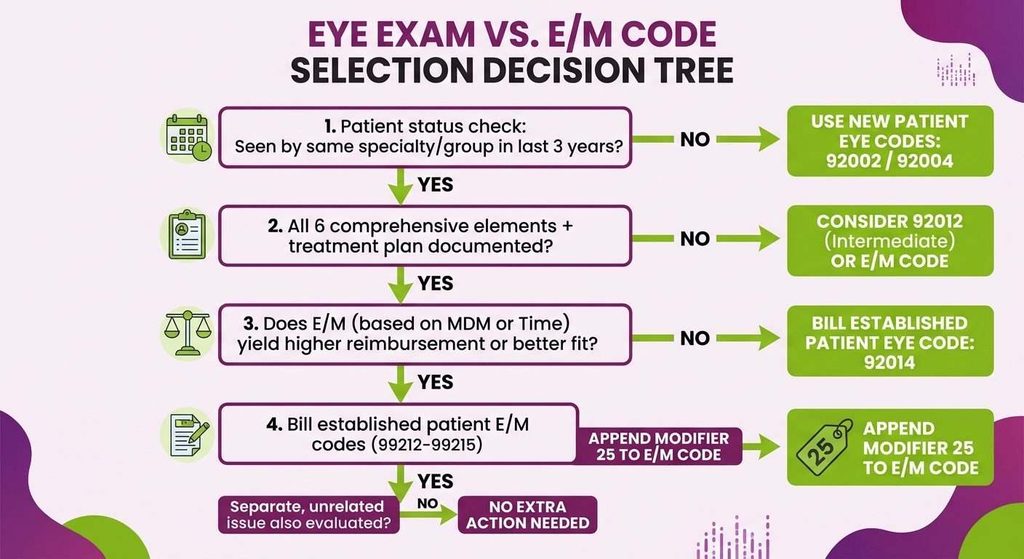
A patient is established when the patient received professional services from the physician, or from another physician of the same specialty and subspecialty in the same group practice, within the past three years. Therefore, a patient last seen four years ago qualifies as new. Additionally, the clock follows the group and specialty, not the individual clinician.
What Separates 92012 From 92014?
The intermediate eye codes require an external ocular and adnexal examination. The comprehensive codes add an ophthalmoscopic examination, gross visual fields, and a basic sensorimotor examination. Therefore, 92012 fits a focused visit for a specific problem, while the 92014 CPT code fits a full evaluation of the visual system.
Should You Bill 92014 or an E/M Code Such as 99214?
A practice bills either 92014 or an office E/M code for one established-patient exam, never both for the same services. The National Correct Coding Initiative (NCCI) policy manual states that codes 92002 to 92014 are not reported separately when E/M codes are reported. Therefore, one visit produces one code family.
Furthermore, CPT permits either code set for eye evaluations, and the documentation decides the choice. The 92014 code depends on the six comprehensive elements, while 99214 depends on medical decision making or total time. Consequently, 92014 vs 99214 is a documentation question, not a preference.
However, NCCI allows an unrelated, significant, and separately identifiable E/M service on the same date to be reported with modifier 25. Therefore, a patient who receives a comprehensive eye exam and a separate evaluation for an unrelated problem can support two codes. Documentation must separate the two services clearly.
How Much Does Medicare Pay for the 92014 CPT Code?
Medicare’s 2026 national payment for CPT 92014 is approximately $127.26 in a non-facility office setting and $62.13 in a facility setting. Each amount equals total relative value units multiplied by the CY 2026 non-QP conversion factor for CPT codes of $33.4009. Therefore, the 92014 reimbursement depends on both RVUs and the conversion factor.
Additionally, the table breaks the 92014 RVU total into its three components for each setting. Practice expense creates the largest gap between the two columns.
| Component | Non-Facility RVU | Facility RVU |
|---|---|---|
| Work | 1.42 | 1.42 |
| Practice expense | 2.35 | 0.40 |
| Malpractice | 0.04 | 0.04 |
| Total RVU | 3.81 | 1.86 |
| 2026 national payment | $127.26 | $62.13 |
Practice expense drives the gap between settings, at 2.35 RVUs in the office against 0.40 in a facility. Consequently, a facility-setting claim pays roughly half the office amount. Moreover, Medicare Part B coinsurance is 20 percent of the approved amount, or about $25.45 at the national rate.
How Do Geography and Payers Change the 92014 Amount?
The national figure is a starting point because geographic practice cost indices adjust Medicare payment by locality. Moreover, commercial payers and Medicare Advantage plans set their own fee schedules. Therefore, each practice’s expected amount differs from $127.26 and requires a locality lookup or a payer-specific contract rate.
What Changes for 92014 Payment in CY 2027?
CMS finalized the CY 2027 physician fee schedule on November 4, 2026, with an effective date of January 1, 2027. The non-QP conversion factor falls 2.31 percent to $32.6286, and the QP factor falls 1.83 percent to $32.9548. Therefore, 92014 payment moves in 2027, and the final amount also depends on any 2027 RVU revisions.
Does CPT 92014 Need Modifiers?
CPT 92014 needs no modifier on a standalone claim, and the code does not take RT or LT because the exam covers both eyes. Therefore, laterality modifiers on 92014 add confusion rather than clarity. However, a few situations call for a closer look at modifier use.
- Modifier 25: identifies a significant, separately identifiable service on the same date as a procedure, and payers apply it to 92014 under their own policies
- Unrelated E/M services: may be reported with modifier 25 when documentation shows a separate and significant evaluation
- Payer-specific edits: Medicare Advantage and commercial plans may add modifier rules that differ from Medicare
Furthermore, every modifier needs support in the note. Consequently, billers confirm the documentation before appending any modifier to the 92014 CPT code, because an unsupported modifier invites a payer review.
Which ICD-10 Codes Support CPT 92014?
CPT 92014 requires an ICD-10-CM diagnosis that shows medical necessity, and the diagnosis must match the condition evaluated. Eye practices draw most pairings from Chapter 7, which covers H00 through H59. Therefore, the diagnosis list must stay current, and the FY 2027 update effective October 1, 2026 added no codes to that chapter.
Furthermore, laterality digits and glaucoma stage characters follow detailed rules, and the Ophthalmology ICD-10 codes guide maps those rules across the full H00 to H59 range. The table lists common diagnosis examples that support a 92014 exam. Verify each code against the current code set before billing.
| Condition | Example ICD-10-CM Code | What the Code Reports |
|---|---|---|
| Age-related nuclear cataract | H25.13 | Bilateral |
| Primary open-angle glaucoma | H40.1131 | Bilateral, mild stage |
| Diabetic retinopathy | E11.3291 | Type 2 diabetes with mild nonproliferative retinopathy without macular edema, right eye |
| Dry eye | H04.123 | Dry eye syndrome of bilateral lacrimal glands |
| Age-related macular degeneration | H35.3110 | Nonexudative, right eye, stage unspecified |
Each example carries laterality or staging that must match the exam documentation. Therefore, an unspecified code such as H25.9 weakens medical necessity. Moreover, specific codes support the diagnostic and treatment program that the 92014 CPT code requires.
Does CPT 92014 Cover Routine Eye Exams and Refraction?
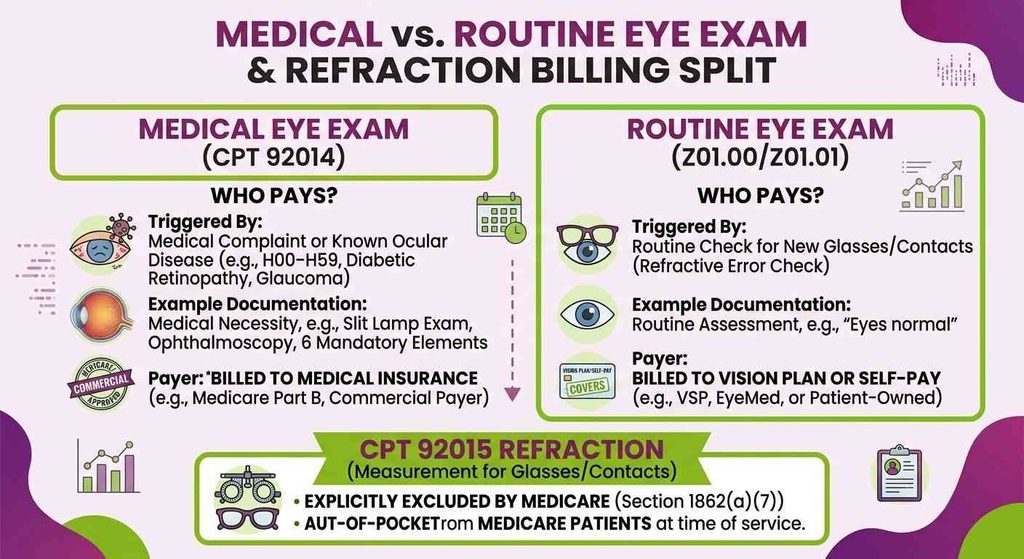
CPT 92014 reports a medical eye exam, and payers decide coverage by the reason for the visit. Medicare excludes eye exams performed to prescribe, fit, or change eyeglasses under Section 1862(a)(7) of the Social Security Act. Therefore, a visit for glasses alone does not become payable by reporting 92014.
Refraction reports separately under CPT 92015, and Medicare does not cover it. Therefore, the patient owes the 92015 charge when a Medicare beneficiary receives a medically necessary 92014 exam with refraction. Moreover, practices typically collect that amount at the time of service.
Vision plans cover routine exams through separate benefits, and those claims use routine diagnosis codes. Z01.00 reports an eye exam without abnormal findings, and Z01.01 reports one with abnormal findings. However, a medical complaint or a diagnosed condition moves the visit to the medical insurance.
Which Other CPT Codes Are Billed With 92014?
CPT 92014 includes the general eye exam, so only separately identifiable services bill alongside it. NCCI recognizes special ophthalmological services as significant, separately identifiable services that may be reported separately. Therefore, diagnostic tests with their own CPT codes can appear on the same claim when medical necessity supports each one.
Additionally, the table lists the codes most often paired with the 92014 eye exam code. The final column states how each code relates to 92014 on the claim.
| Code | Service | Relationship to 92014 |
|---|---|---|
| 92015 | Determination of refractive state | Billed separately; not covered by Medicare |
| 92083 | Visual field examination, extended | Special service; reported separately when medically necessary |
| 92134 | Retinal imaging, posterior segment, with interpretation and report | Special service; reported separately when medically necessary |
| 92250 | Fundus photography with interpretation and report | Special service; reported separately when medically necessary |
| 99202 to 99215 | Office E/M visits | Not reported with 92014 for the same services |
However, some payers set frequency limits and diagnosis requirements for these tests. Consequently, a medical diagnosis and a documented clinical reason must accompany each add-on service. Moreover, staff should check each payer policy before the claim leaves the practice.
What Documentation Supports a 92014 Claim?
A 92014 claim stands on the medical record, and the record must show each comprehensive element plus a treatment program. Auditors compare the claim against documentation line by line. Therefore, a complete note protects payment, while a template that skips elements invites recoupment.
A defensible note does the following:
- Records the chief complaint, history, and general medical observation
- Documents the external examination, including the adnexa
- Describes the ophthalmoscopic findings for each eye
- Notes gross visual fields and basic sensorimotor findings
- States the diagnosis and links it to medical necessity
- Outlines the diagnostic and treatment program initiated or continued
Moreover, the same note drives modifier choice, global period handling, and payer edits, which the Ophthalmology billing guide applies across eye care services. Consequently, documentation quality sets the ceiling for every downstream billing step.
What Are the Most Common 92014 Billing Mistakes?
Most 92014 denials trace to six repeatable errors. Therefore, a pre-bill check against the list below removes most preventable rejections. Moreover, each error originates in registration, documentation, or code selection, so different team members own different fixes. The table pairs each mistake with its consequence and its fix.
| Mistake | Consequence | Fix |
|---|---|---|
| Billing 92014 for a patient not seen within three years | Denial or recoupment | Check the last professional service by specialty and group |
| Billing 92014 with an E/M code for the same services | NCCI bundling denial | Choose one code family per visit |
| Skipping visual fields, sensorimotor, or ophthalmoscopic findings | Downcode or audit finding | Require those fields in the EHR template |
| Linking a vague diagnosis | Medical necessity denial | Link a specific, laterality-correct code |
| Reporting a routine diagnosis alone to Medicare | Non-covered exam denial | Document the complaint or condition |
| Using a prior-year code set after October 1 | Rejected diagnosis | Update the EHR each October 1 |
Most of these errors are preventable at the front end. Consequently, practices that add edits for patient status, exam elements, and diagnosis specificity reduce rework. Moreover, quarterly sample audits show whether coding habits drift between payer updates.
How Can a Practice Protect 92014 Revenue?
Accurate 92014 revenue depends on three controls: correct patient status, complete documentation, and clean claim submission. Moreover, each control needs a named owner on the team. Therefore, practices that audit a sample of established-patient exams every quarter catch coding drift before payers do.
Furthermore, our ophthalmology billing services pair 1,100+ AAPC-certified billers with pre-bill claim checks and a 98% first-pass clean claim rate. As a result, practices that outsource the work gain coding expertise without adding in-house headcount.
Additionally, Transcure’s billing audit reviews 90 days of claims, so established-patient exam errors surface before payers find them. Consequently, a practice sees exactly where 92014 claims lose payment and which fixes recover it.
Frequently Asked Questions About CPT Code 92014
What Is CPT Code 92014 Used For?
CPT code 92014 reports a comprehensive medical eye exam for an established patient. The exam includes history, general medical observation, external and ophthalmoscopic examination, gross visual fields, and a basic sensorimotor examination. Moreover, the service initiates or continues a diagnostic and treatment program for the patient.
What Is the Difference Between 92014 and 92004?
The difference between 92014 and 92004 is patient status. Both codes describe a comprehensive eye exam, but 92004 applies to a new patient and 92014 applies to an established patient. A patient is established after receiving professional services from the same specialty and group within three years.
How Much Does Medicare Pay for the 92014 CPT Code?
Medicare’s 2026 national payment for CPT 92014 is approximately $127.26 in a non-facility setting and $62.13 in a facility setting. These amounts come from 3.81 and 1.86 total RVUs. Moreover, locality adjustments change the final payment, and the CY 2027 conversion factor drops to $32.6286.
Can You Bill 92014 and 99214 on the Same Day?
A practice cannot bill 92014 and 99214 for the same services on the same day. NCCI states that general ophthalmological codes are not reported separately when E/M codes are reported. However, an unrelated, significant, and separately identifiable E/M service may be reported with modifier 25.
Does Medicare Cover a Routine Eye Exam Under 92014?
Medicare does not cover eye exams performed to prescribe, fit, or change eyeglasses. Therefore, a routine visit for glasses alone does not become payable under 92014. Medicare covers the exam when a documented complaint or diagnosed condition supports medical necessity, while refraction under 92015 remains the patient’s responsibility.
Does CPT 92014 Have a Global Period?
CPT 92014 carries an XXX global indicator, which means the global surgery concept does not apply. Therefore, the code has no pre-operative or post-operative period of its own. However, payers may still apply same-day edits when a procedure or an E/M service appears on the claim.