CPT code 29827 reports an arthroscopic rotator cuff repair. One unit covers the repair regardless of how many of the four cuff tendons the surgeon addresses in that shoulder.
CPT 29827 is the highest-volume shoulder scope, and nearly every denial on it traces to the same question: which companion codes survive alongside it. Limited debridement never does. Extensive debridement sometimes does, under conditions the operative note has to earn.
Those two rules pull in opposite directions, which is why the shoulder is such a frequent audit target. Companion coding is where an arthroscopy claim is won or lost, and an orthopedic RCM partner earns its fee on exactly that decision.
What Is the Description of CPT Code 29827?
The 29827 CPT code description, as defined by the AMA, is: “Arthroscopy, shoulder, surgical; with rotator cuff repair.”
This code reports repair of the rotator cuff performed entirely through arthroscopic portals. It sits in the shoulder arthroscopy series, 29805 through 29828, within the musculoskeletal section of the Category I CPT code set. CPT code 29827 covers the diagnostic arthroscopy, the repair itself, and the preparatory work the repair requires.
The code is deceptively simple on its face. Procedure code 29827 is straightforward to select, and the difficulty lies entirely in what else may accompany it on the claim.
What Does Arthroscopic Rotator Cuff Repair Include Under CPT Code 29827?
CPT code 29827 includes everything integral to performing the repair arthroscopically. The included work is not separately reportable under any companion code.
The service includes:
- The diagnostic arthroscopy of the shoulder performed at the same session
- Debridement of the frayed cuff edges as preparation for the repair
- Anchor placement and suture passage to reattach the tendon
- Footprint preparation on the greater tuberosity where performed
The preparatory debridement point matters more than it appears. Any structure debrided as part of another reported procedure cannot count toward a debridement code, so cleaning the torn cuff edges before repairing them contributes nothing toward 29822 or 29823.
Why Only One Rotator Cuff Repair Code Is Reportable Per Shoulder
The rotator cuff comprises four tendons: supraspinatus, infraspinatus, teres minor, and subscapularis. CPT code 29827 is reported once per shoulder regardless of how many of them are repaired.
The unit rule works as follows:
- Repairing one tendon and repairing all four both produce a single unit of 29827
- The code describes repair of the cuff as an anatomic unit, not repair of individual tendons
- Multiple units on one shoulder are never appropriate
- Bilateral repairs are separate shoulders, reported with the appropriate laterality modifiers
The multi-tendon extent still matters, but it belongs in the documentation supporting modifier 22 rather than in the unit count.
How Does CPT 29827 Differ From the Open Repair Codes 23410, 23412, and 23420?
The open codes describe the same clinical goal through a different approach, and they split further by chronicity. Approach and acuity together select the code.
The repair codes break down as follows:
- 29827 arthroscopic rotator cuff repair, performed entirely through portals
- 23410 open repair of a ruptured musculotendinous cuff, acute
- 23412 open repair of a ruptured musculotendinous cuff, chronic, used for mini-open repairs
- 23420 reconstruction of a complete shoulder cuff avulsion, chronic, which already includes acromioplasty
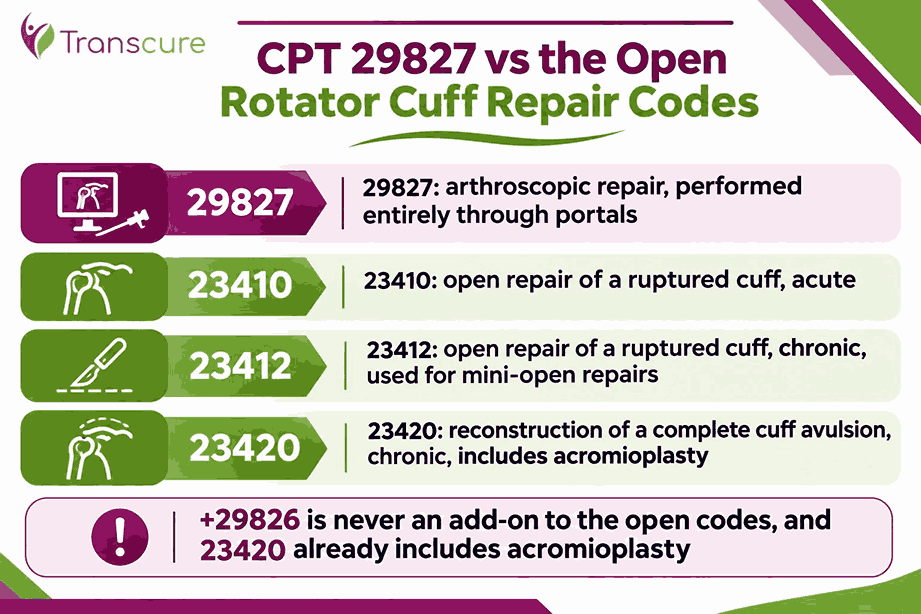
Mini-open repairs report from the 23410 and 23412 series, with the acute-versus-chronic distinction driving the selection. The consequential difference for billing is that +29826 is not an add-on to the open codes, and 23420 already contains the acromioplasty, so decompression is never separately reportable alongside it. Open and arthroscopic repairs sit side by side among the shoulder and sports medicine procedure codes orthopedic surgeons report most, and the approach documented in the operative note decides which one applies.
Which Shoulder Arthroscopy Codes Are Bundled Into CPT 29827 and Which Are Separately Reportable?
Companion coding on this code splits three ways, and each branch behaves differently. Getting these three straight resolves most claims.
Why Limited Debridement (29822) Can Never Be Unbundled From 29827
29822 is bundled into CPT code 29827 on the same shoulder regardless of where the debridement occurred. No modifier bypasses this edit.
The rule is absolute:
- Limited debridement is inclusive in other shoulder arthroscopy procedures under NCCI Chapter 4
- The bundle applies regardless of whether the debridement was in a different location within the shoulder
- Appending modifier 59 to 29822 on the theory that a different location justifies separate payment does not work
- This is the most common billing error on 29827
The instinct behind the error is understandable and still wrong. A surgeon who debrides in one area and repairs in another has performed two distinct pieces of work, but Medicare treats the shoulder as one surgical field for this purpose, so the limited debridement is absorbed.
When Extensive Debridement (29823) Is Separately Reportable
29823 is the opposite case, and this is the most useful distinction on the page. The bundling edit between 29827 and 29823 has been removed, so extensive debridement may be reported separately when genuinely performed in a different area.
Two conditions govern the claim:
- Since January 2021, three or more discrete structures must be debrided to support 29823
- The operative note must name each structure individually
- The debridement must be in a different area from the repair
- Any structure debrided as part of another reported procedure cannot count toward the total
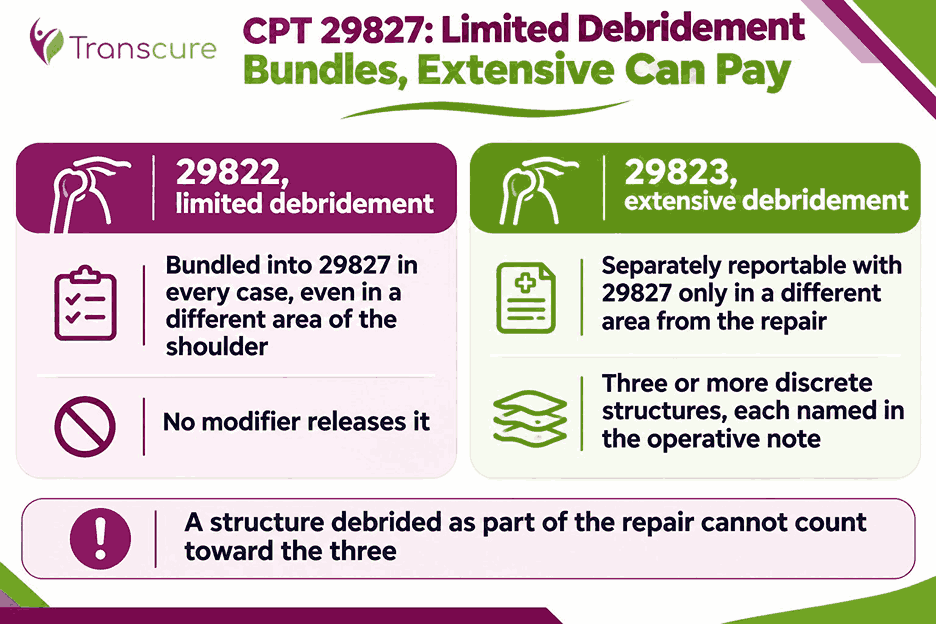
That last condition eliminates the most tempting shortcut. Debriding the biceps tendon during a cuff repair does not count toward the three, because the surgeon addressed that structure as part of the repair. The named structures in the descriptor include humeral bone, humeral articular cartilage, glenoid bone, glenoid articular cartilage, biceps tendon, biceps anchor complex, labrum, articular capsule, both sides of the rotator cuff, subacromial bursa, and foreign bodies.
How Add-On Code +29826 Works With 29827 and Why It Fails With Open Repairs
+29826 reports decompression of the subacromial space with partial acromioplasty. It is an add-on code with a defined list of parent codes.
The parent code rules are:
- +29826 is reportable only with parent codes 29806 through 29825, 29827, and 29828
- It is not an add-on to open repairs 23410 or 23412, and an unlisted code cannot be substituted for that work
- When decompression accompanies an open repair, report 29822 or 29823 as appropriate instead
- 23420 already includes acromioplasty, so decompression is never separately reportable with it
Documentation carries a specific requirement. The code requires partial acromioplasty, meaning actual bone work on the acromion, so a subacromial bursectomy without bone resection is a debridement rather than a decompression. Many payers now expect a bony instrument to be named in the operative note before paying the add-on.
Which HCPCS Codes Are Billed in Relation to CPT Code 29827?
Rotator cuff repair is almost always followed by a period of immobilization in a shoulder orthosis, and that device is billed under a HCPCS Level II code rather than on the surgeon’s claim. The repair creates the need, but the orthosis is a separate claim.
The orthosis billing works as follows:
- Post-operative slings with an abduction pillow are commonly classified by manufacturers under L3670, a prefabricated off-the-shelf shoulder orthosis
- Abduction positioning systems, often called airplane braces, are commonly classified under L3960
- Some abduction restrainer designs are classified under L3660, a figure-of-eight shoulder orthosis
- The device is billed by an enrolled DMEPOS supplier to the DME MAC, separately from the 29827 professional and facility claims
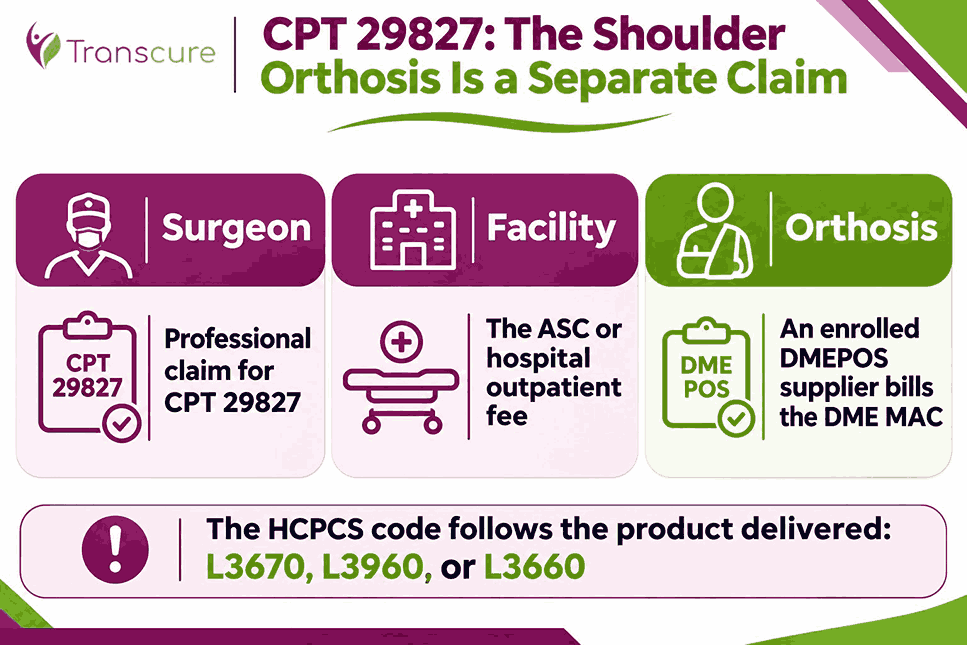
The code follows the specific product’s classification, not the procedure that preceded it. Two slings dispensed after the same repair can carry different codes, so the supplier must match the HCPCS code to the product actually delivered. These devices sit among the shoulder bracing and DME codes an orthopedic practice dispenses, and the operative note supplies the post-surgical indication the supplier’s order depends on.
What ICD-10 Codes and Medical Necessity Criteria Support CPT Code 29827?
Medical necessity for CPT code 29827 rests on an imaging-confirmed tear paired with documented failure of conservative care. Prior authorization on this code is built almost entirely on those two elements.
Representative supporting diagnoses include:
- M75.100 through M75.122 for rotator cuff tears, unspecified as traumatic, by laterality and by whether the tear is complete or incomplete
- S46.011A and S46.012A for a traumatic rotator cuff tear, coded as a strain of the rotator cuff muscle and tendon, initial encounter
- M75.51 and M75.52 for bursitis of the shoulder
- M75.41 and M75.42 for impingement syndrome of the shoulder
The diagnosis must match the imaging. A code describing a complete tear needs an MRI report describing a full-thickness tear, and a mismatch between the coded tear type and the radiology findings is a straightforward denial. Tear completeness, laterality, and traumatic versus nontraumatic origin follow the same logic across the tendon and joint injury diagnosis codes orthopedic practices rely on.
What Are the Conservative Treatment and Imaging Requirements Before CPT 29827 Can Be Authorized?
Payers authorize CPT code 29827 on two pillars: imaging that confirms the tear and records that conservative management failed. Both must be in the submission.
The typical requirements are:
- An MRI or MR arthrogram confirming the tear, with the tear type and size described
- A documented course of conservative care, commonly six weeks to three months depending on the payer
- Physical therapy addressing the shoulder, with the response recorded
- Anti-inflammatory medication and activity modification
- A subacromial injection where trialed, with the result documented
- Persistent pain, weakness, or functional limitation despite the completed trial
Acute traumatic full-thickness tears in appropriate candidates often bypass the conservative-care requirement, since delaying repair risks retraction. The record must state the acute mechanism and the imaging findings supporting immediate surgery.
What Are the Modifiers for CPT Code 29827?
CPT 29827 uses laterality on every claim, complexity for revision and massive tears, and the global-period modifiers. The distinct-service modifiers have narrow application here.
Modifiers RT and LT: Shoulder Laterality
Modifiers RT and LT identify the right and left shoulder. Append the correct laterality modifier to CPT code 29827 on every claim, since payers cannot infer the side. Missing laterality causes claim suspension or outright rejection.
Modifier 22: Increased Procedural Services for Revision or Massive Tears
Modifier 22 reports substantially greater work than the procedure typically requires. Append modifier 22 to 29827 for revision repair, reconstruction, or a massive retracted tear, supported by a narrative describing the additional operative time and technique required. Vague complexity language will not carry it, so the note must quantify what made the case harder.
Modifier 51: Multiple Procedures Same Session
Modifier 51 identifies multiple procedures in the same session. Append modifier 51 to the secondary procedure when a separately payable service accompanies CPT code 29827. The multiple procedure payment reduction then applies to the lower-valued service, and add-on codes are exempt.
Modifier 59 and the X Modifiers: Narrow Application on the Same Shoulder
Modifier 59, or the more specific XS, identifies a distinct procedural service. Its application on the same shoulder is narrow, because bundled companions such as 29822 carry edits that no modifier overrides. Reserve it for a genuinely separate procedure with its own documented area and structures, and never append it to limited debridement with 29827.
Modifier 58: Staged or Related Procedure During the Global Period
Modifier 58 reports a planned or related procedure during the 90-day global period. Append modifier 58 when a staged procedure anticipated at the time of 29827 is performed within the window, such as a planned manipulation under anesthesia.
Modifier 78: Unplanned Return to the OR During the Global Period
Modifier 78 reports an unplanned return to the operating room for a related complication. Append modifier 78 when a complication of CPT code 29827, such as infection or hardware problem, requires unplanned surgery within the global period. Payment covers intraoperative work only.
Modifier 79: Unrelated Procedure During the Global Period
Modifier 79 reports an unrelated procedure during the global period. Append modifier 79 to a service unrelated to the 29827 recovery, such as a contralateral shoulder procedure. The modifier starts a new global period.
Which Documents Are Required For CPT Code 29827?
Documentation for CPT code 29827 must support the repair, the medical necessity, and every companion code billed alongside it. The operative note is where companion claims live or die.
The required documentation includes:
- MRI or MR arthrogram confirming the tear, with type and size described
- Conservative treatment records, or the acute mechanism justifying immediate repair
- Prior authorization where the payer requires it, matched to the correct shoulder
- An operative report naming the tendons repaired and the repair construct used
- For 29823, each of the three or more discrete structures debrided, named individually
- For +29826, explicit description of bone work on the acromion and the instrument used
- Laterality documentation for the shoulder treated
- For modifier 22, a narrative quantifying the additional work performed
What Is the Cost of CPT Code 29827?
The cost of CPT code 29827 divides into the surgeon professional fee and the facility fee. Companion coding decisions move the professional total more than anything else on the claim.
RVUs and Medicare Payment for CPT Code 29827
Medicare prices the professional component of CPT code 29827 through the Physician Fee Schedule. The CY 2026 national values appear below.
| Component | Value (CY 2026) |
|---|---|
| Work RVU | 15.2 |
| National Medicare payment | About $976.31 |
| Conversion factor | $33.4009 |
| Global period | 090 |
The professional fee covers the repair and the 90-day global period. GPCI values adjust the amount by locality, and the 2026 efficiency adjustment applied to non-time-based services affected the work component of surgical codes generally.
For dates of service on or after January 1, 2027, the CY 2027 final rule lowers the nonqualifying APM conversion factor to $32.6286 and the qualifying APM conversion factor to $32.9548. The conversion factor change alone reduces payment for the same RVUs by about 2.3 percent, and the 2.5 percent efficiency adjustment to non-time-based services continues. The final 2027 amount for CPT code 29827 depends on the code’s CY 2027 relative values, so confirm it in the 2027 fee schedule lookup before updating contracts or estimates.
How Add-On and Secondary Procedure Payment Affects the Total Claim
Companion codes change the claim total substantially, and the payment rules differ between secondary procedures and add-ons.
| Code | Role | CY 2026 payment |
|---|---|---|
| 29827 | Primary repair | About $976.31 |
| 29823 | Extensive debridement, when separately reportable | About $558.80 |
| +29826 | Subacromial decompression add-on | About $147.63 listed |
| 29822 | Limited debridement, bundled with 29827 | Not separately payable |
Two payment mechanics govern the total:
- A separately reportable secondary procedure such as 29823 is subject to the multiple procedure payment reduction, so the second code pays at roughly 50 percent
- Add-on codes are exempt from that reduction, since they are already valued as incremental work
- 29822 contributes nothing when billed with 29827, so the effort spent trying to unbundle it has no upside
- Reporting 29823 without the three-structure documentation converts a valid claim into an audit exposure
The +29826 payment picture deserves a caution. The code carries 4.42 total RVUs and a listed national amount near $147.63, but multiple sources report that Medicare does not pay it separately as an add-on with a primary shoulder arthroscopy, bundling it into the primary procedure payment instead. Verify the current treatment with the local contractor before relying on that revenue.
Site of Service Differences Across ASC and Hospital Outpatient Settings
CPT code 29827 is performed in facility settings, and the facility payment differs by site while the professional fee stays constant.
Key setting factors include:
- Ambulatory surgery centers are the common setting, paying the ASC facility rate
- Hospital outpatient departments pay through the outpatient prospective payment system at the applicable APC rate
- The surgeon’s professional fee is the same regardless of which facility hosts the case
- GPCI values adjust the professional components by locality
Commercial Payers and Prior Authorization Requirements
Commercial plans reimburse procedure code 29827 at a contracted multiple of Medicare, and nearly all require prior authorization built on imaging plus conservative care.
Coverage considerations include:
- Prior authorization is standard, and the submission rests on the MRI report and the conservative-treatment record
- Radiology benefit managers and utilization vendors apply their own appropriateness criteria
- Some payer policies treat subacromial decompression as not medically necessary across all indications, which drives denials on the add-on rather than the repair
What Are Example Clinical Scenarios or Use Cases for CPT Code 29827?
CPT code 29827 applies whenever the cuff is repaired arthroscopically. The scenarios below show the clean case, the add-on case, the qualifying debridement case, and the complexity case.
Scenario 1: Isolated Full-Thickness Supraspinatus Tear Repaired Arthroscopically
ICD-10: M75.101 (Unspecified rotator cuff tear or rupture of right shoulder, not specified as traumatic)
A patient with an MRI-confirmed full-thickness supraspinatus tear has failed three months of physical therapy and injection. The surgeon repairs the tear arthroscopically, debriding the frayed cuff edges as part of the repair. The practice reports CPT code 29827 with modifier RT and nothing else. The preparatory debridement is inside the repair, so no debridement code is added.
Scenario 2: Rotator Cuff Repair With Subacromial Decompression and Partial Acromioplasty
ICD-10: M75.101 (Rotator cuff tear, right shoulder) and M75.41 (Impingement syndrome of right shoulder)
The surgeon repairs the cuff and also performs a subacromial decompression with partial acromioplasty, resecting bone from the undersurface of the acromion with a burr. The practice reports 29827 with +29826 and the laterality modifier, with the operative note naming the bony resection and the instrument used.
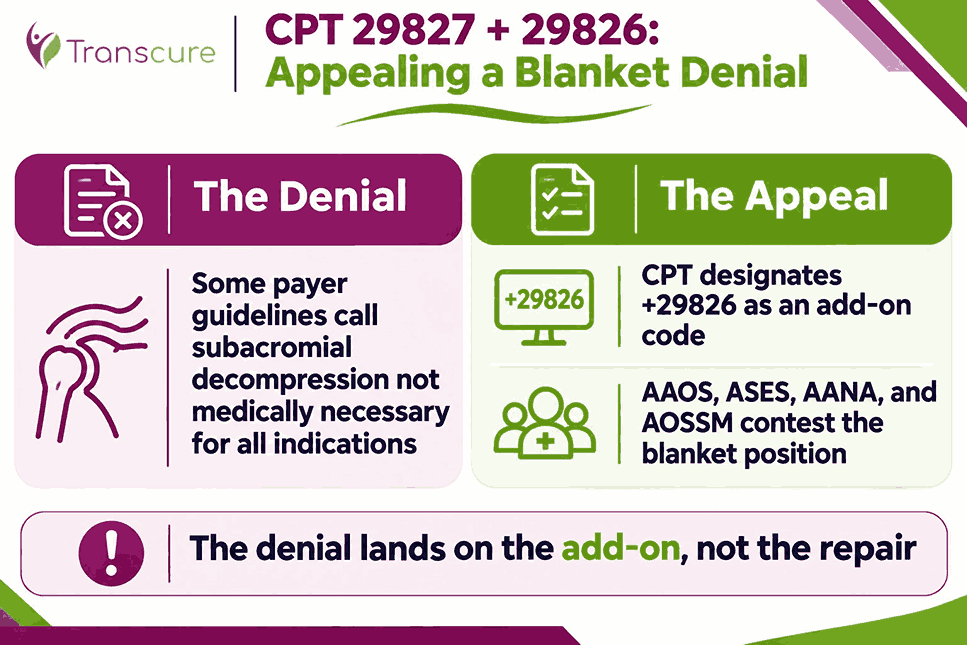
This claim carries a specific commercial risk worth anticipating. Some payer medical necessity policies classify subacromial decompression as not medically necessary across all indications, producing blanket denials when the add-on accompanies a cuff repair. AAOS, ASES, AANA, and AOSSM have formally contested that position, and an appeal should cite the absence of an NCCI edit between the pair, the add-on designation in CPT, and the specialty societies’ guidance that the procedures are separately reportable.
Scenario 3: Rotator Cuff Repair With Extensive Debridement of Three Distinct Structures
ICD-10: M75.102 (Rotator cuff tear, left shoulder) and M24.112 (Other articular cartilage disorders, left shoulder)
The surgeon repairs the cuff and separately debrides the glenoid articular cartilage, the labrum, and the articular capsule, each in an area distinct from the repair. The operative note names all three structures individually. The practice reports CPT code 29827 with 29823 appended with modifier XS and the laterality modifier. Had only two structures been debrided, or had one of them been the cuff itself, only 29827 would be reportable.
Scenario 4: Revision Repair of a Massive Retracted Tear Supporting Modifier 22
ICD-10: M75.121 (Complete rotator cuff tear or rupture of right shoulder, not specified as traumatic)
A patient presents with a failed prior repair and a massive retracted tear requiring extensive mobilization, additional anchors, and substantially longer operative time. The surgeon completes the revision arthroscopically. The practice reports 29827 with modifier 22 and modifier RT, supported by a narrative describing the retraction, the mobilization technique, the anchor count, and the additional time compared with a routine repair.
What Are the CPT Code 29827 Rules To Ensure Successful Reimbursement?
Follow the shoulder bundling architecture, avoid fragmentation, document each companion code, and observe the global period. Meeting these rules protects CPT code 29827 claims from denial and recoupment.
NCCI Bundling Rules and Why the Shoulder Is Treated as One Surgical Field
NCCI treats arthroscopic debridement as inclusive in other shoulder arthroscopy procedures, and Medicare has long applied a single-surgical-field principle to the shoulder. That principle is why location-based arguments fail on this joint.
The core bundling rules are:
- Arthroscopic debridement is considered inclusive in all other shoulder scope procedures under NCCI Chapter 4
- A different location within the same shoulder does not create a separately reportable service for limited debridement
- Diagnostic arthroscopy of the same shoulder is always included in the surgical procedure
- Some pairs are bundled for Medicare even where specialty society guidance treats them as distinct, so specialty society guidance alone does not support separate payment
- Check the current NCCI tables each quarter, since edit status changes and the 29823 edit removal is itself an example
Why Fragmenting Bursal Work Into Debridement Codes Violates NCCI Policy
A specific workaround circulates on this code and is expressly prohibited. Moving bursal work out of the decompression into 29822, then upgrading it to 29823 to capture payment, is fragmenting a service into component parts to increase reimbursement.
The prohibition works as follows:
- The NCCI Policy Manual bars fragmenting a service into component parts to increase payment
- Substituting 29823 for a decompression that Medicare will not pay separately is the classic version of this error
- A subacromial decompression alone cannot satisfy the three-discrete-structure requirement for 29823
- Selecting a code to secure reimbursement rather than to describe the work performed is an audit exposure regardless of the amount involved
Operative Note Elements That Support Each Separately Billed Companion Code
Every companion code on a CPT code 29827 claim needs its own documentary support. Reviewers read the operative note against each line billed.
The documentation requirements are:
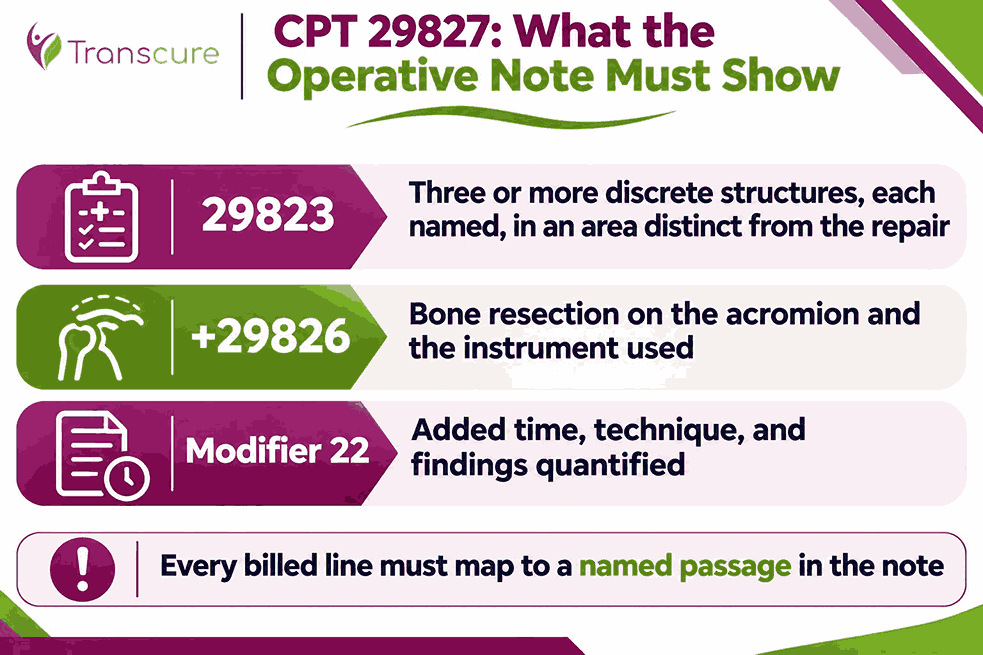
- For 29823, name each of the three or more discrete structures debrided and state that the area was distinct from the repair
- For +29826, describe the bone resection on the acromion and name the instrument used
- For modifier 22, quantify the additional work rather than asserting complexity
- Confirm that no structure counted toward a debridement code was addressed as part of another reported procedure
- Dictate the note so each billed line maps to a named passage, since payers request operative reports on shoulder claims at increasing rates
90-Day Global Period and Post-Operative Billing Rules
CPT code 29827 carries a 90-day global period covering routine post-operative care. Returns and unrelated services during the window each take a specific modifier.
The global-period rules are:
- Routine post-operative visits within 90 days are included in the payment
- A staged or anticipated procedure uses modifier 58, and an unplanned related return to the operating room uses modifier 78
- An unrelated procedure uses modifier 79, and an unrelated evaluation and management visit uses modifier 24
- The decision-for-surgery visit on the day of or day before surgery carries modifier 57 on the E/M line
- The 2027 same-day E/M payment reduction applies only to procedures with a 0-day global period, so the modifier 57 visit before a 90-day procedure like 29827 is not reduced
Top Reasons For Denials Specific To 29827 & Quick Remedies
- 29822 Billed Alongside the Repair: Prevent by removing the limited debridement line entirely, since it is bundled into CPT code 29827 regardless of location and modifier 59 does not release it.
- 29823 Billed Without Three Named Structures: Prevent by naming each discrete structure in the operative note and confirming none of them was addressed as part of the repair itself.
- +29826 Billed Without Documented Bone Work: Prevent by describing the acromial resection and the instrument used, since a bursectomy alone is a debridement rather than a decompression.
- +29826 Billed With an Open Repair: Prevent by reporting 29822 or 29823 instead when decompression accompanies 23410 or 23412, and by never adding it to 23420, which already includes acromioplasty.
- Missing Laterality Modifier: Prevent by appending RT or LT to every claim, since the payer cannot determine the operative shoulder without it.
- Modifier 22 Without a Supporting Narrative: Prevent by quantifying the additional time, technique, and findings that made the revision or massive tear substantially harder than a routine repair.