CPT code 90791 describes the initial comprehensive mental health assessment, which establishes a diagnosis and a treatment direction. Psychiatrists, clinical psychologists, clinical social workers, marriage and family therapists, mental health counselors, and prescribing practitioners such as nurse practitioners, physician assistants, and clinical nurse specialists report it within their state scope of practice and payer enrollment rules.
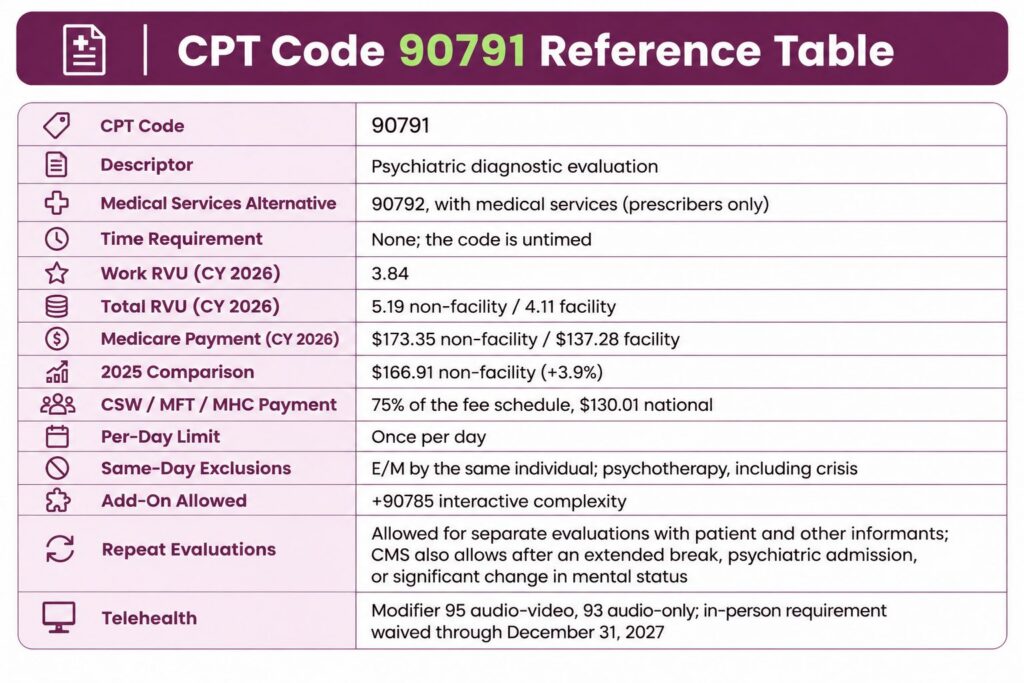
The code has no time requirement and no prescribing component, which separates it from 90792 and psychotherapy codes. Medicare pays a national non-facility rate of $173.35 for 90791 in 2026, before locality adjustment. Payers deny it most often for same-day psychotherapy, repeat evaluations, and incorrect telehealth modifiers or place of service codes.
This guide covers the description of 90791, 2026 Medicare payment, clinical scenarios, and the rules that protect reimbursement. It also covers modifiers, ICD-10 support, required documents, and Medicare telehealth rules that apply through 2027. Rates and rules reflect the 2026 fee schedule and the CY 2027 final rule released on November 4, 2026.
What Is the Description of CPT Code 90791?
The 90791 CPT code description, as defined by the AMA, is psychiatric diagnostic evaluation that does not include medical services. The American Medical Association (AMA) publishes it in the CPT manual under the Psychiatry section, which makes 90791 the core psychiatry CPT code for the initial evaluation. Medicare and most commercial payers recognize it for licensed behavioral health providers who work within their scope of practice.
What Does a Psychiatric Diagnostic Evaluation Include Under CPT Code 90791?
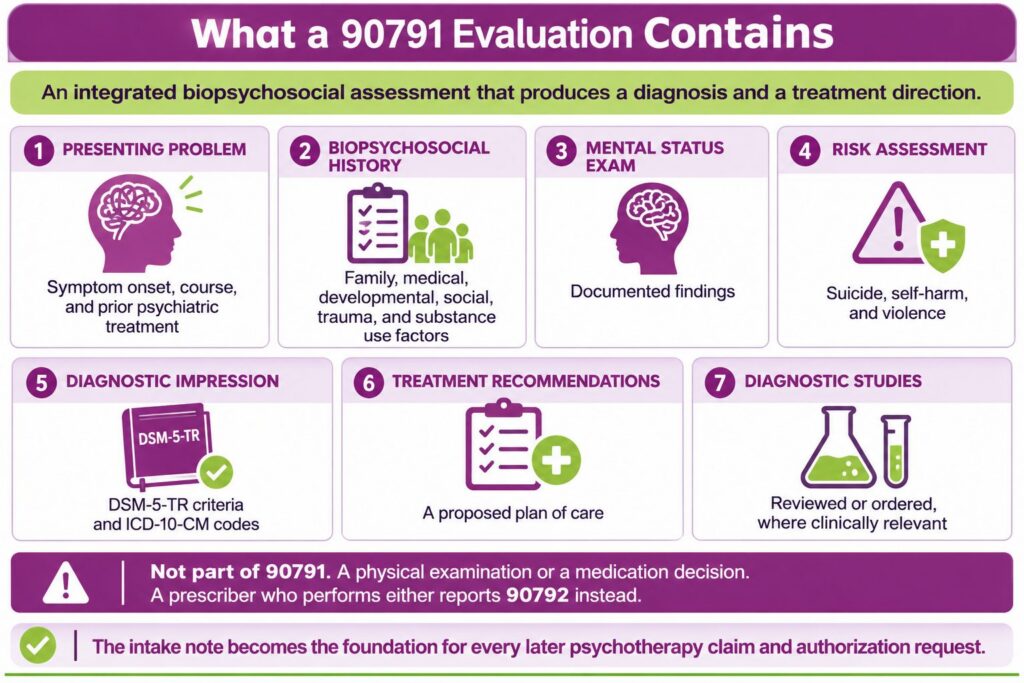
A psychiatric diagnostic evaluation under CPT code 90791 is a biopsychosocial assessment that produces a diagnosis and recommendations. The clinician interviews the patient and reviews available records, including prior treatment summaries and referrals. The clinician may also speak with family members or other sources when the patient consents.
A complete 90791 evaluation typically includes:
- Presenting problem, symptom onset, course, and prior psychiatric treatment
- Biopsychosocial history covering family, medical, developmental, social, trauma, and substance use factors
- Mental status examination
- Risk assessment for suicide, self-harm, and violence
- Diagnostic impression using DSM-5-TR criteria and ICD-10-CM codes
- Treatment recommendations and a proposed plan of care
- Review or ordering of diagnostic studies, where clinically relevant
The code excludes medical services such as a physical examination or a medication decision. A prescriber who performs either service during the intake should report 90792 instead of 90791. In practice, the intake note becomes the foundation for every later psychotherapy claim and authorization request.
Why CPT 90791 Has No Time Requirement
CPT code 90791 carries no time requirement in the code descriptor or the CPT guidelines. Unlike the psychotherapy codes, it has no minimum or maximum number of face-to-face minutes. Payers reimburse the completed evaluation as a single unit, regardless of the length of the session.
| Code | Time range | Time-based code |
|---|---|---|
| 90791 | None | No |
| 90832 | 16 to 37 minutes | Yes |
| 90834 | 38 to 52 minutes | Yes |
| 90837 | 53 minutes or more | Yes |
A 45 minute intake and a 90 minute intake receive the same Medicare payment for the evaluation. Extra time does not support a second unit, because 90791 is reported once per calendar date. Add-on code +90785 reflects communication difficulty during the visit, not additional minutes of clinician time.
Record the start time, stop time, and total minutes in every intake note anyway. Auditors use duration to judge whether a visit matched a full diagnostic evaluation. A 12 minute “intake” with a full 90791 claim attracts review.
How Does CPT 90791 Differ From 90792 and a New Patient E/M?
CPT 90791 and 90792 share the same diagnostic framework. The difference is medical services. Code 90792 adds a medical component, such as a physical exam, a medication assessment, or a prescribing decision. Only physicians, nurse practitioners, and other prescribing clinicians can support it.
| Feature | 90791 | 90792 | New patient E/M (99202-99205) |
|---|---|---|---|
| Medical services | No | Yes | Yes |
| Interactive complexity add-on | Yes | Yes | Only alongside a psychotherapy add-on |
| 2026 Medicare national non-facility rate | $173.35 | $202.08 | Varies by level |
| Same day with an E/M by the same provider | No | No | Not with 90791 or 90792 |
Choose 90792 only when the record shows a medical service. A note that says “will consider medications at follow-up” does not support it. Payers downcode 90792 claims to 90791 when no prescribing decision or physical assessment appears in the chart.
When Can CPT 90791 Be Reported More Than Once for the Same Patient?
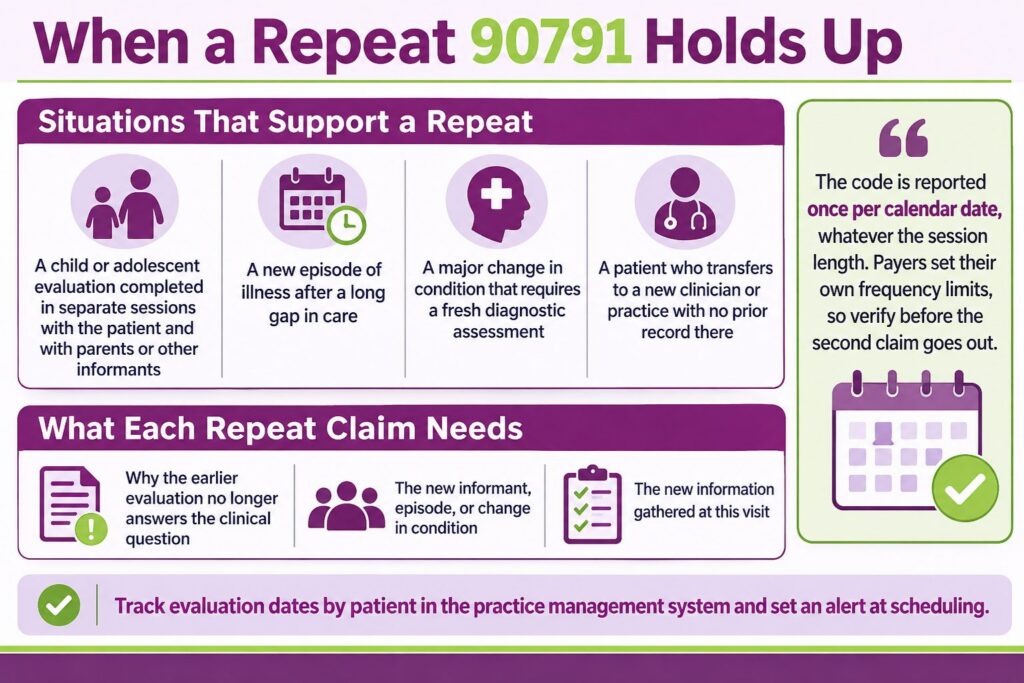
CPT guidelines allow 90791 more than once for the same patient when separate diagnostic evaluations are needed. Medicare contractors confirm that the code is reported once per day and may be repeated across a year with a separate evaluation. Payers monitor the frequency closely.
Common situations that support a repeat evaluation include:
- A child or adolescent evaluation completed in separate sessions with the patient and with parents or other informants
- A new episode of illness after a long gap in care
- A major change in condition that requires a fresh diagnostic assessment
- A patient who transfers to a new clinician or practice and has no prior record with that provider
Each repeat claim needs its own documentation of why the earlier evaluation no longer answers the clinical question. Payers apply their own caps, often one evaluation per provider per year. Verify the limit before the second claim goes out.
Which ICD-10 Codes Support Medical Necessity for CPT Code 90791?
Medical necessity for 90791 rests on a covered mental, behavioral, or neurodevelopmental diagnosis, or a documented presenting symptom. Use the psychiatry ICD codes below as a starting point, and report the most specific ICD-10-CM code the evaluation supports. List the diagnosis that prompted the visit first on the claim.
| ICD-10-CM code | Description | Typical use at intake |
|---|---|---|
| F32.1 | Major depressive disorder, single episode, moderate | Adult presenting with first depressive episode |
| F33.1 | Major depressive disorder, recurrent, moderate | Patient with prior documented episodes |
| F41.1 | Generalized anxiety disorder | Chronic worry with functional impairment |
| F43.10 | Post-traumatic stress disorder, unspecified | Trauma exposure with intrusion symptoms |
| F43.23 | Adjustment disorder with mixed anxiety and depressed mood | Symptoms tied to a recent stressor |
| R45.851 | Suicidal ideations | Presenting symptom when no diagnosis is confirmed |
Use a symptom code such as R45.851 or R45.89 only when the evaluation does not yet support a diagnosis. Many payers reject Z codes as the first-listed diagnosis for 90791. Match the diagnosis to the findings in the mental status examination and history.
Which HCPCS Codes Are Reported in Relation to CPT 90791?
90791 is one of the Level I CPT codes, but HCPCS Level II codes appear beside it or in place of it. Some state Medicaid programs require H-codes for non-physician clinicians. Medicare uses a few G-codes and Q-codes around telehealth and screening.
| HCPCS code | Description | How it relates to 90791 |
|---|---|---|
| H0031 | Mental health assessment by a non-physician | Medicaid substitute for 90791 in some states |
| H0032 | Mental health service plan development by a non-physician | Billed after the assessment where a state requires a separate plan code |
| Q3014 | Telehealth originating site facility fee | Host site only, not home. $31.85 in 2026, paid at 80% |
| 90791 + 95/93 | RHC/FQHC telehealth visit | Bill 90791 with 95 (video) or 93 (audio-only), not G2025 |
Never report 90791 and H0031 for the same evaluation. Check the state Medicaid manual to see which code the program expects.
What Are the Modifiers for CPT Code 90791?
Modifiers tell the payer how, where, and by whom the evaluation was delivered. They do not change the service. A wrong or missing modifier causes many 90791 denials, especially on telehealth and Medicaid claims. The five modifiers and add-on below cover most 90791 claims.
Modifier 95: Synchronous Audio-Video Telehealth
Modifier 95 marks a real-time visit with both audio and video. On Medicare professional claims, POS 02 or 10 identifies the telehealth service, and modifier 95 isn’t required for audio-video visits. Modifier 95 is required on institutional claims and by many commercial and Medicaid payers. Build the rule payer by payer and confirm your MAC’s instruction.
Modifier 93: Audio-Only Telehealth
Modifier 93 marks a real-time audio-only visit. Medicare requires it on audio-only claims, and behavioral health audio-only visits require the patient to be at home. Document that the patient could not use video or declined it, then pair the modifier with POS 10.
Modifiers 93 and 95 in RHCs and FQHCs
CMS’s current claims manual instruction, effective October 1, 2026, directs RHCs and FQHCs to report 95 for audio-video and 93 for audio-only mental health visits, along with the appropriate revenue code. Earlier CMS guidance also recognized FQ for audio-only, and some resources still cite it, so confirm with your MAC before building the claim rule. Do not place two audio-only modifiers on one claim.
Medicaid Licensure-Level Modifiers
Many state Medicaid programs pay 90791 at different rates by clinician credential. The modifier identifies the credential level.
| Modifier | Common meaning |
|---|---|
| HO | Master’s degree level clinician |
| HN | Bachelor’s degree level clinician |
| HP | Doctoral level clinician |
| AH | Clinical psychologist |
| AJ | Clinical social worker |
Definitions and required pairings vary by state. Some programs add U-series modifiers for program type. Read the Medicaid fee schedule and provider manual before submitting the first claim.
Add-On +90785: Interactive Complexity
Add-on code +90785 reports communication factors that complicate the evaluation. CPT lists four of them:
- Maladaptive communication among participants that complicates care
- Caregiver behavior that interferes with carrying out the treatment plan
- A sentinel event or mandated report that must be discussed with the patient or others
- Use of play equipment, a physical device, or an interpreter to overcome a communication barrier when the patient has not developed or has lost the expressive or receptive language skills needed to take part
Do not report +90785 solely for translation or interpretation services. A language difference alone does not qualify. Report one unit per session, and name the specific factor in the note. Multiple participants with straightforward communication do not qualify. Long evaluation time alone does not qualify either.
Which Documents Are Required For CPT Code 90791?
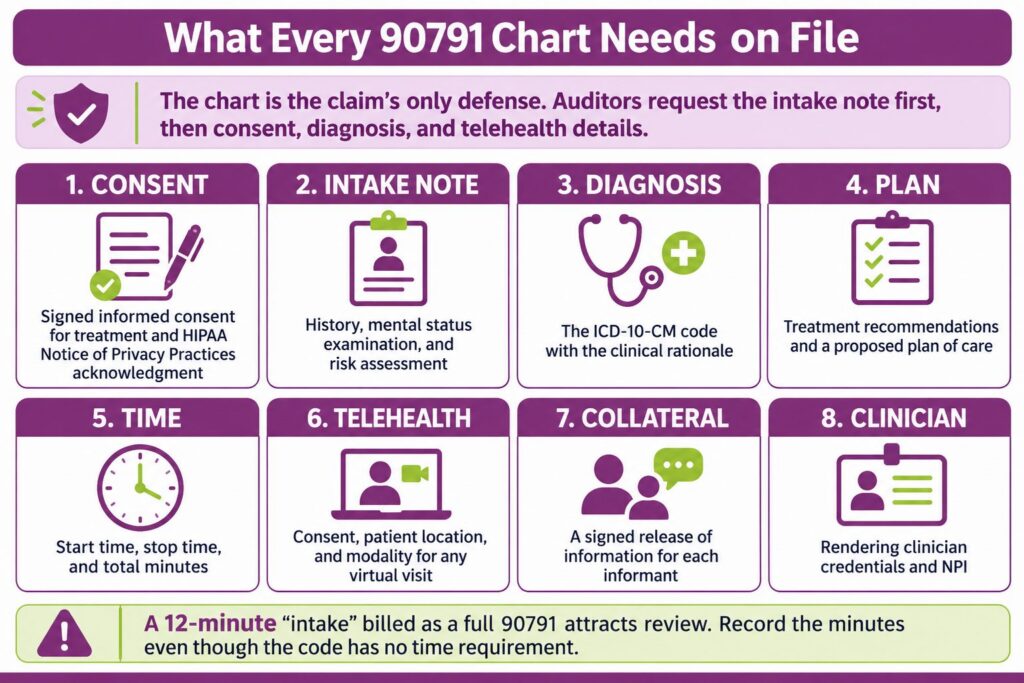
A 90791 claim needs a chart that proves a full diagnostic evaluation took place. Auditors request the intake note first. They then check consent, the diagnosis, and the telehealth details.
Keep these documents on file for every evaluation:
- Signed informed consent for treatment and acknowledgment of the HIPAA Notice of Privacy Practices
- Complete intake note with history, mental status examination, and risk assessment
- Diagnosis with the matching ICD-10-CM code and clinical rationale
- Treatment recommendations and a proposed plan of care
- Start time, stop time, and total minutes
- Telehealth consent, patient location, and modality for any virtual visit
- Signed release of information for each collateral informant
- Rendering clinician credentials and National Provider Identifier (NPI)
What Is the Cost of CPT Code 90791?
The cost of CPT code 90791 is the amount a payer reimburses for the evaluation. Medicare publishes the benchmark each year in the Physician Fee Schedule (PFS). Commercial plans and state Medicaid programs set their own rates, and many start from the Medicare scale.
Three variables set the final amount: the setting, the credential of the clinician, and the payer. A telehealth visit adds a fourth variable, the place of service. The subsections below break down each variable with current figures.
2026 Medicare Payment for CPT 90791
Medicare’s 2026 national payment for 90791 is $173.35 in a non-facility setting and $137.28 in a facility setting. The non-facility amount rose 3.9 percent from $166.91 in 2025. Locality adjustments move the figure up or down in each MAC region.
| Setting | 2025 national rate | 2026 national rate | Change |
|---|---|---|---|
| Non-facility (office, home via POS 10) | $166.91 | $173.35 | +3.9% |
| Facility (hospital, POS 02 telehealth) | $142.97 | $137.28 | -4.0% |
The facility rate fell, consistent with the 2026 final rule that cut indirect practice expense values for facility-based services by 50 percent. Part B pays 80 percent of the allowed amount after the deductible. The patient owes the remaining 20 percent coinsurance.
The 2026 figures apply through December 31, 2026. On November 4, 2026, CMS finalized the CY 2027 fee schedule. The conversion factor for clinicians who are not qualifying APM participants drops 2.31 percent, from $33.40 to $32.63. Qualifying APM participants see a 1.83 percent cut, from $33.57 to $32.95. Both reflect the expiration of the one-year 2.5 percent increase Congress enacted for 2026. Expect downward pressure on 2027 payment for 90791 unless Congress or RVU changes offset the cut.
Why CSWs, MFTs, and MHCs Are Paid at 75 Percent
Medicare law pays clinical social workers (CSWs) 75 percent of the physician fee schedule amount for covered services. Marriage and family therapists (MFTs) and mental health counselors (MHCs) joined Medicare on January 1, 2024. The Consolidated Appropriations Act of 2023 set their payment at the same 75 percent.
| Provider type | Percent of fee schedule | 2026 non-facility amount | 2026 facility amount |
|---|---|---|---|
| Psychiatrist or clinical psychologist | 100% | $173.35 | $137.28 |
| Nurse practitioner, PA, or clinical nurse specialist | 85% | $147.35 | $116.69 |
| CSW, MFT, or MHC | 75% | $130.01 | $102.96 |
These practitioners accept Medicare assignment. The allowed amount is payment in full once the patient pays coinsurance. The figures above use national averages, so verify the locality rate in your MAC fee schedule file before you budget revenue.
Telehealth Place of Service and Payment Rates
Place of service decides which Medicare rate a telehealth evaluation receives. POS 10 means the patient is at home and pays the non-facility rate. POS 02 means the patient is anywhere else and pays the lower facility rate. The gap is $36.07 per evaluation.
| Scenario | Place of service | Modifier | Rate basis |
|---|---|---|---|
| Video visit, patient at home | 10 | 95 where required | Non-facility, $173.35 |
| Video visit, patient at a clinic or other site | 02 | 95 where required | Facility, $137.28 |
| Audio-only visit, patient at home | 10 | 93 | Non-facility, $173.35 |
Coders often choose POS 02 from habit, and the practice loses revenue on every home-based evaluation. Add a prompt in the scheduling workflow that records the patient’s location at the start of each visit. Host sites can bill Q3014 ($31.85, paid at 80%), but not for home visits.
Commercial Payers, Medicaid, and Prior Authorization
Commercial rates vary by payer, region, and contract. PayerPrice’s national payer-file averages put Cigna near $205 and Blue Cross Blue Shield near $184, both above Medicare. UnitedHealthcare averages near $160 and Aetna near $164, both below it. These are all-clinician national averages, not local contracted rates.
State Medicaid programs publish their own fee schedules, and many pay by clinician license level. Managed Medicaid plans may apply a behavioral health carve-out vendor with separate rules. Most payers do not require prior authorization for a first diagnostic evaluation. Many require it for psychological testing, intensive outpatient care, and extended therapy.
Verify these items before the intake appointment:
- Active eligibility and behavioral health benefits
- Whether a carve-out vendor manages mental health claims
- Annual limits on 90791 or on evaluations per episode
- Telehealth coverage, accepted modifiers, and place of service rules
What Are Example Clinical Scenarios or Use Cases for CPT Code 90791?
The four scenarios below cover the situations that generate most 90791 questions. Each one shows the correct code set and the documentation that supports it. Use them as templates for front desk scripts and coder training.
Scenario 1: Initial Intake Evaluation by a Licensed Clinical Social Worker
A 68 year old Medicare patient seeks care for persistent low mood and poor sleep. A licensed clinical social worker completes a 60 minute in-person intake. The evaluation covers history, mental status, risk, and a recommended plan of care.
Claim details for this visit:
- CPT code 90791 with ICD-10-CM F32.1
- Place of service 11 for the office
- No modifier needed for an in-person visit
- Expected Medicare payment near $130.01 at the 75 percent rate, before locality adjustment
The clinician schedules therapy for the following week. That first therapy visit can be billed as 90834 or 90837 on its own date.
Scenario 2: A Child Evaluation Completed Across Two Sessions With a Parent Informant
An eight year old is referred for attention and behavior concerns. The first session is a parent interview about developmental history and school reports. The second session is a play-based interview with the child.
CPT allows 90791 more than once for a patient when separate evaluations involve other informants. Report each session on its own date of service. Add +90785 when a listed factor, such as play equipment used to overcome a communication barrier or maladaptive communication among informants, complicates the evaluation. Name the factor in the note for each claim.
Payers differ on parent-only sessions, and some deny them without the patient present. Check policy first.
Scenario 3: An Intake Where the Clinician Also Begins Therapy the Same Day
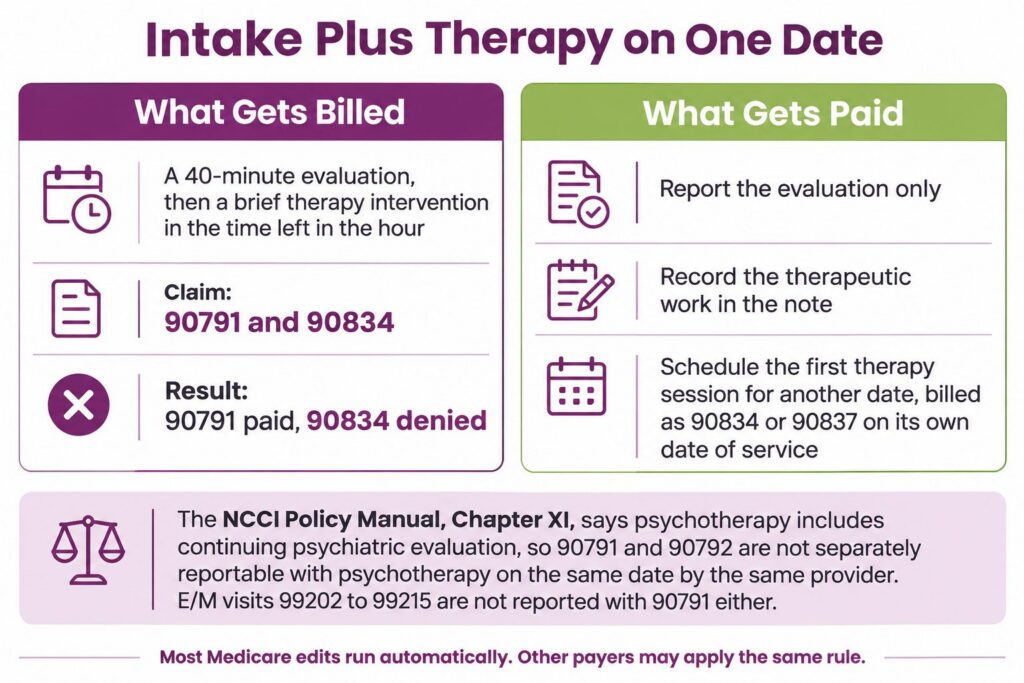
A counselor finishes a 40 minute evaluation with time left in the hour and starts a brief therapy intervention. The clinician wants to bill 90791 and 90834 for the same date. The payer pays 90791 and denies 90834.
CPT guidelines bar psychotherapy codes on the same day as 90791. The NCCI edits enforce that rule, and modifier 59 does not override it. Report the evaluation only. Record the therapeutic work in the note, and schedule the first therapy session for another date.
Scenario 4: An Audio-Only Intake With the Patient at Home
A Medicare patient lives in a rural area, has no smartphone with video, and cannot travel. The clinician completes the intake by phone with the patient at home. Medicare allows audio-only behavioral health telehealth in this situation.
Claim details for this visit:
- CPT code 90791 with modifier 93
- Place of service 10
- Documentation of why video was not available or was declined
- Patient location, consent, and identity verification recorded in the note
Medicare’s in-person visit requirement for behavioral telehealth is delayed through 2027, so the clinician does not need a prior in-person visit. Plans outside Medicare set their own audio-only rules.
What Are the CPT Code 90791 Rules To Ensure Successful Reimbursement?
Most 90791 denials trace back to a short list of rules. They concern same-day combinations, frequency, telehealth, documentation, and credentials. Build each rule into the claim scrubber so errors stop before submission.
The subsections below cover each rule and end with a denial table. Treat the table as a checklist for your billing team and for the coders who review rejected claims.
Same-Day Code Combinations That Deny With 90791
CPT guidelines and NCCI edits block several same-day pairings with 90791. Most of these denials are preventable at scheduling. The modifier does not fix them, because the restriction comes from the CPT instruction itself.
| Combination billed with 90791 | Result | Reason | Fix |
|---|---|---|---|
| 90832, 90834, 90837, or add-ons 90833, 90836, 90838 | Denied | CPT bars psychotherapy on the same day as a diagnostic evaluation | Report 90791 only and book therapy for another date |
| 90839 or +90840 crisis psychotherapy | Denied | CPT says not to report crisis codes with 90791 | Report the code that best describes the service |
| 99202-99215 by the same provider | Denied | Same-day E/M by the same individual is bundled | Choose one service |
| 90792 for the same patient and date | Denied | Only one diagnostic evaluation per day | Select the code that matches the work |
Frequency Rules and Payer Limits on Repeat Evaluations
Medicare does not publish a fixed annual cap for 90791. The code is reported once per day, and repeat evaluations need medical necessity. Commercial and Medicaid plans often set limits per year, per provider, or per episode of care.
When a repeat evaluation is justified, build a documentation pattern:
- State why the earlier evaluation no longer answers the clinical question
- Identify the new informant, episode, or change in condition
- List the new information gathered at this visit
Track evaluation dates by patient in the practice management system, and set an alert at scheduling.
Medicare Telehealth Rules for an Initial Behavioral Health Evaluation Through 2027
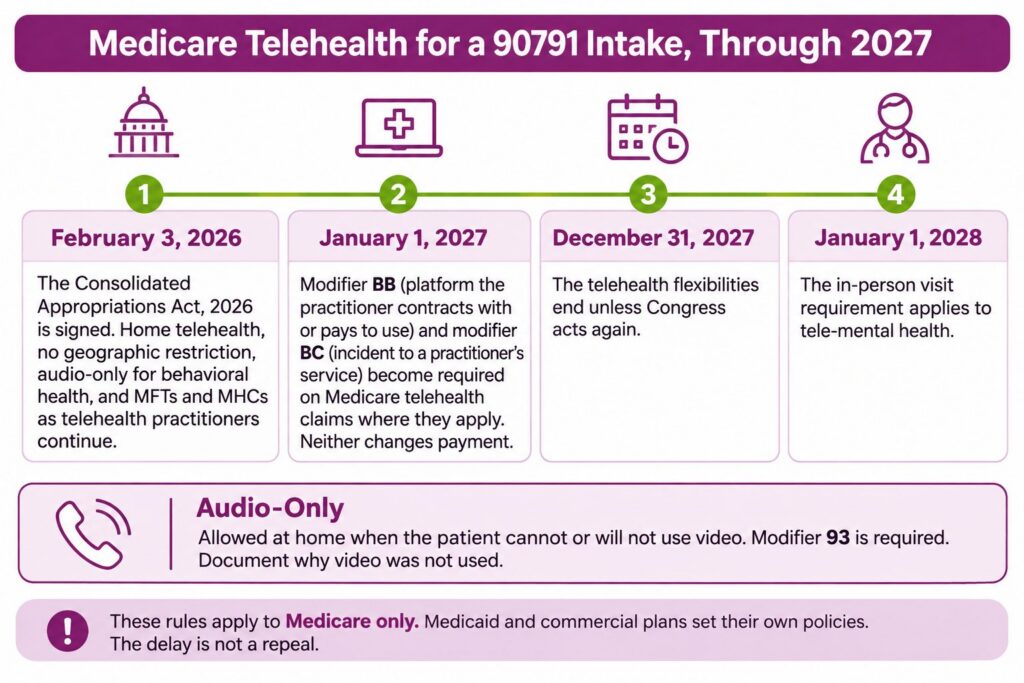
The Consolidated Appropriations Act of 2026 was signed on February 3, 2026. It extends key Medicare telehealth flexibilities through December 31, 2027. The CY 2027 final rule restates those dates for payment policy.
Rules that apply to a Medicare 90791 telehealth evaluation:
- Behavioral health telehealth is available from the patient’s home with no geographic restriction
- The in-person visit requirement is delayed, and it applies from January 1, 2028 unless Congress acts again
- Audio-only visits are allowed for behavioral health when the patient is at home and cannot or will not use video
- Modifier 93 is required on audio-only claims
- MFTs and MHCs are eligible telehealth practitioners
These rules apply to Medicare only. Medicaid and commercial plans set their own policies. Keep in-person scheduling and documentation workflows ready, because the delay is not a repeal.
Documentation Elements That Separate a Diagnostic Evaluation From a Therapy Session
Payers use the note to decide whether the visit was an evaluation or a therapy session. A note that reads like therapy invites a downcode or a denial. The two note types serve different purposes.
| Element | Diagnostic evaluation (90791) | Therapy session (90834 or 90837) |
|---|---|---|
| Purpose | Establish a diagnosis and plan | Treat an existing condition |
| Core content | History, mental status, risk, diagnosis | Interventions, patient response, progress |
| Time | Start, stop, and total minutes recommended | Total minutes required to select the code |
| Treatment plan | Recommended plan of care | Updates to the existing plan |
| Output | Diagnosis, medical necessity, referral needs | Progress toward goals |
Write the diagnosis rationale in plain clinical language. Tie each ICD-10-CM code to symptoms and findings recorded in the note. An evaluation that lists a diagnosis without supporting findings fails an audit even when the visit was thorough.
Top Reasons For Denials Specific To 90791 & Quick Remedies
The denial patterns below appear repeatedly in 90791 claim reviews. Each has a direct remedy that a coder can apply before resubmission.
| Denial reason | Why it happens | Quick remedy |
|---|---|---|
| Same-day psychotherapy billed | Therapy started during the intake visit | Remove the psychotherapy line and schedule therapy separately |
| Same-day E/M by the same provider | Medication or medical review added to the intake | Bill 90792 or an E/M, not both with 90791 |
| Frequency limit exceeded | Repeat evaluation inside the payer window | Appeal with documentation of a separate evaluation |
| Telehealth modifier or POS error | Missing 95 or 93, or POS 02 used for a home visit | Correct the modifier and POS, then resubmit |
| Rendering provider not enrolled or eligible | MFT, MHC, or associate not credentialed with the payer | Confirm enrollment and bill under the eligible clinician |
| Diagnosis not covered | Z code or unspecified code listed first | Report the most specific supported diagnosis |
Run three claim scrubber edits before submission. Block psychotherapy and E/M codes on a 90791 date. Flag POS 02 for any home visit. Require a named factor whenever +90785 appears. These three edits stop most avoidable 90791 denials. Practices without in-house coding depth can hand them to psychiatry billing services that enforce the edits at scheduling and at claim submission.
FAQs
What is CPT code 90791, and how is it different from 90792?
CPT 90791 is a psychiatric diagnostic evaluation without medical services. It covers the biopsychosocial history, mental status exam, risk assessment, diagnosis, and treatment recommendations. It has no time requirement and no prescribing component. CPT 90792 uses the same framework but adds a medical service, such as a physical exam or a medication decision, so only prescribers can support it.
How much does Medicare pay for CPT 90791 in 2026?
The national Medicare rate is $173.35 in a non-facility setting and $137.28 in a facility setting, before locality adjustment. Psychiatrists and clinical psychologists are paid 100% of the fee schedule, nurse practitioners, PAs, and clinical nurse specialists 85%, and clinical social workers, MFTs, and mental health counselors 75%, which works out to about $130.01 non-facility. The CY 2027 final rule cuts the conversion factor by 2.31% for non-APM clinicians, so expect downward pressure on 2027 payment.
Can CPT 90791 be billed on the same day as psychotherapy or an E/M visit?
No. CPT guidelines bar same-day psychotherapy codes (90832, 90834, 90837 and their add-ons) with 90791, and the crisis codes 90839 and +90840 are barred too. A same-day E/M by the same provider is bundled, and modifier 59 does not override any of these restrictions. If therapy begins during the intake, bill the evaluation only and schedule the first therapy session for another date.
Which place of service and modifier apply to a telehealth 90791?
Place of service sets the rate. POS 10 (patient at home) pays the non-facility rate, and POS 02 (patient anywhere else) pays the lower facility rate, a gap of $36.07 per evaluation. Modifier 95 marks audio-video visits and is required by many commercial and Medicaid payers, while Medicare professional claims rely on the POS code instead. Modifier 93 is required on Medicare audio-only claims, and the patient must be at home. Medicare’s in-person visit requirement for behavioral telehealth is delayed through 2027.
Can CPT 90791 be reported more than once for the same patient?
Yes, but only once per calendar date and only with documented medical necessity. Valid reasons include a child evaluation split across sessions with the patient and with parents, a new episode of illness after a long gap in care, a major change in condition, or a transfer to a new clinician. Each repeat claim must explain why the earlier evaluation no longer answers the clinical question. Many commercial and Medicaid payers cap evaluations per year, per provider, or per episode, so verify the limit before submitting.