CPT code 11730 is a surgical procedure code used to report partial or complete simple avulsion of a single nail plate. Procedure code 11730 covers the separation and removal of the entire nail plate, or a portion of it, from the nail bed and underlying structures, including the full length of the nail border to and under the eponychium.
CPT 11730, also referred to as podiatry code 11730, is reported once per nail as the primary code. When additional nails are avulsed in the same encounter, add-on code CPT 11732 is reported for each subsequent nail with the appropriate digit-specific modifier. Between digit modifiers, per-digit frequency windows, and add-on sequencing, many practices lean on dedicated podiatry medical billing services to keep 11730 claims clean.
What Is the Description of CPT Code 11730?
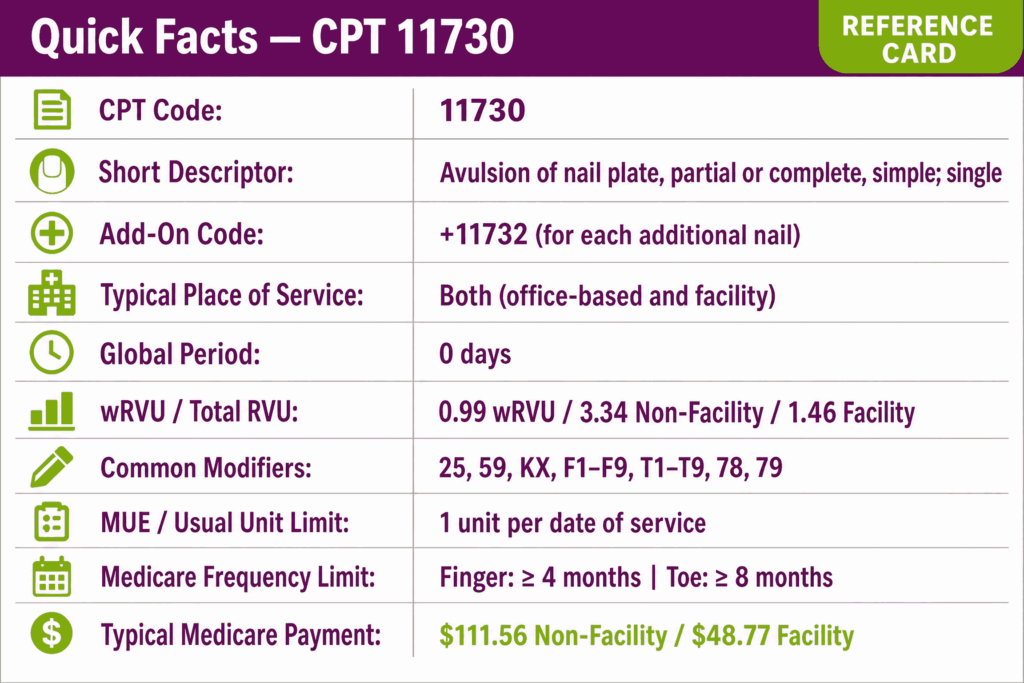
11730 CPT code description as defined by the AMA is: “Avulsion of nail plate, partial or complete, simple; single.”
Effective January 1, 2026, the short descriptor was updated reflecting the current CPT code set. Code 11730 CPT covers both partial avulsion, removal of one or both nail borders, and complete avulsion of the entire nail plate, provided the procedure is simple and performed on a single nail. A nail avulsion under procedure code 11730 typically requires injected local anesthesia except when the digit is devoid of sensation or anesthesia is otherwise medically contraindicated.
What Does Nail Plate Avulsion Include for CPT Code 11730?
The procedure reported under CPT code 11730 involves separation and removal of the nail plate, either partially along one or both lateral borders, or completely, from the nail bed. Per CMS Billing and Coding Article A52998, the avulsion must include the full length of the nail border to and under the eponychium to be correctly reported as 11730 CPT code.
Local anesthetic administration, nail plate loosening, and any wound dressing applied at the conclusion of the procedure are included in procedure code 11730 and are not separately reportable for the same digit on the same date. When both the lateral and medial borders of a single nail are involved, per CMS A52998, a separate code for each border is not reported. Only one unit of CPT code 11730 applies per nail per date of service.
How Does CPT Code 11730 Differ From CPT 11732 and CPT 11750?
These codes cover related but distinct services within nail surgery:
- CPT 11732: Avulsion of nail plate, partial or complete, simple; each additional nail plate (add-on code). Used for every nail avulsed beyond the first in the same encounter. CPT code 11732 is never reported without CPT code 11730 as the primary code and must carry the appropriate digit-specific modifier for each additional nail
- CPT 11750: Excision of nail and nail matrix, partial or complete (e.g., ingrown or deformed nail) for permanent removal. This is a more extensive procedure than podiatry code 11730. It requires not only the removal of the nail plate but also the destruction or permanent removal of the associated nail matrix. CPT 11750 code carries a 10-day global period, unlike CPT code 11730, which carries 0 days
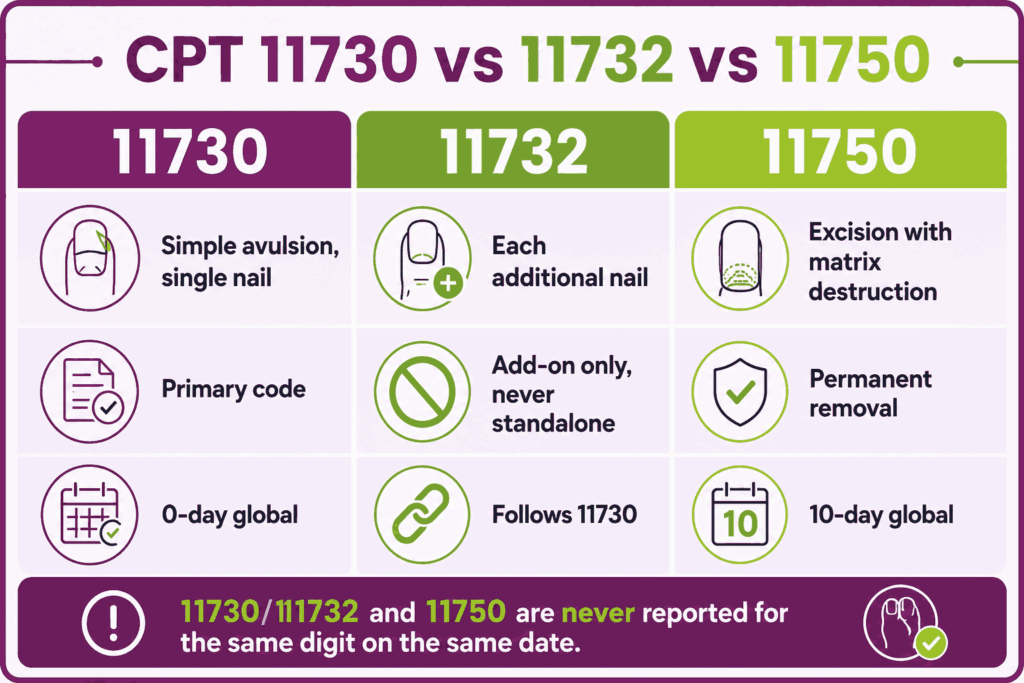
Per CMS Billing and Coding Articles A52998 and A59028, CPT code 11730 or 11732 and CPT 11750 must not be reported for the same digit on the same date of service. Only one procedure code applies per nail per encounter.
When Is Bilateral or Multi-Nail Avulsion Reported and How Does Add-On Code 11732 Apply?
When nail avulsion is performed on two or more nails in a single encounter, CPT code 11730 is reported once as the primary code for the first nail avulsed, and code CPT 11732 is reported once for each additional nail. Each instance of CPT 11732 must carry a separate digit-specific modifier identifying the specific nail treated.
For example, avulsion of three toenails in one encounter is reported as:
- CPT 11730 + appropriate toe modifier (first nail)
- CPT 11732 + appropriate toe modifier (second nail)
- CPT 11732 + appropriate toe modifier (third nail)
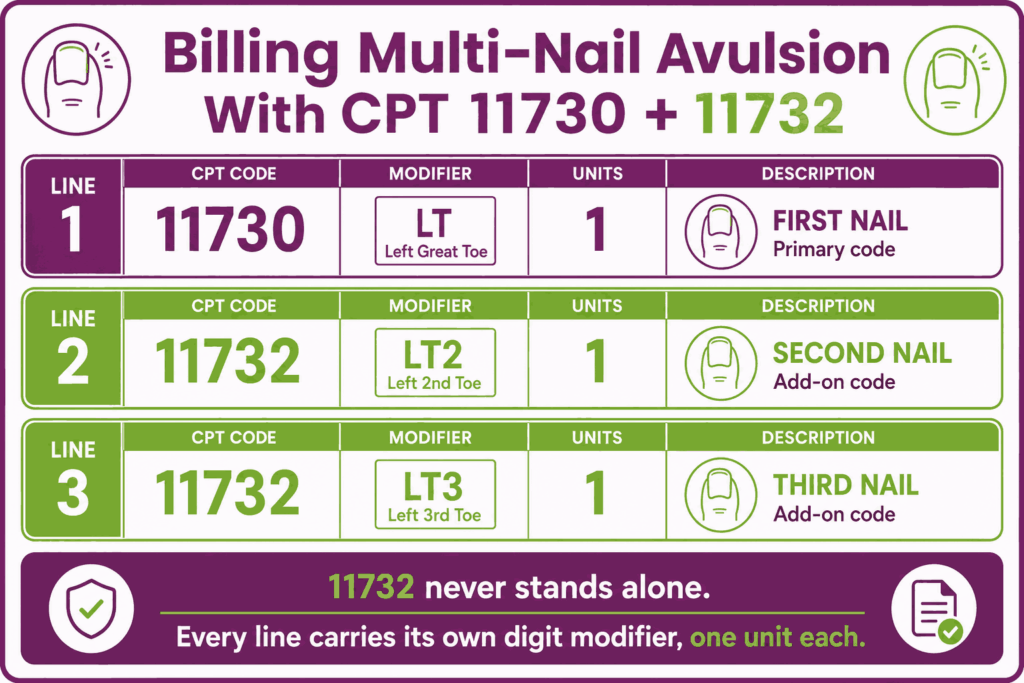
Per CMS A59028, each add-on code is reported with one unit of service. CPT 11732 is never reported as a standalone code and is not subject to its own frequency restriction independently. The per-digit frequency restriction applies to each specific nail based on its prior avulsion date.
What Are the Modifiers for CPT Code 11730?
CPT 11730 code requires digit-specific modifiers on every claim and may also use circumstance modifiers to identify distinct procedural contexts and global period situations.
Modifier 25: Significant, Separately Identifiable E/M on Same Day
Modifier 25 is appended to the E/M service code, not to CPT code 11730, when a significant, separately identifiable evaluation and management service is performed on the same day as the nail avulsion. The E/M must represent work beyond the pre-service assessment included in the avulsion and must be documented separately. Append modifier 25 to the E/M code to support separate reimbursement alongside procedure code 11730.
Modifier 59: Distinct Procedural Service
Modifier 59 is used when the 11730 CPT code is performed as a distinct and separately identifiable service from another procedure on the same date. Append modifier 59 to CPT code 11730 only when documentation supports the distinct nature of the service and an NCCI edit would otherwise bundle it with another service on the same claim.
Modifier KX: Medical Necessity Requirements Met (Repeat Avulsion Exception)
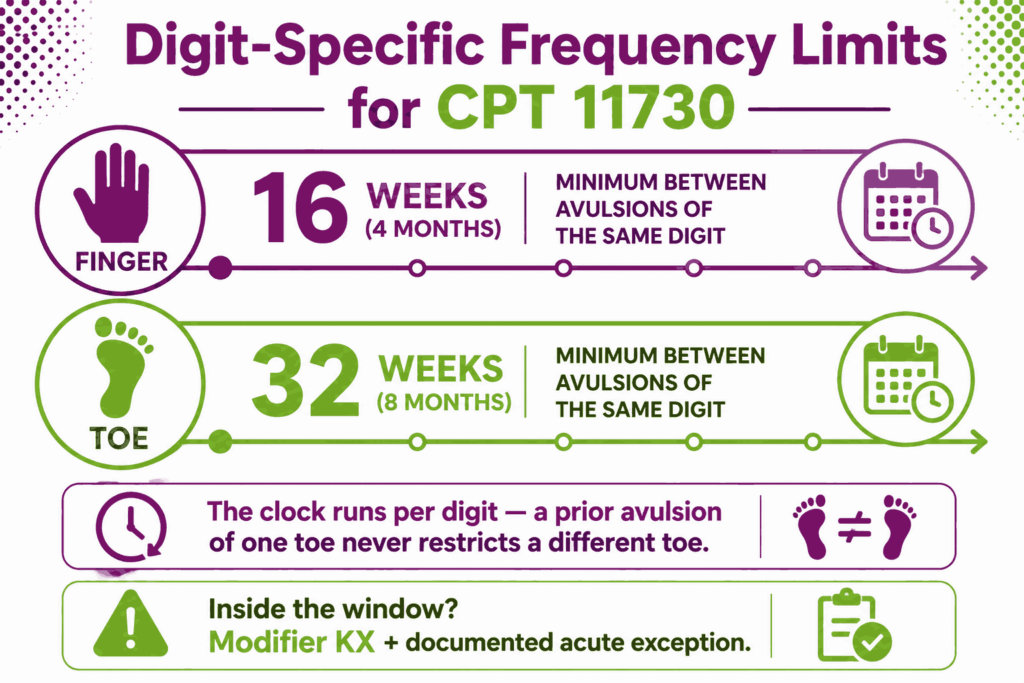
Modifier KX is used when CPT code 11730 is performed within the standard Medicare frequency restriction period, less than 16 weeks for a finger or less than 32 weeks for a toe. And the provider can document that the repeat avulsion is medically necessary due to an acute clinical condition such as recurrent infection, re-growth with renewed periungual involvement, or other compelling clinical basis. Append modifier KX to procedure code 11730 and ensure the medical record contains explicit documentation of the clinical justification supporting the exception to the standard frequency limitation.
Modifiers F1–F9: Finger Digit Identification
HCPCS Level II F-modifiers identify the specific finger on which podiatry code 11730 was performed. CMS Billing and Coding Article A52998 requires digit-specific modifiers on all nail procedure claims. The F-modifier set covers:
- FA: Left hand, thumb
- F1: Left hand, 2nd digit
- F2: Left hand, 3rd digit
- F3: Left hand, 4th digit
- F4: Left hand, 5th digit
- F5: Right hand, thumb
- F6: Right hand, 2nd digit
- F7: Right hand, 3rd digit
- F8: Right hand, 4th digit
- F9: Right hand, 5th digit
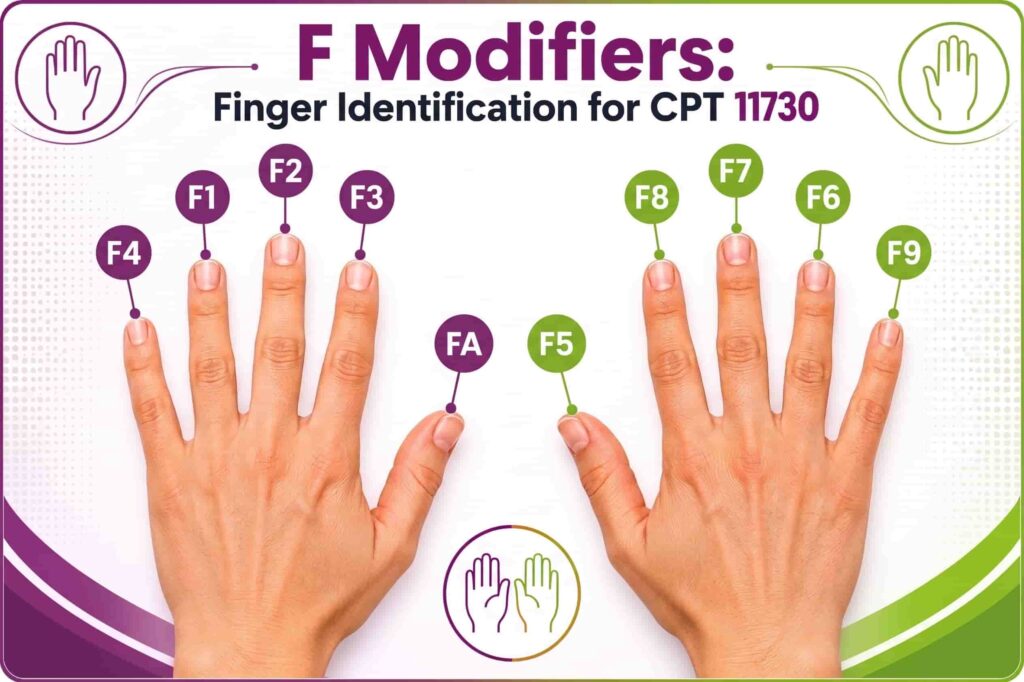
Append the appropriate F-modifier to CPT code 11730 and to each unit of CPT 11732 when nail avulsion involves finger nails.
Modifiers T1–T9: Toe Digit Identification
HCPCS Level II T-modifiers identify the specific toe on which CPT code 11730 was performed. The T-modifier set covers:
- TA: Left foot, great toe
- T1: Left foot, 2nd digit
- T2: Left foot, 3rd digit
- T3: Left foot, 4th digit
- T4: Left foot, 5th digit
- T5: Right foot, great toe
- T6: Right foot, 2nd digit
- T7: Right foot, 3rd digit
- T8: Right foot, 4th digit
- T9: Right foot, 5th digit
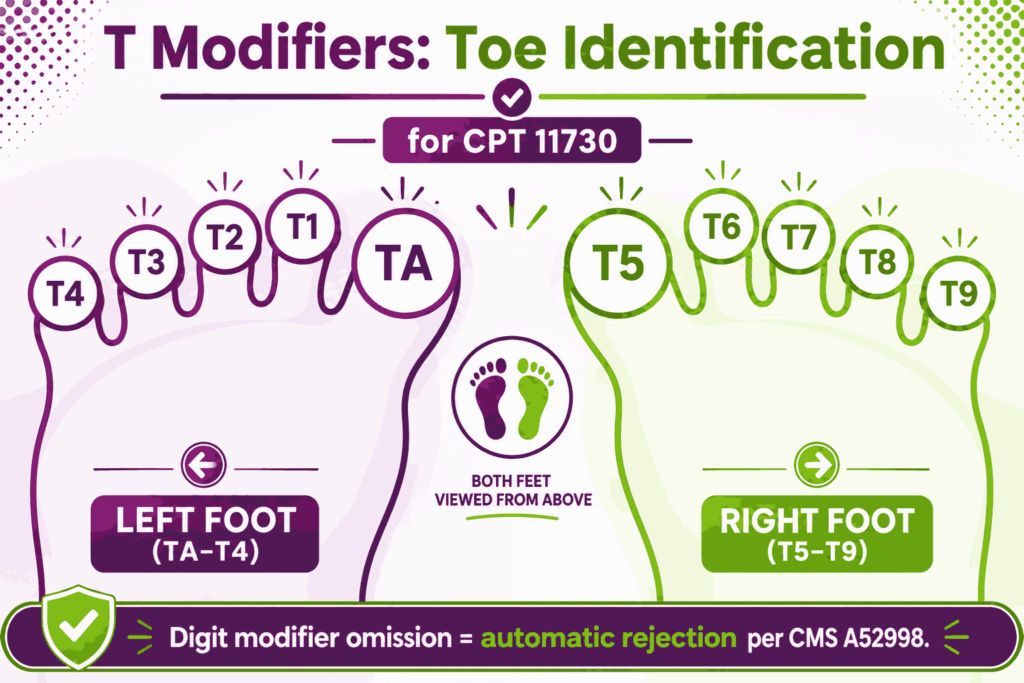
Append the appropriate T-modifier to CPT code 11730 and to each unit of CPT 11732 when nail avulsion involves toenails. Digit modifier omission is a primary cause of claim rejection for procedure code 11730.
Modifier 78: Unplanned Return to Operating Room During Global Period
Modifier 78 applies to CPT code 11730 in the rare circumstance where an unplanned return to the procedure room for a complication related to a prior nail procedure is required during that procedure’s global period. Since 11730 CPT code carries a 0-day global period, modifier 78 would apply if the avulsion is being performed as an unplanned return related to a procedure with an active global period performed on the same digit. Append modifier 78 and document the complication in the medical record.
Modifier 79: Unrelated Procedure During Global Period
Modifier 79 is appended to CPT code 11730 when the nail avulsion is performed during the global period of a prior unrelated surgical procedure. Since CPT code 11730 itself carries a 0-day global period, modifier 79 applies only when the 11730 CPT code is performed within another code’s global period, and the services are unrelated. Document that the nail avulsion is unrelated to the prior surgical service.
Which Documents Are Required For CPT Code 11730?
Per CMS Billing and Coding Article A52998, documentation for CPT code 11730 must include specific elements in the operative note or in progress notes related to a recent or contemporaneous E/M encounter.
Required documents checklist:
- Patient’s primary symptoms and description of prior treatment, if any
- Description of the nail(s) at the time of avulsion, including condition, appearance, and clinical findings supporting the procedure
- Specific nail(s) treated with laterality and digit documented (supports digit modifier selection)
- Type of avulsion performed, partial or complete, and which border(s) were involved
- Anesthesia administered, type, agent, and whether it was injected or omitted, with documented clinical rationale
- Clinical diagnosis supporting medical necessity (qualifying ICD-10 code per CMS coverage lists)
- Postoperative wound care instructions
- For repeat avulsion within frequency restriction: explicit clinical documentation of the acute condition justifying the exception (supports modifier KX)
- If another service was provided alongside podiatry code 11730, full documentation of the medical need for the additional service, and a description of that procedure
What is the Cost of CPT Code 11730?
The cost of CPT code 11730 varies by payer, place of service, and geographic location.
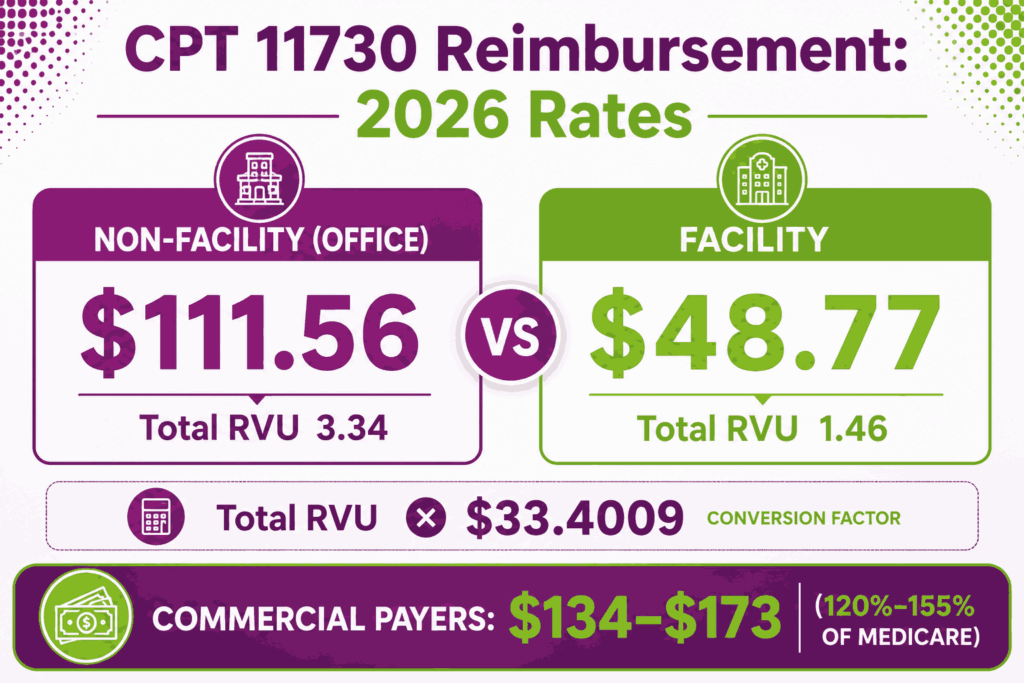
RVUs & Medicare Payment
CMS sets the baseline pricing for nail avulsion 11730 code through specific allocations of Relative Value Units (RVUs). For 2026, the Work RVU (wRVU) is finalized at 0.99, which accounts for the mandatory -2.5% efficiency reduction applied to non-time-based therapeutic procedures.
In a private office setting, the Total Non-Facility RVU stands at 3.34 to factor in clinical supplies, local anesthetics, and instrument sterilization. Multiplied by the 2026 standard conversion factor of $33.4009, the national unadjusted office allowance is $111.56. If performed inside a facility, the practice overhead shifts to the institution, dropping the Total Facility RVU to 1.46 and lowering the direct physician payment to $48.77.
Coding Tip: CPT 11730 holds a 0-day global period. Unlike permanent nail excisions that include a 10-day global window, subsequent follow-up visits for dressing changes or healing checks may be billable if a separate, medically necessary evaluation is documented.
Commercial Payers
Private commercial insurance networks typically establish their fee schedules for 11730 at a premium, ranging between 120% and 155% of the standard Medicare baseline. This positions typical commercial allowable amounts for an office-based procedure between $134 and $173. To bypass automated claim rejections from private carriers in 2026, billing teams must strictly monitor NCCI edits.
Place-of-Service & Geographic Adjustments
CPT code 11730 is most commonly performed in the office setting (POS 11) and carries a higher non-facility Medicare rate due to practice expense RVUs allocated for office-based procedure equipment and supplies. Operating within a private clinic (POS 11) allows the practice to claim the full global fee of $111.56 to absorb all equipment and staffing overhead.
Conversely, if the avulsion takes place within a hospital outpatient department (POS 22) or an ambulatory surgical center (POS 24), the practitioner collects only the professional resource fee of $48.77.
What Are Example Clinical Scenarios or Use Cases for CPT Code 11730?
CPT code 11730 applies when a partial or complete simple nail avulsion is performed on a single nail, supported by a documented clinical indication and appropriate diagnostic coding.
Scenario 1: Partial Nail Avulsion for Acute Ingrown Toenail With Periungual Inflammation
ICD-10: L60.0 (Ingrowing nail)
A patient presents with an acutely painful ingrown left great toenail with surrounding erythema, swelling, and granulation tissue along the medial border. Conservative management has been unsuccessful. After local anesthetic infiltration, the podiatrist performs partial nail avulsion of the medial nail border to and under the eponychium. CPT code 11730 is reported with modifier TA (left foot, great toe). No matrix destruction is performed, confirming the 11730 CPT code rather than the 11750.
Scenario 2: Complete Nail Plate Removal Due to Subungual Abscess
ICD-10: L60.8 (Other nail disorders, reported standalone per CMS A52998 for subungual abscess)
A patient presents with a subungual abscess under the right hallux nail with a significant purulent collection. The podiatrist performs a complete nail plate avulsion under local anesthesia to fully expose and drain the abscess. The nail matrix is left intact. Procedure code 11730 is reported with modifier T5 (right foot, great toe), confirmed by documentation of complete nail plate removal without matrix destruction.
Scenario 3: Traumatic Nail Avulsion Requiring Formal Surgical Removal of Loosened Plate
ICD-10: S90.111A (Contusion of right great toe without damage to nail, initial encounter)
A patient presents with a crush injury to the right second toe. Examination reveals a partially avulsed nail plate with a significant subungual hematoma and an unstable nail plate that cannot be preserved. The physician performs a formal surgical avulsion of the loosened plate under digital block anesthesia. CPT code 11730 is reported with modifier T6 (right foot, 2nd digit) with documentation confirming the traumatic indication and the need for formal avulsion rather than simple trimming.
What Are the CPT Code 11730 Rules To Ensure Successful Reimbursement?
Follow CMS, MAC, and payer-specific rules for digit identification, frequency, bundling, and documentation. Meeting these rules reduces denials and ensures correct payment for podiatry code 11730.
Bundling / NCCI / Same-Day Procedure Rules
Per CMS Billing and Coding Article A59028, CPT code 11730 or CPT 11732 must not be reported alongside CPT 11750 (excision with permanent matrix removal) or CPT 11765 (wedge excision of nail fold) for the same digit on the same date of service. Only one of these nail procedure codes applies per nail per encounter.
When different nail procedures are performed on different nails on the same date, each nail is reported separately with its appropriate primary or add-on code and digit modifier. Verify NCCI edits before billing procedure code 11730 alongside other integumentary codes on the same claim. Cross-checking edits against related podiatry CPT codes before submission prevents the bulk of bundling denials on nail surgery claims.
Units, MUEs & Medicare Digit-Specific Frequency Restrictions
CPT code 11730 is billed as one unit per digit per date of service.
- Per CMS Billing and Coding Articles A52998 and A59028, claims for CPT code 11730 and CPT 11732 will be denied when billed for the same finger within 16 weeks (4 months) or the same toe within 32 weeks (8 months) of a previous avulsion of that specific digit. That is, unless the provider documents a qualifying acute medical exception and appends modifier KX
- The frequency restriction is digit-specific. A prior avulsion of one toe does not restrict the avulsion of a different toe within the restriction period
- CPT code 11730 carries a 0-day global period, follow-up visits, wound checks, and dressing changes after nail avulsion are separately billable by the performing physician without global period restrictions
- When avulsion involves multiple nails in one encounter, CPT 11730 is reported once for the first nail, and CPT 11732 is added for each subsequent nail. The number of CPT 11732 units equals the total number of additional nails beyond the first
When CPT 11730 Cannot Be Billed, and CPT 11750 Must Be Used Instead
CPT code 11730 cannot be reported, and CPT 11750 must be used in the following circumstances:
- When the nail matrix is permanently destroyed or removed at the same operative session by chemical (e.g., phenol), surgical excision, or laser ablation. Matrix destruction changes the procedure from avulsion (11730) to excision with permanent removal (11750)
- When the procedure is performed for the purpose of permanently preventing nail regrowth, permanent removal intent requires CPT 11750 regardless of technique
- When the procedure is performed under the same operative session as a wedge excision of the nail fold on the same digit. CPT 11765 code replaces the 11730 CPT code in that specific context per CMS A59028
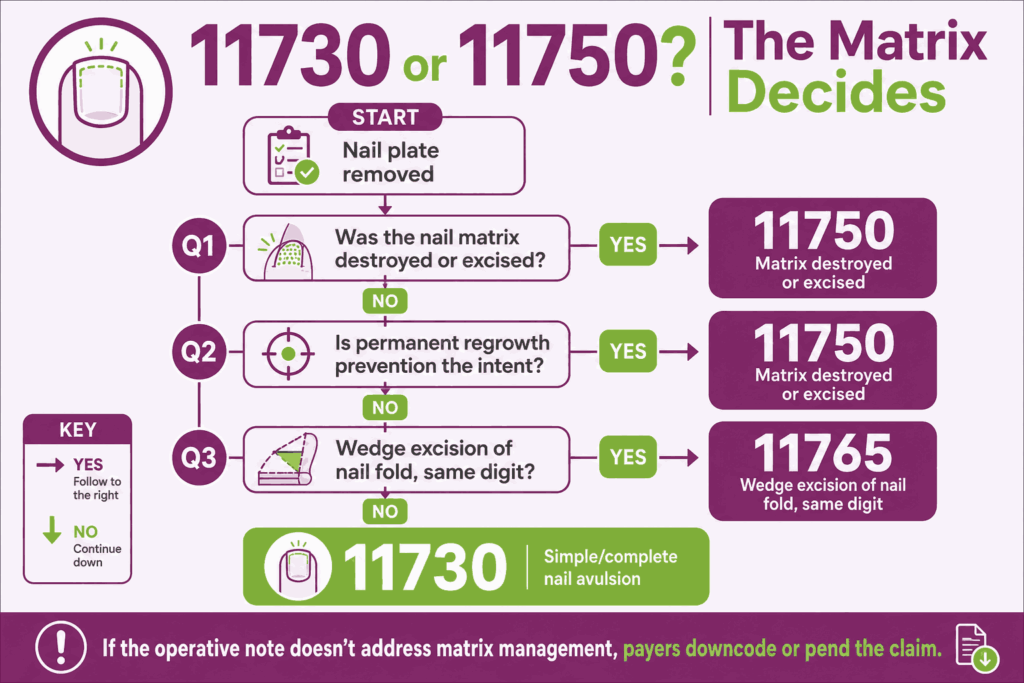
The distinction between CPT code 11730 and procedure code 11750 is documented in the operative note. The presence or absence of matrix destruction is the controlling factor. If the operative note does not explicitly address matrix management, payers may downcode to the 11730 CPT code or request supporting documentation before processing the CPT 11750.
Top Reasons For Denials Specific To 11730 & Quick Remedies
- Missing Digit-Specific Modifier (F or T Modifier): Prevent by appending the appropriate FA/F1–F9 or TA/T1–T9 modifier to every unit of CPT code 11730 and CPT 11732 before submission. Per CMS A52998, digit identification is mandatory, and omission causes automatic rejection.
- 11730 and 11750 Billed for Same Digit Same Date: Prevent by confirming the operative note clearly reflects whether matrix destruction was performed. If the matrix was destroyed, report CPT 11750 only; if not, report podiatry code 11730 only.
- 11732 Reported Without 11730 as the Primary Code: Prevent by confirming CPT code 11730 is always the lead code when multiple nails are avulsed. CPT 11732 is an add-on code and will be denied when submitted without the primary code.
- Incorrect Code for Procedure Performed (11730 vs. 11750): Prevent by reviewing operative notes before coding. If any matrix destruction is documented, CPT 11750 is the correct code, and procedure code 11730 would misrepresent the service.