
An estimated 2 million American adults have been diagnosed with emphysema, according to CDC survey data. That’s roughly 1.6% of adults nationwide, and every one of them eventually gets coded under one of five ICD-10 codes in the J43 family.
Not every term a chart uses maps to its own code, though. Paraseptal, bullous, and centriacinar emphysema all sound like distinct diagnoses, but none of them have a dedicated code of their own. Dedicated pulmonary billing support catches exactly this kind of mismatch before a claim goes out.

This guide breaks down all five emphysema codes, clears up which clinical terms map to which category, and shows where emphysema claims most often go wrong.
Emphysema ICD-10 Codes: Quick Reference
Five codes make up the entire emphysema family in the ICD-10 code set. The table below shows all five side by side, along with what each one actually covers.
| ICD-10 Code | Descriptor | When to Use |
|---|---|---|
| J43.0 | Unilateral pulmonary emphysema (MacLeod’s syndrome) | A rare, distinct condition affecting only one lung, not a severity variant of standard emphysema |
| J43.1 | Panlobular emphysema | Emphysema affecting the entire lobule uniformly, often linked to alpha-1 antitrypsin deficiency |
| J43.2 | Centrilobular emphysema | Emphysema concentrated in the central portion of the lobule, most common in smokers; also called centriacinar |
| J43.8 | Other emphysema | Documented emphysema types that don’t fit the anatomical categories above, including scar emphysema |
| J43.9 | Emphysema, unspecified | No anatomical type documented; also covers bullous, senile, vesicular, and several other clinical terms |
How Is Emphysema Classified in ICD-10?
ICD-10 sorts emphysema by where in the lung the damage sits, and whether it affects one lung or both, not by symptom severity. A chart documenting centrilobular changes on imaging gets a different code than one documenting panlobular involvement.
It comes down to one central question. Does the chart document a specific anatomical pattern, or does it just describe “emphysema” without further detail? That single distinction determines which of the five J43 codes apply.
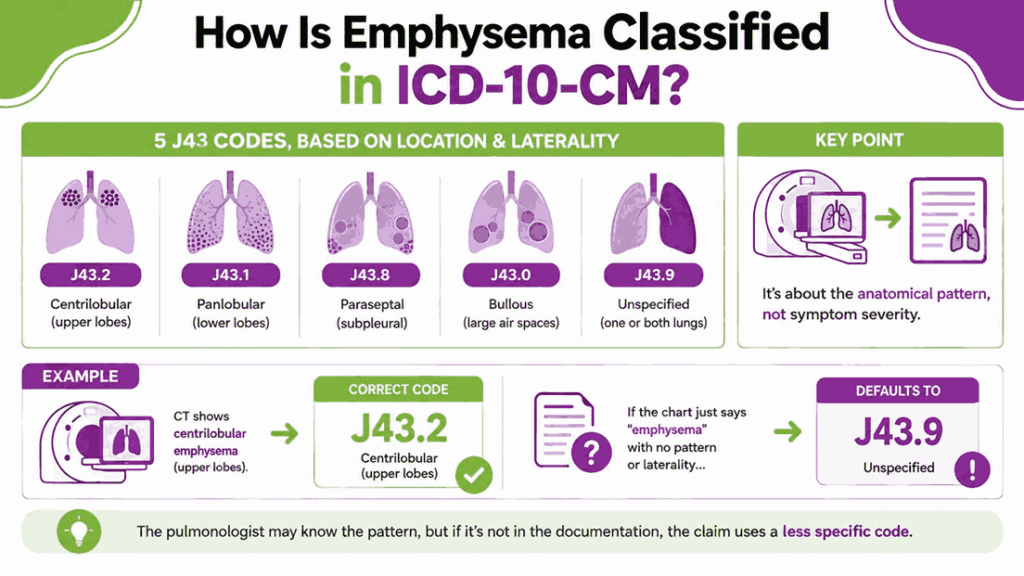
A pulmonologist may know exactly which pattern a CT scan shows, but if that detail never makes it into the documented assessment, the claim defaults to a less specific code regardless of how much clinical information exists. That’s exactly the gap dedicated pulmonology billing support is built to close.
What Determines Which Emphysema Code Applies?
The deciding factor is always anatomical distribution. A patient with severe shortness of breath and a patient with mild symptoms can both carry the same J43 code if their documented anatomical pattern matches, and two patients with identical symptoms can carry different codes if their imaging findings differ.
This is why radiology and pulmonology documentation need to work together on this specific diagnosis. The anatomical detail usually exists somewhere in the patient’s record, but it only affects the code if that detail actually appears in the note the coder is working from.
Anatomical Type vs. Unspecified: The Two Paths Through J43
Every emphysema diagnosis follows one of two paths. The first path applies when a specific anatomical type has been documented: unilateral, panlobular, or centrilobular. That path leads to one of three precise codes, J43.0, J43.1, or J43.2, each tied to a distinct anatomical finding.
The second path applies when no specific type is documented, or when the documented type doesn’t fit any of those three anatomical categories. That path leads to either J43.8, for a named but non-matching type like scar emphysema, or J43.9, when nothing more specific is stated.
Most claims land on this second path simply because the chart never specifies an anatomical pattern in the first place. It’s a documentation gap that shows up across nearly every condition in our pulmonology ICD-10 codes guide.
What Is the ICD-10 Code for Centrilobular Emphysema?
The ICD-10 code for centrilobular emphysema is J43.2. This is the most common anatomical pattern of emphysema, and it describes damage concentrated in the center of the lung’s secondary lobule, typically where the respiratory bronchioles sit.
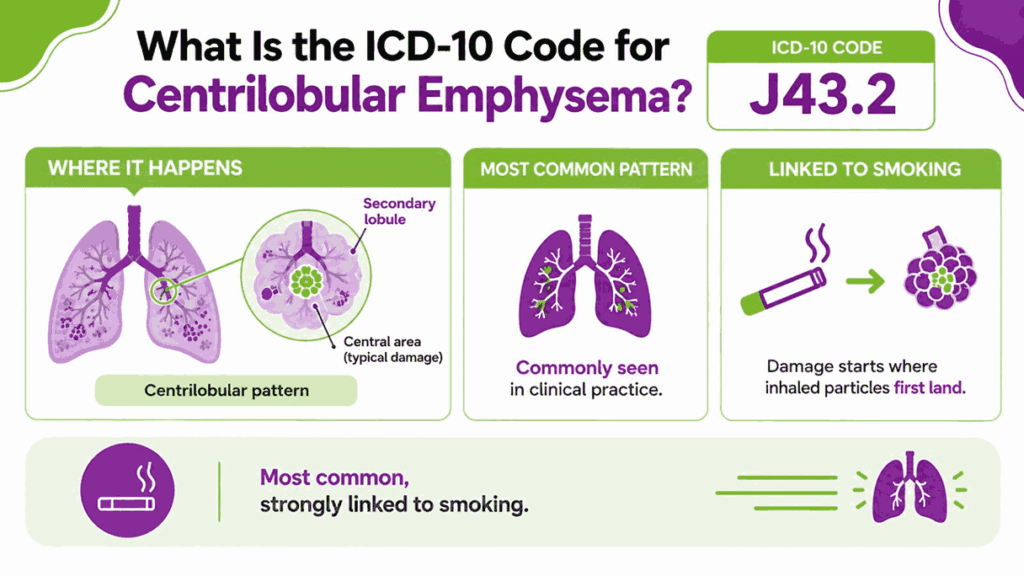
Centrilobular emphysema is strongly linked to smoking, since the damage pattern tracks closely with where inhaled smoke particles first make contact with lung tissue. This is the pattern pulmonologists most often encounter in clinical practice.
Is Centriacinar Emphysema the Same as Centrilobular Emphysema?
Yes, centriacinar and centrilobular emphysema are the same condition described by two different names. Both terms refer to the identical anatomical pattern: damage concentrated in the central portion of the lung’s lobule, and both map to the same code, J43.2.
A chart using either term supports the same diagnosis, and a coder shouldn’t treat them as separate findings or search for a different code.
What Documentation Supports J43.2?
The chart needs to name the pattern directly, not just say “emphysema.” A note that mentions centrilobular or centriacinar changes, ideally backed by a CT scan, gives a coder real support for J43.2 instead of defaulting to the unspecified code.
Adding a smoking history helps too, since centrilobular emphysema is so closely tied to smoking that its absence would actually look unusual. Without the anatomical term or any imaging reference, a coder has nothing to point to for J43.2.
The imaging and pulmonary function tests that confirm this pattern carry their own billing rules too, covered in our pulmonology CPT codes guide.
What Is the ICD-10 Code for Panlobular Emphysema?
The ICD-10 code for panlobular emphysema is J43.1. This pattern involves damage spread evenly across the entire lung lobule, rather than concentrated in one specific area, and it’s the anatomical pattern most closely associated with alpha-1 antitrypsin deficiency.
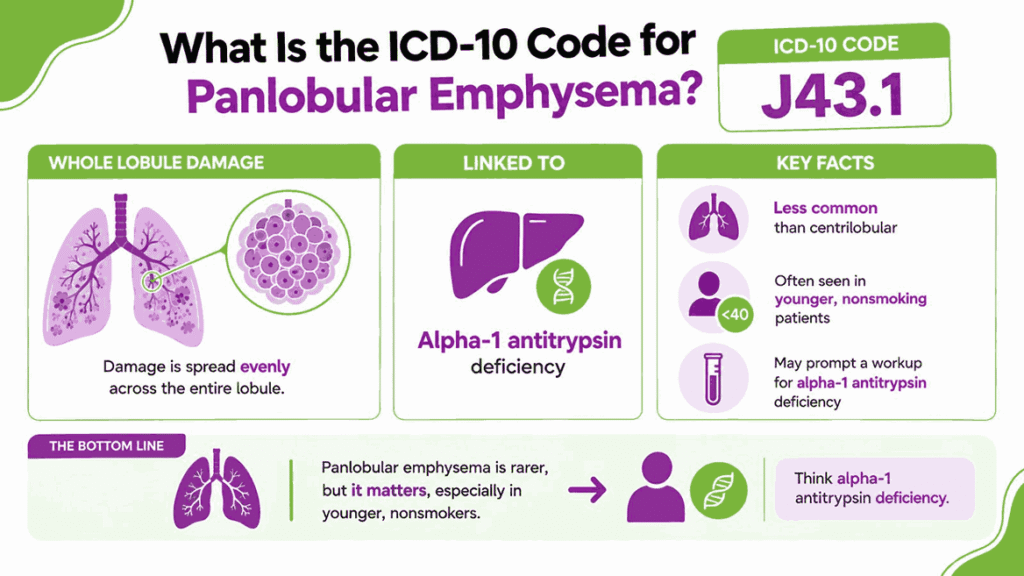
Panlobular emphysema shows up less often than the centrilobular pattern overall, but it carries real clinical significance when it does. A younger patient presenting with this pattern, especially a nonsmoker, often prompts a workup for alpha-1 antitrypsin deficiency specifically, since that genetic condition is a common underlying cause.
How Is Panlobular Emphysema Different From Centrilobular?
The difference comes down to where the damage sits inside the lobule. Centrilobular emphysema concentrates damage in the center, near the respiratory bronchioles. Panlobular emphysema spreads that damage evenly across the whole lobule.
The two patterns also skew toward different causes. Centrilobular emphysema tracks closely with smoking. Panlobular emphysema tracks more closely with alpha-1 antitrypsin deficiency, though smoking can still contribute to either pattern.
What Documentation Supports J43.1?
The chart needs to name the pattern directly, the same standard that applies to J43.2. A note referencing panlobular changes, ideally backed by CT imaging, gives a coder real support for this specific code instead of defaulting to unspecified.
Given how closely this pattern links to alpha-1 antitrypsin deficiency, documentation noting that workup or diagnosis adds real strength to the record.
Can Centrilobular and Paraseptal Emphysema Be Coded Together?
No, even when a CT scan shows both patterns in the same patient, ICD-10 only allows one emphysema code per diagnosis.
Centrilobular and paraseptal changes commonly appear together, especially in longtime smokers with COPD, but that clinical reality doesn’t translate into billing two separate J43 codes for the same lung.
If the note identifies centrilobular changes as the primary finding, J43.2 applies. If the documentation doesn’t call out one pattern as dominant, or explicitly describes a mixed picture with no clear predominant type, the diagnosis typically falls to J43.8.
This is the same logic that governs every other code in the J43 family. One diagnosis, one code, chosen based on what the documentation actually emphasizes, not an attempt to capture every anatomical finding a scan happens to show.
What Is the ICD-10 Code for Unilateral Emphysema (MacLeod’s Syndrome)?
The ICD-10 code for unilateral pulmonary emphysema, also known as MacLeod’s syndrome or Swyer-James syndrome, is J43.0. This condition affects only one lung, or sometimes just one lobe, rather than the bilateral pattern typical of centrilobular or panlobular emphysema.
MacLeod’s syndrome usually traces back to a severe respiratory infection in childhood, often viral, that damaged the small airways on one side while the lung was still developing.
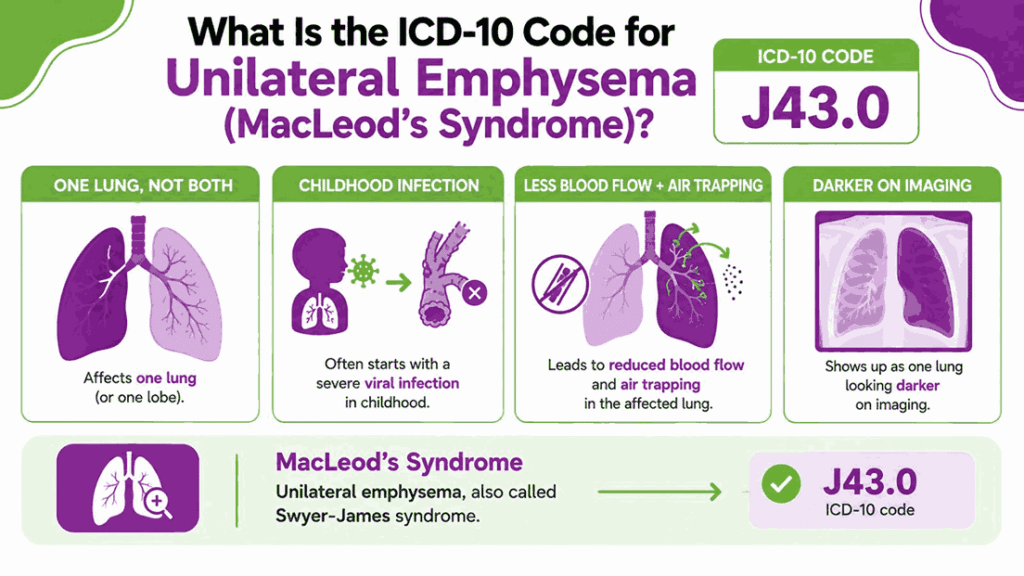
That early injury leads to reduced blood flow and air trapping in the affected lung. It then shows up on imaging as one lung appearing noticeably darker, or hyperlucent, than the other.
What Makes MacLeod’s Syndrome Different From the Other Emphysema Codes?
The cause is what sets this condition apart. MacLeod’s syndrome traces back to a single childhood respiratory illness, and the resulting damage stays confined to one lung rather than progressing bilaterally over time.
This condition is also frequently found incidentally, often on a chest X-ray ordered for an unrelated reason.
A patient can carry this diagnosis for decades with mild or no symptoms at all. This makes clear documentation of the finding especially important, since nothing about the patient’s presentation may otherwise suggest that an anatomical lung condition is present.
Does Paraseptal Emphysema Have Its Own ICD-10 Code?
No, Paraseptal emphysema does not have a dedicated ICD-10 code, despite being a real, distinct, and commonly diagnosed anatomical pattern. This is a genuine gap in the code set, not an oversight in how a chart gets documented.
Where Does Paraseptal Emphysema Get Coded?
Paraseptal emphysema is damage along the outer edge of the lung, near the pleura. Since it doesn’t match unilateral, panlobular, or centrilobular, it falls under J43.8, Other emphysema. There’s no paraseptal-specific code to search for, and it shouldn’t default to J43.9 either.
This distinction matters clinically too. Paraseptal emphysema carries a real risk that the other patterns don’t share as directly; a subpleural bleb can rupture and cause a spontaneous pneumothorax. That’s exactly why a documented paraseptal finding belongs under J43.8.
What Is the ICD-10 Code for Bullous Emphysema?
There’s no dedicated ICD-10 code for bullous emphysema. It’s a real, commonly used clinical term, but it maps to J43.9, Emphysema, unspecified, rather than to a code of its own.
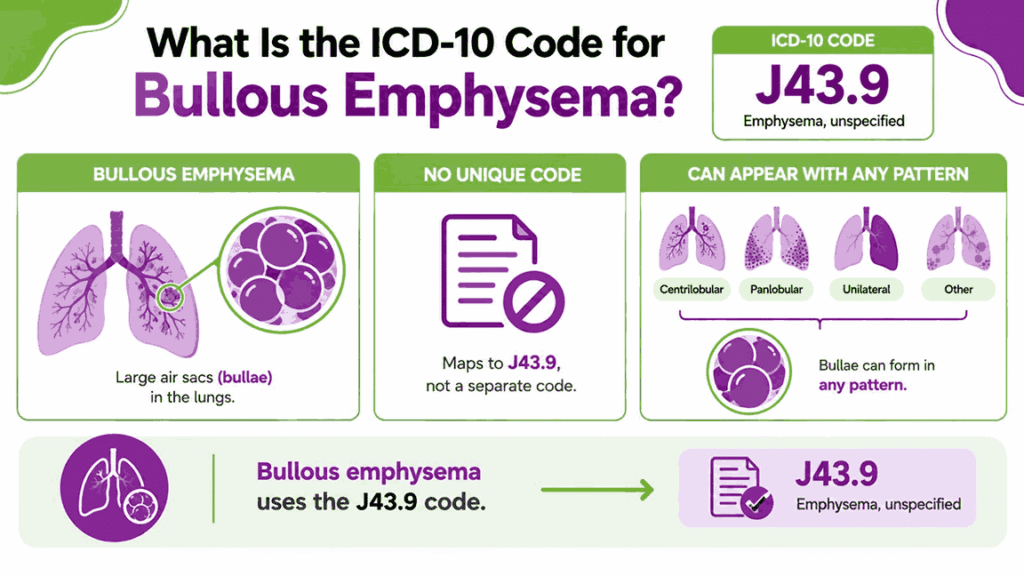
Bullae, the large air-filled sacs the term describes, can actually form alongside any of the other emphysema patterns, which is part of why ICD-10 never gave “bullous” its own separate number.
Why Doesn’t Bullous Emphysema Get Its Own Code?
“Bullous” describes size and appearance, not location, and ICD-10’s J43 codes are built around where the damage sits in the lung, not how big it looks. That’s also why bullae showing up alongside another pattern don’t change the code.
A chart might describe “bullous paraseptal emphysema,” and when that happens, the paraseptal finding still decides the code, J43.8, since paraseptal is the actual anatomical match. “Bullous” is just describing what that damage looks like on imaging; it isn’t a second diagnosis competing for its own code.
Other and Unspecified Emphysema: J43.8 and J43.9
Two codes cover emphysema that doesn’t fit the three named anatomical patterns, and the table below shows how they split.
| Code | When to Use | What Falls Here |
|---|---|---|
| J43.8 (Other) | A specific, named pattern is documented, just not one of the three standard types | Scar emphysema, paraseptal emphysema |
| J43.9 (Unspecified) | No anatomical pattern is documented at all | Bullous, senile, vesicular, interlobular, and atrophic emphysema |
J43.9 is the easiest code to reach for, since it requires no anatomical detail. But when imaging already shows a specific pattern, centrilobular changes on a CT scan, for example, and the coder still defaults to J43.9, the claim loses the documentation specificity the chart actually supports.
Is Subcutaneous Emphysema Coded the Same Way as Pulmonary Emphysema?
No, subcutaneous emphysema is a completely different condition: air trapped under the skin rather than lung tissue damage, and it never uses a J43 code. The correct code depends on what caused it.
- Trauma: T79.7XXA
- Complication of a Medical Procedure: T81.84
Both of these sit entirely outside the J43 family. A chart describing subcutaneous emphysema after a chest tube placement, for example, should never be coded as pulmonary emphysema just because the words look similar.
How Does Excludes1/Excludes2 Logic Affect Emphysema Coding?
Two Excludes relationships govern how J43 interacts with other codes, and mixing them up creates real billing problems.
Can Emphysema Caused by Chemical or Gas Inhalation Be Coded as J43?
No, J43 carries an Excludes2 note specifically for emphysema caused by inhaling chemicals, gases, fumes, or vapors. That presentation routes to J68.4 instead, a different category entirely built for chronic respiratory conditions caused by inhaled substances.
A chart describing occupational or chemical-exposure emphysema should never default to a J43 code just because the word “emphysema” appears in the note.
Can Emphysema and COPD Be Coded Together?
Yes, in specific circumstances. J44.9 carries an Excludes2 note for emphysema without chronic bronchitis, so both codes can be reported together when the findings are genuinely separate and distinctly documented.
If the chart describes emphysema as part of one combined COPD picture instead, the case usually routes through the COPD codes alone, covered in full in our COPD ICD-10 guide.
How Do You Choose the Right Emphysema Code?
To choose the right emphysema code, work through the table below, the same way as every other code family in this guide.
| Step | Question | If Yes | If No |
|---|---|---|---|
| 1 | Is this actually pulmonary emphysema, not subcutaneous or mediastinal air? | Continue to step 2 | Code T79.7XXA (trauma) or T81.84 (procedure) instead |
| 2 | Is the emphysema caused by chemical, gas, or fume inhalation? | Code J68.4 | Continue to step 3 |
| 3 | Does the chart document a specific anatomical pattern? | Continue to step 4 | Code J43.9 |
| 4 | Is the pattern unilateral, panlobular, or centrilobular? | Code J43.0, J43.1, or J43.2 accordingly | Code J43.8 |
What Secondary Codes Are Commonly Required With Emphysema?
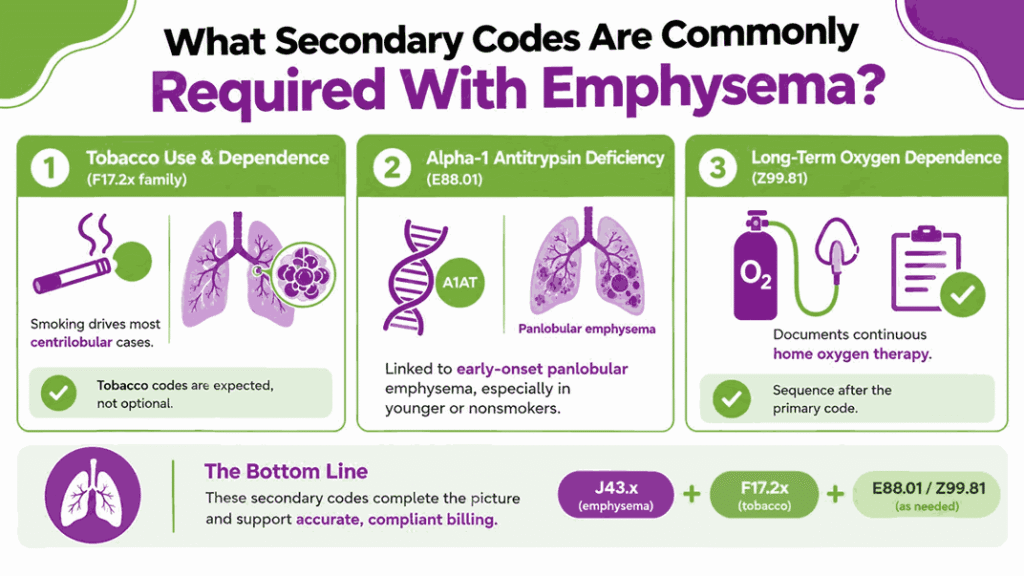
Secondary codes that are commonly required with emphysema are as follows:
Tobacco Use and Dependence
Smoking drives most centrilobular emphysema cases. That’s why tobacco use or dependence codes (F17.2x family) are expected documentation, not optional detail. This is the same standard that applies across every pulmonology code family in this series.
Alpha-1 Antitrypsin Deficiency
E88.01 is the code for alpha-1 antitrypsin deficiency. It has a direct, well-established link to panlobular emphysema specifically; early-onset panlobular emphysema is the typical pulmonary manifestation of this genetic condition.
A younger patient or a nonsmoker presenting with panlobular changes is a strong candidate for this workup. When it’s confirmed, E88.01 belongs on the claim alongside J43.1.
Long-Term Oxygen Dependence
Z99.81 documents a patient on continuous home oxygen therapy. It’s sequenced after the primary emphysema code, the same rule that applies across every other respiratory condition in this guide.
Why Do Emphysema Claims Get Denied?
The table below shows why emphysema claims get denied, what they look like, and how you can easily fix them.
| Denial Cause | What It Looks Like | The Fix |
|---|---|---|
| Defaulting to unspecified | J43.9 billed when imaging documents a specific pattern | Match the chart’s documented anatomical finding to the correct code before defaulting |
| Paraseptal or bullous miscoded | A distinct pattern billed as J43.9 instead of J43.8, or vice versa | Route paraseptal and other named-but-non-matching patterns to J43.8, not J43.9 |
| Subcutaneous emphysema billed as pulmonary | J43.x used for air trapped under the skin | Confirm if the finding is pulmonary or subcutaneous before choosing a code family |
| Excludes2 conflict missed | Chemical or gas-induced emphysema billed as J43 | Route inhalation-caused emphysema to J68.4 instead |
| Missing alpha-1 antitrypsin workup | Panlobular emphysema documented with no genetic workup noted | Document E88.01 status when panlobular pattern appears, especially in younger or nonsmoking patients |
Final Thoughts
The real skill is knowing which common clinical terms don’t have their own code at all. Paraseptal, bullous, and centriacinar all sound like distinct diagnoses, but none of them get a dedicated number; they route to J43.8 or J43.9 instead.
Here, the practical fix is simple. Before finalizing any emphysema claim, check the chart for an actual anatomical pattern, centrilobular, panlobular, or unilateral, before defaulting to unspecified.