
Nevada Medicaid billing is the process of submitting claims for covered services given to Nevada Medicaid and Nevada Check Up members. Private practices bill either the state directly under fee-for-service or a contracted managed care organization. The correct route depends on how each patient is enrolled.
Most claims follow the same core path. The practice enrolls with the state, verifies eligibility, gets prior authorization when needed, and submits a clean claim. Each step carries Nevada-specific rules, forms, and deadlines that differ from Medicare and commercial payers.
The rules changed for many practices in 2026. Nevada expanded Medicaid managed care statewide on January 1, 2026, moving about 75,000 rural members from fee-for-service into managed care plans. This guide covers enrollment, both billing models, claim submission, timely filing limits, common denials, and appeals.

What Is Nevada Medicaid Billing?
Nevada Medicaid billing covers every claim a provider submits for a Medicaid or Nevada Check Up member. Nevada Check Up is the state’s Children’s Health Insurance Program (CHIP). Both programs follow the same billing manual, so practices use one set of rules for adult and child members.
The program is large, which makes billing accuracy a real revenue issue. In 2024, Nevada covered about 788,000 Medicaid members, and managed care made up about 75 percent of that population. For many Las Vegas and Reno practices, Medicaid is one of the biggest payers on the schedule.
Key Entities in Nevada Medicaid Billing
Knowing who does what saves time when a claim goes wrong. The table below shows the main players and their role.
| Entity | Role in Billing |
|---|---|
| Nevada Medicaid (DHCFP) | Sets coverage policy, fee schedules, and the Medicaid Services Manual (MSM) |
| Gainwell Technologies | Fiscal agent that handles enrollment, fee-for-service claims, and prior authorization |
| Managed Care Organizations (MCOs) | Process claims and authorizations for members enrolled in their plans |
| Provider Web Portal (PWP) | Online tool for eligibility checks, claim submission, claim status, and appeals |
| Provider Flex | Online tool used for most provider enrollment tasks |
Gainwell Technologies is the fiscal agent for both Nevada Medicaid and Nevada Check Up. It appears as “Nevada Medicaid” in all provider communications, so most letters with that name come from Gainwell.
Fee-for-Service vs. Managed Care in Nevada Medicaid
The payer on a Nevada Medicaid claim depends on the member’s enrollment, not the service. Fee-for-service (FFS) members are billed to the state through Gainwell. Managed care members are billed to their assigned MCO, which has its own portal, payer ID, and authorization rules.
| Factor | Fee-for-Service | Managed Care |
|---|---|---|
| Who Pays the Claim | Nevada Medicaid through Gainwell | The member’s assigned MCO |
| Where Claims Go | Provider Web Portal or 837 electronic file | MCO portal or clearinghouse payer ID |
| Prior Authorization | Gainwell Prior Authorization Department | Each MCO’s own PA process |
| Timely Filing | 180 days for in-state providers | Set by each MCO provider contract |
| Participation | State Medicaid enrollment | State enrollment plus an MCO contract |
The 2026 Statewide Managed Care Expansion
Before 2026, managed care operated only in Clark and Washoe counties. The state expanded it to every county starting January 1, 2026. Rural providers who billed the state directly for years now bill health plans instead.
Five MCOs now operate across Nevada’s 17 counties: Health Plan of Nevada, Anthem, SilverSummit, Molina, and CareSource. Plan choice varies by region. State officials limited rural markets to two plan choices, naming CareSource and SilverSummit as the rural partners.
What this means for your practice:
- Check the plan on every visit. Members can switch plans, so last month’s MCO may not be this month’s payer.
- Contract with each plan you see. Seeing an MCO member without a contract often leads to denied or out-of-network claims.
- Keep a rule sheet per MCO. Authorization lists, filing limits, and documentation standards differ across the five plans.
- Watch county-level changes. Health Plan of Nevada stopped offering managed care services in Washoe County on January 1, 2026.
Tracking five plans plus fee-for-service is a heavy load for a small front desk team. Our medical billing services in Nevada cover Medicaid and MCO claims under one workflow.
How to Enroll as a Nevada Medicaid Provider
A practice cannot bill Nevada Medicaid until each provider is enrolled and approved. Enrollment is done online. All providers must submit applications electronically, and Provider Flex handles most enrollment tasks separately from the Provider Web Portal.
Enrollment is organized by provider type. Nevada Medicaid defines about 65 provider types, and each type needs its own complete set of enrollment documents under the same NPI. A group that offers several service lines may need more than one application.
| Step | What to Do | Practical Tip |
|---|---|---|
| 1. Confirm Provider Type | Match each service line to its Nevada provider type code | Pick the specialty carefully, since a specialty is required for every type |
| 2. Gather Documents | Use the Enrollment Checklist for that provider type | Missing pages are a common reason for returned applications |
| 3. Apply Online | Submit the application through Provider Flex | Save drafts and finish later if documents are still pending |
| 4. Sign the Contract | Electronically sign the Nevada Medicaid provider contract | Keep a copy for payer audits |
| 5. Contract With MCOs | Join each MCO network you plan to bill | Start early, since contracting can take weeks |
Revalidation and MCO Credentialing
Enrollment is not a one-time task. Nevada Medicaid requires most providers to revalidate at least every five years, and DMEPOS providers every three years. A lapsed revalidation terminates the contract, and the provider must start a brand-new application.
Credentialing for health plans has also changed. In February 2025, Nevada Medicaid centralized credentialing for providers enrolling with managed care entities. Your practice should still confirm contract status with each MCO before seeing its members.
How Do You Bill Nevada Medicaid Step by Step?
You bill Nevada Medicaid by confirming eligibility, getting authorization, coding correctly, and submitting a clean claim to the right payer. The same seven steps apply to fee-for-service and managed care claims. Only the payer and portal change.
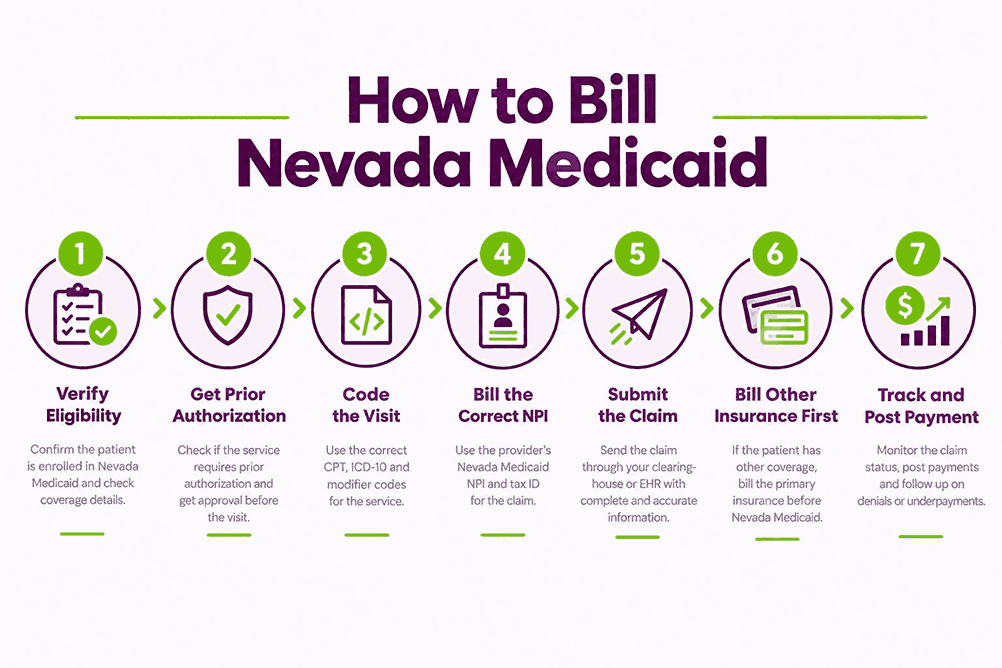
- Verify eligibility before the visit. Check the member’s status and assigned plan in the Provider Web Portal. An eligibility check at every visit catches plan changes early.
- Get prior authorization when required. Nevada Medicaid cannot process authorizations or claims while a patient’s eligibility is pending. Once eligibility is decided, providers may request retroactive authorization.
- Code the encounter accurately. Use current CPT, HCPCS, and ICD-10-CM codes with the right modifiers. Nevada Medicaid loads quarterly and annual National Correct Coding Initiative (NCCI) edit updates into its claims system.
- Bill the correct provider NPI. Each service must carry the National Provider Identifier of the provider who actually delivered it.
- Submit the claim electronically. Fee-for-service claims go through Direct Data Entry (DDE) or the 837P electronic transaction. MCO claims go through that plan’s payer ID.
- Bill other insurance first. Medicaid is the payer of last resort if the patient has commercial or Medicare coverage; bill that payer first and attach the primary EOB.
- Track and post payments. Wait 24 hours before checking claim status, and allow 30 days for adjudication. Post each remittance advice and work denials right away.
Nevada Medicaid Timely Filing Limits
Nevada Medicaid gives in-state providers 180 days to file a fee-for-service claim. The clock starts at the date of service or the eligibility decision, whichever is later. Out-of-state providers and claims with a third-party resource get 365 days.
Deadlines also apply after a claim is processed. Fair hearing requests must arrive within 90 days of the notice date. Claim adjustments and voids follow the same 180-day and 365-day limits.
| Situation | Deadline | Clock Starts From |
|---|---|---|
| In-state provider, no other insurance | 180 days | Date of service or eligibility decision, whichever is later |
| Out-of-state provider | 365 days | Date of service or eligibility decision, whichever is later |
| Claim with third party liability (TPL) | 365 days | Date of service or eligibility decision, whichever is later |
| Claim appeal | 30 calendar days | Date on the remittance advice |
| Fair hearing request | 90 days | Date on the notice |
| Managed care claim | Varies by MCO | Check each MCO provider contract |
In practice, the 180-day window closes faster than most practices expect. A claim that bounces twice for small errors can use up half the window. Submitting within a week of the visit leaves room for corrections.
Common Nevada Medicaid Claim Denials and How to Prevent Them
Most Nevada Medicaid denials come from front-end errors that a practice can catch before submission. Eligibility, authorization, and payer routing problems cause far more denials than clinical disputes. The table below lists the most frequent causes and their fixes.
| Denial Reason | Common Cause | How to Prevent It |
|---|---|---|
| Patient not eligible | Coverage lapsed or member changed plans | Verify eligibility and plan at every visit |
| Wrong payer | MCO member billed to fee-for-service | Confirm the assigned MCO before submitting |
| Missing prior authorization | Service needed PA that was never requested | Keep an updated PA list for FFS and each MCO |
| Timely filing exceeded | Claim sent after the 180-day limit | Submit within days of the visit and track aging |
| Provider not contracted for dates of service | Revalidation lapsed, or contract dates do not match | Monitor the Provider Revalidation Report |
| Other insurance not billed first | Primary coverage missed at intake | Collect all insurance details at check-in |
| NCCI edit | Codes billed together that should be bundled | Run claims through an NCCI scrubber before submission |
Contract dates are an overlooked cause. Nevada Medicaid advises providers to confirm they are contracted for the dates of service on each claim. A lapsed revalidation can deny every claim for that period.
How to Appeal a Denied Nevada Medicaid Claim
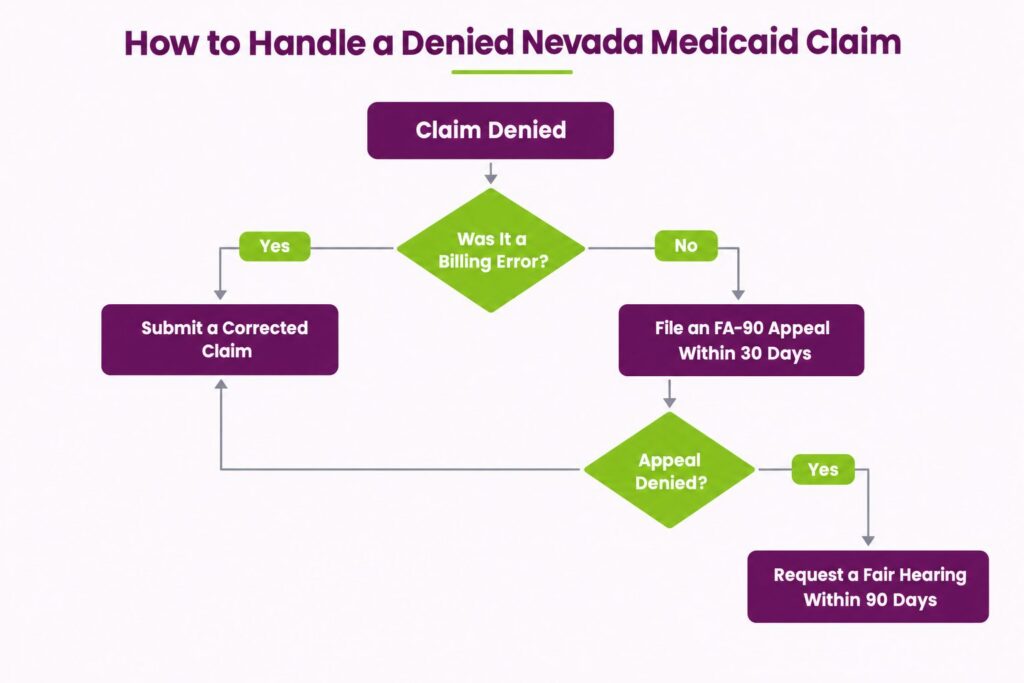
You appeal a denied fee-for-service claim through the Provider Web Portal within 30 calendar days of the remittance advice. Appeals are submitted electronically through Secure Correspondence in the portal. The system rejects entries past the 30-day limit.
Appeals are not the right tool for every denial. If a claim was denied because of a billing error, submit a corrected claim as a new claim instead. Save appeals for denials you believe were wrong.
Follow these steps to file an appeal:
- Confirm the deadline. Count 30 calendar days from the date on the remittance advice, not the date you opened it.
- Complete the FA-90 form. Fill out the current Formal Claim Appeal Request (FA-90) in full, with a separate FA-90 for each appealed claim.
- Attach supporting documents. Include the claim’s Internal Control Number (ICN), a clear reason for the appeal, and records that support it.
- Submit once. Resubmitting a denied claim and getting another denial does not open a new 30-day appeal window.
- Escalate if needed. If the appeal is denied, you can request a fair hearing within 90 days of the notice.
For managed care claims, each MCO has its own appeal process and deadlines. Check the plan’s provider manual before filing. The billing team at Transcure tracks these plan-specific appeal windows for Nevada practices every day.
Should You Outsource Nevada Medicaid Billing?
Outsourcing makes sense when Medicaid denials, aging claims, or MCO rules take more staff time than your practice can spare. The 2026 expansion added more payers and more rules. Many small practices now manage five plans plus fee-for-service with the same front desk team.
Common signs your practice needs outside help:
- Medicaid claims regularly sit unpaid past 45 days.
- Denials for eligibility or authorization repeat every month.
- Staff misses the 30-day appeal window on recoverable claims.
- Nobody tracks revalidation dates or MCO contract status.
A specialized partner like Transcure handles eligibility, authorizations, claim scrubbing, denials, and appeals under one workflow. Our team works with practices across Nevada, from Las Vegas and Henderson to Reno and rural counties.
Frequently Asked Questions
How Long Do You Have to File a Nevada Medicaid Claim?
In-state providers have 180 days from the date of service or the eligibility decision, whichever is later. Out-of-state providers and claims with other insurance get 365 days. Managed care plans set their own limits in each provider contract.
Which Is The Best Medical Billing Company In Nevada?
The best medical billing companies in Nevada include Transcure, Southern NV Billing, and Marshall Medical Billing. However, among all, Transcure stands out due to its AI agents with certified billers across the full revenue cycle. Its team handles Nevada Medicaid fee-for-service and all five managed care plans under one workflow.
Who Processes Nevada Medicaid Claims?
Gainwell Technologies processes fee-for-service claims as the state’s fiscal agent. Claims for managed care members go to the member’s assigned MCO: Health Plan of Nevada, Anthem, SilverSummit, Molina, or CareSource.
How Do I Check a Nevada Medicaid Claim Status?
You check claim status through the Nevada Medicaid Provider Web Portal. Wait at least 24 hours after submission before checking. Allow about 30 days for the claim to be fully adjudicated.
Can I Bill a Medicaid Patient Directly in Nevada?
Generally, no. You cannot bill a Medicaid member for covered services once Medicaid is billed. If a patient paid and later receives retroactive coverage for those dates, the practice must refund that payment.
How Often Do Nevada Medicaid Providers Revalidate?
Most Nevada Medicaid providers revalidate every five years. DMEPOS providers revalidate every three years. A missed revalidation ends the provider contract and requires a completely new enrollment application.