
Family physicians handle nearly one in five office visits across the United States, according to the American Academy of Family Physicians. This accounts for over 192 million visits every year, 48% more than any other medical specialty. Family practices remain central to US primary care.
Family practices treat patients of every age, covering acute visits, chronic care, and preventive screenings together. This mix of service types creates complex E/M coding and frequent payer scrutiny. Accurate billing becomes essential, since even small coding errors trigger denials and delay reimbursement.

This guide breaks down family practice billing for 2026, covering E/M code selection, preventive care billing rules, and common denial triggers. Providers get practical strategies to reduce claim rejections and protect revenue with expert Family Practice Billing Services from Transcure. Each section addresses a distinct challenge family practices face daily.
What Is Family Practice Billing?
Family practice medical billing is the process of coding and submitting claims for the full scope of services family physicians deliver.
It covers office visits, preventive and wellness visits, chronic disease management, and minor in-office procedures across patients of all ages.
Primary care medical billing differs from specialty billing due to visit volume and code diversity. Family physicians bill E/M codes, preventive service codes, vaccine codes, and chronic care management codes within one practice, creating more denial points than single-specialty coding.
What are the Key Components of Family Practice Billing?
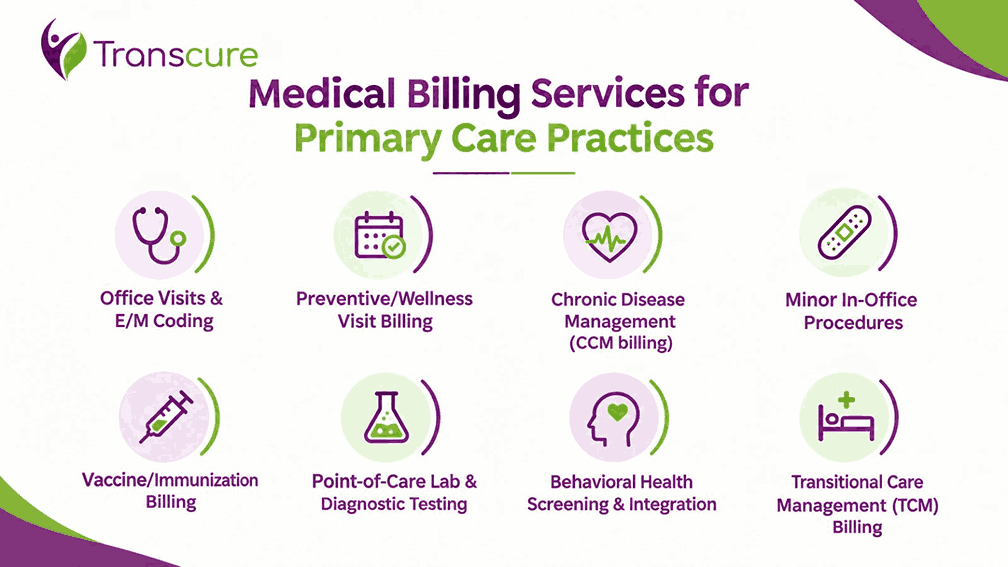
- Office Visits & E/M Coding: Codes new vs. established patient E/M visit levels.
- Preventive/Wellness Visit Billing: Bills annual wellness visits under codes G0438, G0439.
- Chronic Disease Management (CCM billing): Bills monthly non-face-to-face chronic care coordination.
- Minor In-Office Procedures: Codes skin biopsies, injections, and minor surgeries.
- Vaccine/Immunization Billing: Bills vaccine product codes plus administration fees.
- Point-of-Care Lab & Diagnostic Testing: Bills CLIA-waived tests like glucose and strep panels.
- Behavioral Health Screening & Integration: Bills depression, SBIRT, and substance-use screenings.
- Transitional Care Management (TCM) Billing: Bills post-discharge follow-up calls within 7-14 days.
Why RCM Matters for Family Practice?
Family practice generates more patient visits than any other specialty. A single physician completes 20 to 30 encounters daily across every age group and condition type. Each encounter creates separate coding decisions, and small errors compound fast across thousands of monthly claims.
CMS enforces strict documentation rules for E/M level selection, preventive service billing, and chronic care management time logs. HIPAA governs patient data handling across every claim submission. Non-compliant documentation triggers payer audits, recoupment demands, and civil monetary penalties that reduce practice revenue.
High visit volume multiplies the financial impact of small coding errors. One misapplied modifier or undocumented MDM element, repeated across 500 monthly claims, produces measurable revenue loss. Family practice revenue cycle management addresses this by standardizing coding decisions across visit types and providers.
Effective family practice revenue cycle management tracks denial patterns, verifies eligibility before each visit, and audits E/M level selection monthly. Practices without structured RCM lose 5 to 10 percent of collectible revenue annually, which consistent coding and faster claim resubmission can recover.
What is E/M Coding for Family Practice?
Family practice bills more E/M codes than any other specialty because of visit volume. The full E&M codes list for office visits spans 99202-99215, and correctly assigning each E/M CPT code determines reimbursement accuracy for every encounter.
New Patient vs Established Patient E/M Codes (99202-99215)
An established patient has received professional services from the same physician, or another physician in the same specialty and group, within the past 3 years. Every other patient qualifies as new.
New patient codes require more total time than established patient codes at each corresponding level:
| Code | Patient Type | Total Time |
|---|---|---|
| 99202 | New | 15-29 minutes |
| 99203 | New | 30-44 minutes |
| 99204 | New | 45-59 minutes |
| 99205 | New | 60-74 minutes |
| 99212 | Established | 10-19 minutes |
| 99213 | Established | 20-29 minutes |
| 99214 | Established | 30-39 minutes |
| 99215 | Established | 40-54 minutes |
Family practices bill 99213 and 99214 more than any other E/M code due to the high proportion of established chronic-condition visits.
99213 vs 99214 vs 99215: When to Use Each CPT Code
CPT 99213 applies to established patients with one or more stable chronic conditions or a low-severity acute problem, requiring low-complexity MDM or 20-29 minutes of total time. A stable hypertension follow-up with a routine refill qualifies.
When a patient presents with two or more stable chronic conditions, such as an exacerbation or prescription drug management, requiring moderate-complexity MDM or 30-39 minutes, CPT 99214 applies. Uncontrolled diabetes with a dosage change qualifies.
In severe exacerbations, CPT 99215 applies when high-risk drug therapy requires intensive monitoring or decisions about hospitalization, requiring high-complexity MDM or 40-54 minutes. This code represents the highest reimbursement among the three and draws the most payer scrutiny.
Time-Based vs MDM-Based E/M Coding
The AMA removed history and exam as leveling factors for office E/M codes in 2021. Two methods now determine code level: total time on the date of encounter, or Medical Decision Making (MDM) complexity.
MDM complexity depends on 3 elements: the number and complexity of problems addressed, the amount and complexity of data reviewed, and the risk of complications or morbidity from patient management. The 2 highest of the 3 elements determine the MDM level.
Time-based coding counts only the billing provider’s personal time, including chart review, exam, counseling, and documentation. Time clinical staff spend on rooming or vitals does not count toward the provider’s total.
Modifier 25: When a Same-Day Office Visit Is Separately Billable
Modifier 25 identifies a significant, separately identifiable E/M service performed by the same physician on the same day as a procedure or another billed service. Family practice bills modifier 25 most often when a preventive visit uncovers a new problem requiring separate evaluation.
The E/M documentation must show work beyond the routine pre- and post-procedure assessment already bundled into the procedure code. A wellness visit that converts into a diabetes medication adjustment supports modifier 25 only when the physician documents a distinct history, exam, and assessment for the problem.
Payers apply NCCI edits that bundle E/M codes with same-day procedures by default. Missing or unsupported modifier 25 documentation is a leading cause of family practice denials.
What are Common E/M Documentation Mistakes That Trigger Denials?
Family practices lose reimbursement to 5 recurring documentation errors:
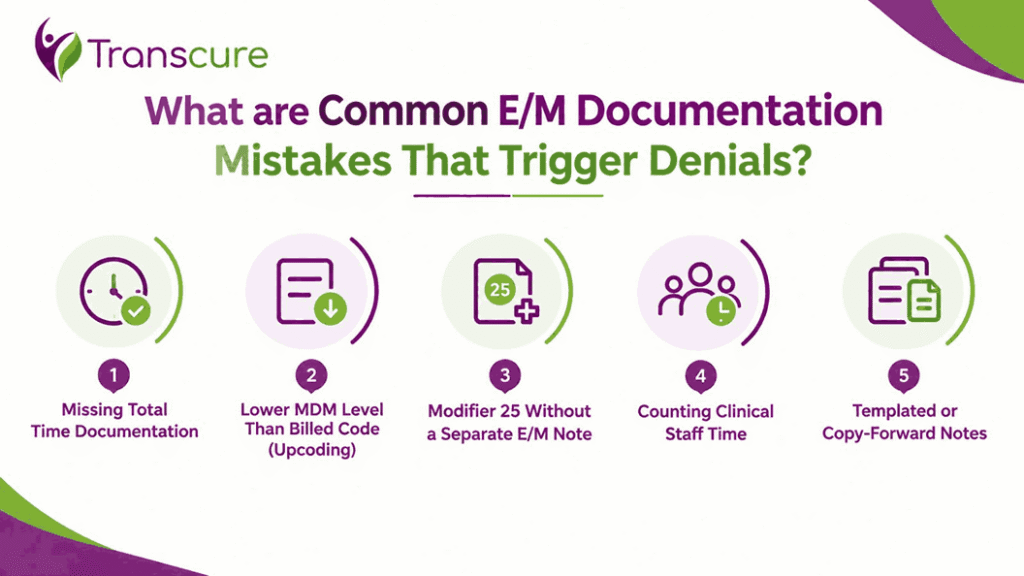
- Missing total time documentation when billing by the time-based method
- Documentation that supports a lower MDM level than the code billed (upcoding)
- Modifier 25 applied without a separately identifiable, distinct E/M note
- Counting clinical staff time toward the billing provider’s total time
- Templated or copy-forward notes that don’t reflect encounter-specific findings
What Is Preventive Care Billing in Family Practice?
In family practice, preventive care billing entails coding and submitting insurance claims for routine wellness check-ups, screenings, and vaccinations aimed at preventing illness, rather than treating the symptoms of a disease.
What Is the Difference Between G0438 and G0439?
G0438 covers the first annual wellness visit a patient receives under Medicare. G0439 covers every annual wellness visit after that first one.
Medicare requires at least 12 months between G0438 or G0439 and the next G0439 claim. Both codes require the same documentation, including a health risk assessment and a written prevention plan.
The only real difference between G0438 and G0439 is visit order and billing frequency, not the content of the visit.
What Does Medicare Cover in an Annual Wellness Visit?
A Medicare annual wellness visit covers a health risk assessment, a review of current medications, and a cognitive impairment screening. It also covers vital signs, a review of functional ability, and a written screening schedule for the next 5 to 10 years.
Medicare does not cover a hands-on physical exam, treatment of new medical problems, or a pelvic exam during this visit. Those services require separate codes and, in some cases, a separate diagnosis and modifier.
What Happens When a Preventive Visit Turns Into a Problem Visit?
Physicians often discover a new problem while performing an annual wellness visit. When that happens, the physician can bill a separate E/M visit on the same day using modifier 25.
The E/M note must clearly document the new problem, separate from the wellness visit content, to support the claim. This same modifier 25 rule applies across all E/M billing, not just preventive visits, as covered earlier in this guide.
Which ICD-10 Codes Apply to Wellness Visits?
Wellness visits require specific ICD-10 codes to support the claim. Z00.00 applies to an adult wellness visit with no abnormal findings. Z00.01 applies when the visit uncovers an abnormal finding.
Pediatric wellness visits use Z00.129 for no findings and Z00.121 when findings are present. Using the wrong ICD-10 code on a wellness claim is a frequent cause of preventive visit denials.
What Are the Common Billing Challenges in Family Practice?
Family practices face 4 recurring billing challenges. Each one comes with a short fix below.
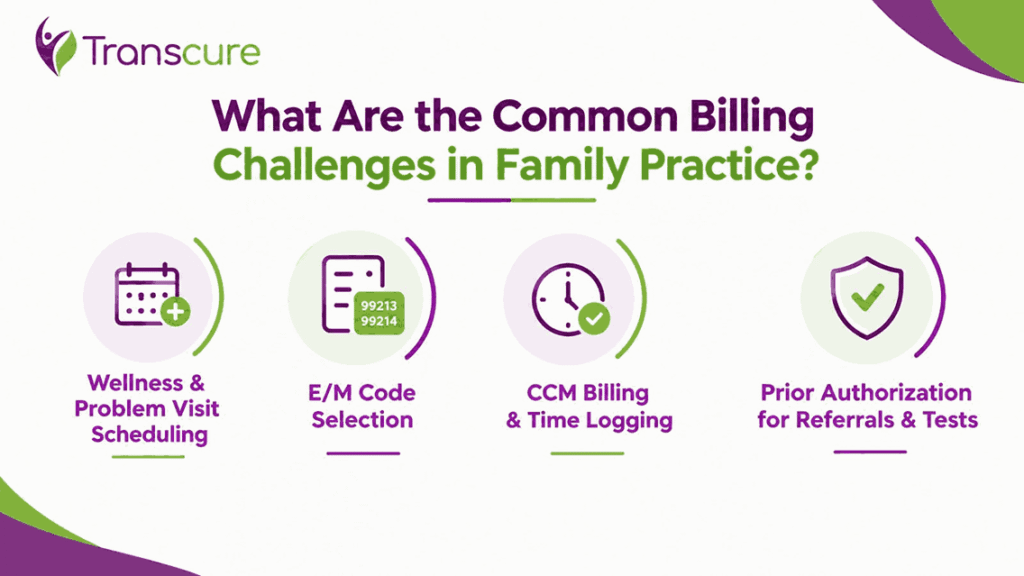
- Front desk staff often book a wellness visit and a problem visit as one single appointment.
- Some providers pick 99213 out of habit when the chart actually supports 99214.
- Others assign 99215 without documenting high complexity, which raises audit risk.
- CCM pays based on minutes of non-face-to-face care logged each month.
- Staff often skip logging time, so the practice cannot support a CCM claim later.
- Referrals and tests like MRIs often need prior authorization before a payer pays.
- Delays in getting authorization slow patient care and raise the risk of denial.
What Is the Complete Family Practice Billing Process?
Family practice billing follows 10 steps from patient check-in to final payment. Transcure has its own built-in AI agents, including ELIXA, PRIA, DEXA, CODIN, CLAIR, REMITA, and ARIA. Each one runs a specific part of the billing cycle automatically, and once introduced here, only the tool name is used going forward.
1. Patient Registration and Insurance Check
Front desk staff collect the patient’s insurance card, ID, and demographic details at check-in. Staff matches every detail against the provider record before the visit starts. A single wrong digit in the insurance number at this stage often causes a denial weeks later.
2. Eligibility and Benefits Verification
Coverage, copay, deductible, and plan limits get checked before the patient arrives for the appointment. Transcure’s AI Agent ELIXA connects to payer systems and confirms this coverage in real time, without staff making a single phone call. Coverage gaps surface here, long before a claim gets denied.
3. Prior Authorization
Certain services, such as MRIs or specialist referrals, require payer approval before they can proceed. PRIA detects which cases need authorization and follows up with payers automatically on the practice’s behalf. Manual phone calls chasing authorization status become unnecessary once this step runs on autopilot.
4. Patient Encounter and Clinical Documentation
During the visit, the physician records the reason for the encounter, exam findings, and the chosen treatment plan. This documentation becomes the foundation for every code billed afterward in the cycle. Weak documentation at this stage weakens every claim that follows it, regardless of coding accuracy.
5. Medical Coding
Transcure’s AI coding agent, CODIN, reads the finished clinical note and automatically matches it to the correct CPT and ICD codes. During this stage, the system assigns E/M levels, preventive codes, and chronic care codes. Missing documentation gets flagged here too, before the claim ever reaches submission.
6. Charge Entry
Once codes are assigned, billing staff enter them along with matching fees into the billing system. Clinical documentation officially becomes a billable claim at this point in the cycle. Accurate entry here keeps every claim aligned with what the provider actually documented during the visit.
7. Claim Submission
The finished claim heads to the payer electronically once every code and modifier has been checked. CLAIR scrubs the claim first, catching errors in codes, modifiers, and payer-specific rules before submission. Fewer errors reaching the payer means a higher first-pass clean claim rate overall.
8. Payment Posting
After the payer reviews the claim, payment arrives along with an explanation of benefits document. REMITA matches this remittance data to the original claim and posts the payment automatically to the account. Underpayments and mismatches get flagged immediately, instead of sitting unnoticed for weeks.
9. Denial Management and Appeals
Some claims come back denied due to coding errors, missing information, or payer-specific policy rules. DEXA analyzes each denial in real time and helps staff draft a stronger appeal much faster. This step gets its own full section later, since denial handling deserves deeper coverage.
10. A/R Follow-Up and Reporting
Unpaid claims get tracked, and staff follow up with payers repeatedly until the balance gets resolved. ARIA scores every outstanding account by its likelihood of recovery and ranks them by value. Regular reporting then shows exactly where revenue remains stuck across the entire cycle.
What Is Denial Management for Family Practice?
Denial management in medical billing is the process of finding, fixing, and preventing claims that payers refuse to pay. Denial management in healthcare covers every specialty, but family practice sees higher denial rates because of visit volume alone.
Denial management in RCM connects coding, documentation, and payer follow-up into one continuous cycle, not separate tasks. What is denial management in practice? It means catching a denied claim, finding the root cause, and stopping it from repeating.
What Are the Top Reasons Family Practice Claims Get Denied?
- Modifier 25 misuse tops the list of family practice denial reasons across most payers.
- An AWV billed as a problem visit, or a problem visit billed as an AWV, ranks second.
- Missing time or MDM documentation for the billed E/M level drives a large share of rejections.
- Incomplete preventive service documentation, especially for the required AWV elements, rounds out the top 4 reasons.
Can You Correct a Claim or Do You Need an Appeal?
Payers reject some claims for simple errors that a quick correction and resubmission can fix. A wrong modifier, a typo in the patient ID, or a missing referral number usually falls into this category.
An appeal becomes necessary when the payer disputes medical necessity or denies coverage for the service entirely. Appeals require supporting documentation, a formal letter, and often a peer-to-peer review with the payer’s medical director.
How Do You Build a Denial Feedback Loop?
Staff should track the denial reason code for every rejected claim in a simple shared log. Group denials by cause each month to spot patterns like a specific payer or a specific provider.
Route the findings back to coders and providers so the same mistake stops repeating on future claims. Review the log monthly and adjust training or documentation templates based on what keeps showing up.
Should You Keep Family Practice Billing In-House or Outsource It?
Most family practices weigh in-house billing against handing the work to an outside partner. An in-house biller earns roughly 50,000 dollars a year, based on current BLS wage data for the role.
That salary does not include benefits, software licenses, training time, or the cost of covering a sick day. Outsourced family practice billing companies typically charge a percentage of monthly collections, often between 3 and 8 percent depending on scope.
Practices that outsource family practice billing pay only when claims actually get paid, unlike a fixed in-house salary.
A rising number of denied claims is one of the clearest signs in-house billing is falling behind. Growing accounts receivable days, past 30 or 40 days on average, point to the same underlying problem.
High staff turnover in the billing role often leaves gaps in coding knowledge that show up as lost revenue. A practice with no dedicated coder for E/M and preventive codes usually undercodes visits without realizing it.
How Do You Choose the Right Family Practice Billing Partner?
Family Practice Experience
Family practice or primary care experience matters more than general medical billing experience. A partner who already knows AWV rules, CCM time logs, and E/M coding patterns avoids a steep learning curve.
Transparent Pricing
Transparent pricing means one clear percentage of collections with no setup fee and no hidden per-claim charge. Ask any potential partner for a written fee schedule before signing a contract.
HIPAA Compliance
HIPAA compliance is non-negotiable, since patient data passes through the billing partner’s systems on every claim. Ask for proof of HIPAA training, data encryption standards, and any additional certifications like ISO 27001.
Dedicated Account Management
Dedicated account management means one named contact who knows your providers, payers, and EMR setup. A ticket queue system where every question goes to a different person slows problem resolution.

What Are the Top Tips to Improve Family Practice RCM?
- Build a one-page cheat sheet listing E/M time thresholds, MDM criteria, and preventive codes by age. Keep this sheet visible for coders and providers so code selection stays consistent across the practice.
- Feed every denial reason back into staff training within the same month it happens. A feedback loop that takes 3 months to act on a pattern lets that pattern repeat 3 more times.
- Schedule a chart audit every quarter and review a random sample of E/M and preventive claims. Chart audits catch undercoding and overcoding before a payer audit does.
What CMS Updates Affect Family Practice Billing in 2026?
CMS has raised the 2026 Medicare conversion factor to $33.40 for most physicians, representing a 3.26 percent increase. Physicians participating in eligible alternative payment models receive a slightly higher conversion factor of $33.57. Primary care and independent physicians benefit more from this update than many specialist physicians.
CMS has finalized three new add-on G-codes, G0568, G0569, and G0570, for behavioral health integration services. These codes are used in conjunction with existing advanced primary care management base codes (G0556, G0557, and G0558). Family practices that provide integrated behavioral health screening can now bill for these services alongside chronic care management.
CMS did not change the core AWV or E/M code descriptors for 2026, keeping G0438, G0439, and 99202 through 99215 stable. The FY 2026 ICD-10-CM update added 487 new diagnosis codes, revised 38 codes, and deleted 28 codes. This update took effect on October 1, 2025, and applies through September 30, 2026. Family practices should update coding software and train staff on new codes before the effective date each year.
Frequently Asked Questions:
What is the taxonomy code for family medicine?
The taxonomy code for family medicine is 207Q00000X, maintained by the National Uniform Claim Committee. Payers use this code to confirm the provider’s specialty and process claims correctly.
Can a family practice bill a telehealth E/M visit?
Yes, family practices can bill telehealth E/M visits using modifier 95 for real-time audio-video visits. Modifier 93 applies when payer rules allow an audio-only telehealth visit instead.
Can you bill a vaccine administration and an office visit on the same day?
Yes, but the visit needs modifier 25 to separate the E/M service from the vaccine administration charge. The vaccine product code and the administration code alongside the E/M code on the same claim.
What is the timely filing limit for family practice claims?
Most commercial payers require claims within 90 to 365 days of the date of service, depending on the contract. Medicare requires claims within 12 months of the date of service, with no exceptions for late filing.
What is the difference between medical billing and medical coding?
Medical coding assigns the correct CPT and ICD codes based on the chart documentation. Medical billing takes those codes and submits, tracks, and collects payment on the resulting claim.