The Centers for Medicare & Medicaid Services released the Calendar Year 2027 Ambulatory Surgical Center Payment Rule on July 2, 2026. CMS labels it CMS-1850-P. The rule sets Medicare payment policy for roughly 6,400 ambulatory surgical centers starting January 1, 2027.
CMS proposes a 2.4% payment increase for ASCs that meet quality reporting rules. It also proposes moving hundreds of new procedures onto the ASC Covered Procedures List. Quality measure changes and a new technology payment path appear in the same rule.
This guide covers the payment update, the procedure list changes, and the quality reporting revisions. It also covers the smaller provisions that affect ASC operations. Comments on the proposed rule closed August 31, 2026, and CMS expects to publish a final rule around November 1, 2026.
What Is the CMS 2027 ASC Payment Rule?
CMS-1850-P is the Calendar Year 2027 Hospital Outpatient Prospective Payment System and Ambulatory Surgical Center Payment Rule. CMS published it in the Federal Register on July 7, 2026. The rule updates Medicare payment rates for hospital outpatient departments and ambulatory surgical centers together.
The rule affects close to 3,500 hospitals and about 6,400 ambulatory surgical centers. Both facility types share the same annual rulemaking cycle. CMS finalizes ASC-specific provisions inside the same document each year.
Key Dates for the 2027 ASC Rule
| Date | Event |
|---|---|
| July 2, 2026 | CMS releases the proposed rule (CMS-1850-P) |
| July 7, 2026 | CMS publishes the rule in the Federal Register |
| August 31, 2026 | Public comment period closes |
| November 1, 2026 (expected) | CMS publishes the final rule |
| January 1, 2027 | Final policies take effect |
ASCs should treat every provision in this guide as proposed until CMS finalizes it. Some numbers and effective dates may shift between the proposed version and the final rule.
Why OPPS and ASC Payment Move Together
CMS pays hospital outpatient departments through the Hospital Outpatient Prospective Payment System, known as OPPS. It pays ambulatory surgical centers through a separate but related system. Both systems use the same annual proposed rule and comment cycle.
The two systems share several structural elements:
- The same procedure code sets across CPT and HCPCS
- The same quality reporting infrastructure and comment cycle
- Payment groups that carry relative weights tied to the OPPS ambulatory payment classification
A procedure removed from the Inpatient Only List typically becomes payable under both OPPS and the ASC Covered Procedures List. This linkage means an ASC payment change often traces back to an OPPS policy decision made in the same rule.
How Much Will ASC Payment Rates Increase in 2027?
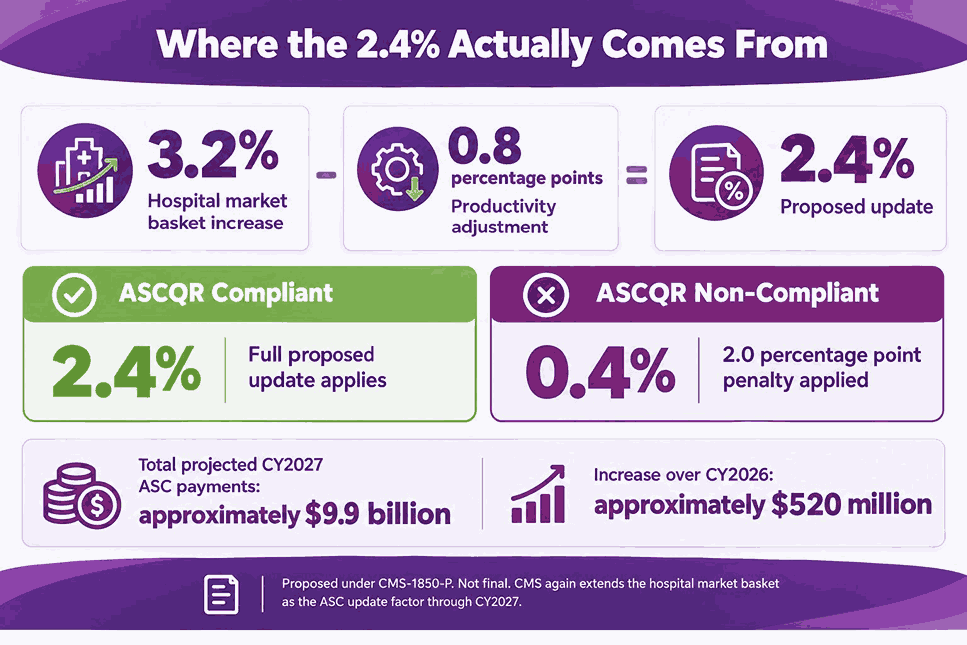
CMS proposes a 2.4% payment increase for ASCs that meet quality reporting requirements. This figure comes from a 3.2% hospital market basket increase. CMS then subtracts a 0.8 percentage point productivity adjustment.
ASCs that fail to meet Ambulatory Surgical Center Quality Reporting Program rules face a 2 percentage point penalty. Their net update falls to roughly 0.4%. This penalty applies every year a facility misses required data submission.
What Drives the 2.4% Update
- Hospital market basket increase: 3.2%, reflecting projected growth in input costs like labor and supplies
- Productivity adjustment: minus 0.8 percentage points, a statutory requirement tied to economy-wide productivity trends
- ASCQR compliance: the full 2.4% update applies only to facilities that report required quality data
- Non-compliance penalty: a 2 percentage point reduction, dropping the net update to roughly 0.4%
CMS also proposes extending the hospital market basket as the ASC update factor through CY2027. ASC-specific market basket data has not been available, so CMS continues borrowing from the hospital index for one more year. This extension has repeated for several consecutive rulemaking cycles now.
CMS estimates ASC payments will rise by about $520 million from CY2026 levels. OPPS payments to hospitals are expected to rise by roughly $9.5 billion over the same period.
Bottom line: most compliant ASCs will see a net 2.4% rate increase, not the full market basket figure, once quality reporting status is factored in.
How ASC Rates Compare to Hospital Outpatient Rates
Medicare typically pays ASCs less than hospital outpatient departments for the same procedure. CMS applies a different conversion factor and a different set of relative weights to the ASC payment system. The gap reflects lower assumed overhead in a freestanding surgical center.
Geographic wage adjustments also differ between the two systems. A hospital outpatient department in a high-wage area sees a larger location adjustment than an ASC in the same market. Facilities operating both site types should model each payment separately rather than assuming a fixed ratio.
| Factor | Hospital Outpatient (OPPS) | Ambulatory Surgical Center |
|---|---|---|
| Base rate structure | Higher assumed overhead | Lower assumed overhead |
| Wage index adjustment | Full hospital wage index | Separate, smaller adjustment |
| Update factor for 2027 | 2.4% (proposed) | 2.4% (proposed) |
| Quality penalty for non-reporting | 2.0 percentage points | 2.0 percentage points |
Which Procedures Are Moving to the ASC Setting in 2027?
This is the section with the biggest operational impact for ASC case mix and revenue planning. CMS pairs two related actions in the same rule. It removes procedures from the Inpatient Only List, and it adds procedures to the ASC Covered Procedures List.
The Inpatient-Only List Phase-Out
The Inpatient Only List identifies procedures Medicare covers only in the hospital inpatient setting. CMS created the list in 2000 to protect patients needing extended recovery or intensive monitoring. Around 1,428 procedures remained on the list heading into CY2027.
CMS built the list around three original criteria:
- Invasiveness of the procedure itself
- The patient’s expected condition immediately after surgery
- Safety concerns tied to the need for extended recovery or monitoring
Those criteria have not changed, but CMS now argues fewer procedures still meet them. CMS proposes removing 637 procedures from the Inpatient Only List for CY2027. These removals span 11 clinical families, including auditory, digestive, endocrine, respiratory, and urinary procedures. The remaining 801 procedures move off the list in CY2028.
| Phase | Year | Procedures Removed | Status |
|---|---|---|---|
| Year 1 | CY2026 | First group removed | Completed |
| Year 2 | CY2027 (proposed) | 637 procedures | Pending final rule |
| Year 3 | CY2028 | Remaining 801 procedures | Planned |
| Full phase-out | January 1, 2029 | Inpatient Only List eliminated | Target completion |
CMS says advances in surgical technique and recovery protocols reduced the need for mandatory inpatient stays for many procedures. The agency believes clinical judgment, not a fixed list, should decide the setting for most surgical cases now.
New Additions to the ASC Covered Procedures List
CMS proposes adding 618 codes to the ASC Covered Procedures List for CY2027. Most of these codes correspond to procedures leaving the Inpatient Only List. This marks the largest single-year addition since the phase-out began.
The added procedures represent a step up in clinical complexity compared to CY2026 additions. Notable examples include laparoscopic colectomy, partial nephrectomy, and sleeve lobectomy. Prostatectomy procedures also appear on the proposed addition list.
| Procedure | Specialty | Clinical Note |
|---|---|---|
| Laparoscopic colectomy | General surgery / colorectal | Removes part of the colon through small incisions |
| Partial nephrectomy | Urology | Removes part of a diseased or damaged kidney |
| Sleeve lobectomy | Thoracic surgery | Removes a lung lobe with a bronchial sleeve resection |
| Prostatectomy | Urology | Removes all or part of the prostate gland |
These procedures carry longer operative times and more complex anesthesia needs than typical ASC cases. A center adding sleeve lobectomy to its schedule needs different equipment and staffing than a center running routine colonoscopies.
How Payment Works for Newly Added Procedures
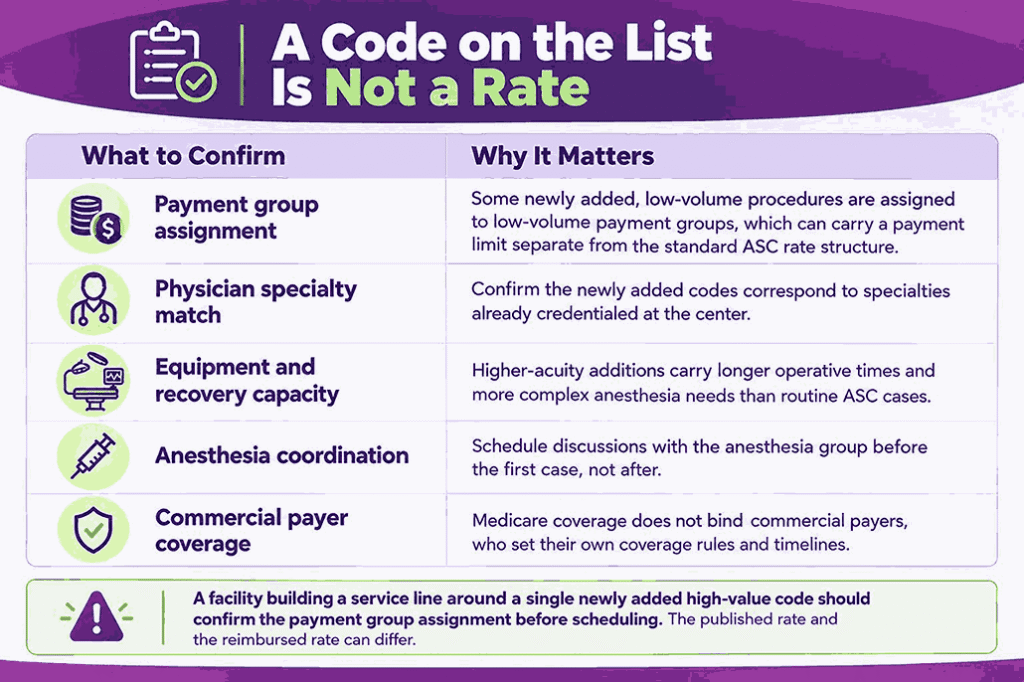
New ASC additions do not automatically get full ambulatory payment classification rates. CMS proposes assigning some newly added, low-volume procedures to low-volume payment groups. These groups can carry a payment limit separate from the standard ASC rate structure.
This limit matters most for centers planning around a single high-value procedure. A facility building a service line entirely around one newly added code should confirm its payment group assignment first. The published rate and the actual reimbursed rate can differ once volume limits apply.
What This Means for ASC Case Mix and Revenue
ASCs that add these procedures to their case mix need updated CPT and HCPCS coding workflows. Higher-acuity cases also raise anesthesia, staffing, and post-operative monitoring requirements. Revenue cycle teams should model reimbursement before scheduling new procedure types.
Physician-owned centers stand to gain the most from this expansion. Facility fees that once flowed only to hospitals become accessible once a procedure lands on the ASC Covered Procedures List. This shifts where major surgical revenue can land inside a health system or physician group.
Margin check: a center adding two or three sleeve lobectomy cases per month takes on a higher facility fee per case. It also takes on higher staffing, equipment, and recovery-time cost. Model both sides before scheduling the first case.
- Confirm which newly added codes match existing physician specialties on staff
- Check equipment and recovery-room capacity against the acuity of new procedures
- Model payer contracts separately from Medicare, since commercial payers set their own coverage rules
- Coordinate with anesthesia groups before scheduling higher-complexity cases
Getting this reimbursement math right before the first case is scheduled is standard due diligence for ASC billing services working through a specialty-mix shift like this.
What’s Changing in ASC Quality Reporting for 2027?
The Ambulatory Surgical Center Quality Reporting Program, known as ASCQR, links payment to quality data submission. ASCs that skip required reporting lose 2 percentage points from their annual update. CMS proposes one major measure change for CY2027.
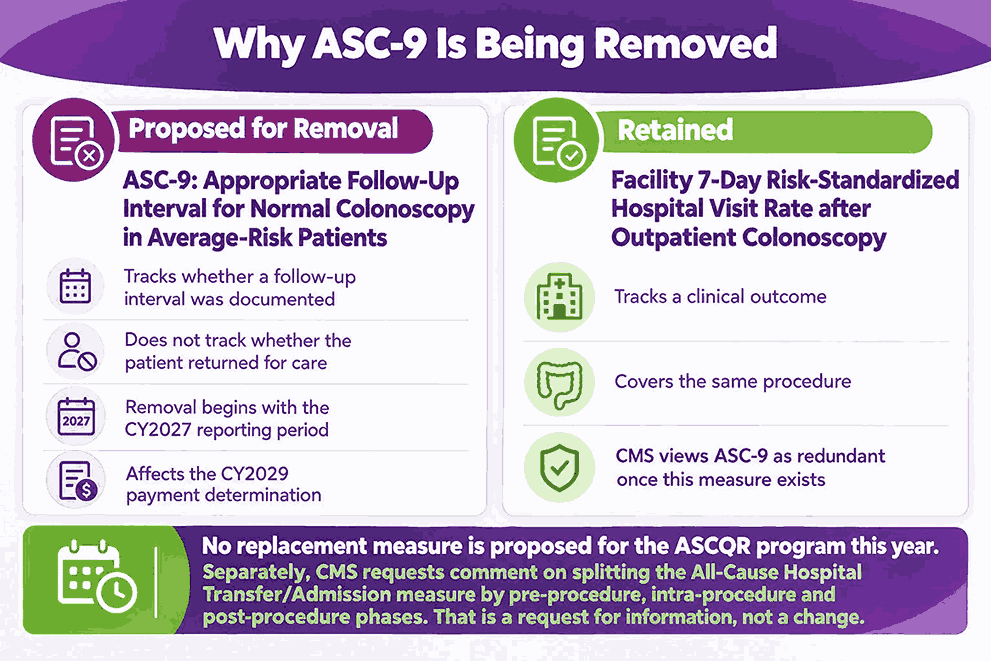
CMS proposes removing the Appropriate Follow-Up Interval for Normal Colonoscopy in Average-Risk Patients measure, known as ASC-9. The removal begins with the CY2027 reporting period. It affects the CY2029 payment determination.
Why CMS Wants to Remove ASC-9
- ASC-9 tracks whether a follow-up interval was documented, not whether the patient actually returned for care
- A separate measure, the Facility 7-Day Risk-Standardized Hospital Visit Rate after Outpatient Colonoscopy, already tracks a real clinical outcome
- CMS views ASC-9 as redundant once an outcome-based measure covers the same procedure
- No replacement measure is proposed for the ASCQR program this year
CMS also requests comment on the All-Cause Hospital Transfer/Admission measure. The agency wants to split this measure by pre-procedure, intra-procedure, and post-procedure phases. This request for information does not change the measure yet.
A phase-based version would show which stage of care carries the most transfer risk. ASCs handling higher-acuity cases from the new Covered Procedures List additions may see this measure evolve first.
Watch this measure. ASCs are taking on more complex cases from the expanded procedures list. CMS is likely to tighten how transfer risk gets tracked in future rulemaking cycles.
How the ASCQR Penalty Actually Works
The ASCQR Program operates on a pay-for-reporting basis, not pay-for-performance. Facilities do not need to hit specific quality scores. They only need to submit the required data on time each reporting period.
Missing a submission deadline triggers the full 2 percentage point penalty regardless of the facility’s actual quality performance. This makes reporting compliance a pure administrative task with a large financial consequence attached.
What Facilities Still Need to Report
- Facility-level data on the remaining outpatient colonoscopy outcome measure
- Any hospital transfer or admission events tied to ASC procedures
- Standard administrative measures CMS carries forward from prior years
- Any measure-specific attestations CMS requires during the reporting window
None of these requirements change for CY2027 beyond the proposed ASC-9 removal. Facilities already meeting current ASCQR deadlines should not see new administrative work from this rule.
Other Provisions ASCs Should Track
CMS-1850-P includes several provisions outside the core payment and quality sections. Most target hospitals directly, but a few carry indirect effects for ASCs. Hospital-affiliated and off-campus ASCs should read these sections closely.
The 340B Drug Payment Cut
CMS proposes cutting payment for 340B-acquired drugs from average sales price plus 6% to average sales price minus 33.4%. This change mainly affects hospitals enrolled in the 340B Drug Pricing Program. CMS also proposes accelerating recovery of prior 340B remedy payments.
To speed up that recovery, CMS proposes raising the OPPS conversion factor reduction tied to the 340B remedy offset from 0.5% to 3%. Facilities working through remaining remedy repayments would see those repayments recouped faster. Rural sole community hospitals are generally exempt from the 340B payment cut.
| Provision | What It Does | Who It Affects Most |
|---|---|---|
| 340B drug payment cut | Lowers payment for 340B-acquired drugs to ASP minus 33.4% | Hospitals in the 340B Drug Pricing Program |
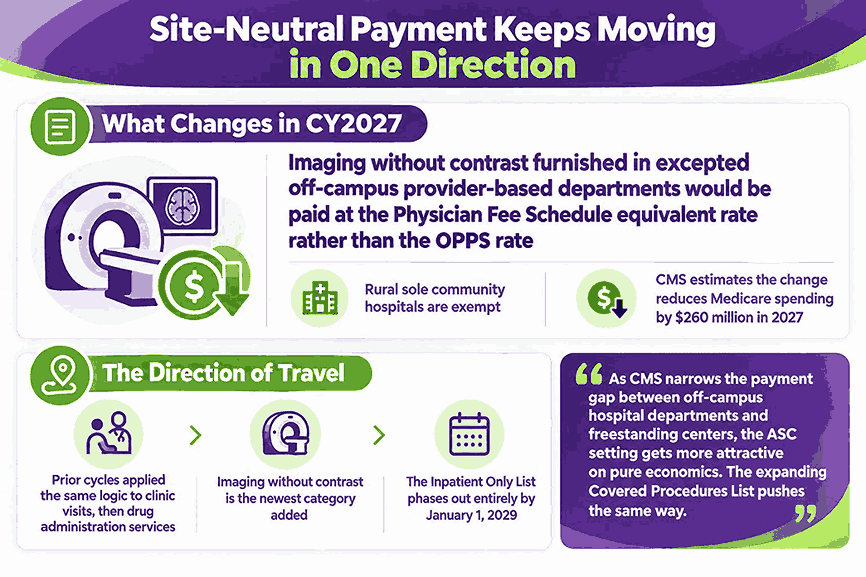
| Site-neutral payment expansion | Pays imaging without contrast at the Physician Fee Schedule rate at off-campus departments | Off-campus hospital outpatient departments |
| Software as a Medical Service framework | Creates a new payment path for algorithm-driven clinical tools | Hospitals and ASCs using AI-driven software |
| Prior authorization expansion | Adds more botulinum toxin injection codes to the prior authorization list | ASCs and hospitals billing Botox-related codes |
The Software as a Medical Service framework, known as SaMS, is new for CY2027. It gives CMS a payment path for tools that support or automate clinical decisions. This is the first payment framework CMS has built specifically for algorithm-driven technology.
Rural sole community hospitals get exemptions from some of these changes. CMS carved out these exemptions to limit financial disruption in low-volume markets.
Requests for Information (Not Yet Proposals)
- Standardizing hospital price transparency data across facilities and reporting formats
- Expanding domestic procurement requirements for personal protective equipment and essential medicines
- Allowing accrediting organizations to review certain EMTALA administrative requirements during regular surveys
Requests for information do not carry the force of a proposal. CMS uses them to gather industry feedback before writing a future rule. ASCs affiliated with hospitals may want to submit comments on these topics during future comment windows.
Why Site-Neutral Payment Keeps Expanding
CMS has expanded site-neutral payment policy for several consecutive rulemaking cycles. The goal is paying the same rate for the same service, regardless of where a hospital system performs it. Imaging without contrast is the newest service category added to this policy.
This trend matters for ASC strategy beyond the imaging provision itself. As CMS narrows the payment gap between off-campus hospital departments and freestanding centers, the ASC setting becomes more attractive on pure economics. Growth in the ASC Covered Procedures List reinforces the same direction.
How the Rule Affects Different ASC Specialties
The proposed changes do not land evenly across specialties. Some specialties gain new procedure access. Others face quality measure changes or payment pressure from unrelated 340B provisions if hospital-affiliated.
| Specialty | Main Impact from CY2027 Rule | Action Item |
|---|---|---|
| Orthopedics | Continued Inpatient Only List removals expand joint and spine case access | Confirm surgeon credentialing for newly eligible procedures |
| Gastroenterology | ASC-9 removal simplifies colonoscopy quality reporting | Update reporting workflows once the final rule confirms removal |
| Urology | New ASC-CPL additions include partial nephrectomy and prostatectomy | Model reimbursement and staffing for higher-acuity urologic cases |
| General surgery / colorectal | Laparoscopic colectomy moves onto the ASC-CPL | Assess anesthesia and recovery-room capacity before scheduling |
| Thoracic surgery | Sleeve lobectomy becomes ASC-payable | Evaluate equipment needs against current center capabilities |
Pain management and ophthalmology see fewer direct changes in this specific rule. Their ASCQR measures and payment update follow the same 2.4% path as every other specialty. Facilities in these specialties should still confirm reporting status ahead of the deadline.
What Should ASCs Do Now?
ASCs cannot act on a proposed rule as if it were final. CMS can change numbers, add exemptions, or drop provisions before November 2026. Facilities should still prepare for the provisions most likely to survive into the final rule.
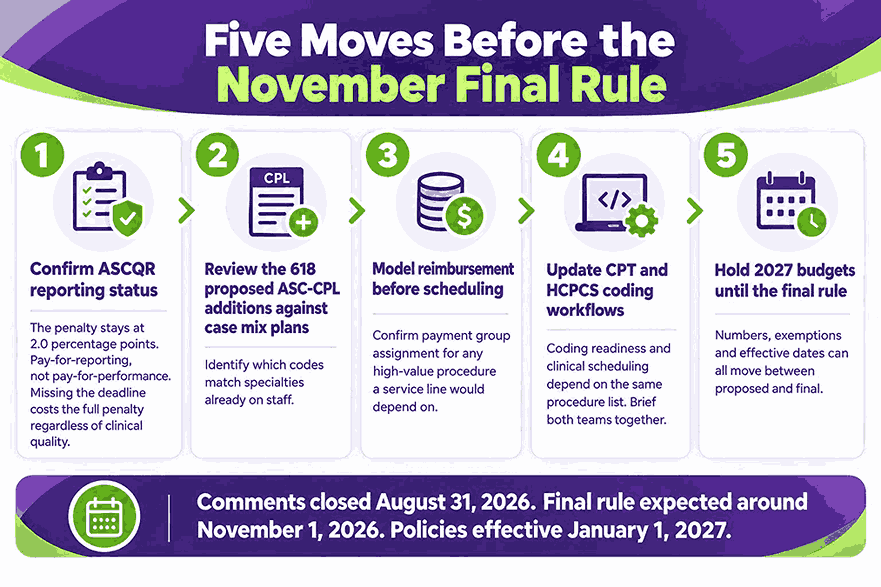
- Confirm ASCQR reporting status now, since the penalty stays at 2 percentage points
- Review the proposed ASC Covered Procedures List additions against current case mix plans
- Model reimbursement for laparoscopic colectomy, partial nephrectomy, sleeve lobectomy, and prostatectomy if these procedures fit the facility’s specialty mix
- Update coding workflows for new CPT and HCPCS codes tied to the added procedures
- Watch for the final rule in November 2026 before locking in 2027 budgets
Facilities that skip these steps risk two problems. They may miss the ASCQR reporting deadline and lose 2 percentage points of payment. They may also under-prepare for the higher-acuity cases moving into the ASC setting.
Revenue cycle teams and clinical leadership should review this list together. Coding readiness and clinical scheduling depend on the same set of procedure additions, so both teams need the same information at the same time. Facilities managing several of these transitions at once often loop in ASC billing companies early, since ASCQR penalty exposure and new-code reimbursement modeling both land in the same reporting window.
Frequently Asked Questions
Is the CMS 2027 ASC payment rule final?
No. CMS released it as a proposed rule on July 2, 2026. The comment period closed August 31, 2026. CMS expects to publish a final rule around November 1, 2026, effective January 1, 2027.
What is CMS-1850-P?
CMS-1850-P is the official designation for the Calendar Year 2027 Hospital Outpatient Prospective Payment System and Ambulatory Surgical Center Payment Rule. It sets Medicare payment policy for hospitals and ASCs together. The rule covers payment rates, quality measures, and new procedure additions.
How many procedures are moving from the Inpatient Only List to ASCs in 2027?
CMS proposes removing 637 procedures from the Inpatient Only List for CY2027. It proposes adding 618 codes to the ASC Covered Procedures List in the same rule. Most of these codes correspond directly to the removed inpatient-only procedures.
Is ASC-9 being removed from quality reporting?
Yes. CMS proposes removing the Appropriate Follow-Up Interval for Normal Colonoscopy measure beginning with the CY2027 reporting period. The change affects the CY2029 payment determination. No replacement measure is proposed this year.
How much will overall ASC payments increase in 2027?
CMS estimates total ASC payments will rise by about $520 million compared to CY2026 levels. This estimate reflects the 2.4% rate update combined with expected changes in case volume and mix. Actual facility-level results depend on specialty mix and reporting status.
What happens if an ASC does not submit required quality data?
The facility loses 2 percentage points from its annual payment update. Its net update falls to roughly 0.4% instead of the full 2.4%. This penalty applies regardless of the facility’s actual clinical quality performance.
When does the Inpatient Only List phase-out finish?
CMS plans to remove the remaining 801 procedures in CY2028. Full elimination of the Inpatient Only List is scheduled for January 1, 2029. CY2027 represents the second year of the three-year phase-out.
What is the ASC Covered Procedures List?
It is the official list of procedures Medicare will pay for when performed in an ambulatory surgical center. CMS adds and removes codes from this list every year. The CY2027 proposal adds 618 codes, largely tied to the Inpatient Only List phase-out.
Does this rule change commercial payer reimbursement too?
Not directly. CMS-1850-P only sets Medicare payment policy. Commercial payers often reference CMS coverage and coding decisions when updating their own policies, but each payer sets its own timeline and rates.