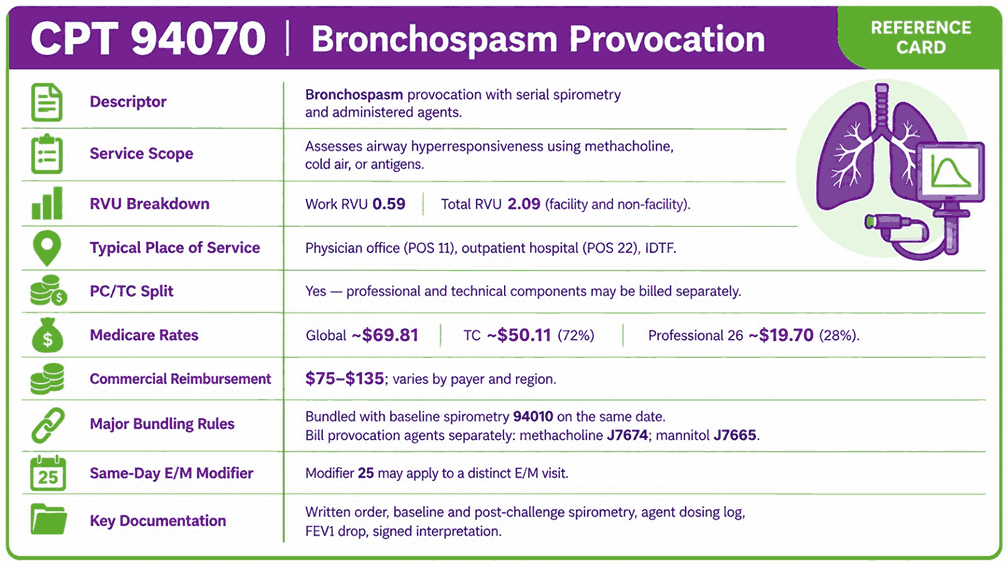
CPT code 94070 reports bronchospasm provocation testing, which uses repeated spirometry measurements after the patient receives an administered agent. Common agents include methacholine, cold air, and antigens.
The CDC reports that 8.9% of U.S. adults currently have asthma. Pulmonologists use this test to measure airway sensitivity when symptoms and baseline spirometry make the diagnosis unclear.
Practices can bill CPT 94070 when the chart documents medical necessity, lists the agent and doses given, and meets payer requirements.
This guide covers the code description, Medicare payment, real-world billing scenarios, and coding rules that prevent claim denials.
What Is the Description of CPT Code 94070?
Providers report the 94070 CPT code for bronchospasm provocation evaluation with multiple spirometry measurements and an administered agent. Medicare assigns CPT 94070 a work RVU of 0.59 and a total RVU of 2.09 in both facility and non-facility settings.
Claims report 1 unit per date of service because the serial measurements make up one study. Placement in the CPT manual falls under the Pulmonary section (94010 to 94799).
Is 94070 the Same as Spirometry?
No, 94070 is a challenge study that includes spirometry, while 94010 reports baseline spirometry alone. Baseline and post-challenge FEV1 readings are part of the 94070 protocol, so 94010 is not added for the same session.
Pre- and post-bronchodilator spirometry reports under 94060 when ordered as its own study. Charging spirometry on top of 94070 duplicates work that the code already pays for.
How Does 94070 Differ From 94060 and 94375?
94070 adds an administered challenge agent, 94060 adds a bronchodilator, and 94375 records a flow-volume loop.
| Code | What It Reports | When It Is Used |
|---|---|---|
| 94060 | Spirometry before and after a bronchodilator | Measuring airflow reversal in known or suspected obstruction |
| 94375 | Respiratory flow-volume loop | Recording airflow against lung volume to show the pattern of obstruction |
| 94070 | Multiple spirometry readings after an administered agent | Measuring airway hyperresponsiveness |
Each code answers a different clinical question, so the order and the test performed select the code. Knowing how 94070 sits among other pulmonology CPT codes prevents duplicate and unbundled lines that payers reject.
Which Challenge Agents and Methods Fall Under 94070?
Laboratories report the methacholine challenge CPT code 94070 for methacholine, mannitol, cold air, and antigen protocols.
- Rising doses of nebulized methacholine
- Mannitol powder inhaled in capsule doses
- Cold air breathed during dry-air hyperventilation
- Antigen extracts inhaled for allergen-specific challenge
Exercise challenge is a separate service reported under 94617, which includes pre- and post-exercise spirometry, ECG recording, and pulse oximetry.
When Do Providers Order 94070?
- Clinicians order 94070 when symptoms point to asthma, but baseline spirometry cannot confirm it. Four indications commonly lead to an order.
- Normal baseline spirometry with persistent respiratory symptoms
- Unexplained chronic cough or wheeze
- Suspected occupational or exposure-related asthma
- Assessment of airway hyperresponsiveness to guide diagnosis or treatment
A normal baseline FEV1 does not rule out asthma, because airway narrowing may appear only after a trigger. Results are reported as the dose or concentration that drops FEV1 by 20%, known as PC20 or PD20.
Does 94070 Split Into Professional and Technical Components?
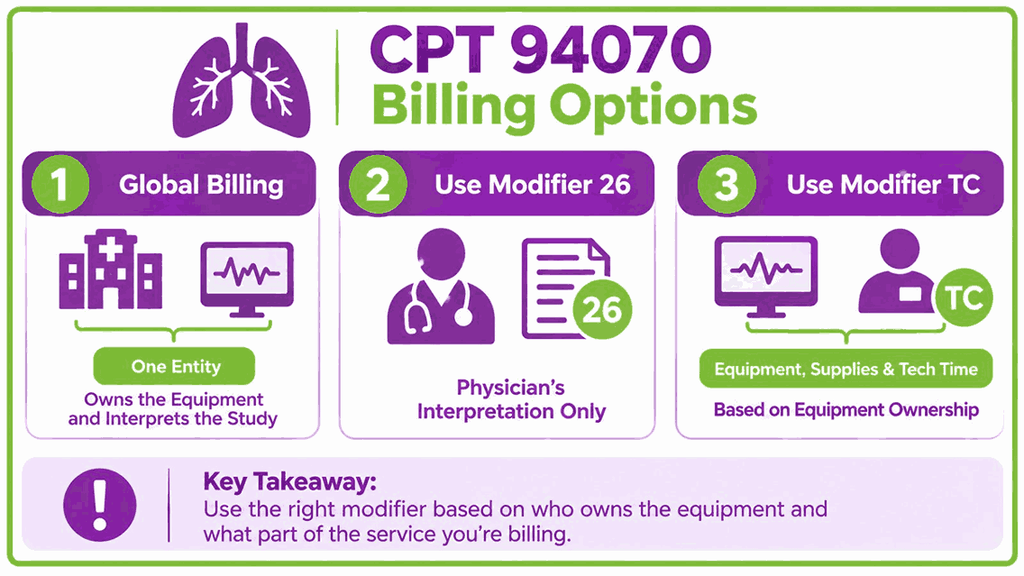
94070 has two components, so one practice can bill globally, or two parties can bill separately. Global billing applies when the same entity owns the equipment and interprets the study.
When Do You Use Modifier 26 With 94070?
Modifier 26 reports only the physician’s interpretation and written report. Physicians who read studies in a hospital-owned lab append 26, and the facility bills the technical component.
When Do You Use Modifier TC With 94070?
Report modifier TC for the equipment, supplies, space, and technologist time behind the challenge study. Equipment ownership determines who bills TC. Printouts from the technologist without a signed interpretation cannot support global billing.
Which ICD-10 Codes Support 94070?
Respiratory diagnoses within pulmonology ICD-10 codes support 94070 when the record documents why airway reactivity testing was needed.
| Diagnosis Family | Example ICD-10-CM Codes |
|---|---|
| Asthma | J45.909 |
| Exercise-induced bronchospasm | J45.990 |
| Chronic cough | R05.3 |
| Wheezing | R06.2 |
| Dyspnea and shortness of breath | R06.00, R06.02 |
| Abnormal pulmonary function study | R94.2 |
Covered code lists differ by Medicare Administrative Contractor, so the local policy confirms the final choice.
Can You Bill a Symptom Code Alongside a Confirmed Asthma Diagnosis?
Yes, when the record documents both and ties them to the encounter. Established asthma with a new persistent cough illustrates the pairing.
Extra diagnosis codes do not establish medical necessity, so the note must explain why airway reactivity testing was needed.
How Does 94070 Pair With 94729 and 94640?
94729 is an add-on code for diffusing capacity that reports with a primary code, and 94070 is one of 7 primary codes it accepts. Billers add 94729 only when the lab performs and documents a diffusing capacity study in the same session.
Inhalation treatment 94640 reports a separate service for acute airway obstruction or sputum induction. Administering the nebulized agent is part of the 94070 study, so the current NCCI table decides if 94640 can be added.
Plethysmography lung volumes under CPT 94726 are a separate study and carry their own line on the claim.
What Does CPT Code 94070 Cost, and Who Pays for It?
For 2026, Medicare pays approximately $69.81 nationally for the global 94070 service before geographic adjustment. Technical-component billing accounts for approximately $41.08 of that amount, and the professional component under modifier 26 accounts for approximately $28.72.
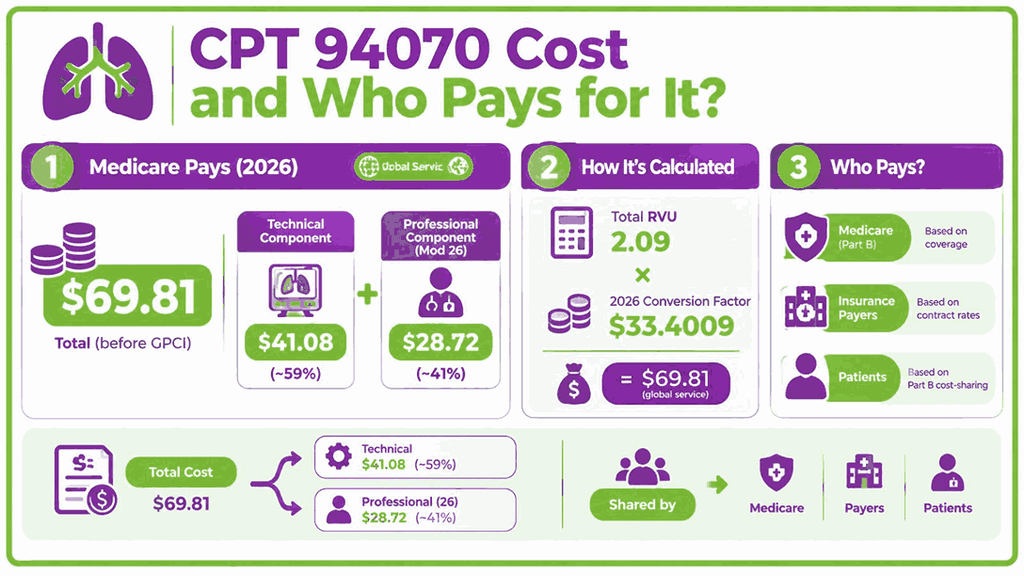
Those figures come from the total RVU of 2.09 multiplied by the 2026 conversion factor of $33.4009. Payers and patients split the cost based on coverage, contract rates, and Part B cost-sharing.
Does Medicare Cover CPT Code 94070?
Medicare Part B covers the challenge study when it is reasonable and necessary, and the record supports it. CMS Billing and Coding Article A57216 on pulmonary function testing lists 94070 among the codes that meet Medicare standards of care.
Local policy governs the final answer because each contractor sets its own covered diagnoses and frequency limits. Screening of asymptomatic patients does not meet coverage standards.
Does Commercial Insurance Cover CPT Code 94070?
Many commercial plans cover 94070 when the study is medically necessary, but coverage depends on the insurer’s policy and the patient’s benefits.
Some plans require prior authorization, limit how often the test can be repeated, or ask for documented symptoms and baseline spirometry results.
Contract rates are negotiated, and many plans base payment on a percentage of the Medicare fee schedule. Pulmonology billing providers check authorization rules, network status, and plan-specific limits before scheduling the patient.
Does the Patient Owe a Deductible or Coinsurance?
Cost-sharing applies because 94070 is a diagnostic test and not a preventive service like the lung cancer screening reported under CPT 71271. Under Part B, patients generally pay the annual deductible (if unmet), then 20% of the Medicare-approved amount.
At the $69.81 national amount, 20% coinsurance comes to about $13.96. Commercial plans may apply a deductible, copayment, or coinsurance based on the policy.
Does Reimbursement Differ Between Global, Modifier 26, and TC Billing?
Component billing divides the 2026 national payment between the physician and the equipment owner, and global billing keeps it together.
| Billing Method | What It Covers | Medicare Payment |
|---|---|---|
| Global | Professional and technical components | $69.81 |
| Modifier 26 | Physician interpretation and written report | Approximately $28.72 |
| Modifier TC | Equipment, supplies, and technologist time | Approximately $41.08 |
Facility and non-facility settings carry the same practice expense RVUs for this code, so place of service does not change the physician’s national amount. Hospital outpatient departments bill the technical component under OPPS, so the facility payment follows a separate schedule.
How Much Can Local Reimbursement Differ From the National Average?
Geographic practice cost indices adjust the three RVU components, so the same 94070 service pays a different amount in each of the 109 localities.
Arkansas pays approximately $62.17 for the global service, and the San Jose locality for San Benito County pays approximately $92.61. That spread is about $30.44, or roughly 49% of the Arkansas amount.
| Medicare Locality | Global Payment |
|---|---|
| Arkansas | $62.17 |
| Dallas, TX | $69.55 |
| Houston, TX | $70.25 |
| Manhattan, NY | $79.89 |
| San Jose area (San Benito County), CA | $92.61 |
Qualifying APM participants are paid with a $33.5675 conversion factor, which adds about 0.5% to each figure.
Is the Challenge Agent Billed Separately?
Drug supplies bill separately from 94070 under their own HCPCS codes. J7674 reports methacholine chloride by nebulizer per 1 mg, and J7665 reports mannitol by inhaler per 5 mg.
Payment for the agent follows drug pricing and contractor rules, so verify the rate before billing. Code 95070 reports bronchial challenge testing that excludes the necessary pulmonary function tests, so it is not a substitute for 94070.

What Are Some Real-World Billing Scenarios for CPT 94070?
Billing 94070 follows four common patterns, from a same-day visit with a challenge study to a screening denial. The scenarios below list the CPT codes, ICD-10 codes, modifiers, and documentation required.
Scenario 1: Methacholine Challenge in a Pulmonology Office With a Same-Day Visit
A 38-year-old with a persistent dry cough for 4 months comes to the pulmonology office, where prior spirometry came back normal. Concern for cough-variant asthma leads the pulmonologist to evaluate the patient and order a methacholine challenge for that afternoon.
Equipment ownership places both services on one practice claim. Work beyond ordering and reviewing the test must appear in the note before modifier 25 applies.
- CPT Codes: 99214-25 (office visit) and 94070, plus J7674 for the methacholine when the payer allows
- ICD-10 Codes: R05.3 (chronic cough) and R06.2 (wheezing)
- Modifiers: 25 on the E/M code and none on 94070 because the practice bills globally
- Documentation Required: A separately identifiable E/M note, the challenge order, baseline FEV1, each dose step with its post-dose FEV1, the PC20 result, and the physician’s signed interpretation.
Scenario 2: Physician Interpretation Only at a Hospital PFT Lab
Technologists in a hospital PFT lab run a methacholine challenge for a 52-year-old with shortness of breath. An independent pulmonologist then reviews the tracings and writes the interpretation. Different components of the same code go to different claims.
- CPT Codes: 94070-26 from the pulmonologist, while the hospital bills the technical side on its facility claim
- ICD-10 Codes: R06.02 (shortness of breath) and R06.2 (wheezing)
- Modifiers: 26 on the professional line, with POS 22 on the professional claim
- Documentation Required: A signed interpretation that states the PC20 or PD20 and the percent change in FEV1, plus confirmation that the hospital owns the equipment and employs the technologist.
Scenario 3: NCCI Edit Between 94070 and Baseline Spirometry
Clearinghouse edits flag a claim that lists 94010 and 94070 for a 27-year-old with wheezing. Spirometry at baseline sits inside the challenge protocol, so the biller removes the 94010 line instead of forcing modifier 59 onto it.
Separate spirometry ordered for its own clinical question is the only reason to revisit modifier 59.
- CPT Codes: 94070 only, after the 94010 line is removed
- ICD-10 Codes: R06.2 (wheezing) and R06.09 (other forms of dyspnea)
- Modifiers: None, because the edit resolves by removing the bundled line
- Documentation Required: An order that names a bronchial challenge and not a separate spirometry study, the baseline FEV1 recorded as part of the protocol, the dose steps, the post-dose results, and the signed interpretation.
Scenario 4: Denial for a Challenge Test With No Documented Symptoms
Employer wellness screening sends a 41-year-old with no respiratory symptoms for a methacholine challenge. Denial for medical necessity follows on the 94070 line because the record shows no symptoms and no abnormal baseline result.
Resubmission helps only when the original note already records symptoms, since a late addition cannot create necessity. Responsibility for the charge shifts to the patient or program sponsor when no symptom supports the test.
- CPT Codes: 94070 (denied on first submission)
- ICD-10 Codes: Z13.83 (encounter for screening for respiratory disorder)
- Modifiers: None relevant to the denial
- Documentation Required to Overturn the Denial: A note dated at the encounter that records the symptoms, the reason for ordering, the dose results, and the signed interpretation, plus a signed financial responsibility form from before the test when the plan permits patient billing.
What Are the Coding Rules for CPT 94070?
Rules for 94070 fall into 3 groups covering documentation, coverage and frequency, and edits and appeals. A gap in any group can turn a payable challenge study into an unpaid claim.
What Documentation Must Support a 94070 Claim?
94070 support starts with a signed order, a documented indication, the full challenge record, and a signed physician interpretation. Records list baseline FEV1, the agent given, each dose step, and the FEV1 measured after every dose.
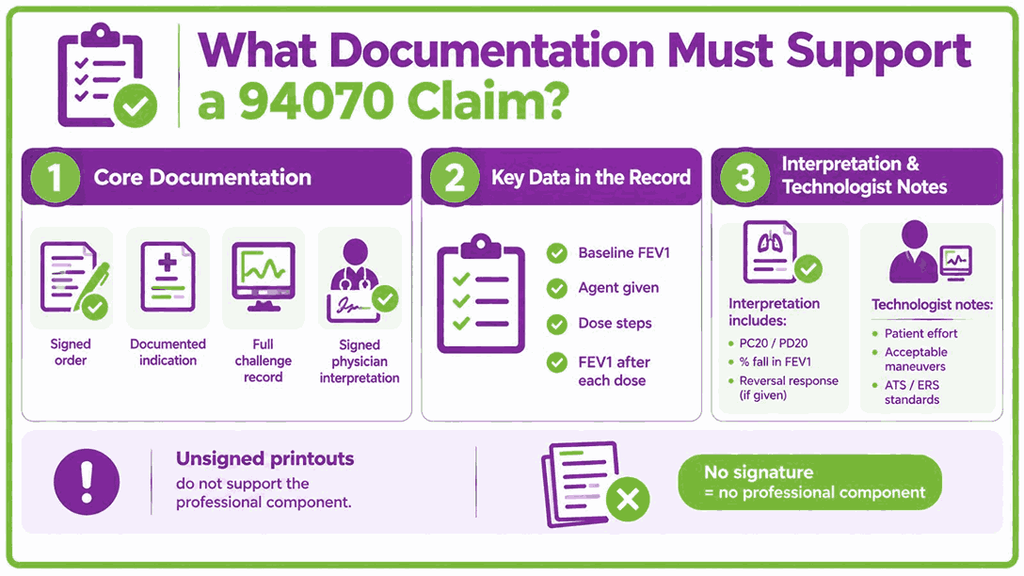
Interpretations state the PC20 or PD20, the percent fall in FEV1, and the response to a reversal bronchodilator when one was given.
Technologists record patient effort and acceptable, reproducible maneuvers under ATS and ERS standards. Unsigned printouts leave the professional component undocumented.
Who Qualifies for 94070?
Qualification depends on documented symptoms or a clinical question that baseline spirometry cannot answer. Medical necessity decides the outcome, and the table below separates what supports a claim from what does not.
| Situation | Supports Medical Necessity | Does Not Support |
|---|---|---|
| Clinical Picture | Persistent cough, wheeze, or dyspnea with no confirmed cause | No symptoms and no respiratory diagnosis |
| Baseline Spirometry | Normal or nondiagnostic result with ongoing symptoms | Result that already shows reversible obstruction |
| Source of Request | Clinician order tied to a diagnostic question | Employer, school, or sports screening request |
| Occupational Concern | Symptoms linked to a workplace exposure | Routine surveillance with no symptoms |
| Order | Signed order that names bronchial challenge testing | No written order in the record |
You can still perform studies from the right column, but Medicare treats the claim as non-covered. Advance Beneficiary Notices signed before the test move financial liability to the patient.
How Often Can 94070 Be Billed?
Frequency limits for 94070 come from the contractor’s LCD or the payer’s policy, so the local rule governs. Repeat challenge testing fits a documented change in symptoms, a new exposure, or a treatment change that raises a new diagnostic question.
Calendar the next eligible date after each study so scheduling staff can verify it before booking.
Do Local Coverage Determinations Add Requirements?
LCDs add covered diagnosis lists and documentation rules that differ by Medicare Administrative Contractor. Article A57216 pairs a pulmonary function testing policy with the ICD-10 codes that support necessity for 94070.
Jurisdiction lookup in the Medicare Coverage Database shows the policy for a practice’s contractor. National necessity standards apply everywhere, while the LCD adds diagnosis and frequency detail.
How Do NCCI Edits Affect 94070?
NCCI procedure-to-procedure edits bar some code pairs on one date, and a modifier indicator of 1 allows modifier 59 for distinct services. Indicator 0 permits no modifier, so the pair never bills together.
Serial FEV1 measurements belong to the 94070 protocol, so a separate 94010 line rarely survives the edit. Units stay at 1 per date of service because every dose step counts toward 1 study.
Quarterly updates to the edit tables make the current version the one that governs.
When Do You Use Modifier 25 With 94070?
Append modifier 25 to the E/M code when a significant, separately identifiable office visit occurs on the same date as 94070. Visit notes must document work beyond ordering and reviewing the challenge test, such as a full history and a treatment decision.
Position on the claim matters because 25 attaches to the E/M line and never to 94070.
What Is the Appeal Window if a Claim Is Denied?
Redetermination requests must reach the Medicare contractor within 120 days of receiving the denial notice, which opens the first of 5 appeal levels. Decisions typically arrive within 60 days of the request.
Late filing forfeits appeal rights unless the contractor finds good cause. Agreements with commercial payers set separate deadlines, often stated in the denial letter.
Why Do CPT 94070 Claims Get Denied?
Rejections of 94070 usually trace back to documentation, bundling, or medical necessity, rarely to the test itself. Recurring causes and fixes appear in the table below.
| Denial Cause | What It Looks Like | Quick Fix |
|---|---|---|
| Missing Physician Interpretation | Technologist printout in the chart with no signed interpretation | Add a signed interpretation addendum and resubmit |
| Bundled Spirometry Line | 94010 or 94060 billed on the same date as 94070 | Remove the line after checking the NCCI modifier indicator |
| No Documented Symptoms | Screening request with no respiratory symptom or diagnosis | Document the clinical indication at the visit and use an ABN when coverage is doubtful |
| Diagnosis Outside the Local Policy | Code missing from the contractor’s covered list | Match the diagnosis to the LCD code list |
| Stopped-Early Test | Challenge ended before the full dose series with no reason in the note | Document why the study stopped and follow the payer’s rule for partial services |
| Frequency Limit Exceeded | Repeat test inside the policy window with no change in condition noted | Calendar the next eligible date and document any change |
| Missing or Unsigned Order | No written order naming bronchial challenge testing | Obtain a signed order before the study |
Every fix comes down to 1 rule, which is to document the order, the doses, and the interpretation before building the claim.
Final Words on CPT Code 94070
Collections on 94070 depend on the paperwork behind the challenge study. Charts need a signed order, the agent and each dose, the FEV1 after every step, and a signed physician interpretation.
Check the NCCI modifier indicator before pairing spirometry with 94070, confirm who bills 26 and TC, and calendar the next eligible date. Teams that build these habits into scheduling and charge capture give each CPT code a clear path to payment on first submission.