Summary: “The ICD-10 code family for back pain is M54, with codes split by spinal region: cervical (M54.2), thoracic (M54.6), lumbar (M54.50/M54.51/M54.59), and unspecified (M54.9). The single most important update, M54.5, was deleted effective October 1, 2021, and is not billable.”
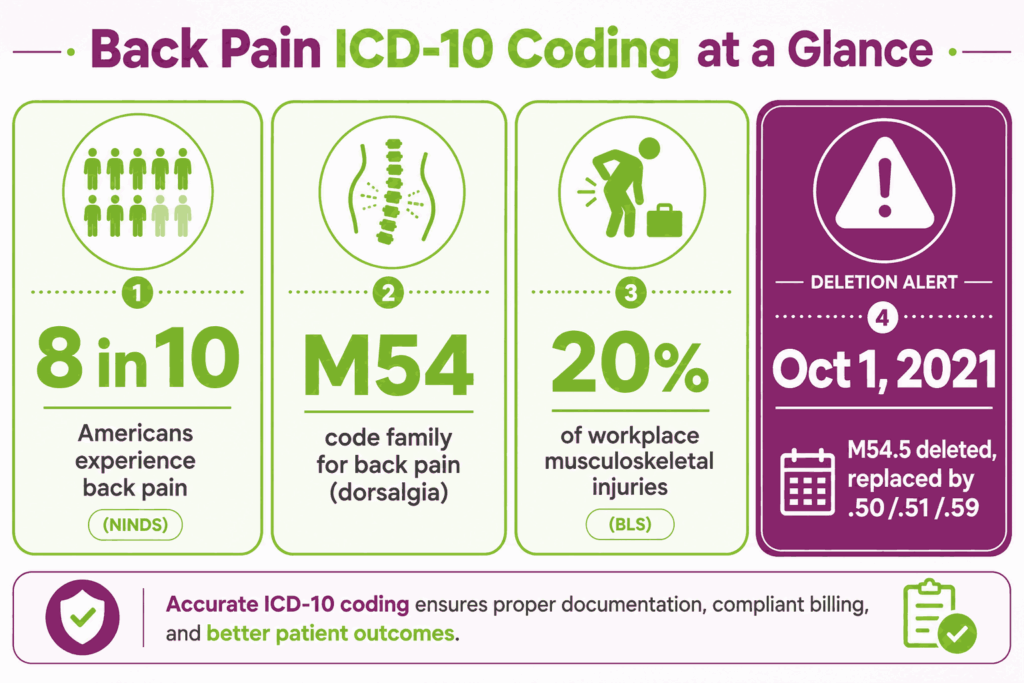
Back pain is one of the top reasons for primary care visits in the US. The National Institute of Neurological Disorders and Stroke reports that roughly 80% of adults experience low back pain at some point in life. Back injuries are also the largest single category of workplace musculoskeletal disorders tracked by the Bureau of Labor Statistics, which is why workers’ compensation carriers scrutinize M54 claims more closely than most commercial payers do.
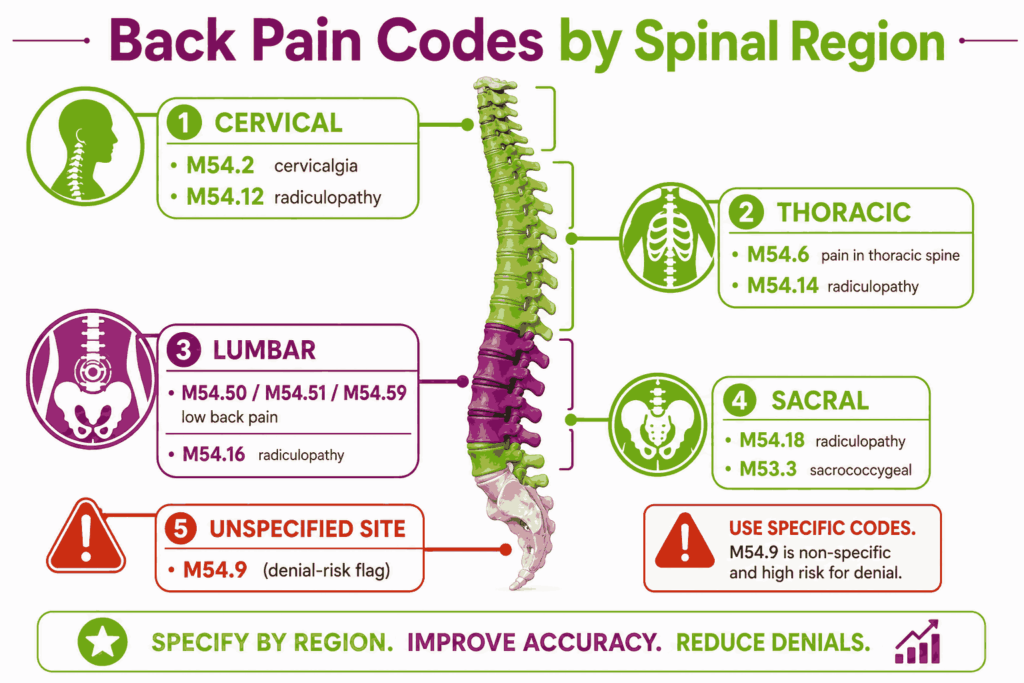
M54 is the ICD-10 code family for back pain (dorsalgia). The codes split by spinal region: cervical, thoracic, lumbar, sacral, and unspecified. The single most important rule for back pain coding in 2026: M54.5 was deleted from ICD-10-CM effective October 1, 2021, and is no longer a valid billable code. The replacement codes are M54.50, M54.51, and M54.59.
This guide covers the full M54 family by spinal region, the vertebrogenic low back pain code (M54.51) and its pairing with basivertebral nerve ablation, the radiculopathy (M54.1x) and sciatica (M54.3x, M54.4x) interplay, the disc disorder codes (M50, M51) that displace M54 and the Excludes1 notes that enforce it, sequencing rules under Section IV.G, CPT pairings, and the denial patterns coders see most often. NCHS and CMS publish the ICD-10-CM addenda each summer, and the revised code set takes effect every October 1, so verify M54 against the current fiscal year release before submission.
What Is the ICD-10 Code Family for Back Pain?
The ICD-10 code family for back pain is M54 (dorsalgia). The M54 codes sit inside Chapter 13 of ICD-10-CM under the M50–M54 block on other dorsopathies.
What Is the M54 Code Range in ICD-10-CM?
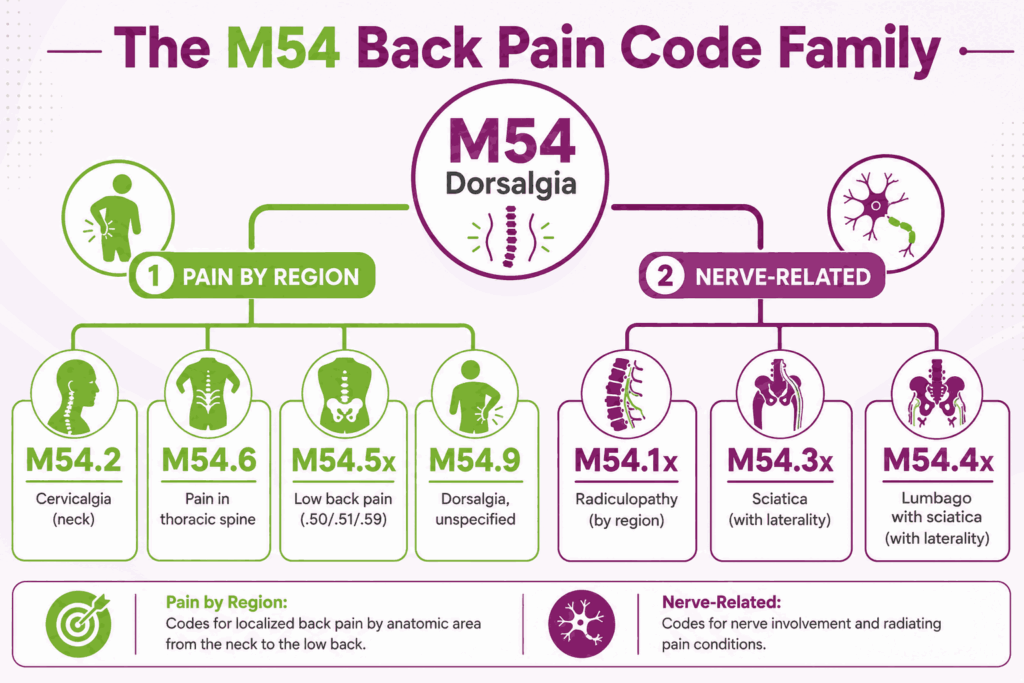
M54 covers back-related pain presentations. The block includes back pain (M54.5x, M54.6, M54.9), radiculopathy (M54.1x), sciatica (M54.3x), lumbago with sciatica (M54.4x), and cervicalgia (M54.2). Each parent code targets a specific clinical pattern or spinal region.
Why Does ICD-10-CM Code Back Pain by Spinal Region Instead of Laterality?
ICD-10-CM codes back pain by spinal region because spinal anatomy drives clinical workup and procedural pairing. The spine is a midline structure, and most back pain presentations do not split into right and left. Region is the primary axis of code selection. Laterality applies only to sciatica (M54.3x) and lumbago with sciatica (M54.4x). That region-first axis is unusual: most of how ICD-10 organizes symptom codes by body region leans on laterality, and back pain is one of the few families where side rarely applies.
Is Back Pain a Symptom Code or a Diagnosis Code in ICD-10?
Back pain (M54) is a symptom code under ICD-10-CM Section IV.G. When the chart documents a definitive spinal diagnosis, such as disc disorder or spondylosis, the underlying diagnosis takes primary and the M54 symptom code drops or sequences as secondary.
What Is “Dorsalgia” in ICD-10-CM Terminology?
Dorsalgia is the ICD-10-CM term for back pain. The Alphabetic Index routes both “back pain” and “back ache” to dorsalgia and the M54 family. The clinical wording in the note does not change code selection.
What Are the Back Pain ICD-10 Codes by Spinal Region?
Back pain ICD-10 codes split by spinal region. The five regional groups below cover every billable M54 back pain code, along with the unspecified default. These five groups sit inside the wider orthopedic ICD-10 code library, where the dorsalgia block borders the disc, spondylosis, and deforming dorsopathy families that replace M54 once imaging returns.
What Are the Codes for Cervical (Neck) Pain?
Cervical back pain codes capture pain in the neck region. The most common code is M54.2.
| Code | Description |
|---|---|
| M54.2 | Cervicalgia (neck pain) |
| M54.81 | Occipital neuralgia |
M54.2: Cervicalgia (Neck Pain)
M54.2 is the ICD-10 code for cervicalgia (neck pain). M54.2 is the highest-volume cervical pain code in US claims data. The chart documents neck pain without a confirmed cervical disc or spondylosis diagnosis.
How Does M54.2 Differ From M54.81?
M54.2 covers diffuse neck pain. M54.81 covers occipital neuralgia, a specific neuralgic condition affecting the occipital nerves at the base of the skull. The two are not interchangeable.
What Are the Codes for Thoracic (Mid and Upper Back) Pain?
Thoracic back pain codes capture pain in the upper and mid back. The thoracic region has one primary code, M54.6, with lower procedural volume than lumbar or cervical.
M54.6: Pain in Thoracic Spine
M54.6 is the ICD-10 code for pain in the thoracic spine. The chart documents mid-back pain, upper back pain, or thoracic spine pain.
How Are Mid Back Pain, Upper Back Pain, and Middle Back Pain Coded?
Mid back pain ICD 10, middle back pain ICD 10, and upper back pain ICD 10 all route to M54.6 when the pain localizes to the thoracic spine. The Alphabetic Index does not separate these clinical descriptors.
What Are the Codes for Lumbar (Low Back) Pain?
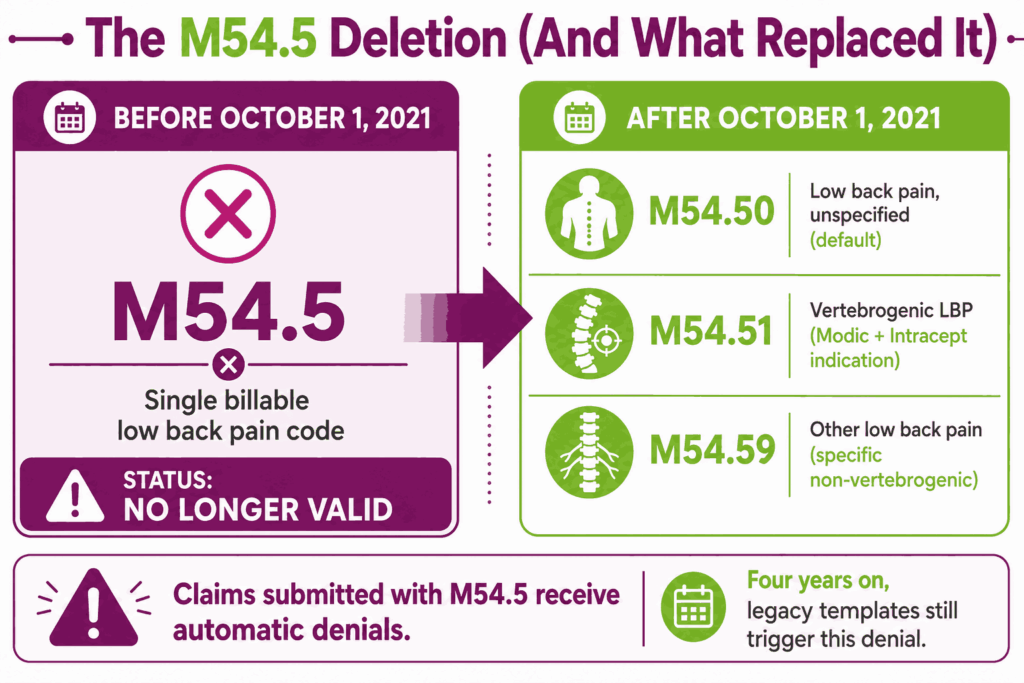
Low back pain codes underwent a major restructuring effective October 1, 2021. The single billable code M54.5 was deleted and replaced with three specific codes.
| Code | Description |
|---|---|
| M54.50 | Low back pain, unspecified |
| M54.51 | Vertebrogenic low back pain |
| M54.59 | Other low back pain |
M54.50: Low Back Pain, Unspecified
M54.50 is the ICD-10 code for low back pain, unspecified. M54.50 applies when the chart documents low back pain without a more specific underlying mechanism.
M54.51: Vertebrogenic Low Back Pain
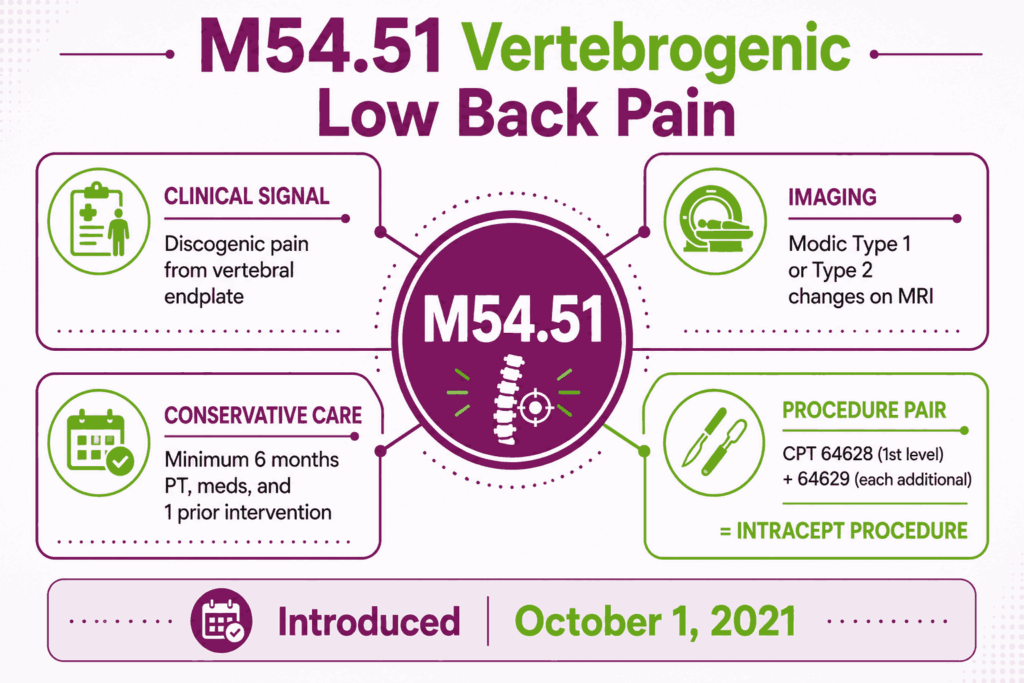
M54.51 is the ICD-10 code for vertebrogenic low back pain. The code captures discogenic pain originating from the vertebral endplate, confirmed by Modic type 1 or type 2 changes on MRI. M54.51 supports medical necessity for basivertebral nerve ablation.
M54.59: Other Low Back Pain
M54.59 is the ICD-10 code for other low back pain. The code applies when the chart documents a specific low back pain presentation that does not match M54.50 or M54.51.
Why M54.5 Is No Longer a Valid Code
M54.5 was deleted from ICD-10-CM effective October 1, 2021, and is no longer a valid billable code. Claims submitted with M54.5 receive automatic denials. Coders must select M54.50, M54.51, or M54.59 based on chart documentation.
What Are the Codes for Sacral and Coccygeal Pain?
Sacral and coccygeal pain codes appear in pelvic floor, postpartum, and post-trauma documentation. The two most common codes appear below.
| Code | Description |
|---|---|
| M54.18 | Radiculopathy, sacral and sacrococcygeal region |
| M53.3 | Sacrococcygeal disorders, NEC |
M54.18: Sacral and Sacrococcygeal Radiculopathy
M54.18 captures radiculopathy in the sacral and sacrococcygeal region with sacral nerve root involvement.
M53.3: Sacrococcygeal Disorders
M53.3 covers sacrococcygeal disorders not classified elsewhere, including coccydynia (tailbone pain). M53.3 sits outside the M54 family but commonly appears alongside back pain codes.
What Is the Code for Unspecified Back Pain?
Unspecified back pain codes apply only when documentation is genuinely incomplete. They carry the highest denial risk in this category.
M54.9: Dorsalgia, Unspecified
M54.9 is the ICD-10 code for dorsalgia, unspecified. The code applies when the chart documents back pain without a specified region. Back pain unspecified, ICD-10 codes to M54.9.
Why M54.9 Triggers Denials on Specific-Procedure Claims
M54.9 triggers denials on spinal procedure claims because the procedure itself is region-specific. A lumbar epidural steroid injection (CPT 62323) paired with M54.9 fails the diagnosis-to-procedure match.
How Do You Code Vertebrogenic Low Back Pain (M54.51)?
Vertebrogenic low back pain (M54.51) is the most clinically important new code in the back pain family. The code links a specific MRI finding to a specific procedural intervention.
What Is Vertebrogenic Low Back Pain Clinically?
Vertebrogenic low back pain is chronic low back pain originating from the vertebral endplate. The basivertebral nerve transmits the pain signal. Modic type 1 and type 2 changes on MRI confirm the diagnosis. The pain pattern is typically midline and worse with axial loading.
When Was M54.51 Introduced, and Why?
M54.51 was introduced on October 1, 2021, as part of the M54.5 split. Before that date, all low back pain coded to M54.5, which made it impossible to distinguish vertebrogenic pain from other low back pain on claims.
What Documentation Supports M54.51 Coding?
M54.51 documentation requires confirmed Modic changes on MRI and failed conservative care.
Modic Type 1 and Type 2 Changes on MRI
Modic changes are vertebral endplate signal changes visible on MRI. Type 1 (inflammatory) and type 2 (fatty) changes support M54.51. The MRI report must specify the Modic type and affected vertebral levels.
Failed Conservative Care Documentation
Failed conservative care captures at least six months of treatment including physical therapy, medications, and at least one prior interventional procedure such as an epidural steroid injection.
How Does M54.51 Pair With Basivertebral Nerve Ablation (CPT 64628, 64629)?
CPT 64628 covers basivertebral nerve ablation (Intracept procedure) for the first vertebral body. CPT 64629 covers each additional vertebral body. The procedure pairs with M54.51 as primary. Payers require documented Modic changes, failed conservative care, and pain duration of at least six months.
How Do Radiculopathy (M54.1x) and Sciatica (M54.3x) Relate to Back Pain?
Radiculopathy and sciatica codes sit next to back pain codes in the M54 family. The three categories often appear together clinically but require distinct code selection based on pain pattern.
What Are the Radiculopathy Codes by Spinal Region?
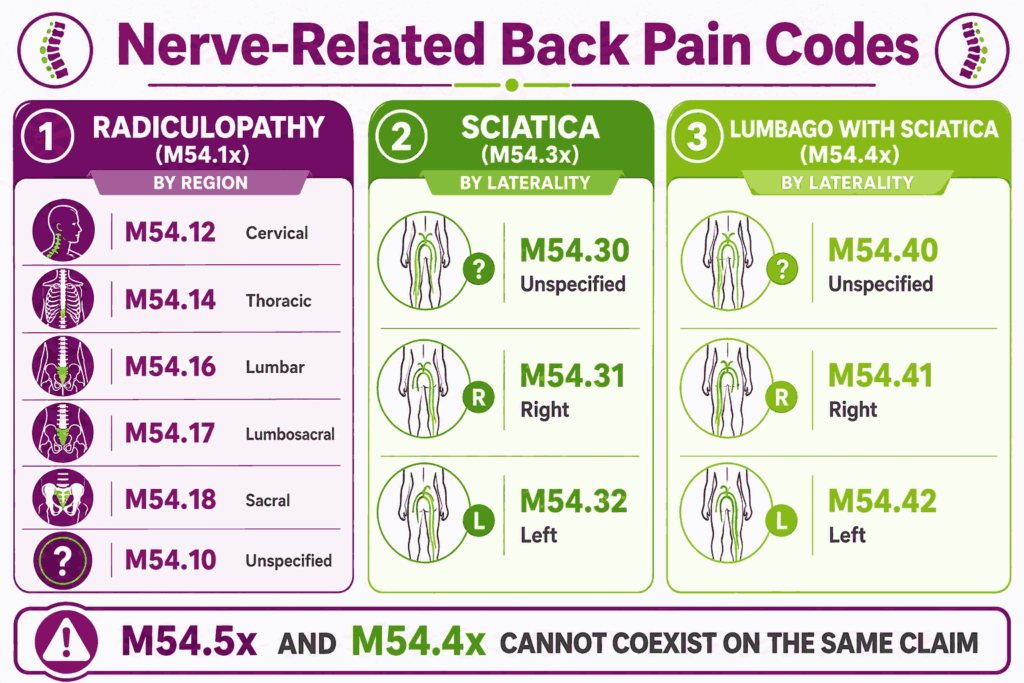
Radiculopathy ICD 10 codes split by spinal region. The M54.1x family captures nerve root irritation across the cervical, thoracic, lumbar, and sacral regions.
| Code | Description |
|---|---|
| M54.10 | Radiculopathy, site unspecified |
| M54.11 | Occipito-atlanto-axial region |
| M54.12 | Cervical region |
| M54.13 | Cervicothoracic region |
| M54.14 | Thoracic region |
| M54.15 | Thoracolumbar region |
| M54.16 | Lumbar region |
| M54.17 | Lumbosacral region |
| M54.18 | Sacral and sacrococcygeal region |
Cervical Radiculopathy (M54.12)
M54.12 captures cervical radiculopathy. The chart documents nerve root pain radiating from the neck into the arm with sensory or motor findings on exam.
Lumbar Radiculopathy (M54.16)
M54.16 captures lumbar radiculopathy and is one of the highest-volume direct-code searches in this cluster. The chart documents nerve root pain in the lumbar distribution with radiation into the lower extremity.
Lumbosacral and Other Regional Radiculopathy Codes
M54.17 covers lumbosacral, often associated with L5-S1 pathology. M54.13 covers cervicothoracic, M54.14 covers thoracic, M54.15 covers thoracolumbar, and M54.18 covers sacral and sacrococcygeal radiculopathy.
What Are the Sciatica Codes?
Sciatica ICD 10 codes split by laterality. The M54.3x family is one of the few back pain code groups that carries laterality.
| Code | Description |
|---|---|
| M54.30 | Sciatica, unspecified side |
| M54.31 | Sciatica, right side |
| M54.32 | Sciatica, left side |
When Do You Use M54.4 (Lumbago With Sciatica)?
M54.4 captures the combined presentation of low back pain with radiating sciatica. The code applies when both conditions are clinically active on the same encounter.
M54.40: Lumbago With Sciatica, Unspecified Side
M54.40 applies when low back pain and sciatica coexist, but the chart does not document the affected side.
M54.41: Lumbago With Sciatica, Right Side
M54.41 applies when low back pain and right-sided sciatica coexist.
M54.42: Lumbago With Sciatica, Left Side
M54.42 applies when low back pain and left-sided sciatica coexist.
Can M54.5x Codes and M54.4x Codes Appear on the Same Claim?
M54.5x (low back pain) and M54.4x (lumbago with sciatica) cannot coexist on the same claim. M54.4x already captures both the low back pain and sciatica components. Reporting both miscounts the clinical picture and triggers automated denial.
When Should You Code Back Pain (M54) vs. an Underlying Spinal Diagnosis?
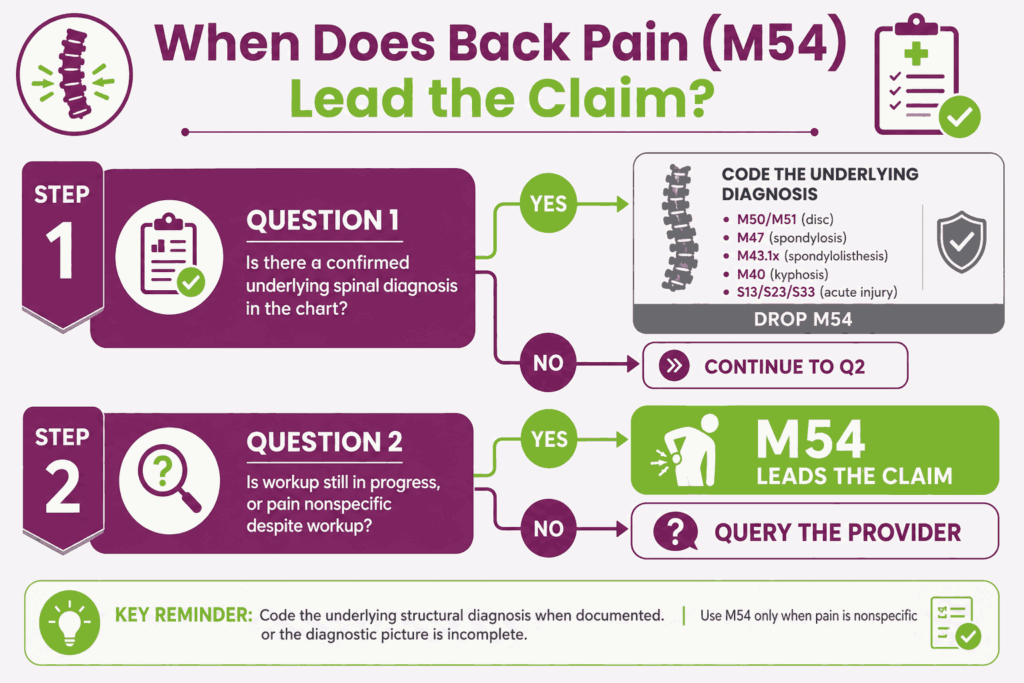
The decision between coding back pain (M54) and the underlying spinal diagnosis depends on the workup stage. ICD-10-CM Section IV.G applies the same logic used for any symptom-versus-diagnosis sequencing.
What Does ICD-10-CM Section IV.G Say About Back Pain Coding?
Section IV.G states that symptom codes are acceptable as primary diagnoses when no related definitive diagnosis has been established. Once a specific spinal diagnosis is confirmed, that diagnosis takes primary, and the M54 symptom code drops or sequences secondary.
When Is M54 the Correct Primary Diagnosis?
M54 is the correct primary diagnosis in three scenarios: initial visits without a confirmed spinal diagnosis, workup-in-progress encounters, and chronic back pain ICD 10 management where the source remains nonspecific despite workup.
When Should the Underlying Spinal Diagnosis Be Coded Primary Instead?
The underlying spinal diagnosis takes primary whenever the chart confirms a specific spinal condition that the presenting back pain represents.
Confirmed Intervertebral Disc Disorder (M50, M51)
Confirmed cervical disc disorders code to M50. Confirmed thoracic or lumbar disc disorders code to M51. M54 drops from the claim because disc pain is integral to the disc disorder diagnosis. Disc disorders displace M54 codes more often than any other diagnosis, and parts of the M51 family carry Excludes1 notes that block the pairing outright. The next section covers the full mapping.
Confirmed Spondylosis (M47)
Confirmed spondylosis codes to M47 by spinal region. M47.812 covers cervical, M47.814 covers thoracic, and M47.816 covers lumbar. The spondylosis code takes primary.
Confirmed Spondylolisthesis (M43.1x)
Confirmed spondylolisthesis codes to M43.1x by region. M43.16 covers lumbar spondylolisthesis. The code takes primary over any M54 back pain code.
Confirmed Kyphosis or Lordosis (M40)
Confirmed kyphosis and lordosis code to M40 by region and type. The structural diagnosis takes primary when documented.
Confirmed Spinal Stenosis (M48.0x)
Confirmed spinal stenosis codes to M48.0x by region. M48.061 covers lumbar stenosis without neurogenic claudication, and M48.062 covers lumbar stenosis with neurogenic claudication. The spinal stenosis codes under M48.06 take primary once imaging confirms the narrowed canal.
Osteoporotic Vertebral Compression Fracture (M80.08x)
A thoracolumbar pain presentation that imaging resolves to an osteoporotic compression fracture codes to M80.08x, not to M54. The osteoporosis codes in the M80 family carry the fracture site and encounter status on a single code, and the pain is integral to the fracture diagnosis. This is the most commonly missed alternative in patients over 65.
Acute Spinal Injury (S13, S23, S33)
Acute spinal injury codes to S13 (cervical), S23 (thoracic), or S33 (lumbar/sacral) by region. The injury code takes primary with the 7th-character encounter designation.
How Do You Sequence M54 With an Underlying Diagnosis?
Sequence the underlying spinal diagnosis first when confirmed. Drop M54 unless the pain is clinically meaningful beyond the primary code. Sequence G89 pain qualifier codes when chronicity meaningfully affects management.
How Do You Choose the Correct Back Pain ICD-10 Code?
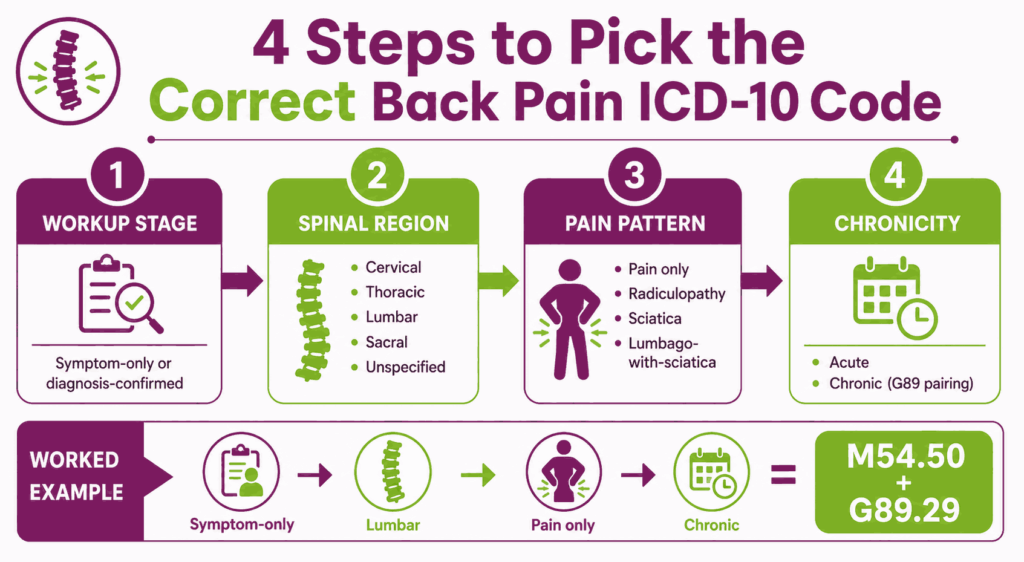
Back pain ICD-10 code selection follows a four-step decision logic. Each step narrows the code by one attribute: workup stage, spinal region, pain pattern, and chronicity.
What Is the Four-Step Decision Logic for Back Pain Coding?
The four-step logic works as follows.
- Identify Workup Stage: Symptom-only or diagnosis-confirmed.
- Identify Spinal Region: Cervical, thoracic, lumbar, sacral, or unspecified.
- Identify Pain Pattern: Pain only, radiculopathy, sciatica, or combined lumbago-with-sciatica.
- Identify Chronicity: Acute or chronic for G89 pairing decisions.
How Do You Code Disc Herniation and Degeneration (M50, M51)?
Disc disorders code to M50 in the cervical spine and M51 in the thoracic, lumbar, and lumbosacral spine. M51 is the diagnosis that most often replaces a low back pain code, and several M51 codes cannot appear on a claim alongside M54.
Which M51 Codes Apply to the Lumbar and Lumbosacral Spine?
M51 codes split first by clinical consequence, then by spinal region. The fifth character marks the consequence, and the sixth character marks the region, where 4 is thoracic, 5 is thoracolumbar, 6 is lumbar, and 7 is lumbosacral.
| Code | Description |
|---|---|
| M51.06 | Lumbar disc disorder with myelopathy |
| M51.07 | Lumbosacral disc disorder with myelopathy |
| M51.16 | Lumbar disc disorder with radiculopathy |
| M51.17 | Lumbosacral disc disorder with radiculopathy |
| M51.26 | Other lumbar intervertebral disc displacement |
| M51.27 | Other lumbosacral intervertebral disc displacement |
| M51.36x | Other lumbar intervertebral disc degeneration |
| M51.37x | Other lumbosacral intervertebral disc degeneration |
How Does Chart Wording Map to the M51 Codes?
Charts rarely use ICD-10 wording. Herniated disc, herniated nucleus pulposus, HNP, bulging disc, protrusion, and extrusion all route to the displacement codes, M51.26 and M51.27, when the note documents no nerve involvement. Degenerative disc disease and DDD route to M51.36x or M51.37x. Documented nerve root findings move the claim to M51.16 or M51.17 regardless of which term the provider used.
What Separates Myelopathy From Radiculopathy in the M51 Family?
Myelopathy means spinal cord compression and codes to M51.0x. Radiculopathy means nerve root compression and codes to M51.1x. The exam findings differ: myelopathy presents with gait disturbance, hyperreflexia, and bowel or bladder involvement, while radiculopathy presents with dermatomal pain, sensory loss, and diminished reflexes. Coding myelopathy without cord-level findings in the note is an audit trigger.
What Do the Expanded M51.36x and M51.37x Codes Capture?
The lumbar and lumbosacral disc degeneration codes carry a sixth character that records where the patient feels the pain. The expansion means disc degeneration now encodes the same information a back pain code would.
| Code | Description |
|---|---|
| M51.360 | Lumbar disc degeneration with discogenic back pain only |
| M51.361 | Lumbar disc degeneration with lower extremity pain only |
| M51.362 | Lumbar disc degeneration with discogenic back pain and lower extremity pain |
| M51.369 | Lumbar disc degeneration without mention of back pain or lower extremity pain |
The M51.37x codes follow the identical pattern for the lumbosacral region. The provider note must state whether the pain is axial, radiating, or both, because the sixth character has no default a coder can safely assume.
Why Do the Low Back Pain Codes Carry an Excludes1 Against M51?
M54.50, M54.51, and M54.59 carry an Excludes1 note against lumbar and lumbosacral disc degeneration with discogenic back pain, M51.362 and M51.372. Excludes1 means the two codes never appear on the same claim.
The practical effect: once the MRI documents disc degeneration and the note attributes the back pain to it, the disc code takes the claim and the low back pain code drops. Coders who append M54.50 to a disc degeneration claim out of habit trigger the edit before medical necessity is ever reviewed.
Can M51.16 and M54.16 Appear on the Same Claim?
M51.16 and M54.16 cannot appear together. M51.16 already contains the radiculopathy, so adding M54.16 double-reports the nerve root involvement. The same rule applies to M51.17 with M54.17, and to M50.1x with M54.12 in the cervical spine. Report the disc code alone.
Which Procedures Pair With M51 Diagnoses?
Lumbar interlaminar epidural injection (62323) and transforaminal injection (64483) pair with M51.16 and M51.26 once conservative care has failed. Lumbar discectomy (63030) requires a displacement or radiculopathy code. Payers deny discectomy claims submitted against M51.36x because degeneration alone does not establish surgical necessity, and this mismatch is one of the most common surgical denials in the spine category.
How Do You Determine the Correct Spinal Region From Documentation?
Spinal region documentation drives the parent code group. Cervical region maps to M54.2 or M54.12. Thoracic region maps to M54.6 or M54.14. Lumbar region maps to M54.50/.51/.59 or M54.16. Sacral region maps to M54.18 or M53.3.
How Do You Determine Acute vs. Chronic Back Pain for Coding?
Acute back pain ICD 10 documentation captures pain duration less than three months. Chronic back pain ICD 10 documentation captures pain persisting three months or longer. Chronicity does not change the M54 code itself but drives G89 pain qualifier pairing.
How Do Excludes1 and Excludes2 Notes Apply to M54?
Excludes1 notes prohibit reporting M54 codes alongside conditions where the M54 symptom is integral. Excludes2 notes allow both codes when conditions coexist. M54 carries Excludes1 against psychogenic dorsalgia (F45.41). The low back pain codes carry a further Excludes1 against lumbar and lumbosacral disc degeneration with discogenic back pain, so M54.50, M54.51, and M54.59 never appear alongside M51.362 or M51.372.
What Documentation Supports Back Pain ICD-10 Claims?
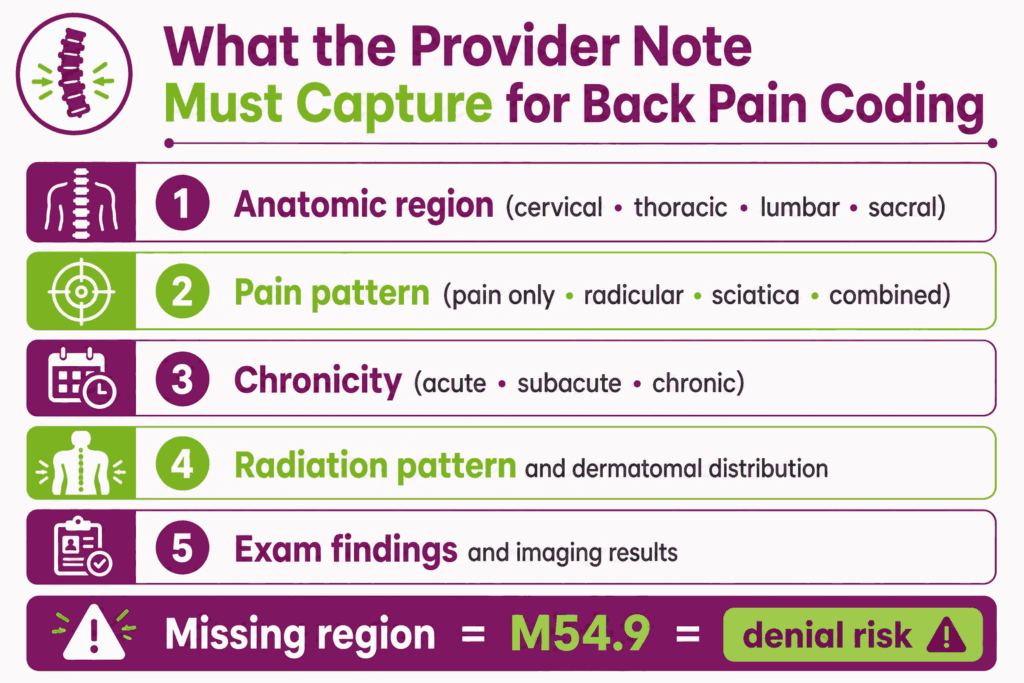
Documentation supports back pain ICD-10 claims when the provider’s note captures region, pain character, chronicity, radiation pattern, and imaging findings. ICD-10-CM Official Guidelines require complete documentation for accurate code assignment.
What Clinical Elements Must the Provider’s Note Contain?
The provider’s note must capture five clinical elements that drive code selection.
- Spinal region (cervical, thoracic, lumbar, sacral)
- Pain pattern (back pain only, radicular, sciatica, combined)
- Chronicity (acute or chronic)
- Radiation pattern and distribution
- Exam findings and imaging results
How Should the Spinal Region Be Documented?
Spinal region documentation must be explicit. “Back pain” without region forces M54.9, which carries denial risk. Documentation of “low back pain,” “lumbar pain,” “thoracic back pain,” or “neck pain” maps cleanly to specific M54 codes.
How Should Pain Radiation Be Documented to Distinguish Back Pain From Radiculopathy and Sciatica?
Pain radiation documentation distinguishes back pain (M54.5x, M54.6) from radiculopathy (M54.1x) and sciatica (M54.3x, M54.4x). The note captures radiation distribution, dermatomal pattern, associated neurological findings, and side. Without these elements, the coder defaults to the pain-only code.
How Should Modic Changes and Imaging Findings Be Captured for M54.51?
M54.51 documentation requires the MRI report specifying Modic type 1 or type 2 changes at named vertebral levels. The provider’s note must reference the MRI findings and confirm the vertebrogenic clinical pattern.
How Should Conservative Treatment Failure Be Documented for Procedural Claims?
Conservative treatment failure captures the trial of NSAIDs, physical therapy, prior interventional procedures, and patient response. Spinal procedure claims require this documentation for medical necessity. Expert Orthopedic billing and coding services catch the gap at the scrubber, flagging procedural claims that reach submission without a documented conservative-care trail.
Which CPT and HCPCS Codes Pair With Back Pain ICD-10 Codes?
Back pain ICD-10 codes pair with E&M, imaging, spinal procedural, physical therapy, and chiropractic codes. The CPT-to-ICD-10 pairing drives medical necessity, especially for high-cost spinal procedures. The transforaminal, radiofrequency ablation, and chiropractic manipulation codes below sit alongside the wider surgical set in the orthopedic CPT code reference.
Which E&M Codes Are Most Commonly Billed With Back Pain?
E&M codes 99202–99205 (new patient office) and 99211–99215 (established patient office) are most commonly billed with M54 codes, with CPT 99214 typical for an established patient whose back pain is being managed conservatively across repeat visits before imaging or injection. Chronic back pain encounters often pair E&M with G89.29 as a secondary code. ER codes 99281–99285 apply for acute back pain presenting to the emergency department.
Which Imaging Codes Pair With M54?
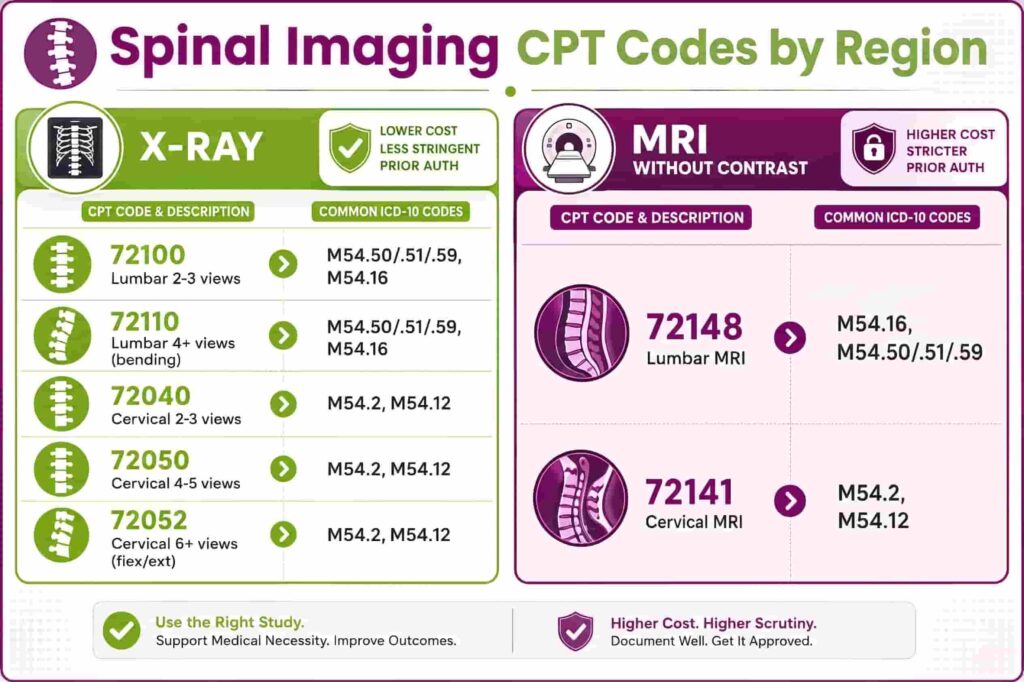
Imaging codes pair with M54 codes by spinal region. Each pairing requires matching the imaging anatomy to the diagnosis region.
Lumbar Spine X-Ray (CPT 72100, 72110)
CPT 72100 covers lumbar X-ray with 2-3 views. CPT 72110 covers 4 or more views, including bending studies. Both pair with M54.50, M54.51, M54.59, or M54.16.
Cervical Spine X-Ray (CPT 72040, 72050, 72052)
CPT 72040 covers cervical 2-3 views. CPT 72050 covers 4-5 views. CPT 72052 covers 6 or more views with flexion-extension. Each pairs with M54.2 or M54.12.
Lumbar MRI Without Contrast (CPT 72148)
CPT 72148 covers lumbar MRI without contrast. The procedure code 72148 pairs with M54.16, M54.50, M54.51, or M54.59 when documentation supports medical necessity. Most payers require four to six weeks of documented conservative care first, and a red-flag finding in the note is what overrides that requirement.
Cervical MRI Without Contrast (CPT 72141)
CPT 72141 covers cervical MRI without contrast. The code pairs with M54.2 or M54.12 when conservative care has failed, and neurological symptoms persist.
Which Spinal Procedural Codes Pair With Back Pain Diagnoses?
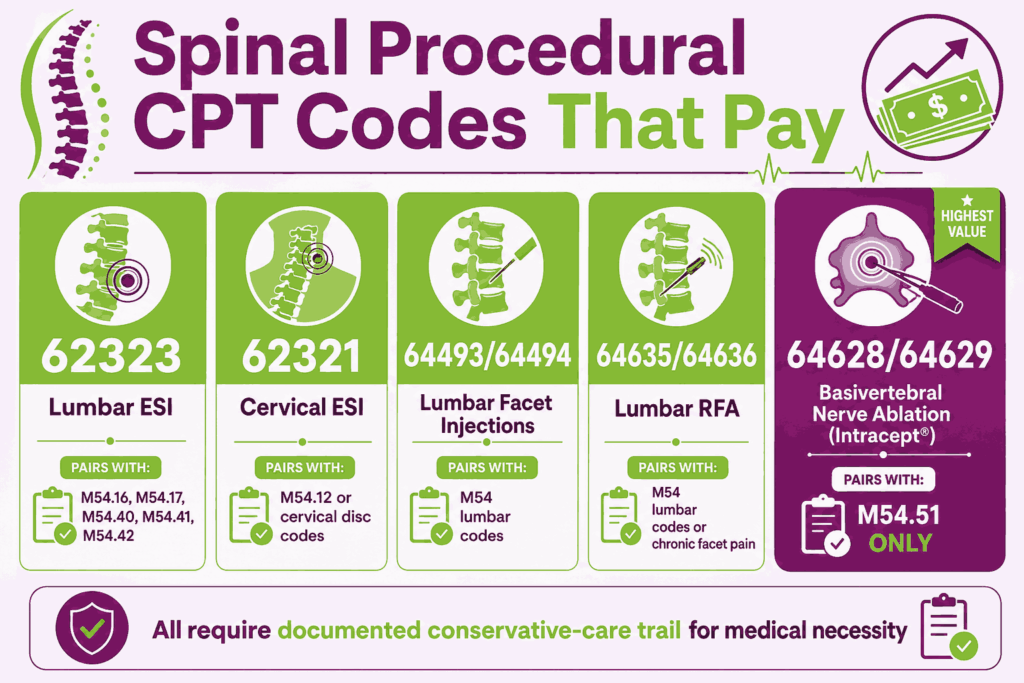
Spinal procedural codes generate the highest-value claims in this category. Correct ICD-10 pairing is mandatory for procedural reimbursement.
Lumbar Interlaminar Epidural Steroid Injection (CPT 62323)
CPT 62323 covers interlaminar epidural or subarachnoid injection of the lumbar or sacral region with imaging guidance. The code pairs with M54.16, M54.17, M54.40, M54.41, or M54.42. Transforaminal injections are a different family: 64483 for the first lumbar or sacral level and 64484 for each additional level. Payers apply separate policies to each approach, and reporting an interlaminar code for a transforaminal procedure is a documented recoupment target.
Cervical and Thoracic Interlaminar Epidural Steroid Injection (CPT 62321)
CPT 62321 covers interlaminar epidural or subarachnoid injection of the cervical or thoracic region with imaging guidance. The code pairs with M54.12, M54.14, or the corresponding disc disorder codes. The cervical and thoracic regions share one code, the code 62321; the split is at the lumbar boundary, not between neck and mid-back.
Facet Joint Injections (CPT 64493–64495 Lumbar, 64490–64492 Cervical)
CPT 64493 covers paravertebral facet joint injection at a single lumbar or sacral level, with 64494 for the second level and 64495 for the third and any additional. CPT 64490 covers cervical or thoracic single level, with 64491 for the second and 64492 for the third and beyond. Imaging guidance is bundled into all six codes, so billing fluoroscopy separately triggers an edit. Each pairs with the matching M54 region code.
Radiofrequency Ablation (CPT 64633–64636)
CPT 64635 covers lumbar or sacral facet RFA at the first level, 64636 each additional. CPT 64633 covers cervical or thoracic RFA at the first level, 64634 each additional. Each pairs with the matching M54 region code or a chronic facet pain diagnosis, and payers require a documented positive diagnostic block before approving the ablation.
Basivertebral Nerve Ablation (CPT 64628, 64629)
CPT 64628 covers basivertebral nerve ablation first vertebral body. CPT 64629 covers each additional body. Pairs exclusively with M54.51.
Which Physical Therapy and Chiropractic Codes Pair With Back Pain?
Physical therapy codes 97161–97163 (evaluation), 97110 (therapeutic exercise), 97140 (manual therapy), and 97530 (therapeutic activities) pair with M54 codes for PT plans of care. Chiropractic codes 98940–98942 pair with M54 codes for chiropractic claims.
Which HCPCS Codes Apply to Back Pain Claims?
Lumbar-sacral orthoses bill under the L0450 through L0651 range, where the prefabricated versus custom-fitted distinction drives coverage and audit exposure. TENS units bill under E0730 and require documented conservative-care failure. The full supply and orthosis set sits in the orthopedic HCPCS code reference. Verify current L-code coverage policy before submission, since the prefabricated LSO codes are a standing audit target.
How Do You Avoid CPT–ICD-10 Mismatches for Back Pain Claims?
Coders avoid mismatches by checking three points. The imaging or procedure region matches the diagnosis region. The radicular or sciatica component matches the documented pain pattern. The procedure indication matches the chronicity and conservative-care trail.
What Are the Most Common Back Pain Coding Denials, and How Do You Prevent Them?
Back pain coding denials come from deleted-code use, region mismatches, sciatica miscoding, M54.9 use on specific procedures, and workers’ compensation documentation gaps. Each pattern has a known prevention path.
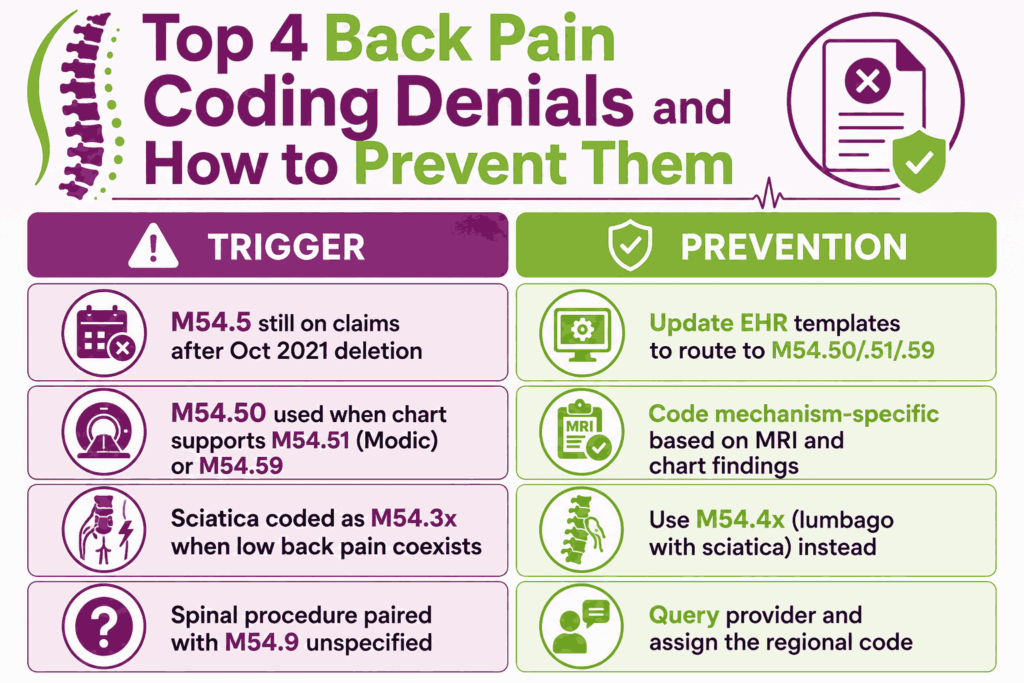
Why Does M54.5 Still Appear on Denial Reports?
M54.5 still appears on denial reports four years after deletion because legacy EHR templates and old documentation habits persist. The fix is mandatory EHR template updates that route low back pain to M54.50, M54.51, or M54.59.
Why Are M54.50 Claims Denied When Documentation Supports M54.51 or M54.59?
M54.50 claims are denied when the chart documents vertebrogenic features (Modic changes) or other specific mechanisms that map to M54.51 or M54.59. Payers downcode the claim or reject medical necessity for procedures requiring the specific code.
Why Are Sciatica Claims Denied When M54.3x Should Have Been M54.4x?
Sciatica claims coded as M54.3x are denied when the chart documents both low back pain and sciatica together. The correct code is M54.4x (lumbago with sciatica). Reporting both M54.5x and M54.3x triggers automated denial.
Why Are Spinal Procedure Claims Denied With M54.9?
Spinal procedure claims paired with M54.9 are denied because the procedure is region-specific. A lumbar epidural steroid injection paired with M54.9 fails the diagnosis-to-procedure match. The fix is to query the provider and assign the regional code.
Why Are Workers’ Compensation Back Pain Claims Denied?
Workers’ compensation back pain claims are denied for incomplete mechanism-of-injury documentation, missing date of injury, or unspecified codes. WC payers require detailed documentation linking the back pain to the workplace incident and the specific spinal region.
What Are the Payer-Specific Rules for Back Pain Coding?
Payer rules for back pain vary by program and procedure. The table below summarizes the most common requirements.
| Payer | Common Rule |
|---|---|
| Medicare | LCDs require conservative-care trial documentation for ESI, RFA, and basivertebral ablation |
| BCBS plans | Prior authorization for MRI; some plans restrict M54.51 procedural coverage by region |
| UnitedHealthcare | Step therapy before advanced imaging; PA required for spinal procedures |
| Aetna | Conservative-care documentation required for all spinal procedure coverage |
| Workers’ Comp | State-specific rules; mechanism-of-injury documentation mandatory |
Frequently Asked Questions About Back Pain ICD-10 Coding
The answers below cover the highest-volume specific-code searches and the most-cited back pain coding questions from billers, coders, and clinical documentation specialists.
What Is the ICD-10 Code for Back Pain?
M54 is the ICD-10 code family for back pain (dorsalgia). The specific code depends on spinal region. M54.50 covers unspecified low back pain. M54.2 covers neck pain. M54.6 covers thoracic spine pain. M54.9 covers dorsalgia unspecified.
What Is the ICD-10 Code for Low Back Pain?
Low back pain ICD 10 routes to M54.50 for unspecified, M54.51 for vertebrogenic, or M54.59 for other low back pain. M54.5 is no longer valid since October 1, 2021.
What Is the ICD-10 Code for Lower Back Pain?
Lower back pain ICD 10 routes to the same codes as low back pain: M54.50, M54.51, or M54.59. The Alphabetic Index treats “low” and “lower” back pain identically.
What Is the ICD-10 Code for Upper Back Pain?
Upper back pain ICD 10 routes to M54.6 (pain in thoracic spine). The thoracic region covers upper back anatomy in ICD-10-CM terminology.
What Is the ICD-10 Code for Mid Back Pain?
Mid back pain ICD 10 and middle back pain ICD 10 route to M54.6 when pain localizes to the thoracic spine. The same code covers upper back pain.
What Is the ICD-10 Code for Thoracic Back Pain?
Thoracic back pain ICD 10 routes to M54.6 (pain in thoracic spine). The code applies to mid back, upper back, and middle back pain presentations.
What Is the ICD-10 Code for Chronic Back Pain?
Chronic back pain ICD 10 uses the M54 regional code paired with G89.29 (other chronic pain). G89.29 captures chronicity; the M54 code captures region. Sequence G89.29 first when chronic pain management is the encounter focus.
What Is M54.50?
M54.50 is the ICD-10 code for low back pain, unspecified. The code applies when the chart documents low back pain without a more specific mechanism. M54.50 is the default low back pain code for symptom-only encounters.
What Is M54.16?
M54.16 is the ICD-10 code for radiculopathy in the lumbar region. The chart documents radicular pain with lumbar nerve root involvement and radiation into the lower extremity.
What Is the ICD-10 Code for a Herniated Disc?
A herniated lumbar disc codes to M51.26 when no nerve involvement is documented, or M51.16 when the note documents radiculopathy. Cervical disc herniation codes to M50.2x or M50.1x on the same logic. Herniated disc, HNP, protrusion, and extrusion all route to the same code families.
What Is M51.26?
M51.26 is the ICD-10 code for other intervertebral disc displacement in the lumbar region. The code applies when imaging confirms disc displacement and the note documents no radiculopathy or myelopathy.
Can You Code M54.50 With a Disc Degeneration Code?
No, M54.50 carries an Excludes1 note against lumbar disc degeneration with discogenic back pain (M51.362). When the chart attributes the low back pain to documented disc degeneration, the M51 code takes the claim and the M54 code drops.
What Is M54.2?
M54.2 is the ICD-10 code for cervicalgia (neck pain). The code is the highest-volume cervical pain code and applies when no confirmed cervical disc or spondylosis diagnosis exists.
Is M54.5 Still a Valid ICD-10 Code?
M54.5 was deleted from ICD-10-CM effective October 1, 2021, and is no longer a valid billable code. Claims submitted with M54.5 receive automatic denials. The replacement codes are M54.50, M54.51, and M54.59.
Is M54.A6 a Valid ICD-10 Code for Thoracic Spine Pain?
No. M54.6 remains the ICD-10-CM code for pain in the thoracic spine and is valid in the FY2026 code set. Several online references list M54.A6 as a replacement. Verify any code against the CMS tabular before submitting; the ICD-10-CM addenda are the only authoritative source for additions and deletions.
What Is the ICD-10 Code for Sciatica?
Sciatica ICD 10 routes to M54.30 (unspecified), M54.31 (right), or M54.32 (left). When low back pain coexists with sciatica, use M54.4x (lumbago with sciatica) instead.