Summary: “The ICD-10 code family for osteoporosis is M80 (with current pathological fracture) and M81 (without). The M80 vs M81 decision is the first thing a coder must answer.”
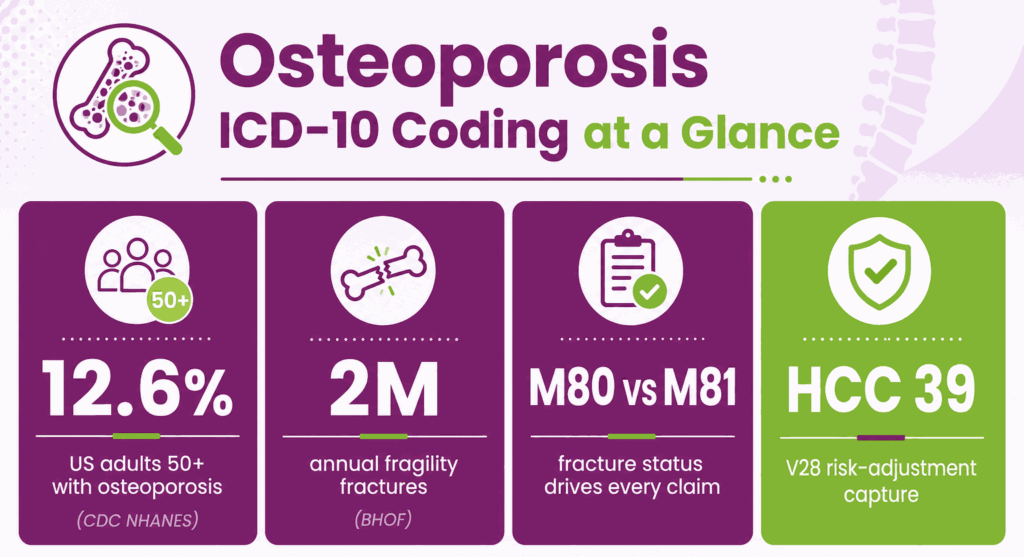
Osteoporosis is one of the most common chronic bone conditions in US adults. The Centers for Disease Control and Prevention (CDC) NHANES data shows that 12.6% of US adults aged 50 and over have osteoporosis. The Bone Health and Osteoporosis Foundation estimates that approximately 10 million Americans have osteoporosis, with another 44 million carrying low bone density. The same source has long attributed roughly 2 million fragility fractures a year to osteoporosis, an estimate that traces to burden-of-disease modeling rather than a current claims count.
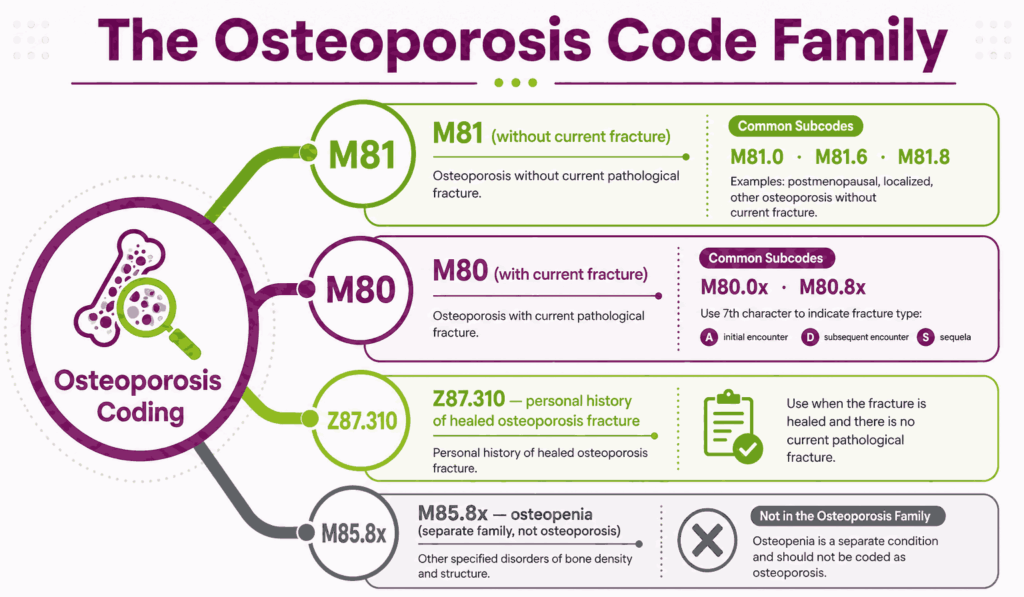
The ICD-10-CM code range for osteoporosis is M80 through M81. M81 is the ICD-10 code family for osteoporosis without current pathological fracture. M80 is the ICD-10 code family for osteoporosis with current pathological fracture. The M80 vs. M81 binary is the first question a coder must answer on every claim.
This guide covers the M80 and M81 catalogs, the 7th-character encounter system that drives M80 coding, the Z87.310 history code, and the separate osteopenia family (M85.8x). It also explains the CPT and J-code pairings for DXA imaging and osteoporosis drugs, the denial patterns, and the HCC and HEDIS implications. The FY2026 ICD-10-CM update took effect on October 1, 2025.
What Are the ICD-10 Codes for Osteoporosis?
The M80–M85 block sits alongside the arthropathy, dorsopathy, and soft-tissue blocks in the orthopedic ICD-10 code index, which is where bone-density codes intersect with the fracture and injury families.
What Is the M80–M81 Code Range in ICD-10-CM?
The M80 to M81 code range covers osteoporosis as a chronic bone disease. M80 captures osteoporosis with a current pathological fracture. M81 captures osteoporosis without a current pathological fracture. The full range sits inside Chapter 13 of ICD-10-CM.
What Is the Difference Between M80 and M81?
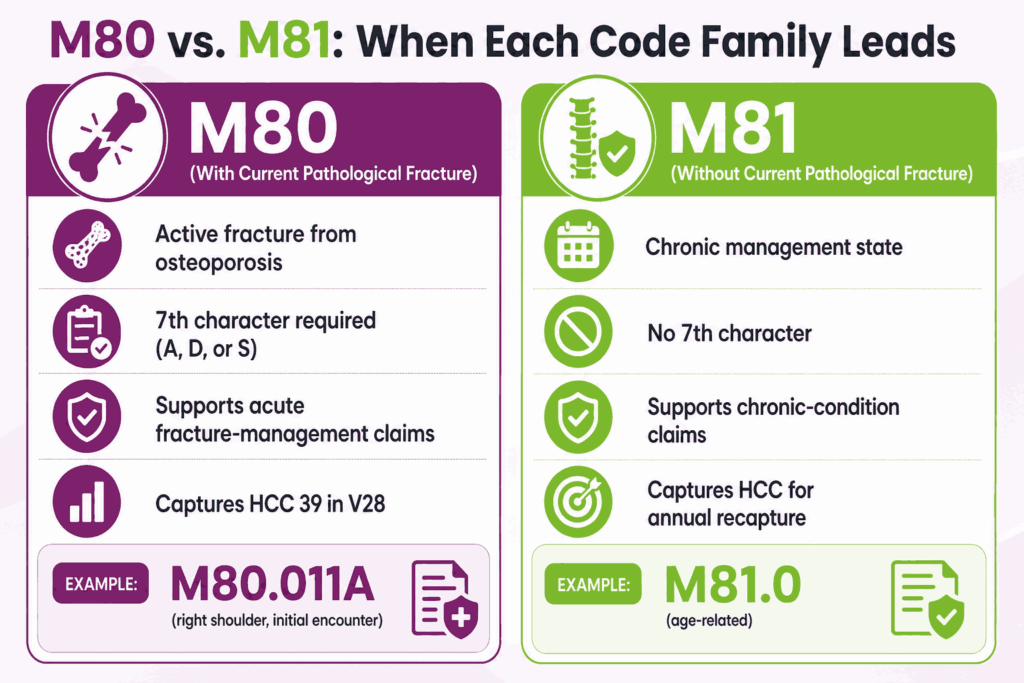
M80 is used when the patient has an active pathological fracture caused by osteoporosis. M81 is used when osteoporosis is documented, but no current pathological fracture is present. The two families never coexist as primary codes on the same claim.
How Does Z87.310 Fit Into This Family?
Z87.310 is the ICD-10 code for personal history of (healed) osteoporosis fracture. Z87.310 applies when the pathological fracture is fully healed, but documentation must capture the historical fracture for risk stratification, screening, and HCC purposes. Z87.310 pairs with an active M81 code.
Is Osteopenia Coded the Same as Osteoporosis?
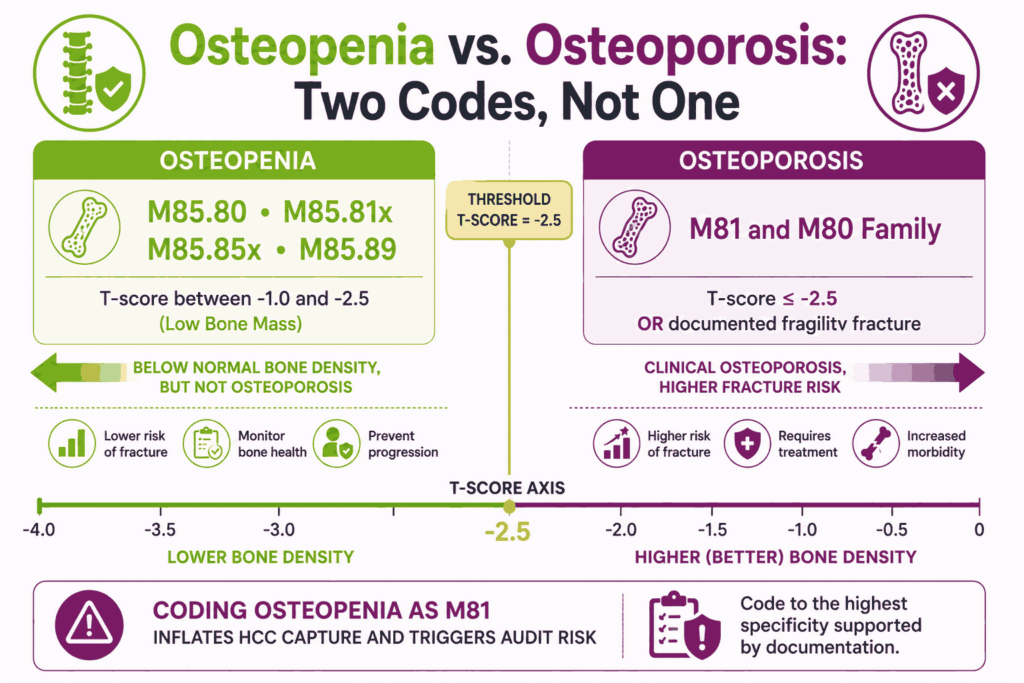
Osteopenia is coded under M85.8x, not M81, in ICD-10-CM. The two are separate clinical states. Osteopenia is defined by a DXA T-score between -1.0 and -2.5. Osteoporosis requires a T-score of -2.5 or lower or a documented fragility fracture.
Why Does the M80 vs. M81 Distinction Drive Reimbursement?
The M80 vs. M81 distinction drives reimbursement because only M80 carries risk-adjusted value. M80 codes drive fracture-related MS-DRG assignment, support fracture-management procedural claims, and map to a fracture HCC under the CMS-HCC V28 model. M81 supports chronic-condition management claims but maps to no HCC and does not support acute fracture procedural claims.
How Do You Decide Between M80, M81, Z87.310, and S-Codes?
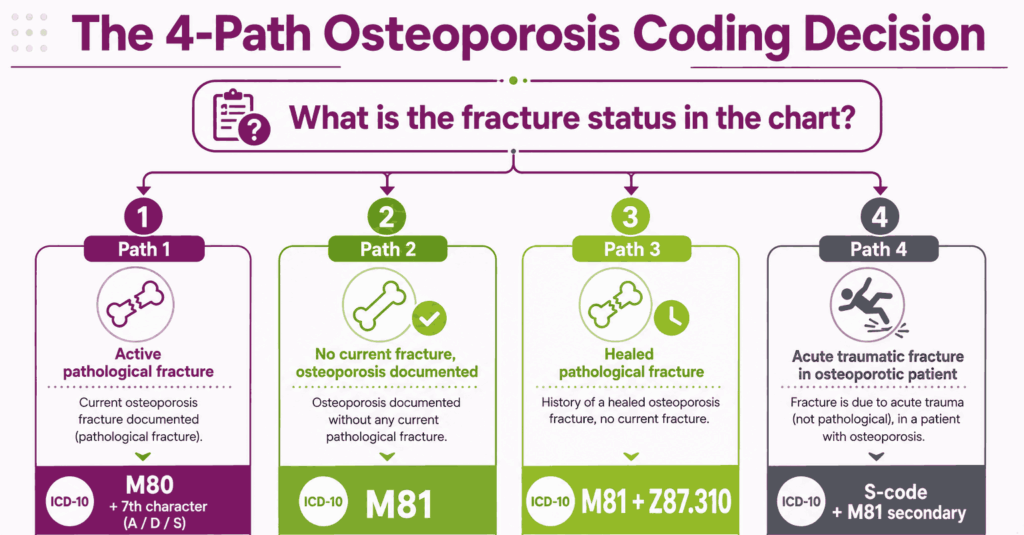
The decision between M80, M81, Z87.310, and S-codes follows a four-path logic based on fracture status and mechanism. The four paths cover active pathological fracture, no current fracture, healed pathological fracture, and acute traumatic fracture.
What Is the Four-Path Decision Logic for Osteoporosis Coding?
The four-path logic works as follows.
- Active Pathological Fracture Present: Use M80 as primary. The 7th character marks the encounter type.
- No Current Fracture, Osteoporosis Documented: Use M81 as primary.
- Healed Pathological Fracture, No Current Fracture: Use M81 with Z87.310 as secondary.
- Acute Traumatic Fracture with Osteoporosis Documented: Use the S-code injury family for the fracture, then M81 as secondary for the underlying osteoporosis.
The four paths matter most on back pain encounters. A patient presenting with thoracolumbar pain who turns out to have an osteoporotic vertebral compression fracture codes to M80.08x, not to the back pain codes in the M54 family, because the fracture is the confirmed diagnosis and the pain is integral to it.
When Is M81 the Correct Primary Diagnosis?
M81 is the correct primary diagnosis in three scenarios: chronic management visits, initial diagnosis without fracture, and follow-up after a healed fracture.
Annual Follow-Up and Chronic-Disease Management
Annual follow-up and chronic-disease management visits use M81 as primary when no current pathological fracture exists. The note records DXA history, treatment plan, and any prior fracture history through Z87.310 as a secondary code.
Initial Diagnosis Without Current Fracture
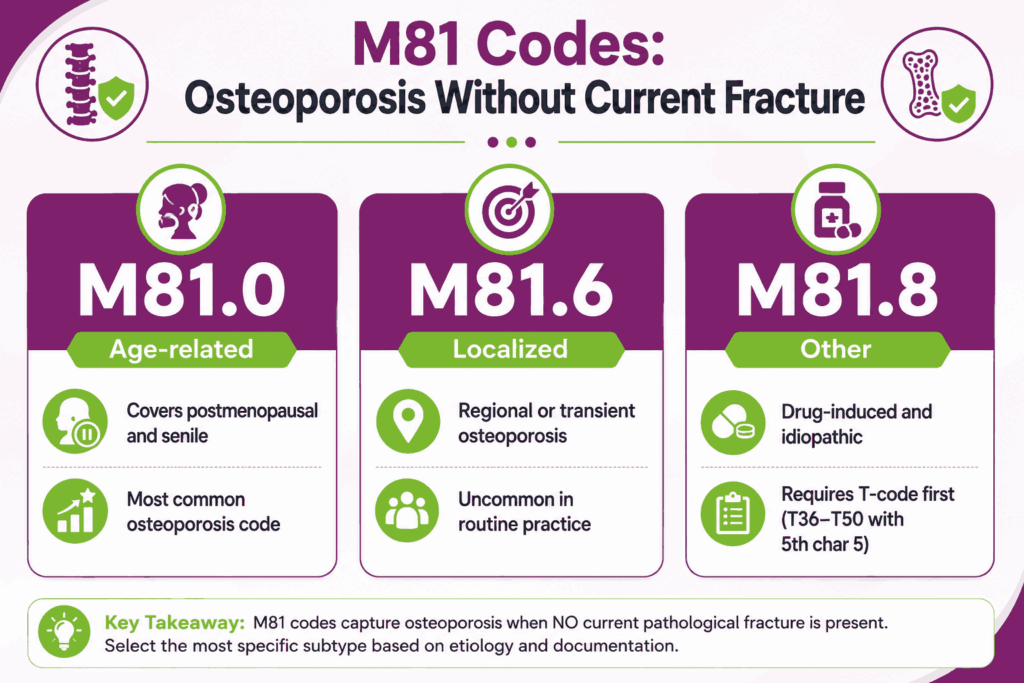
Initial diagnosis encounters use M81 when a DXA scan or clinical workup confirms osteoporosis, but the patient has no current pathological fracture. M81.0 captures age-related osteoporosis. M81.6 captures localized osteoporosis. M81.8 captures other osteoporosis types.
After a Healed Pathological Fracture (Paired With Z87.310)
After a healed pathological fracture, M81 pairs with Z87.310. The healed status removes the patient from M80 coding. The Z87.310 pairing preserves the fracture history for risk stratification and HCC recapture.
When Is M80 the Correct Primary Diagnosis?
M80 is the correct primary diagnosis whenever a current pathological fracture from osteoporosis is documented. M80 codes carry a 7th character that marks the encounter type within the healing timeline.
Active Pathological Fracture From Osteoporosis
Active pathological fractures from osteoporosis use M80 with 7th character A (initial encounter). The 7th character A applies during the active treatment phase: ER visits, surgical fixation, and the first weeks of management.
Subsequent Care for a Pathological Fracture
Subsequent care for a pathological fracture uses M80 with 7th character D, G, K, or P. D covers routine healing, follow-up visits, and routine post-operative care. G, K, and P cover delayed healing, nonunion, and malunion respectively, and each supports a different level of continued treatment.
Sequela of a Healed Pathological Fracture
Sequela of a healed pathological fracture uses M80 with 7th character S. The 7th character S applies when a late effect of the original fracture is the reason for the encounter, such as chronic deformity or residual disability.
How Do You Code Pathological vs. Traumatic Fractures in Osteoporotic Patients?
Pathological and traumatic fracture coding diverge based on the documented mechanism. Pathological fractures use M80. Traumatic fractures use S-codes. The provider’s documentation of the mechanism is the deciding factor.
When the Mechanism Supports Pathological Coding (M80)
The mechanism supports pathological coding (M80) when the fracture occurs from a low-energy event such as a ground-level fall, normal lifting, or no identifiable trauma. Vertebral compression fractures without trauma routinely code under M80.08x.
When Significant Trauma Supports S-Code Injury Coding
Significant trauma supports S-code injury coding when the fracture occurs from a high-energy event, such as a motor vehicle collision or fall from height. The injury S-code takes primary, with M81 as secondary to capture the underlying osteoporosis.
What If Both Pathological and Traumatic Elements Are Documented?
Mixed documentation requires a provider query. The coder cannot infer the mechanism. The query asks the provider to clarify whether the trauma was significant enough to cause the fracture in a non-osteoporotic patient.
What Are the M81 Codes? (Osteoporosis Without Current Pathological Fracture)
The M81 family captures osteoporosis without a current pathological fracture. The table below lists every billable M81 code.
What Are All the Codes in the M81 Family?
The M81 family contains three subgroups by clinical type, as listed below.
| Code | Description |
|---|---|
| M81.0 | Age-related osteoporosis without current pathological fracture |
| M81.6 | Localized osteoporosis (Lequesne) |
| M81.8 | Other osteoporosis without current pathological fracture |
When Should You Use M81.0 (Age-Related Osteoporosis)?
M81.0 is the ICD-10 code for age-related osteoporosis without a current pathological fracture. M81.0 covers the most common osteoporosis presentations, including postmenopausal and senile osteoporosis. The note must document the diagnosis and confirm no current pathological fracture.
How Does M81.0 Map to Postmenopausal and Senile Osteoporosis?
Postmenopausal osteoporosis icd 10 routes to M81.0. Senile osteoporosis icd 10 also routes to M81.0. ICD-10-CM consolidates both clinical subtypes under the age-related primary code. The provider’s note describes the clinical context; coders assign M81.0 in both cases.
When Is M81.6 (Localized Osteoporosis) the Correct Code?
M81.6 applies when osteoporosis is documented in a specific anatomic region rather than systemically. M81.6 is uncommon in routine practice but appears in cases of regional disuse osteoporosis or transient regional osteoporosis.
How Do You Code Drug-Induced and Other Osteoporosis Under M81.8?
Drug-induced osteoporosis ICD 10 routes to M81.8 (other osteoporosis without current pathological fracture). M81.8 also covers idiopathic osteoporosis and osteoporosis from other causes that do not match M81.0 or M81.6.
The “Code First” Rule for T36–T50 Adverse Effect Codes
Drug-induced osteoporosis requires “code first” sequencing. The T36–T50 adverse effect code (with 5th character 5) sequences first, followed by M81.8. The T-code identifies the responsible drug and its adverse effect status.
Glucocorticoid-Induced Osteoporosis Documentation
Glucocorticoid-induced osteoporosis is the most common drug-induced form. The note must document the glucocorticoid (such as prednisone), dose, duration, and the clinical confirmation of osteoporosis. The claim sequences T38.0X5A (or appropriate T-code) before M81.8.
What Are the M80 Codes? (Osteoporosis With Current Pathological Fracture)
The M80 family captures osteoporosis with a current pathological fracture. M80 codes are the most code-dense in the osteoporosis family because they combine anatomic site, laterality where applicable, and a 7th-character encounter type. The M80 family is one of the few places where site, laterality, and encounter status all ride on a single code, which is a departure from how ICD-10 groups diagnosis codes by chapter elsewhere.
What Are All the Codes in the M80 Family?
The M80 family splits into two clinical groups (.0 age-related, .8 other) and ten anatomic sites, as summarized below.
| Code Group | Description |
|---|---|
| M80.00xx | Age-related osteoporosis with fracture, unspecified site |
| M80.0xxx | Age-related osteoporosis with fracture at specified site (shoulder, humerus, forearm, hand, femur, lower leg, ankle and foot, vertebra, pelvis, other site) |
| M80.80xx | Other osteoporosis with fracture, unspecified site |
| M80.8xxx | Other osteoporosis with fracture at specified site |
How Are M80 Codes Built by Anatomic Site and Laterality?
M80 codes use the 5th character for anatomic site and the 6th character for laterality (1 right, 2 left, 9 unspecified) where applicable. The 7th character marks the encounter type. Two sites use alphabetic 5th characters rather than numeric, which is where coders most often mis-key the code.
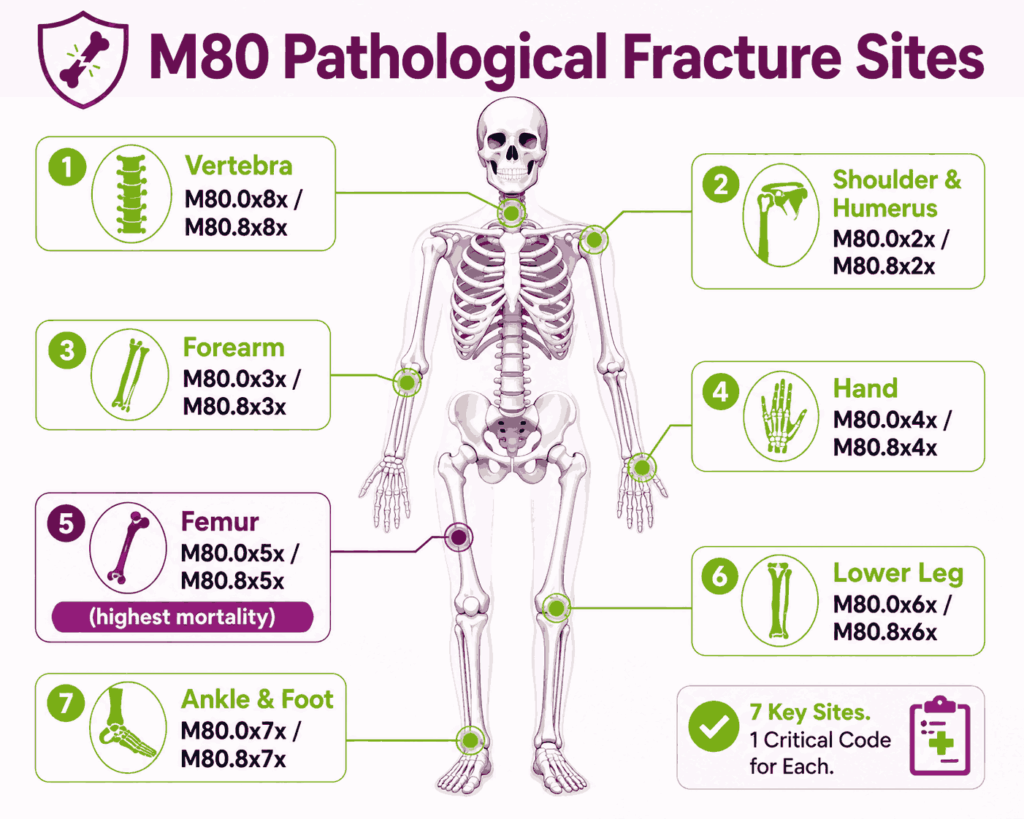
Vertebra (M80.08xx, M80.88xx)
M80.08x covers age-related osteoporosis with vertebral fracture. M80.88x covers other osteoporosis with vertebral fracture. Vertebra does not carry laterality. Vertebral compression fractures are the most common pathological fracture pattern in osteoporosis.
Shoulder (M80.01xx, M80.81xx)
M80.01x covers age-related osteoporosis with a shoulder fracture. M80.81x covers other osteoporosis at the same site. Laterality is captured in the 6th character.
Humerus (M80.02xx, M80.82xx)
M80.02x covers age-related osteoporosis with a humerus fracture. M80.82x covers other osteoporosis at the same site. Shoulder and humerus are separate sites in ICD-10-CM, and collapsing them into one code is a frequent assignment error.
Forearm (M80.03xx, M80.83xx)
M80.03x covers age-related osteoporosis with forearm fracture. M80.83x covers other osteoporosis. Forearm fractures include distal radius (Colles) and ulnar pathological fractures.
Hand (M80.04xx, M80.84xx)
M80.04x covers age-related osteoporosis with a hand fracture. M80.84x covers other osteoporosis. Laterality is captured in the 6th character.
Femur (M80.05xx, M80.85xx)
M80.05x covers age-related osteoporosis with femur fracture. M80.85x covers other osteoporosis. Femoral neck and intertrochanteric fractures dominate this category and carry the highest mortality among osteoporotic fractures.
Lower Leg (M80.06xx, M80.86xx)
M80.06x covers age-related osteoporosis with lower leg fracture. M80.86x covers other osteoporosis. Lower leg includes tibia and fibula pathological fractures.
Ankle and Foot (M80.07xx, M80.87xx)
M80.07x covers age-related osteoporosis with ankle or foot fracture. M80.87x covers other osteoporosis. Laterality is captured in the 6th character.
Pelvis (M80.0Bxx, M80.8Bxx)
M80.0Bx covers age-related osteoporosis with a pelvic fracture. M80.8Bx covers other osteoporosis at the same site. The 5th character is the letter B, not a digit. Pelvic insufficiency fractures are common in older women and are frequently miscoded to an unspecified site.
Other Site (M80.0Axx, M80.8Axx)
M80.0Ax covers age-related osteoporosis with a pathological fracture at a site not listed above. M80.8Ax covers other osteoporosis. The 5th character is the letter A. Coders reach for M80.00 or M80.80 when M80.0A or M80.8A is the more specific choice.
When Do You Use M80.0 vs. M80.8?
M80.0 applies to age-related osteoporosis with current fracture. M80.8 applies to other osteoporosis (including drug-induced and idiopathic) with current fracture. The clinical context recorded in the note determines the choice.
How Does the 7th-Character Encounter System Work in M80 Codes?
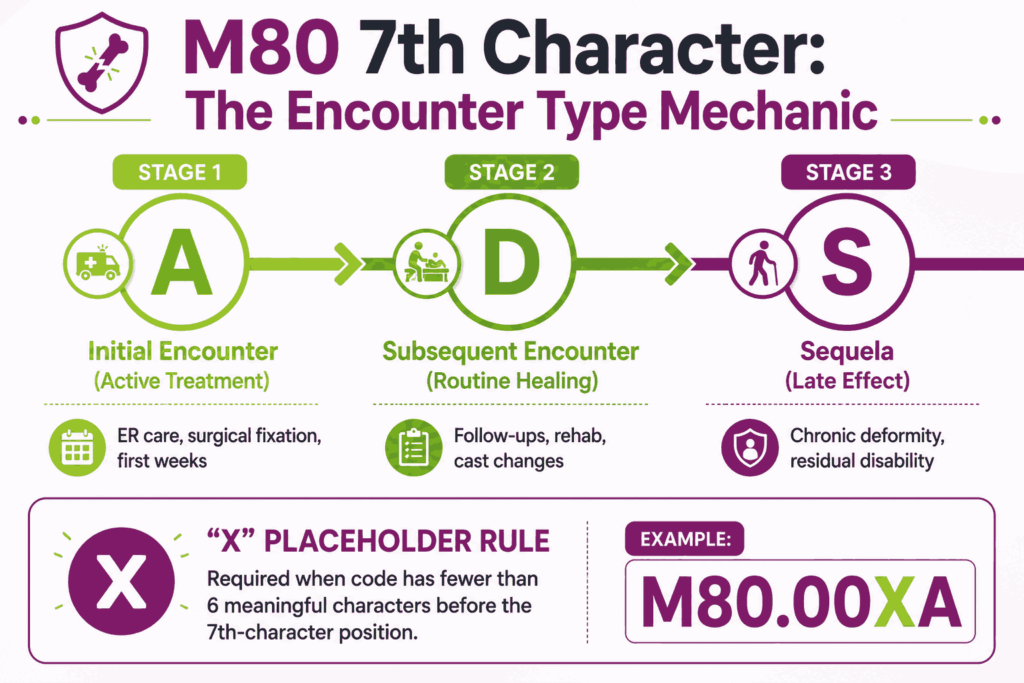
The 7th-character encounter system in M80 codes uses six letters: A, D, G, K, P, and S. The system mirrors injury coding for traumatic fractures but applies to pathological fractures from osteoporosis. The four subsequent-encounter characters separate routine healing from the complications that drive extended treatment.
A: Initial Encounter (Active Treatment)
The 7th character A applies during the active treatment phase of the fracture. Active treatment includes ER care, surgical fixation, and the first weeks of management. M80.00XA is the most-searched M80 code because the unspecified-site, age-related code with initial encounter is a frequent default.
D: Subsequent Encounter (Routine Healing)
The 7th character D applies during routine healing. D covers follow-up visits, cast changes, rehabilitation, and routine post-operative care that does not involve active treatment of the original fracture.
G: Subsequent Encounter With Delayed Healing
The 7th character G applies when the fracture is healing more slowly than expected but has not been declared a nonunion. The note documents the delay, the imaging that shows it, and the adjusted treatment plan.
K: Subsequent Encounter With Nonunion
The 7th character K applies when the fracture has failed to unite. Nonunion drives revision surgery, bone stimulator claims, and extended follow-up, so the character change carries real reimbursement weight.
P: Subsequent Encounter With Malunion
The 7th character P applies when the fracture has healed in a deformed position. Malunion after vertebral or femoral pathological fracture often triggers corrective procedural claims.
S: Sequela (Late Effect)
The 7th character S applies when a late effect of the original fracture is the reason for the encounter. Examples include chronic kyphosis after vertebral compression fracture and chronic disability from a healed femoral fracture.
When Is the “X” Placeholder Character Required?
The “X” placeholder character holds the 6th position when the code structure has fewer characters than the 7th-character slot requires. The placeholder rule is mandatory in M80 codes that need fewer than six meaningful characters before the encounter character.
How Is Osteopenia Coded vs. Osteoporosis?
Osteopenia is coded under M85.8x, not M81, in ICD-10-CM. The two conditions are clinically and code-wise distinct. Coders who treat osteopenia as a milder M81 cause downstream HCC capture errors and DXA medical-necessity denials.
What Are the ICD-10 Codes for Osteopenia?
Osteopenia ICD 10 routes to M85.8 through the Alphabetic Index. The site character mirrors the M80 structure, so a coder moving between the two families reads the same anatomic sequence.
| Code | Description |
|---|---|
| M85.80 | Other specified disorders of bone density and structure, unspecified site |
| M85.81x | Shoulder (.811 right, .812 left, .819 unspecified) |
| M85.82x | Upper arm (with laterality) |
| M85.83x | Forearm (with laterality) |
| M85.84x | Hand (with laterality) |
| M85.85x | Thigh (with laterality) |
| M85.86x | Lower leg (with laterality) |
| M85.87x | Ankle and foot (with laterality) |
| M85.88 | Other site |
| M85.89 | Multiple sites |
How Is Osteopenia Different From Osteoporosis Clinically and in Coding?
Osteopenia is low bone density that does not meet the diagnostic threshold for osteoporosis. The DXA T-score for osteopenia is between -1.0 and -2.5. The T-score for osteoporosis is -2.5 or lower, or a documented fragility fracture confirms the diagnosis.
How Do T-Score and Z-Score Documentation Drive Code Choice?
T-score documentation drives the code choice between osteopenia (M85.8x) and osteoporosis (M81 or M80). Z-score documentation supports the diagnosis in younger or premenopausal patients. The provider’s note must record the actual numeric T-score and the anatomic site of measurement.
Why Is Osteopenia Often Miscoded as M81?
Osteopenia is often miscoded as M81 because clinicians and coders treat it as a milder form of osteoporosis. M81 requires a T-score of -2.5 or lower or a documented fragility fracture. Coding osteopenia as M81 inflates HCC capture and triggers audit risk. Orthopedic medical billing services catch this at the scrubber by checking the documented T-score against the code family before the claim goes out.
What Documentation Supports Osteoporosis ICD-10 Claims?
Documentation supports osteoporosis ICD-10 claims when the provider’s note captures diagnosis confirmation, T-score, fracture status, fracture mechanism, and treatment plan. ICD-10-CM Official Guidelines require complete documentation for code assignment.
What Clinical Elements Must the Provider’s Note Contain?
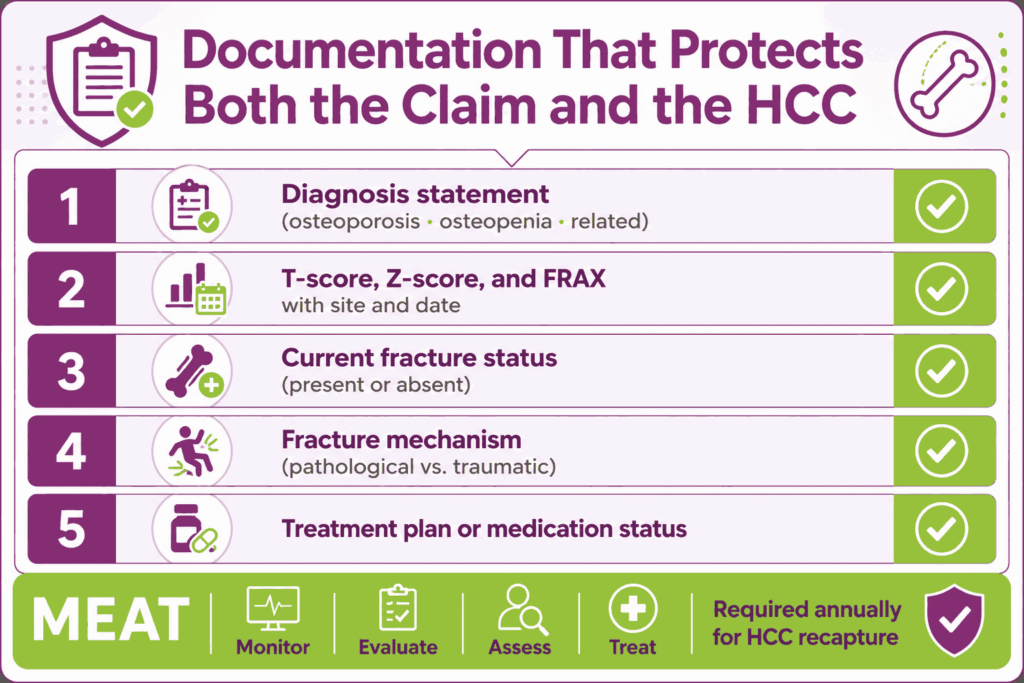
The provider’s note must capture five clinical elements that drive code selection.
- Diagnosis statement (osteoporosis, osteopenia, or related)
- T-score and Z-score with anatomic site
- Current fracture status (present or absent)
- Fracture mechanism when present (pathological or traumatic)
- Treatment plan or medication status
How Should T-Score, Z-Score, and FRAX Score Be Documented?
T-score, Z-score, and FRAX score documentation captures the diagnostic basis for osteoporosis or osteopenia coding. The note records the numeric scores, the anatomic measurement sites, and the date of the DXA scan. FRAX scores support fracture risk stratification.
How Should the Fracture Mechanism Be Documented?
The fracture mechanism is documented as the energy level and circumstances of the fracture event. Low-energy mechanisms (ground-level fall, no trauma) support pathological coding (M80). High-energy mechanisms (motor vehicle collision, fall from height) support traumatic coding (S-codes).
How Do You Document Drug-Induced Osteoporosis for M81.8 Coding?
Drug-induced osteoporosis documentation for M81.8 coding requires three elements. The responsible drug must be named in the note. The duration and dose must be recorded. The causal link between the drug and the bone-density change must be clinically established.
How Should Fracture Status Be Documented at Each Encounter?
Fracture status must be documented at every encounter during the treatment episode, not only at the initial visit. The note states whether a pathological fracture is currently present, which site it involves, and where the patient sits in the healing timeline. Charts that stop documenting the fracture after the first visit push later encounters back to M81 and drop the risk-adjusted capture mid-episode.
Which CPT, HCPCS, and J-Codes Pair With Osteoporosis ICD-10 Codes?
Osteoporosis ICD-10 codes pair with CPT codes for DXA imaging, J-codes for pharmacy buy-and-bill, and E&M codes for management visits. Correct pairing supports medical necessity for screening, treatment, and follow-up claims.
Which DXA Scan and Imaging Codes Pair With M80, M81, and M85.8x?
DXA imaging codes are the highest-volume CPT codes paired with osteoporosis diagnoses. The table below summarizes the codes and their indications.
| Code | Description | Common ICD-10 Pairing |
|---|---|---|
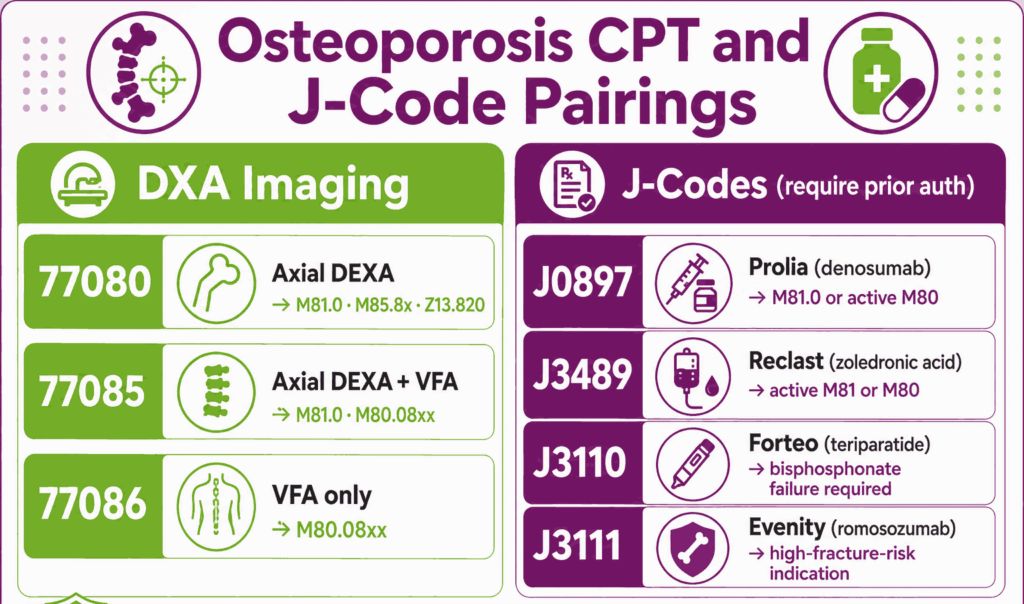
| 77080 | Axial DEXA (hip and spine) | M81.0, M85.8x, Z13.820 |
| 77081 | Peripheral DEXA | M81.0, M85.8x |
| 77085 | Axial DEXA with vertebral fracture assessment | M81.0, M80.08xx |
| 77086 | Vertebral fracture assessment only | M81.0, M80.08xx |
| Z13.820 | Encounter for screening for osteoporosis | Paired with screening DXA when no diagnosis exists |
DXA is one slice of the imaging and procedural set these diagnoses touch. The orthopedic CPT code reference covers the fracture-management and vertebral augmentation codes that follow an M80 diagnosis.
Axial DEXA (CPT 77080)
CPT 77080 covers axial DEXA of the hip and spine. CPT 77080 is the most common osteoporosis screening icd 10 procedural code. Medicare covers 77080 every two years for qualifying patients.
Peripheral DEXA (CPT 77081)
CPT 77081 covers peripheral DEXA of the forearm or heel. Peripheral DEXA is used when axial DEXA is not feasible or as a supplemental measurement.
Vertebral Fracture Assessment (CPT 77085, 77086)
CPT 77085 combines axial DEXA with vertebral fracture assessment. CPT 77086 covers vertebral fracture assessment alone. Both pair with M81.0 for chronic management and with M80.08xx when a vertebral pathological fracture is current.
Screening DEXA Under Medicare
Screening DEXA under Medicare uses Z13.820 as the primary diagnosis when no osteoporosis is documented yet. Medicare requires the patient to meet eligibility criteria, including age, postmenopausal status, or risk factor presence.
Which Pharmacy J-Codes Pair With Osteoporosis Diagnoses?
The buy-and-bill J-codes below, along with the orthosis L-codes used in fracture aftercare, are catalogued in the orthopedic HCPCS and J-code reference.
J0897: Denosumab (Prolia)
J0897 covers denosumab (Prolia) injection. The product is administered every six months. Pair J0897 with M81.0 for postmenopausal patients or with the appropriate M80 code when fracture is current.
J3489: Zoledronic Acid (Reclast)
J3489 covers zoledronic acid (Reclast) infusion. The product is administered annually. Pair J3489 with the active M81 or M80 code based on fracture status.
J3110: Teriparatide (Forteo)
J3110 covers teriparatide (Forteo) injection. The product is administered daily by self-injection. Payers commonly require failure of bisphosphonates before approval.
J3111: Romosozumab (Evenity)
J3111 covers romosozumab (Evenity) injection. The product is administered monthly for up to 12 doses. Pair J3111 with the active osteoporosis code and document the high-fracture-risk indication.
Which E&M Codes Are Most Commonly Billed With Osteoporosis?
E&M codes 99202–99205 (new patient office) and 99211–99215 (established patient office) are most commonly billed with M81 for chronic management, with CPT 99214 carrying most established-patient visits where medication management or DXA review drives the encounter. Annual wellness visits (G0438, G0439) routinely include osteoporosis screening discussions paired with Z13.820.
How Do You Avoid CPT–ICD-10 Mismatches for Osteoporosis Claims?
Coders avoid CPT–ICD-10 mismatches by checking three points before submission. The fracture status matches the code family (M80 for current fracture, M81 for no current fracture). The screening code Z13.820 is used only when no osteoporosis diagnosis exists yet. The J-code prior authorization is in place before drug administration.
What Are the Most Common Osteoporosis Coding Denials, and How Do You Prevent Them?
Osteoporosis coding denials come from M80/M81 binary errors, wrong 7th characters, osteopenia miscoding, DXA medical-necessity gaps, and J-code authorization failures. Each pattern has a known prevention path.
Why Are M81 Claims Denied When a Current Pathological Fracture Is Present?
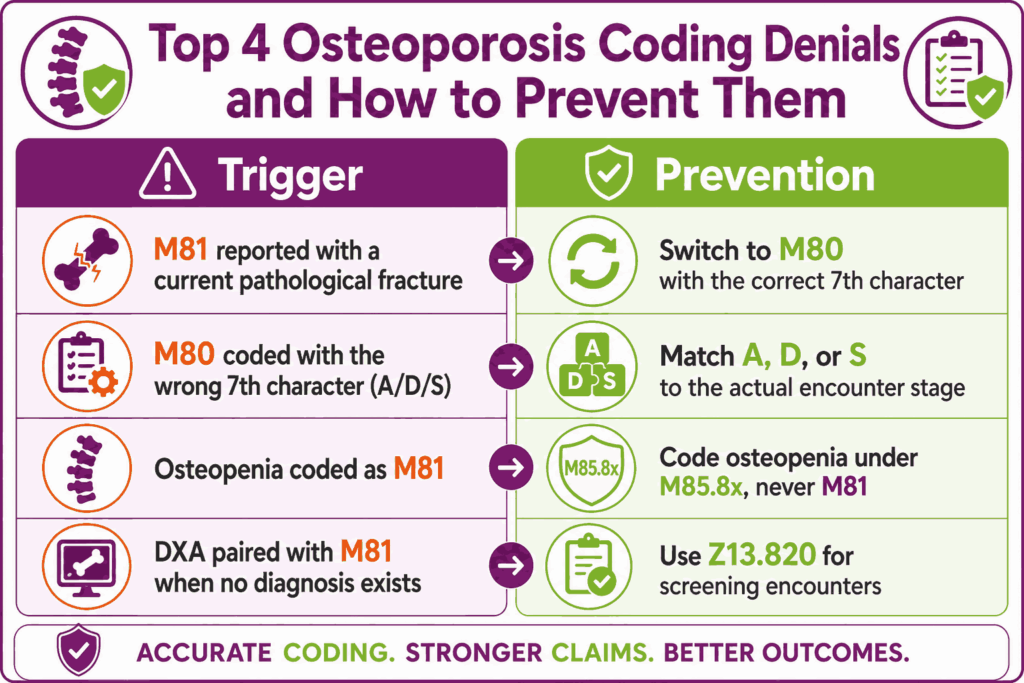
M81 claims are denied when a current pathological fracture is documented because the correct code family is M80. Payer edits flag the mismatch between the diagnosis code and procedural codes for fracture management. The fix is to switch to M80 with the correct 7th character.
Why Are M80 Claims Denied With the Wrong 7th Character?
M80 claims are denied with the wrong 7th character when the encounter type does not match the clinical status. An M80 claim with 7th character A for a routine follow-up visit is denied because A applies only to active treatment.
Why Are Traumatic Fractures Denied When Osteoporosis Should Have Made Them M80?
Traumatic fractures are denied when a low-energy mechanism documented in the chart should have routed the code to M80 rather than to an S-code. The fix is to query the provider on the mechanism and select M80 when the chart supports pathological coding.
Why Are Osteopenia Claims Denied When Coded as M81?
Osteopenia claims coded as M81 are denied because osteopenia does not meet the M81 diagnostic threshold. The T-score for osteopenia falls between -1.0 and -2.5, not at or below -2.5. The fix is to code osteopenia as M85.8x.
Why Are DXA Claims Denied for Medical Necessity?
DXA claims are denied for medical necessity when the diagnosis code does not support the procedure. Screening DXA paired with M81 (when no diagnosis exists) triggers denial. The fix is to use Z13.820 for screening encounters and reserve M81 for confirmed diagnoses.
Why Are J-Code Claims Denied for Prior Authorization?
J-code claims for Prolia (J0897), Reclast (J3489), Forteo (J3110), and Evenity (J3111) are denied when prior authorization is missing or the supporting diagnosis is incorrect. Most payers require documented T-score, fracture history, and prior treatment failure for high-cost agents.
What Are the Payer-Specific Rules for Osteoporosis Coding?
Payer rules for osteoporosis vary by program and procedure. The table below summarizes the most common requirements.
| Payer | Common Rule |
|---|---|
| Medicare | DXA covered every 2 years for qualifying patients; T-score and indication required for J-code claims |
| BCBS plans | Prior authorization for Prolia, Reclast, Forteo, Evenity; step therapy in many plans |
| UnitedHealthcare | Step therapy required before Evenity and Forteo in most policies |
| Aetna | T-score documentation required for all osteoporosis drug authorizations |
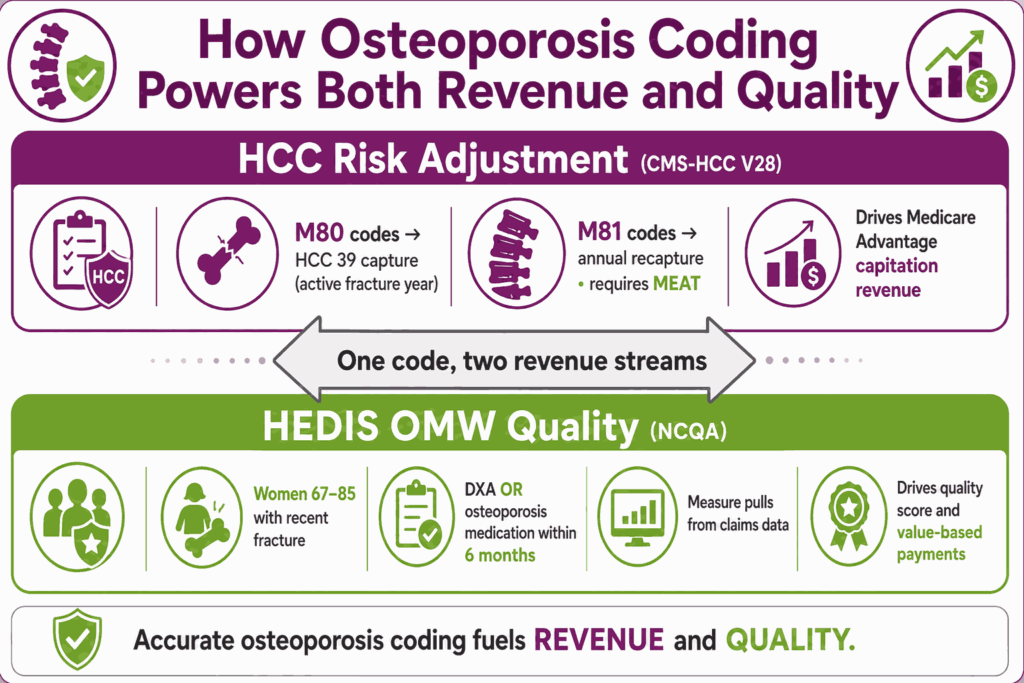
| Medicare Advantage | Fracture HCC capture requires an M80 code with documented fracture status; M81 carries no HCC value |
How Does Osteoporosis Coding Affect Risk Adjustment and HEDIS Quality Measures?
Osteoporosis coding affects risk adjustment through the M80 fracture codes and HEDIS quality scoring through the NCQA OMW measure. The M80 versus M81 choice decides whether the encounter carries risk-adjusted value at all.
Which Osteoporosis Codes Carry HCC Value?
M80 codes carry HCC value because the pathological fracture drives the mapping. M81 codes carry none. Osteoporosis without a current pathological fracture does not map to any HCC, regardless of T-score or treatment intensity. Accurate M80 coding during the fracture year captures the risk score; defaulting to M81 forfeits it.
Why Does Coding M81 When a Fracture Exists Forfeit Revenue?
Coding M81 when the chart documents a current pathological fracture forfeits the HCC entirely. The osteoporosis etiology is built into the M80 code, so M81 paired with a separate fracture code is both incorrect and unpaid at the risk-adjustment level. This is the highest-value query in the osteoporosis family.
When Should a Coder Query on M80 vs. M81?
A query is warranted when the chart records osteoporosis and a fracture in separate places without linking them. Discharge summaries that document only “osteoporosis” after a fracture admission are the common pattern. The query asks the provider to confirm whether the fracture is pathological and attributable to the osteoporosis.
Does the 7th Character Affect HCC Capture?
The 7th character A and the 7th character D both qualify for fracture HCC capture while active treatment continues. Subsequent encounters for routine healing do not end the capture. Coders who switch to M81 during aftercare lose the HCC before they need to.
How Does NCQA HEDIS OMW Tie to Coding?
NCQA HEDIS OMW (Osteoporosis Management in Women Who Had a Fracture) tracks whether women aged 67–85 with a recent fracture receive DXA or osteoporosis medication within six months. The measure pulls from claims data, so accurate fracture coding and DXA or J-code claims drive the quality score.
What Is the Dual-Purpose Documentation Strategy for Claims and Quality?
The dual-purpose documentation strategy captures clinical facts that satisfy both claim coding and quality measure logic. The note records diagnosis, T-score, current fracture status, fracture mechanism, and treatment plan in a single structured section. Coders pull the right code; quality teams pull the right denominator hit.
Frequently Asked Questions About Osteoporosis ICD-10 Coding
The answers below cover the highest-volume specific-code searches and the most-cited osteoporosis coding questions from billers, coders, and HCC abstractors.
What Is the ICD-10 Code for Osteoporosis?
The ICD-10 code range for osteoporosis is M80 through M81. M81.0 covers age-related osteoporosis without current fracture. M80 covers osteoporosis with a current pathological fracture. The exact code depends on fracture status, anatomic site, and encounter type.
What Is the ICD-10 Code for Postmenopausal Osteoporosis?
Postmenopausal osteoporosis ICD 10 routes to M81.0 (age-related osteoporosis without current pathological fracture). ICD-10-CM does not separate postmenopausal osteoporosis from senile osteoporosis at the code level. Both clinical subtypes consolidate under M81.0.
What Is the ICD-10 Code for Senile Osteoporosis?
Senile osteoporosis ICD 10 routes to M81.0. The same code covers postmenopausal osteoporosis. The provider’s note describes the clinical context for medical record purposes.
What Is the ICD-10 Code for Osteopenia?
The osteopenia ICD 10 code is M85.80 for unspecified site. M85.81x covers the shoulder with laterality. M85.85x covers the thigh with laterality. M85.89 covers multiple sites. Osteopenia is not coded under M81.
What Is the Difference Between M80 and M81?
M80 covers osteoporosis with a current pathological fracture. M81 covers osteoporosis without a current pathological fracture. M80 carries a 7th-character encounter type (A, D, G, K, P, or S). M81 does not require a 7th character.
What Is M81.0?
M81.0 is the ICD-10 code for age-related osteoporosis without current pathological fracture. M81.0 is the most common osteoporosis code in US claims data and covers postmenopausal and senile osteoporosis presentations.
What Is M80.00XA?
M80.00XA is the ICD-10 code for age-related osteoporosis with current pathological fracture, unspecified site, initial encounter. The “X” is a placeholder character; “A” is the 7th-character encounter marker for active treatment.
What Is the ICD-10 Code for History of Osteoporosis With Fracture?
Z87.310 is the ICD-10 code for personal history of (healed) osteoporosis fracture. Z87.310 pairs with an active M81 code to capture historical fracture status when the fracture is fully healed.
Can M81 and a Fracture S-Code Be on the Same Claim?
M81 and an S-code can be on the same claim when the fracture is traumatic rather than pathological. The S-code is primary for the acute injury. M81 is secondary to capture the underlying osteoporosis. The provider’s documented mechanism drives the decision.
Does Osteoporosis Carry an HCC?
Osteoporosis without a current pathological fracture does not carry an HCC. M81.0 and M81.8 map to no risk-adjustment category under the CMS-HCC V28 model. Osteoporosis with a current pathological fracture maps to a fracture HCC through the M80 codes, so the fracture, not the osteoporosis, is what carries the risk score.