HCPCS code L4361 describes a pneumatic or vacuum walking boot, prefabricated and supplied off the shelf. It is an ankle-foot orthosis billed under the Medicare brace benefit, not a general-purpose immobilizer.
L4361 turns on a distinction most codes never face. The identical physical boot is coded by the beneficiary’s condition rather than the product, so the reason the patient wears it decides whether Medicare covers it at all.
That fork, plus the add-on bundling rule and the five-year lifetime, drives most denials on the code. Defensible walking boot coding depends on documented intent, and practices often hand that burden to podiatry claims management.
What Is the Description of HCPCS Code L4361?
The L4361 HCPCS code descriptor as defined by CMS is: “Walking boot, pneumatic and/or vacuum, with or without joints, with or without interface material, prefabricated, off-the-shelf.”
This code reports a stock pneumatic walking boot dispensed with minimal adjustment. HCPCS code L4361 falls under the ankle-foot orthosis family and is paid through the DMEPOS fee schedule as a prosthetic and orthotic item. It belongs to the L-series of the Level II code set CMS maintains for devices and supplies rather than physician services.
Two variables select the code within the walking boot family. L4361 is the pneumatic option supplied off the shelf, and the mechanism plus the fitting method together decide which of the four prefabricated codes applies.
What Device Does HCPCS Code L4361 Represent?
HCPCS code L4361 represents a rigid walking boot with an air bladder or vacuum mechanism that provides adjustable compression around the limb. It immobilizes the ankle and foot while permitting weight-bearing ambulation.
The features that define the device are:
- A pneumatic or vacuum system that inflates against the limb for compression and a closer fit
- A rigid outer shell that immobilizes the ankle and controls motion
- A rocker sole that supports a functional gait while the limb is immobilized
- Interface material lining the shell, with joints present in some models
The pneumatic mechanism is the coding variable. A boot without the air bladder or vacuum system is not L4361, and it routes to the non-pneumatic codes described below.
When Is a Walking Boot Coded L4361 and When Must It Be Coded A9283?
The identical physical boot carries different codes depending on the beneficiary’s condition. Policy Article A52457 states that certain products have both covered and non-covered uses and must be coded based on the beneficiary’s condition.
The coding fork works as follows:
- When used as a brace to treat an orthopedic condition, the walking boot is coded L4360, L4361, L4386, L4387, or L4631
- When used solely for the prevention or treatment of a lower extremity ulcer or for pressure reduction, the boot must be coded A9283
- A9283 has no Medicare benefit category, so the item is noncovered on that pathway
- Medicare covers therapeutic shoes under the diabetic shoe policy for the prevention and treatment of diabetic foot ulcers
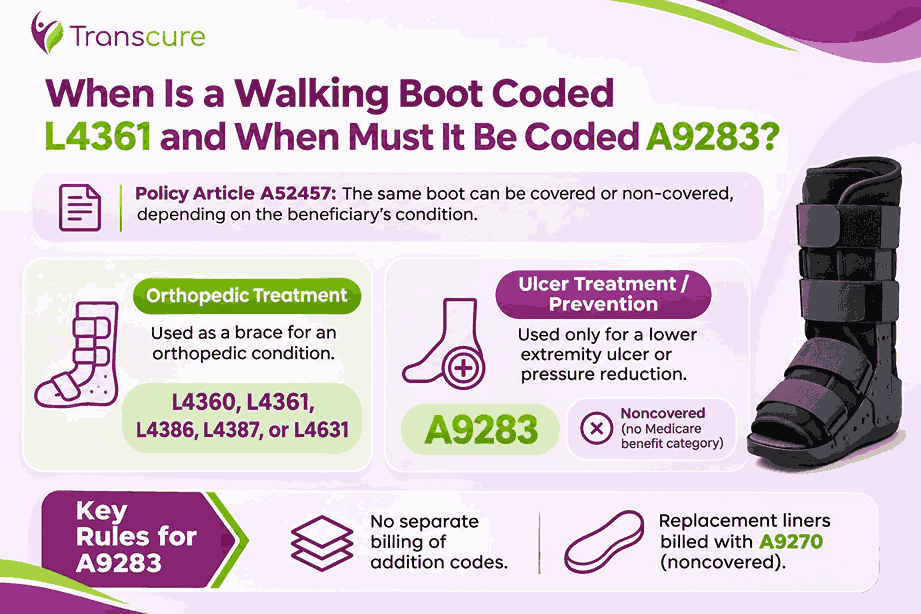
Two rules attach to the A9283 pathway itself. There is no separate billing of addition codes with A9283, and replacement liners for a device billed under A9283 must be billed with A9270 as a noncovered item. Offloading of this kind is routine in wound care claims, where the treating practitioner’s note decides which pathway the boot follows.
One older instruction should not be carried forward. Earlier guidance told suppliers to append modifier GY to the L-code when the boot was used only for ulcer treatment or prevention, and the DME MAC articles carrying that instruction have been retired. The current rule is to select A9283 in the first place, not to bill L4361 with GY.
What Separates Off-the-Shelf L4361 From Custom-Fitted L4360?
L4361 and L4360 describe the same pneumatic walking boot, separated only by whether an individual with expertise customized it. Minimal self-adjustment and expertise-level customization are mutually exclusive classifications.
The distinction works as follows:
- L4361 applies when the boot is supplied off the shelf and requires only minimal self-adjustment by the patient, caretaker, or supplier
- L4360 applies when a qualified individual trimmed, bent, molded, assembled, or otherwise customized the boot for the specific patient
- The customization must be real and recorded, since a boot dispensed as supplied fails the L4360 code definition
- A boot the manufacturer labeled as off-the-shelf cannot be recoded to L4360 because a podiatrist adjusted it in the office
Code from the manufacturer designation and the fitting record together, never from the fee schedule amount. This pair draws more audit attention than any other walking boot question, and the supplier record is the only evidence distinguishing two identical devices.
How Does L4361 Differ From the Non-Pneumatic Boots (L4386, L4387), the Stirrup-Style Ankle Orthosis (L4350), and Custom-Fabricated Boots (L2999, L4631)?
The walking boot family divides along three axes: the compression mechanism, the fitting method, and whether the device is prefabricated or custom fabricated. Orthopedic practices meet the same family in fracture and post-surgical care, where it sits within the lower extremity bracing codes orthopedics dispenses.
The related codes break down as follows:
- L4361 pneumatic or vacuum walking boot, prefabricated, off-the-shelf
- L4360 the same pneumatic boot, prefabricated and customized by an individual with expertise
- L4387 non-pneumatic walking boot, prefabricated, off-the-shelf, mirroring the pneumatic pair without the air bladder
- L4386 non-pneumatic walking boot, prefabricated and customized by an individual with expertise
- L4350 ankle control orthosis, stirrup style, rigid, prefabricated, off-the-shelf, which is a smaller ankle stirrup rather than a full walking boot
- L2999 and L4631 for custom-fabricated walking boots
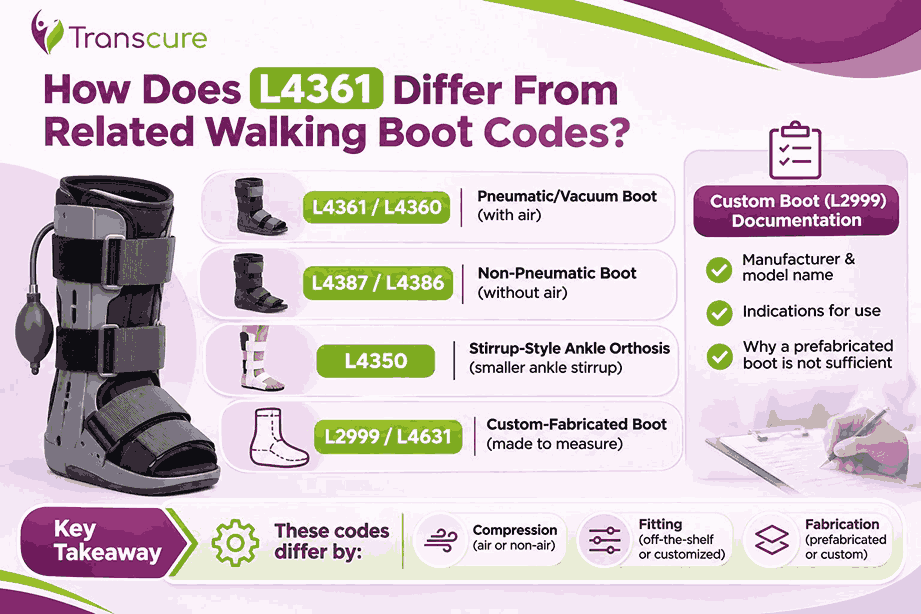
The custom-fabricated route carries its own documentation burden. A custom-fabricated walking boot billed under L2999 must be accompanied by the manufacturer and model name, the indications for use, and an explanation of why a prefabricated boot is not sufficient. Walking boots share the foot and ankle device range of the podiatry supply and device codes, alongside diabetic shoes and custom inserts.
What ICD-10 Codes and Medical Necessity Criteria Support HCPCS Code L4361?
Coverage for HCPCS code L4361 runs through LCD L33686. The LCD covers ankle-foot orthoses for ambulatory beneficiaries with weakness or deformity of the foot and ankle who require stabilization for medical reasons and have the potential to benefit functionally.
The coverage criteria and representative diagnoses include:
- The beneficiary must be ambulatory, since the brace benefit for these codes applies to orthoses used during ambulation
- Weakness or deformity of the foot and ankle must be documented
- The beneficiary must have the potential to benefit functionally from the orthosis
- S92.354A and related codes for metatarsal fracture, initial encounter for closed fracture
- S82.891A and related codes for lower leg and ankle fracture
- S93.401A for sprain of unspecified ligament of the ankle
- M14.671 and M14.672 for Charcot’s joint of the ankle and foot
The diagnosis alone does not settle coverage on this code. The record must show the boot immobilizes an orthopedic condition, because the same diagnosis paired with ulcer or offloading intent moves the claim to the noncovered A9283 pathway. The fracture, sprain, and Charcot codes that support the brace benefit sit among the foot and ankle diagnosis codes podiatrists report, where laterality and encounter characters must match the limb and the stage of care.
Which Codes Are Billed Alongside L4361, and Which Are Not Separately Payable?
HCPCS code L4361 describes a complete product, so the components and services that accompany it are already inside the payment. Add-on codes are the most common unbundling error.
The companion-code rules are:
- Add-on codes must not be billed with walking boots coded L4360, L4361, L4386, or L4387, and such claims are denied as unbundling
- Fitting and application of the boot are inside the L4361 payment and are not separately reportable
- Application of an off-the-shelf product is included in the evaluation and management service for the visit
- Commercial payers commonly deny L1902 billed on the same day as L4361 as bundled, even when both lines carry KX and a laterality modifier
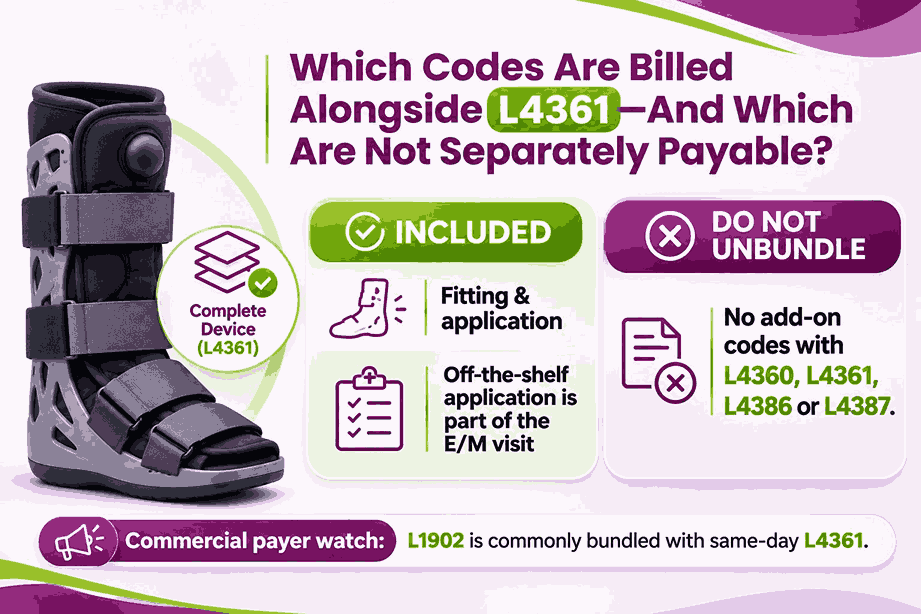
The code describes a complete device rather than a base plus components. Reaching for an addition code to capture liner, joint, or fitting value duplicates payment already inside the allowable. The procedures that most often precede a boot, from fracture care to ulcer debridement and total contact casting, are billed under foot and ankle procedure codes on the practitioner’s claim, separate from the device.
What Are the Modifiers for HCPCS Code L4361?
HCPCS code L4361 requires a coverage attestation and laterality on every claim, plus the purchase, liability, and replacement modifiers.
Modifier KX: Coverage Criteria in LCD L33686 Are Met
Modifier KX attests that the coverage criteria in LCD L33686 are met and documented. Append KX to HCPCS code L4361 when the beneficiary is ambulatory, has documented weakness or deformity of the foot and ankle, and the boot treats an orthopedic condition. A covered claim missing KX is denied.
Modifiers RT and LT: One Unit Per Limb on Separate Claim Lines
Modifiers RT and LT identify the right and left limb. Bill L4361 as one unit per limb on separate claim lines, never as a bilateral modifier or as RTLT on one line. A bilateral dispense is two lines, each with one unit and its own laterality modifier.
Modifier NU: New Equipment Purchase
Modifier NU identifies the purchase of new equipment. Append NU to HCPCS code L4361 when dispensing a new boot, since orthoses are purchased rather than rented. The modifier confirms the item is new at the time of the claim.
Modifier GA: ABN on File for an Expected Medical-Necessity Denial
Modifier GA reports that an Advance Beneficiary Notice of Noncoverage is on file for an expected medical-necessity denial. Append GA to L4361 when the coverage criteria may not be met and the patient accepted liability in writing before delivery. This applies to medical-necessity denials, not to the A9283 pathway, which is a benefit-category matter.
Modifier GZ: No ABN, Denial Expected as Not Medically Necessary
Modifier GZ reports an expected medical-necessity denial with no ABN on file. Append GZ to HCPCS code L4361 when necessity is doubtful and no waiver was obtained before delivery. The line denies with supplier liability, so the practice absorbs the cost of the boot.
Modifier RA: Replacement Due to Loss, Theft, or Irreparable Damage
Modifier RA reports the replacement of an item. Append RA to L4361 when replacing a boot lost, stolen, or irreparably damaged, or when the previous boot has passed its reasonable useful lifetime. The record must document the reason the replacement was needed.
Which Documents Are Required For HCPCS Code L4361?
Documentation for HCPCS code L4361 must establish the orthopedic indication, the off-the-shelf classification, and delivery. The indication is what separates a covered brace from a noncovered offloading device.
The required documentation includes:
- A standard written order with all required elements before the claim is submitted
- The qualifying diagnosis and evidence that the beneficiary is ambulatory
- Documentation of weakness or deformity of the foot and ankle and the functional benefit expected
- A clear statement that the boot immobilizes an orthopedic condition rather than managing an ulcer or reducing pressure
- The manufacturer designation supporting the off-the-shelf classification
- The fitting record, showing that only minimal self-adjustment was required
- Proof of delivery with the date, item description, and recipient signature
What Is the Cost of HCPCS Code L4361?
HCPCS code L4361 is paid through the DMEPOS fee schedule as a purchased orthotic device. There is no RVU calculation because the code prices a device rather than a physician service.
DMEPOS Fee Schedule Payment for L4361
Medicare prices HCPCS code L4361 by state through the DMEPOS fee schedule, within a national floor and ceiling. The 2026 allowable runs from $318.18 to $424.24 depending on the state.
| State Example | 2026 Allowable |
|---|---|
| TX, IL, OH, MI, MN (floor states) | $318.18 |
| NY, NJ | $330.09 |
| FL, GA, NC, TN | $338.06 |
| PA, MD, VA, DC | $353.59 |
| CA, AZ, NV | $371.23 |
| AK | $374.91 |
| HI | $400.91 |
| MA, WA, OR, CT, ME (ceiling states) | $424.24 |
The 2026 amounts reflect a 2 percent increase over 2025, when the range ran from $311.94 to $415.92. Medicare pays 80 percent of the allowable after the Part B deductible, so the patient owes roughly $64 to $85 in coinsurance depending on the state. A sequestration reduction applies to the Medicare share.
The 2026 amounts apply through December 31, 2026. CMS publishes the CY 2027 DMEPOS fee schedule ahead of its January 1, 2027 effective date, updating fees for items outside competitive bidding by the CPI-U increase minus a productivity adjustment, so verify the 2027 state amount before quoting a patient estimate for dates of service in 2027. HCPCS code L4361 is not part of the Round 2028 competitive bidding program, which covers off-the-shelf back, knee, and upper extremity braces, so walking boots stay on the standard fee schedule rather than moving to single payment amounts.
Why In-Office Dispensing Requires DMEPOS Supplier Enrollment
A practice that dispenses walking boots from its own inventory is acting as a DMEPOS supplier, and Medicare treats it that way. Writing an order is not the same as furnishing the item.
The enrollment rules are:
- A physician or practice furnishing L4361 from office stock must enroll as a DMEPOS supplier through the National Provider Enrollment East or West contractor in PECOS, which replaced the National Supplier Clearinghouse on November 7, 2022
- Enrolled suppliers must meet the DMEPOS supplier standards, though physicians and non-physician practitioners furnishing items only to their own patients as part of their professional service are exempt from the surety bond requirement
- Claims for a dispensed boot go to the DME MAC rather than the Part B carrier
- A practice without supplier enrollment cannot bill the boot, even when the clinical indication is sound
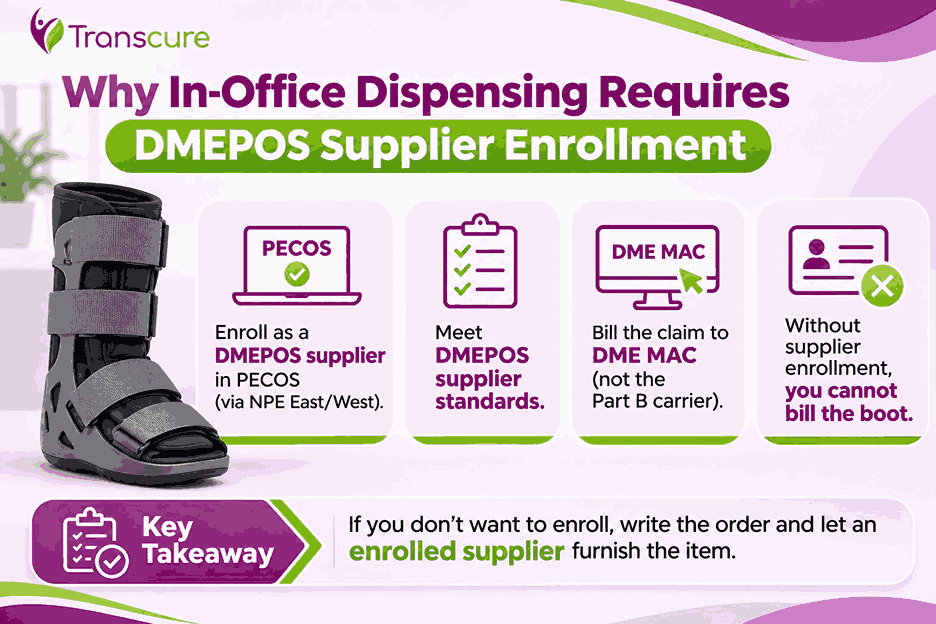
Many practices dispense boots for patient convenience without realizing the billing consequence. The alternative is to write the order and let an enrolled supplier furnish the item.
Commercial Payers and Medicaid Coverage
Commercial and Medicaid plans set their own walking boot rules, and several differ meaningfully from Medicare. Verify coverage before the boot leaves the office, since an unrecoverable device cost follows a denied claim.
Coverage considerations include:
- Some plans require prior authorization for orthotic devices even where Medicare does not
- Commercial payers commonly bundle same-day orthosis codes, including L1902 billed with L4361
- Plan definitions of off-the-shelf versus custom-fitted may not match the Medicare standard
- Medicaid programs vary by state on whether walking boots are a covered benefit and at what frequency
Patient Financial Responsibility and Cash-Pay Rules for Non-Covered Offloading Use
Selling the boot as a cash item is acceptable when the use is noncovered, such as pure offloading. The sequence is what makes it compliant, and the order of steps matters more than the principle.
The cash-pay rules are:
- Provide the patient written notice of non-coverage before delivery, not after
- A supplier who does not notify the patient before claim submission loses the ability to bill the patient
- Document the patient’s acknowledgment and the agreed price before the boot is dispensed
- For a covered claim that may fail on medical necessity, use an ABN with modifier GA instead
What Are Example Clinical Scenarios or Use Cases for HCPCS Code L4361?
HCPCS code L4361 appears in acute fracture care, post-operative immobilization, the offloading fork, deformity cases, and replacements. The scenarios below show each.
Scenario 1: Acute Fifth Metatarsal Fracture Immobilized With an Off-the-Shelf Pneumatic Boot
ICD-10: S92.354A (Nondisplaced fracture of fifth metatarsal bone, right foot, initial encounter for closed fracture)
A patient sustains a fifth metatarsal fracture and needs immobilization while remaining ambulatory. The supplier dispenses a stock pneumatic walking boot requiring only minimal self-adjustment. The claim reports HCPCS code L4361 with modifiers KX, RT, and NU. The fracture is an orthopedic condition, which places the boot squarely in the brace benefit.
Scenario 2: Post-Operative Ankle Stabilization Following Orthopedic Surgery
ICD-10: Z47.89 (Encounter for other orthopedic aftercare)
A patient recovering from ankle surgery requires immobilization and controlled weight-bearing during healing. The surgeon’s office, enrolled as a DMEPOS supplier, dispenses an off-the-shelf pneumatic boot. The claim reports L4361 with KX, the laterality modifier, and NU. Immobilization following orthopedic surgery is an explicitly covered use under the brace benefit. Orthopedic groups dispensing boots after foot and ankle surgery work under the same supplier rules, familiar ground for revenue cycle teams serving orthopedic surgeons.
Scenario 3: Diabetic Foot Ulcer Offloading — Why the Claim Is A9283 and Not L4361
ICD-10: E11.621 (Type 2 diabetes mellitus with foot ulcer) and L97.411 (Non-pressure chronic ulcer of right heel and midfoot limited to breakdown of skin)
A patient with a type 2 diabetic foot ulcer receives a walking boot solely to offload pressure from the ulcer while it heals. Although the device is physically identical to the boot in Scenario 1, the use is ulcer treatment rather than orthopedic immobilization. The claim must report A9283, which has no Medicare benefit category. Appending GY to L4361 is the retired approach and should not be used, and no addition codes are billed with A9283.
Scenario 4: Charcot Arthropathy With Deformity and Instability Supporting the Brace Benefit
ICD-10: M14.671 (Charcot’s joint, right ankle and foot) and E11.610 (Type 2 diabetes mellitus with diabetic neuropathic arthropathy)
A patient with Charcot arthropathy has midfoot deformity and joint instability requiring immobilization. This is the hardest real-world call on the code, because Charcot patients frequently have ulcers as well, and the two pathways diverge on intent.
Charcot arthropathy involves deformity and instability, which are orthopedic indications supporting HCPCS code L4361. The documentation must establish that the boot immobilizes the deformity and stabilizes the joint, rather than managing edema or an ulcer. Where the note describes offloading an ulcer as the purpose, the claim belongs under A9283 instead, so the recorded intent decides the code.
Scenario 5: Repeat Boot Within the Five-Year Useful Lifetime for a New, Unrelated Injury
ICD-10: S82.892A (Other fracture of left lower leg, initial encounter for closed fracture)
A patient who received a walking boot two years earlier for a right ankle injury now fractures the left lower leg. The prior boot is within its five-year reasonable useful lifetime, which normally triggers a same-or-similar denial. Because the new injury involves the opposite limb and a separate orthopedic condition, the claim reports L4361 with the LT modifier and documentation of the new injury. The record must distinguish this from a replacement of the earlier device.
What Are the HCPCS Code L4361 Rules To Ensure Successful Reimbursement?
Follow the add-on prohibition, the same-or-similar and lifetime rules, the per-limb billing requirement, and the orthopedic indication standard. Meeting these rules protects HCPCS code L4361 claims from denial and recoupment.
Why Add-On Codes Cannot Be Billed With L4361
HCPCS code L4361 describes a complete product, so addition codes have nothing left to add. Claims for add-on codes used with walking boots coded L4360, L4361, L4386, or L4387 are denied as unbundling.
The add-on rules are:
- The four prefabricated walking boot codes describe complete products, including the shell, interface, and any joints
- Addition codes billed alongside them are denied as unbundling rather than reduced
- Assembly of the item and installation of components are part of furnishing the boot, not separate services
- The A9283 pathway carries the same prohibition, with no separate billing using addition codes
Same or Similar Equipment Denials and the Five-Year Reasonable Useful Lifetime
Orthoses carry a five-year reasonable useful lifetime, and a same-or-similar item already on file triggers denial. Both require a check before the boot is dispensed.
The same-or-similar rules are:
- Check the beneficiary’s equipment history before dispensing, since an existing comparable orthosis leads to denial
- A replacement within five years requires a qualifying reason such as loss, theft, or irreparable damage, reported with modifier RA
- Normal wear does not justify replacement before the lifetime expires
- A new boot for a different limb or a separate, unrelated orthopedic condition is not a replacement, and the record must make that distinction explicit
Units, Bilateral Billing, and Laterality Requirements
HCPCS code L4361 is billed as one unit per limb. Laterality appears on every claim line.
The unit and laterality rules are:
- Report one unit per limb, with RT on one line and LT on the other for a bilateral dispense
- Never combine both limbs on a single line or substitute a bilateral modifier
- Each line carries its own KX attestation and NU modifier where applicable
- Missing laterality is a preventable denial on a code where the payer cannot infer the side
Documentation That Supports the Orthopedic Indication Over Offloading
The single documentation element that decides coverage is the stated purpose of the boot. The same patient, the same diagnosis list, and the same device can land on either side of the fork.
The documentation should establish:
- The orthopedic condition being immobilized, named specifically rather than implied
- Weakness or deformity of the foot and ankle, with the functional benefit expected from stabilization
- That the beneficiary is ambulatory, since the AFO coverage criteria apply to orthoses used during ambulation
- Explicit language that the boot immobilizes or stabilizes, rather than offloads or relieves pressure
- Where an ulcer is also present, why the boot addresses the orthopedic problem rather than the ulcer
Top Reasons For Denials Specific To L4361 & Quick Remedies
- Boot Dispensed for Ulcer Offloading Billed as L4361: Prevent by coding A9283 when the boot is used solely for prevention or treatment of a lower extremity ulcer or pressure reduction, rather than appending GY to the L-code.
- Add-On Codes Billed Alongside the Boot: Prevent by removing every addition code, since walking boot codes describe complete products and add-on lines are denied as unbundling.
- Off-the-Shelf Boot Coded as Custom-Fitted: Prevent by coding from the manufacturer designation and the fitting record together, since in-office adjustment does not convert L4361 into L4360.
- Same or Similar Equipment on File: Prevent by checking the equipment history before dispensing and documenting a new, unrelated condition or a qualifying replacement reason with modifier RA.
- Missing KX or Laterality: Prevent by appending KX when the LCD L33686 criteria are met and billing one unit per limb with RT or LT on separate lines.
- Billing Without DMEPOS Supplier Enrollment: Prevent by enrolling as a DMEPOS supplier before dispensing from office stock, or by writing the order and letting an enrolled supplier furnish the boot.