
Podiatry coding spans more ICD-10 chapters than most specialties, reaching from M-codes into skin, infection, and endocrine codes. The stakes peak in diabetic foot care. According to Armstrong and colleagues in the New England Journal of Medicine, about one-third of people with diabetes develop a foot ulcer in their lifetime.
Those ulcers precede roughly 80 percent of diabetes-related lower-limb amputations, so coding accuracy carries clinical and financial weight. Combination coding, laterality, and medical necessity rules decide whether a claim clears. Dedicated podiatry billing services exist to hold that detail across high-volume encounters.
This guide maps podiatry ICD-10 codes in two layers. The first covers the coding mechanics behind every diagnosis: chapter structure, laterality, seventh characters, diabetic foot ulcers, and routine foot care. The second lists the most common conditions by category, with anchor codes for each.
What Are Podiatry ICD-10 Codes?
Podiatry ICD-10 codes are diagnosis codes that classify foot and ankle conditions, including deformities, nail and skin disorders, injuries, and diabetic complications. These codes feed claim adjudication, medical necessity, and quality reporting. Podiatry coding accuracy determines whether a foot or ankle service gets reimbursed.
Which ICD-10 Chapters Cover Podiatry Diagnoses?
Podiatry pulls codes from more chapters than almost any musculoskeletal specialty. A single practice routinely codes across six chapters in one week.
- Chapter 13 (M-codes): Deformities, plantar fasciitis, metatarsalgia, gout.
- Chapter 19 (S-codes): Ankle sprains, foot contusions, Achilles ruptures.
- Chapter 1 (B35): Fungal nail and skin infections.
- Chapter 12 (L-codes): Ingrown nails, ulcers, cellulitis.
- Chapter 4 (E11): Diabetic foot complications.
- Chapter 6 (G57): Morton’s neuroma and nerve lesions.
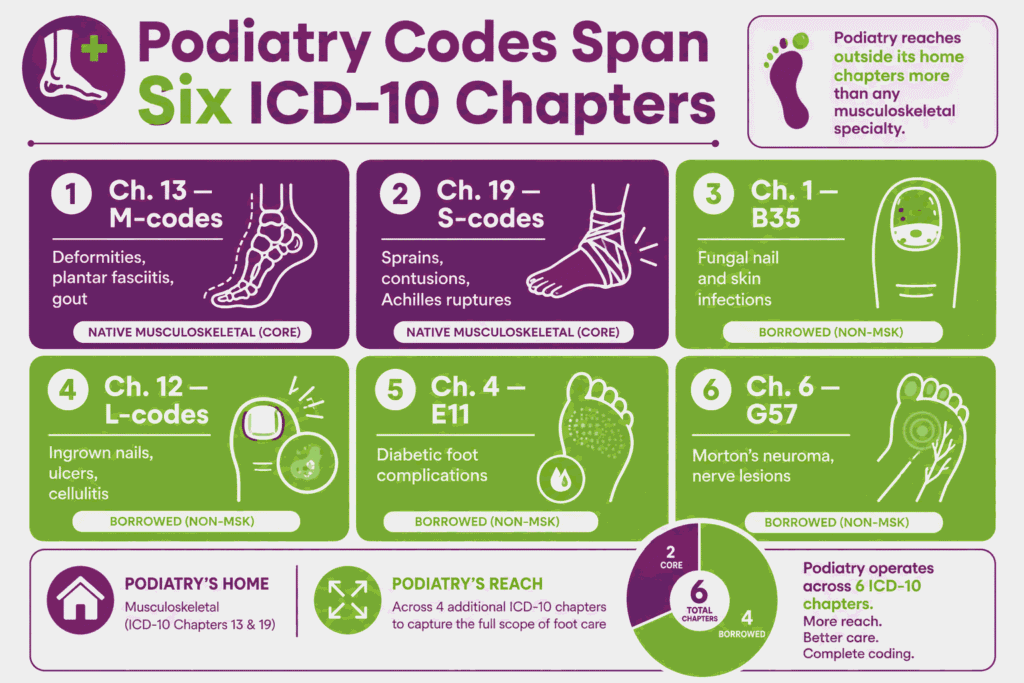
This spread matters because the chapters follow different rules. S-codes require a seventh character. Diabetic codes require combination coding. Misreading the chapter leads to the wrong code path.
How Is a Podiatry ICD-10 Code Structured?
A podiatry ICD-10 code is an alphanumeric string of three to seven characters, where each position adds detail such as site, laterality, and encounter. Two examples show the range.
- M20.11 names hallux valgus (bunion) of the right foot. The category names the deformity, and the final character marks the side.
- S93.401A names a sprain of an unspecified ligament of the right ankle, initial encounter. The seventh character A marks the episode of care.
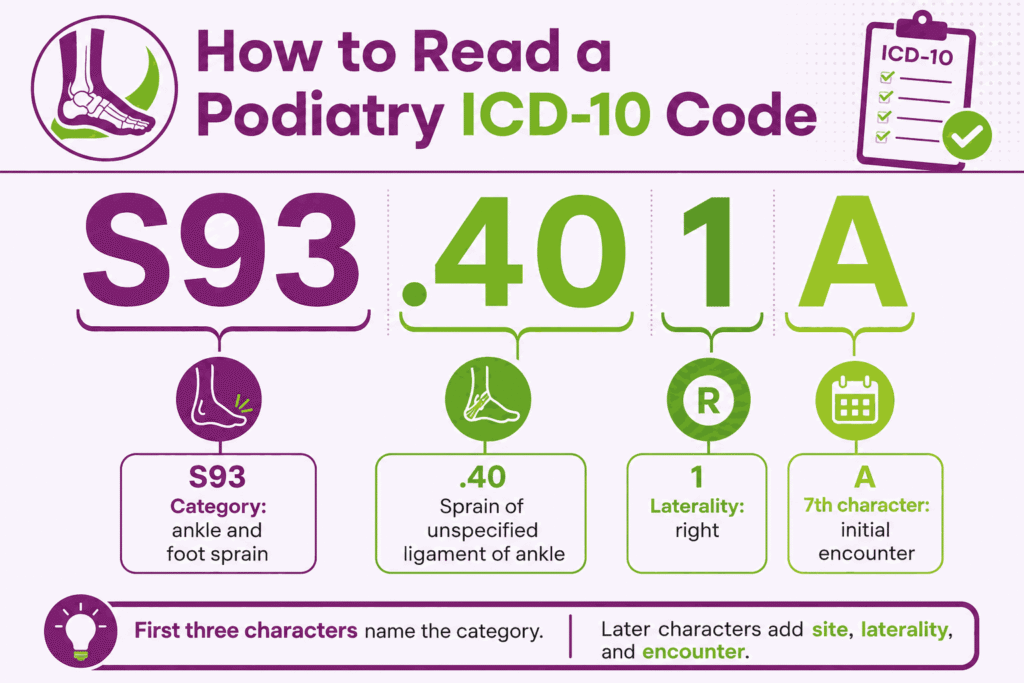
Codes that stop at an unspecified site or unspecified laterality stay billable but draw denials. Specific codes protect reimbursement.
How Do You Code Podiatry Diagnoses Correctly?
Correct podiatry coding depends on four elements: laterality, encounter type, combination coding for diabetic complications, and medical necessity for routine care. These elements separate a clean claim from a denied one. The condition lists later in this guide supply the codes; this section supplies the rules.
Why Does Laterality Matter in Foot and Ankle Coding?
Laterality matters because the foot is a paired structure, and most foot and ankle codes require right, left, or bilateral. Unspecified laterality is a leading denial trigger.
Foot pain shows the pattern:
- M79.671 marks pain in the right foot.
- M79.672 marks pain in the left foot.
- M79.673 marks pain in an unspecified foot.
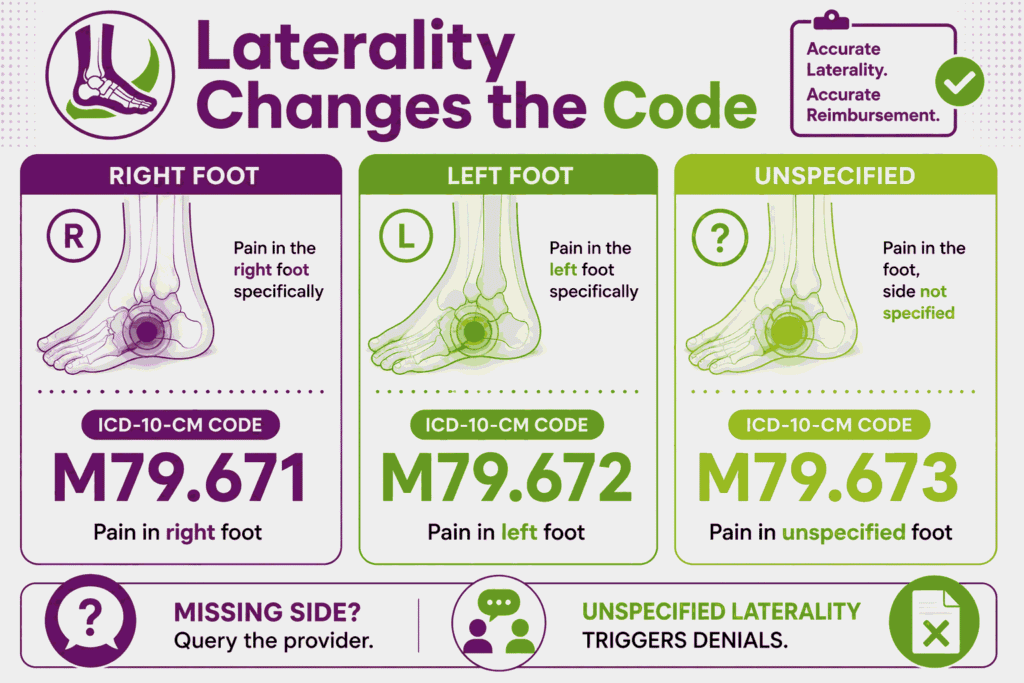
When documentation omits the side, query the provider rather than default to unspecified. The FY2026 code set tightened laterality expectations for lower-extremity conditions.
When Do Foot and Ankle Codes Need a 7th Character?
Foot and ankle injury codes need a seventh character that marks the episode of care. These codes begin with S and are invalid without the seventh character.
Three core values apply:
- A — Initial encounter: Active treatment of the sprain, contusion, or rupture.
- D — Subsequent encounter: Routine healing care after active treatment ends.
- S — Sequela: A condition arising from the original injury.
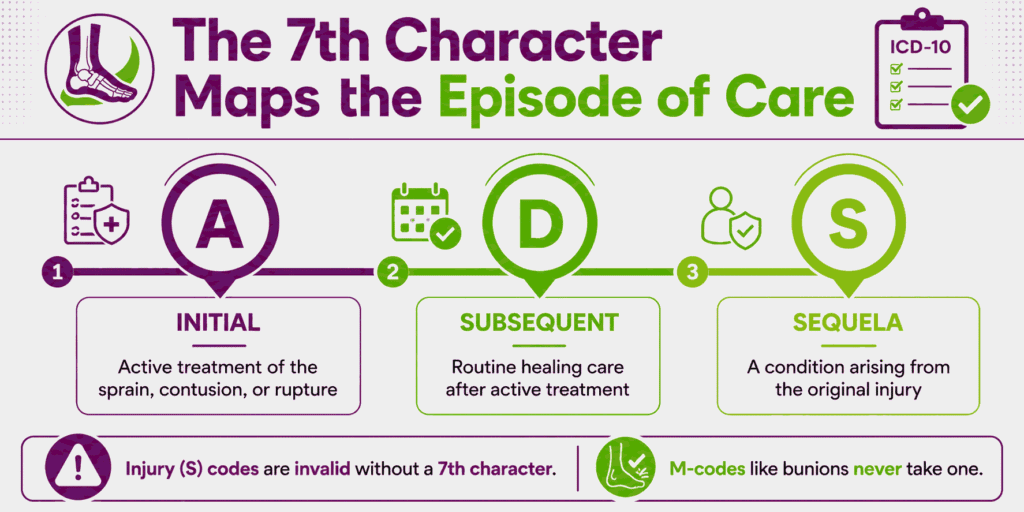
Ankle sprains (S93.4-), foot contusions (S90.3-), and Achilles ruptures (S86.0-) all carry this requirement. Chronic M-code conditions, such as bunions or metatarsalgia, do not.
How Do You Code Diabetic Foot Ulcers?
Diabetic foot ulcer coding requires combination coding: the diabetes code first, then the ulcer code. A single code cannot capture both the systemic disease and the wound. This pairing is the highest-value coding skill in podiatry.
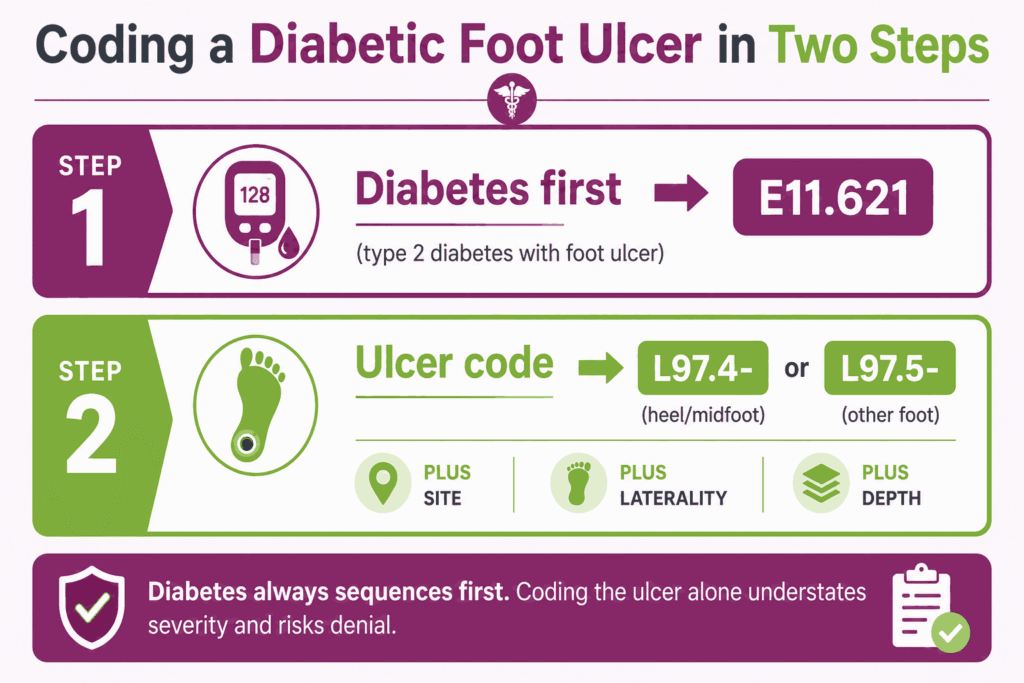
Combination Coding: Sequencing Diabetes Before the Ulcer
The diabetes code leads, and the ulcer code follows. For a type 2 diabetic foot ulcer, sequence E11.621 (type 2 diabetes with foot ulcer) first, then the matching L97 ulcer code.
The diabetic foot ulcer ICD-10 codes pairing also captures a diabetic foot infection when infection is documented. Coding the ulcer alone, without the diabetes link, understates severity and risks denial.
Documenting Ulcer Depth, Site, and Laterality
The L97 ulcer code specifies site, laterality, and depth. Foot ulcer ICD-10 codes split by site, with L97.4- for the heel and midfoot and L97.5- for the rest of the foot, toes included. The final characters mark the side and the tissue depth.
- L97.419 marks a right heel and midfoot ulcer, unspecified severity.
- L97.529 marks a left other-foot ulcer, unspecified severity.
The FY2026 update expanded ulcer depth classifications, so documentation must state the deepest tissue involved. Depth drives both the code and the reimbursement weight.
How Do You Bill Routine Foot Care?
Routine foot care is billable only when a qualifying systemic condition makes it medically necessary. Medicare excludes routine foot care by default, treating nail trimming and callus care as non-covered.
Coverage opens when the patient has a systemic disease such as diabetes or peripheral vascular disease, with documented class findings. The claim then needs the right modifier:
- Q7: One class A finding.
- Q8: Two class B findings.
- Q9: One class B and two class C findings.
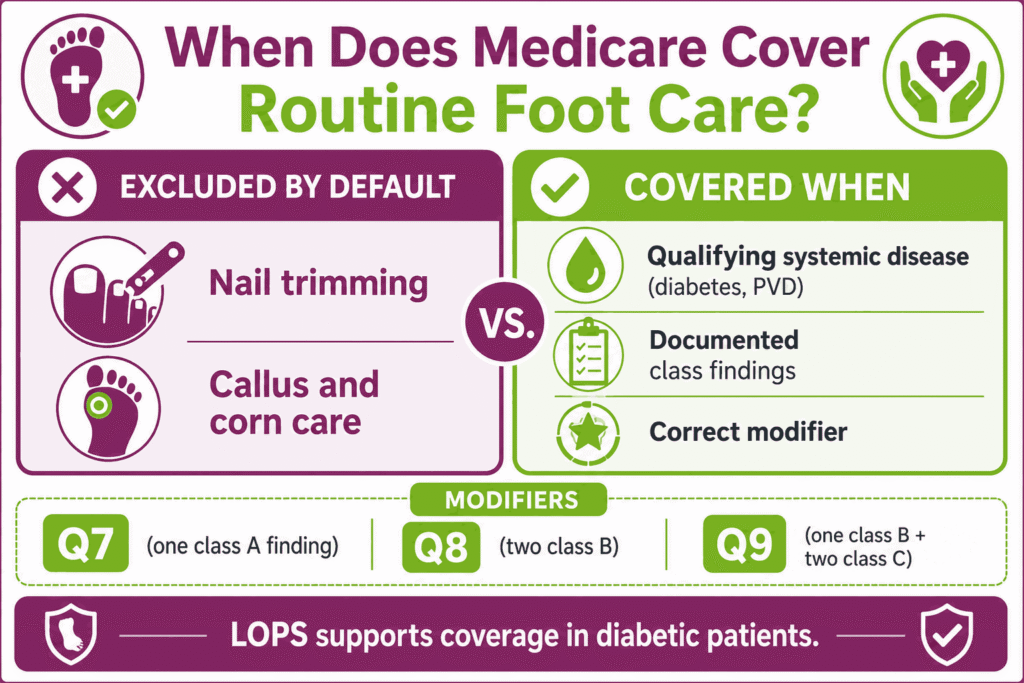
Loss of protective sensation (LOPS) supports coverage in diabetic patients. Without the systemic link and modifier, routine foot care claims fail medical necessity. Because tracking these shifting compliance guidelines can easily overwhelm an internal billing staff, top-performing podiatry billing companies implement customized, front-end software edits that automatically cross-reference systemic diagnoses with the correct clinical modifiers before submission.
Which ICD-10 Codes Cover the Most Common Podiatry Conditions?
The most common podiatry conditions cluster into five categories: heel and forefoot pain, structural deformities, nail and skin disorders, diabetic complications, and trauma. Each condition below lists its anchor codes. Many carry full code sets across laterality, which the linked guides detail.
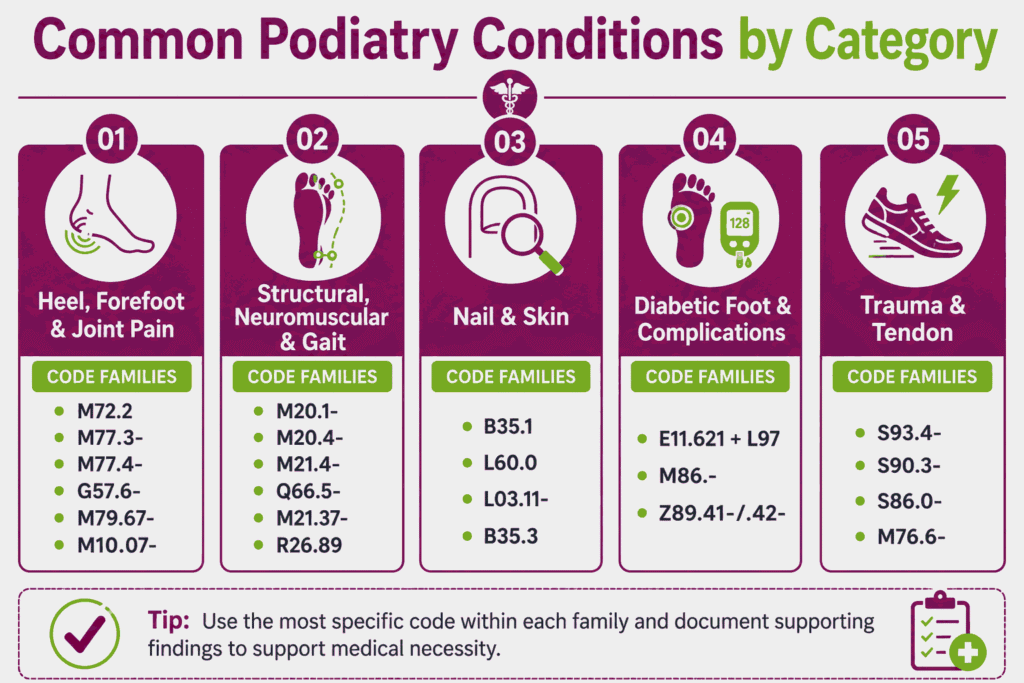
Heel, Forefoot, and Joint Pain ICD-10 Codes
Heel, forefoot, and joint pain codes draw from the M-code chapter and are split by site and laterality. Region specificity separates most codes.
Plantar Fasciitis ICD-10 Codes
The plantar fasciitis ICD-10 code is M67.A01 (right), M67.A02 (left), or M67.A09 (unspecified), effective October 1, 2026, with laterality built in. Coders searching ICD-10 code for plantar fasciitis land here. The retired code, M72.2, now covers only plantar fascial fibromatosis (Ledderhose disease), a related but distinct nodular condition, split into M72.20/21/22 by side.
The calcaneal spur ICD-10 code, M77.3-, takes laterality, so left heel pain and right heel pain code separately. The full plantar fasciitis ICD-10 codes set covers the fascia and adjacent heel conditions.
Metatarsalgia and Morton’s Neuroma ICD-10 Codes
Forefoot pain splits between two causes. The metatarsalgia ICD-10 code is M77.4-, where M77.41 marks the right foot and M77.42 the left. The ICD-10 code for metatarsalgia differs from the Morton neuroma ICD-10 code, G57.6-, a nerve lesion where G57.61 marks the right foot. These sets separate mechanical from neurologic forefoot pain.
Foot and Toe Pain ICD-10 Codes
Foot and toe pain codes use the M79.67 subcategory when no structural diagnosis applies. The ICD-10 code for right foot pain is M79.671, and the ICD-10 code for left foot pain is M79.672. No single bilateral code exists, so the ICD-10 code for bilateral foot pain is M79.671 and M79.672 reported together. M79.673 means unspecified, not bilateral.
The toe pain ICD-10 codes sit alongside, capturing right toe pain, left toe pain, and right great toe pain. This foot pain ICD-10 codes set serves as a symptom code pending diagnosis.
Gout in the Foot ICD-10 Codes
Gout codes for the foot use M10.07- for idiopathic gout of the ankle and foot. The gout right foot ICD-10 code is M10.071, and the gout left foot ICD-10 code is M10.072. Chronic tophaceous gout shifts to the M1A category. This gout ICD-10 codes set separates acute flares from chronic disease.
Structural, Neuromuscular, and Gait ICD-10 Codes
Structural and gait codes draw mostly from the M21 acquired deformity range and code by type and laterality. Acquired and congenital forms carry separate codes.
Bunion and Hammertoe ICD-10 Codes
Bunion and hammertoe codes split by deformity. The bunion ICD-10 code is M20.1- for hallux valgus, so the right bunion ICD-10 code is M20.11 and the left is M20.12. The hammer toe ICD-10 code, M20.4-, follows the same laterality pattern. These sets detail each deformity by side.
Flat Feet ICD-10 Codes
Flat feet codes split by cause. The ICD-10 code for flat feet is M21.4- when acquired and Q66.5- when congenital. M21.41 marks acquired flat foot on the right side. This flat feet ICD-10 codes set separates the acquired adult form from the congenital presentation.
Foot Drop ICD-10 Codes
Foot drop codes use the M21.37 subcategory for acquired drop foot. The ICD-10 code for right foot drop is M21.371, and the ICD-10 code for left foot drop is M21.372. The condition codes by laterality and reflects a neuromuscular cause. This foot drop ICD-10 codes set details each side.
Toe Walking ICD-10 Codes
The toe walking ICD-10 code does not exist as a dedicated entry, so toe walking maps to the R26 gait abnormality category. R26.89 covers other abnormalities of gait and mobility, the usual assignment. This toe walking ICD-10 codes guide explains documentation when no specific code applies.
Nail and Skin Condition ICD-10 Codes
Nail and skin codes draw from the infection and dermatology chapters. Fungal, bacterial, and structural nail conditions each carry distinct codes.
Onychomycosis (Nail Fungus) ICD-10 Codes
The onychomycosis ICD-10 code is B35.1, the entry for tinea unguium. Coders searching ICD-10 code for onychomycosis or nail fungus ICD-10 land on B35.1, which covers dermatophytic toe nail fungus. Documentation should confirm the fungal cause to support antifungal treatment. This nail fungus ICD-10 codes set covers tinea unguium and its differentials.
Ingrown Toenail ICD-10 Codes
The ingrown toenail ICD-10 code is L60.0, the entry for unguis incarnatus. The ICD-10 code for ingrown toenail applies to both conservative and surgical management. Related nail dystrophies carry separate L60 codes. This ingrown toenail ICD-10 codes set covers the condition and adjacent nail disorders.
Foot Cellulitis and Athlete’s Foot ICD-10 Codes
Foot skin infections split by type. The ICD-10 code for athlete’s foot is B35.3, the entry for tinea pedis.
Foot cellulitis uses L03.11-, where the ICD-10 code for right foot cellulitis and the ICD-10 code for left foot cellulitis differ by the final digit. The toe infection ICD-10 code, L03.03-, captures cellulitis of the toe. These codes separate fungal from bacterial infection.
Diabetic Foot and Complication ICD-10 Codes
Diabetic foot and complication codes combine endocrine, skin, and bone codes. Combination coding and laterality govern the code path.
Diabetic Foot Ulcer ICD-10 Codes
The diabetic foot ulcer ICD-10 codes require the diabetes code first, then the ulcer code. Sequence E11.621 ahead of the matching L97.4- or L97.5- code for site and depth. The ICD-10 code for diabetic foot ulcer also covers a documented diabetic foot infection ICD-10, or diabetic foot wound ICD-10 scenario. This set details every site, depth, and laterality combination.
Foot Osteomyelitis ICD-10 Codes
Foot osteomyelitis codes use the M86 category with the site character for ankle and foot. The ICD-10 code for osteomyelitis right foot is M86.071 in the acute form, and the chronic form shifts to M86.67-. The ICD-10 code for osteomyelitis left foot mirrors it by laterality. This foot osteomyelitis ICD-10 codes set details acute and chronic forms by side.
Toe Amputation Status ICD-10 Codes
The toe amputation ICD-10 codes use Z89.41- for the great toe and Z89.42- for other toes. The right toe amputation ICD-10 code, Z89.411, marks the acquired absence of the right great toe. These status codes document prior amputation, not the procedure. This set covers the great toe and the lesser toe absence by side.
Trauma and Tendon Injury ICD-10 Codes
Trauma and tendon injury codes sit in Chapter 19 and require a seventh character for encounter type. Each code specifies the site and laterality.
Ankle Sprain ICD-10 Codes
The ankle sprain ICD-10 codes use the S93.4 subcategory with laterality and a seventh character. The ICD-10 code for right ankle sprain is S93.401A at the initial encounter, and the ICD-10 code for left ankle sprain is S93.402A.
Coders also reach these through right ankle sprain ICD-10 and left ankle sprain ICD-10 queries. The ICD-10 code set for ankle sprain details each ligament across the encounter timeline.
Foot Contusion ICD-10 Codes
Foot contusion codes use the S90.3 subcategory with laterality and a seventh character. The ICD-10 code for right foot contusion is S90.311A at the initial encounter. The code specifies the side and episode of care. This foot contusion ICD-10 codes set details each side across the encounter timeline.
Achilles Rupture and Tendinitis ICD-10 Codes
Achilles codes split by cause. The Achilles tendon rupture ICD-10 code uses S86.0- with a seventh character, the same entry behind the Achilles tendon tear ICD-10 query. Non-traumatic disease uses M76.6-, which the Achilles tendon pain ICD-10 search returns for chronic tendinopathy. This Achilles ICD-10 codes set separates traumatic tears from overuse tendinitis.
Why Do Podiatry Claims Get Denied?
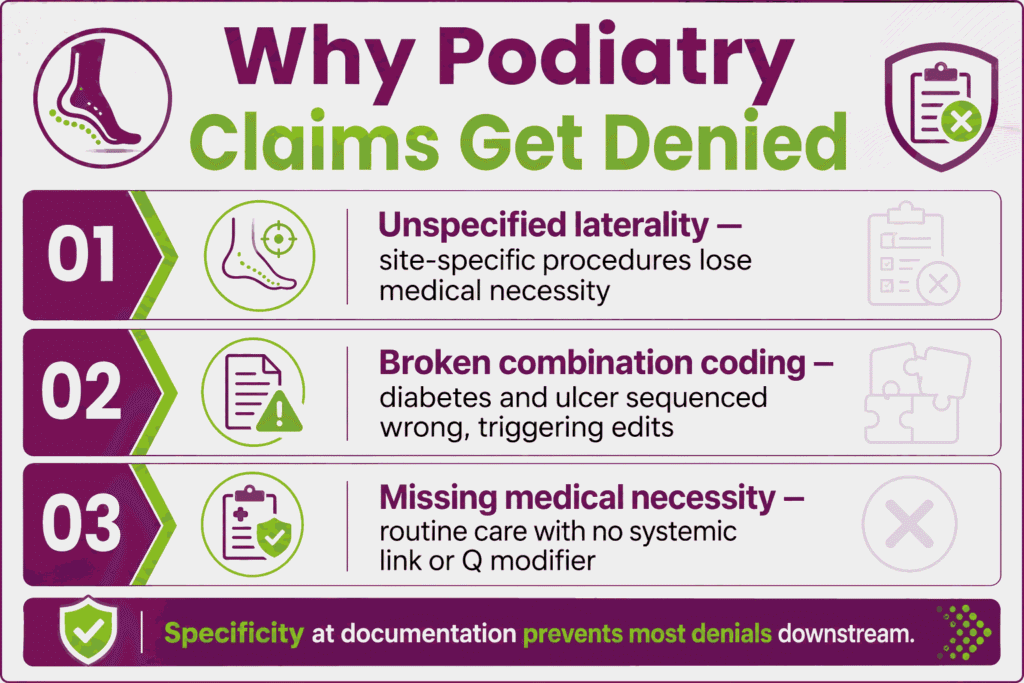
Podiatry claims get denied primarily due to unspecified laterality, broken combination coding, and missing medical necessity for routine care. Podiatry carries more coding variables than most office-based specialties, so each variable becomes a denial point. Specificity in documentation prevents most denials downstream.
Furthermore, aligning these highly technical diagnoses with the exact procedural codes requires utilizing a comprehensive podiatry CPT codes guide to ensure that evaluation and management (E/M) services do not conflict with same-day surgical modifiers.
What Documentation Supports Podiatry Code Selection?
Podiatry code selection requires documentation of laterality, ulcer site and depth, the systemic disease link, and class findings for routine care. The record must state which foot, the wound depth, and the qualifying condition. For diabetic ulcers, documentation must connect the diabetes to the wound. Local coverage determinations define which findings justify routine foot care. When podiatry services include orthotics, therapeutic shoes, wound supplies, or other equipment, HCPCS coding for podiatry supplies and DME must also match the documented diagnosis and service.
How Do You Reduce Podiatry Coding Denials?
Reducing podiatry denials requires four practices: coding to full laterality, sequencing combination codes correctly, applying the right Q modifier, and scrubbing claims at the front end. Unspecified codes raise audit flags. Reversed diabetes and ulcer sequencing triggers edits. Front-end review catches both before submission.
Implementing a guide for podiatry billing as a core training tool for your administrative team establishes a clear, repeatable workflow that eliminates manual data-entry errors and significantly drives down your practice’s days in accounts receivable (A/R).
Podiatry ICD-10 Coding FAQs
What Is the Most Common Podiatry ICD-10 Code?
The most common podiatry ICD-10 codes vary by practice, but foot pain (M79.67-), plantar fasciitis (M67.A0-, effective October 1, 2026), onychomycosis (B35.1), and hallux valgus (M20.1-) rank among the highest-volume diagnoses across most podiatry offices.
How Do You Code a Diabetic Foot Ulcer in ICD-10?
Code a diabetic foot ulcer with combination coding. Sequence the diabetes code first, such as E11.621 for type 2 diabetes with foot ulcer, then add the L97.4- or L97.5- code for the ulcer site, laterality, and depth.
Does Medicare Cover Routine Foot Care?
Medicare excludes routine foot care unless a qualifying systemic condition makes it medically necessary. Coverage requires a systemic disease such as diabetes, documented class findings, and the correct Q7, Q8, or Q9 modifier.
How Often Do Podiatry ICD-10 Codes Change?
Podiatry ICD-10 codes update annually on October 1, when CMS releases the new fiscal-year code set. The FY2026 update added laterality requirements and expanded ulcer depth classifications. The FY2027 update, effective October 1, 2026, moves plantar fasciitis into its own laterality-specific code for the first time.